
Wristwatches · Wristwatch
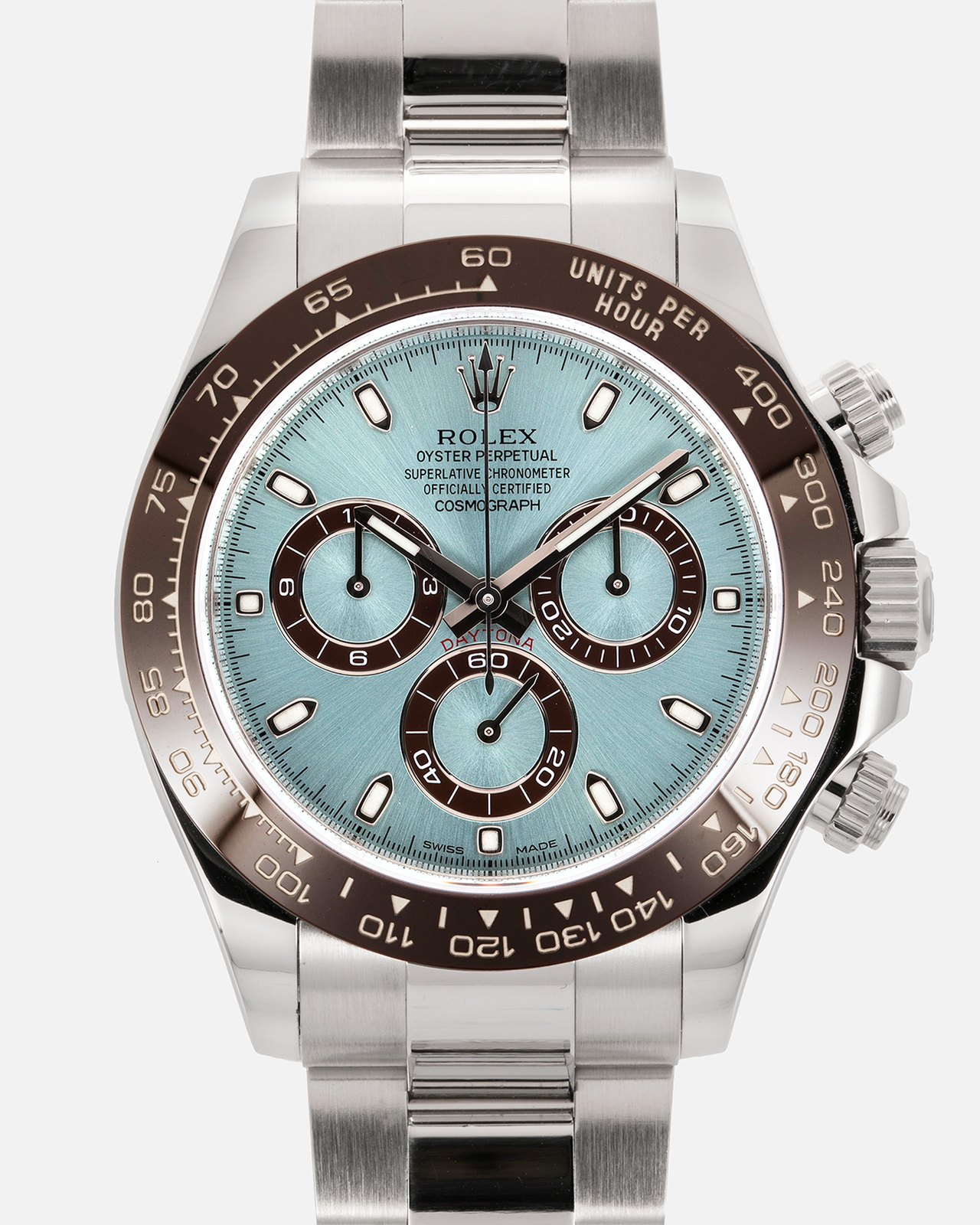
Rolex Cosmograph Daytona Ref. 116506 Platinum, 2015
- Maker / attribution
- Rolex (maker)
- Date
- 2015
- Historical period
- Contemporary Horology (2010 – Present)
- Country of origin
- Switzerland
- Object type
- Wristwatch
- Materials / technique
- platinum
- Dimensions
- Case 40 mm
- Stock no.
- Product 6887173849175
- Credit line
- Dealer listing, S.Song Watches (product 6887173849175)
- Catalogue title (original)
- Rolex Cosmograph Daytona Ref. 116506 Platinum (English)
View the source record (dealer listing) ↗ (opens another website in a new tab)Suggest a correction
Record summary
Catalogued by S.Song Watches (dealer), Seattle (stock number Product 6887173849175), this is a wristwatch by Rolex, made in Switzerland, dated 2015. The Atlas places it in the Contemporary Horology period (2010 – Present) of its Wristwatches collection. Materials and techniques recorded by the source: platinum. Recorded dimensions: Case 40 mm. The record is illustrated with 6 photographs.
Assembled from the source record's structured fields. Dates and attributions are given as the source states them; where a field is missing the Atlas leaves it blank rather than estimating.
Catalogue description
Dealer description — S.Song Watches
I really don’t think I need to go too much into the Daytona as pretty much everyone, watch enthusiast or not, knows or has at least heard about this watch. It has always been the case that the ultimate Rolex is ironically not a solid gold President Day-Date, but the Cosmograph Daytona. With waitlists in the years to authorized dealers these days not even entertaining you unless you’ve bought another (or a few) Rolex before, the Daytona is without a doubt the most desirable and hardest to get Rolex in the market today. Period. However, I believe it remains crucial to briefly reiterate the Daytona's origin story. In 1959, the Daytona International Speedway emerged as the swiftest racing track in the United States, and in 1962, it became renowned for hosting the esteemed “Rolex 24 At Daytona” endurance race. Recognizing the significance of this racing venue, Rolex was designated as the official timepiece/timekeeper of the Daytona International Speedway. In 1963, Rolex solidified its connection to the illustrious racetrack by christening its newly introduced racing chronograph as the Cosmograph Daytona. The Daytona we have on offer today represents a slight departure from the stainless steel or gold models that are typically seen. Why? Because this is the Daytona Ref. 116506 in platinum, which also happens to be one of my all-time favourite Daytonas. In 2013, Rolex introduced the Daytona Platinum Ref. 116506 to commemorate the 50th anniversary of its legendary Daytona collection. Since its release, it has gained significant attention and remains highly sought after by collectors and enthusiasts worldwide, despite being a somewhat controversial timepiece. The controversy revolves around the use of platinum, which is considered a “noble” metal, as the case material for Rolex's renowned sports chronograph. However, it is often the case that such controversies only serve to enhance its allure for those who appreciate the unique combination. The Daytona Platinum Ref. 116506 showcases a refined and sophisticated design with its 40mm platinum 950 case. It features an exquisite ice blue dial complemented by a chestnut brown Cerachrom bezel and sub-dials. Positioned prominently in the centre is the iconic red "Daytona" inscription, just above the small-seconds sub-dial. Notably, the use of an ice blue dial is exclusively reserved for platinum models, serving as a distinctive marker for collectors that this colour is unique to platinum variations. This further enhances the exclusivity and desirability of the watch. The Rolex Daytona has solidified its position as the flagship and iconic timepiece of Rolex, thanks in part to its remarkable history and association with renowned individuals throughout the years. On the wrist, with all of the hype and history aside, it is just a downright handsome watch, plain and simple. With its 40mm size, the Daytona fits perfectly on the wrist and possesses a design language that aligns with other legendary creations like the 911 Porsche and Fender Stratocaster. This particular model becomes even more exceptional with its ice-blue dial and substantial platinum case. While I often mention that white gold is the discreetly luxurious metal of choice, opting for platinum, if possible, adds an extra level of distinction. In my opinion, it effortlessly flies under the radar and imparts a sense of exclusivity. Furthermore, every time you wear it, the weight of the platinum case and bracelet serves as a constant reminder that this is not just an ordinary contemporary Daytona—it is something truly extraordinary.
Historical context
Contemporary Horology (2010 – Present)
Silicon components, connected watches, optical-lattice research clocks and a thriving independent scene.
Smartwatches became the world's best-selling watches, while mechanical watchmaking focuses on craft, innovation (silicon components, new escapements) and independent makers.
Read the period in the timelineMore wristwatches from this periodEarlier: Mechanical Renaissance
Atlas type guide
Wristwatches
Bracelet watches were worn by women from the early nineteenth century — Breguet made one for Caroline Murat, Queen of Naples, in 1810–12 — but the wristwatch only became a man's instrument with military use and aviation in the early twentieth century. Between the World Wars it overtook the pocket watch; the 1920s and 1930s brought rectangular Art Deco cases, water-resistant cases and the first automatic winding systems.
After 1945 the wristwatch became a carrier of identity — dress watches, sports and dive watches, chronographs, calendars — produced by Swiss, American, Japanese, German, Soviet and Chinese industries. The quartz revolution after 1969 and the mechanical renaissance since the 1990s, including the rise of independent watchmakers, complete the story.
What to look for
- The reference number (between the lugs or inside the case back) and serial number, the starting point for dating.
- The calibre: its maker and number are often stamped under the dial or on the bridge.
- Originality of dial, hands and crown — refinished ('redial') dials are common.
- Case material marks: 18K/750, 14K/585, stainless steel, gold-filled, plated.
Dating clues
- Wire-lug cases: before c. 1925.
- Water-resistant screw-down cases: from 1926.
- Quartz movements: from 1969; sapphire crystals widespread after c. 1980.
General guidance written by the Atlas editors about this kind of object. It is not a statement about this particular piece; for that, rely on the source record above and on physical examination.
Related records

Movements & Components · c. 1970s
Rolex watch movement, c. 1970s
Antiquorum auction archive, Geneva

Pocket Watches · 1982
Fake Rolex watch, gold coloured metal, possibly made in Taiwan, 1982; part of a casual outfit, UK, 1982-84.
Victoria and Albert Museum, London

Wristwatches · c. 1920s
Rolex wristwatch, c. 1920s
Antiquorum auction archive, Geneva

Wristwatches · c. 1920s
Rolex wristwatch, ref. 6194, c. 1920s
Antiquorum auction archive, Geneva

Wristwatches · c. 2010s
Breguet Type XXI, ref. 3810, c. 2010s (Antiquorum Lot 381-24)
Antiquorum auction archive, Geneva

Wristwatches · c. 2010s
Breguet Type XXI, ref. 3810, c. 2010s (Antiquorum Lot 386-229)
Antiquorum auction archive, Geneva

Wristwatches · Sold in September 2010
Breitling Cosmonaute, ref. A 22322, Sold in September 2010
Antiquorum auction archive, Geneva

Wristwatches · c. 2010
Corum Bubble Chrono, ref. 396.150.20, c. 2010
Antiquorum auction archive, Geneva