
Wristwatches · Wristwatch
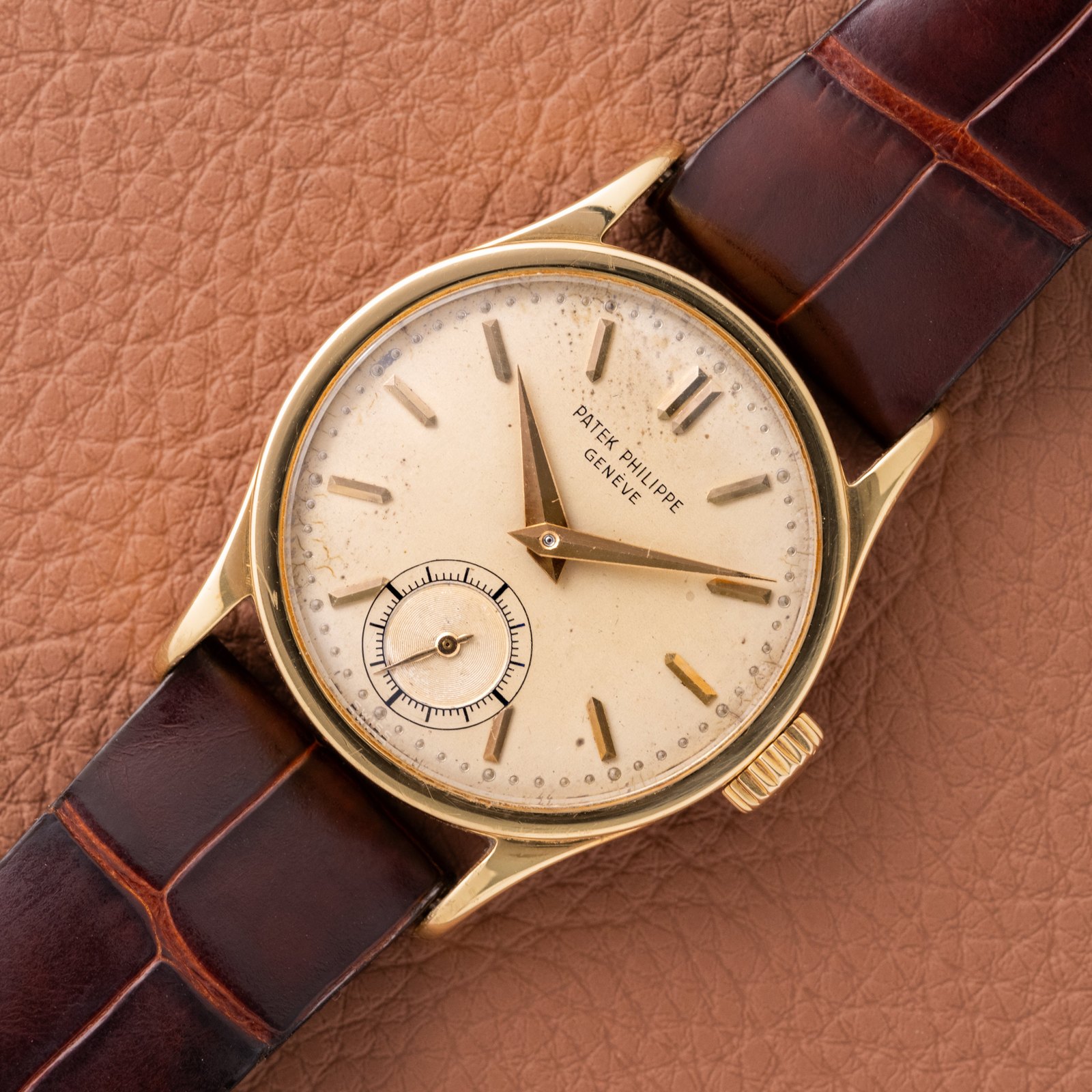
Patek Philippe Yellow Gold Calatrava (Ref. 96), 1940s
- Maker / attribution
- Patek Philippe (maker)
- Date
- 1940s
- Historical period
- Golden Age of Mechanical Watchmaking (1900 – 1945)
- Country of origin
- Switzerland
- Object type
- Wristwatch
- Materials / technique
- yellow gold
- Dimensions
- Case 31 mm
- Stock no.
- Product 8834760376503
- Credit line
- Dealer listing, Huntington Company (product 8834760376503)
- Catalogue title (original)
- 1940s Patek Philippe Yellow Gold Calatrava (Ref. 96) (English)
View the source record (dealer listing) ↗ (opens another website in a new tab)Suggest a correction
Record summary
Catalogued by Huntington Company (dealer) (stock number Product 8834760376503), this is a wristwatch by Patek Philippe, made in Switzerland, dated 1940s. The Atlas places it in the Golden Age of Mechanical Watchmaking period (1900 – 1945) of its Wristwatches collection. Materials and techniques recorded by the source: yellow gold. Recorded dimensions: Case 31 mm. The record is illustrated with 6 photographs.
Assembled from the source record's structured fields. Dates and attributions are given as the source states them; where a field is missing the Atlas leaves it blank rather than estimating.
Catalogue description
Dealer description — Huntington Company
History and Significance Few watches have played a more important role in shaping the history of Patek Philippe than the Calatrava reference 96. Introduced in 1932, the reference 96 established a design philosophy that would influence nearly every generation of the manufacturer's dress watches that followed. Its clean lines, balanced proportions, and remarkably simple appearance represented a departure from the more decorative wristwatches of the preceding decades. Inspired by the principles of Bauhaus design, the original Calatrava demonstrated that elegance could be achieved through proportion and restraint rather than elaborate decoration. More than ninety years after its introduction, the reference 96 remains one of the most influential designs in traditional Swiss watchmaking. The reference 96 was introduced during a particularly important period in Patek Philippe's history, shortly after the Stern family acquired the manufacture. The early 1930s represented a turning point for the company, as wristwatches were becoming increasingly important within the broader world of fine watchmaking. The Calatrava offered a distinctly modern approach to the traditional dress watch, establishing a recognizable identity that would remain remarkably consistent for decades. Its design was so successful that many later Calatrava references can be traced directly back to the original reference 96. Few watches have maintained such a clear influence over the evolution of an entire collection. One of the most fascinating aspects of collecting vintage Patek Philippe watches is the extraordinary variety of dial aging that can develop over several decades. Unlike modern watches, where pristine surfaces are often considered essential, vintage examples can acquire a remarkable amount of character through natural changes to their original finishes. Certain dials develop warm tones, subtle discoloration, and irregular patterns that distinguish individual watches from otherwise identical examples. These transformations are particularly interesting when the original dial remains untouched, preserving the watch's history rather than attempting to restore its original appearance. The resulting patina can become one of the most compelling characteristics of a vintage timepiece. The dial on this particular reference 96 is a beautiful example of that phenomenon. Decades of natural aging have created a warm, almost parchment-like appearance reminiscent of the pages of an antique book. The soft discoloration gives the dial a richness that would be difficult to reproduce intentionally, creating a distinctly vintage character that feels entirely appropriate for a watch of this age. Rather than detracting from the design, the patina introduces another layer of personality to an otherwise remarkably simple Calatrava. It is a wonderful example of how an original dial can develop an entirely individual appearance while preserving the fundamental elegance of the watch. Writer’s Thoughts A vintage Patek Philippe reference 96 is already a special watch, but an example with this kind of dial aging has an entirely different personality. The warm patina resembles the pages of an old book, with a softness and depth that could only develop over decades. There is something particularly satisfying about seeing a watch that has been allowed to age naturally rather than having its original character erased through restoration. The dial tells a story that a perfectly preserved example simply cannot, making this reference 96 especially memorable. Our Promise Every watch is thoroughly vetted, carefully described with complete transparency, and guaranteed authentic. Each piece is offered in honest condition, ensuring collectors receive a timepiece that reflects both originality and integrity. Specifications Brand: Patek Philippe Model: Calatrava Reference: 96 Year: 1940s Case Material: 18k Yellow Gold Case Size: 31mm Dial: Original Dial with Warm Patina Movement: Mechanical Manual Wind Strap/Buckle: Original Patek Philippe Leather Strap Buckle/Clasp: Original Patek Philippe Gold Buckle Contents: Watch only Condition Case: Yellow gold case retains its attractive vintage proportions with deeply defined hallmarks. Dial: Original untouched dial shows beautiful natural aging with warm patina . Hands: Vintage hands show aging consistent with the overall character of the watch. Crystal: Crystal remains clear. Strap/Buckle: Original Patek Philippe leather strap retains its vintage character. Buckle/Clasp: Original Patek Philippe gold buckle remains fitted to the strap.
Historical context
Golden Age of Mechanical Watchmaking (1900 – 1945)
The wristwatch displaces the pocket watch; waterproof cases, self-winding and grand complications.
The wristwatch overtook the pocket watch. Military use in the First World War, aviation, water-resistant cases (1926), automatic winding (1923–31), rectangular Art Deco designs and early chronographs and calendars defined the period.
Read the period in the timelineMore wristwatches from this periodEarlier: Industrial Revolution
Atlas type guide
Wristwatches
Bracelet watches were worn by women from the early nineteenth century — Breguet made one for Caroline Murat, Queen of Naples, in 1810–12 — but the wristwatch only became a man's instrument with military use and aviation in the early twentieth century. Between the World Wars it overtook the pocket watch; the 1920s and 1930s brought rectangular Art Deco cases, water-resistant cases and the first automatic winding systems.
After 1945 the wristwatch became a carrier of identity — dress watches, sports and dive watches, chronographs, calendars — produced by Swiss, American, Japanese, German, Soviet and Chinese industries. The quartz revolution after 1969 and the mechanical renaissance since the 1990s, including the rise of independent watchmakers, complete the story.
What to look for
- The reference number (between the lugs or inside the case back) and serial number, the starting point for dating.
- The calibre: its maker and number are often stamped under the dial or on the bridge.
- Originality of dial, hands and crown — refinished ('redial') dials are common.
- Case material marks: 18K/750, 14K/585, stainless steel, gold-filled, plated.
Dating clues
- Wire-lug cases: before c. 1925.
- Water-resistant screw-down cases: from 1926.
- Quartz movements: from 1969; sapphire crystals widespread after c. 1980.
General guidance written by the Atlas editors about this kind of object. It is not a statement about this particular piece; for that, rely on the source record above and on physical examination.
Related records

Clocks · 1965–1975
Quartz master clock QM 1, with movement by Patek Phillippe, Switzerland, 1965–1975. Supplied by English Clock Systems.
Science Museum Group, London

Instruments · 1965–1984
Chronometer by Patek Philippe and Kelvin Hughes, England, 1965–1984
Science Museum Group, London

Pocket Watches · c. 1895
Patek Philippe pocket watch, c. 1895
Antiquorum auction archive, Geneva

Pocket Watches · c. 1900
Patek Philippe Chronometro Gondolo, c. 1900
Antiquorum auction archive, Geneva

Wristwatches · 1931
Rolex 'Oyster Perpetual' rotor self-winding wrist-watch, lever escapement, in steel case with glass in back, Montres Rolex SA, Geneva, Switzerland, 1931
Science Museum Group, London

Wristwatches · 1900–1999
Wristwatch by Certina, Switzerland, 1900–1999
Nordic Museum Foundation
Wristwatches · 1900–1999
Wristwatch by Omega, Västerås, 1900–1999
Nordic Museum Foundation
Wristwatches · 1900–1999
Wristwatch by Universal, Switzerland, 1900–1999
Nordic Museum Foundation