
Wristwatches · Wristwatch
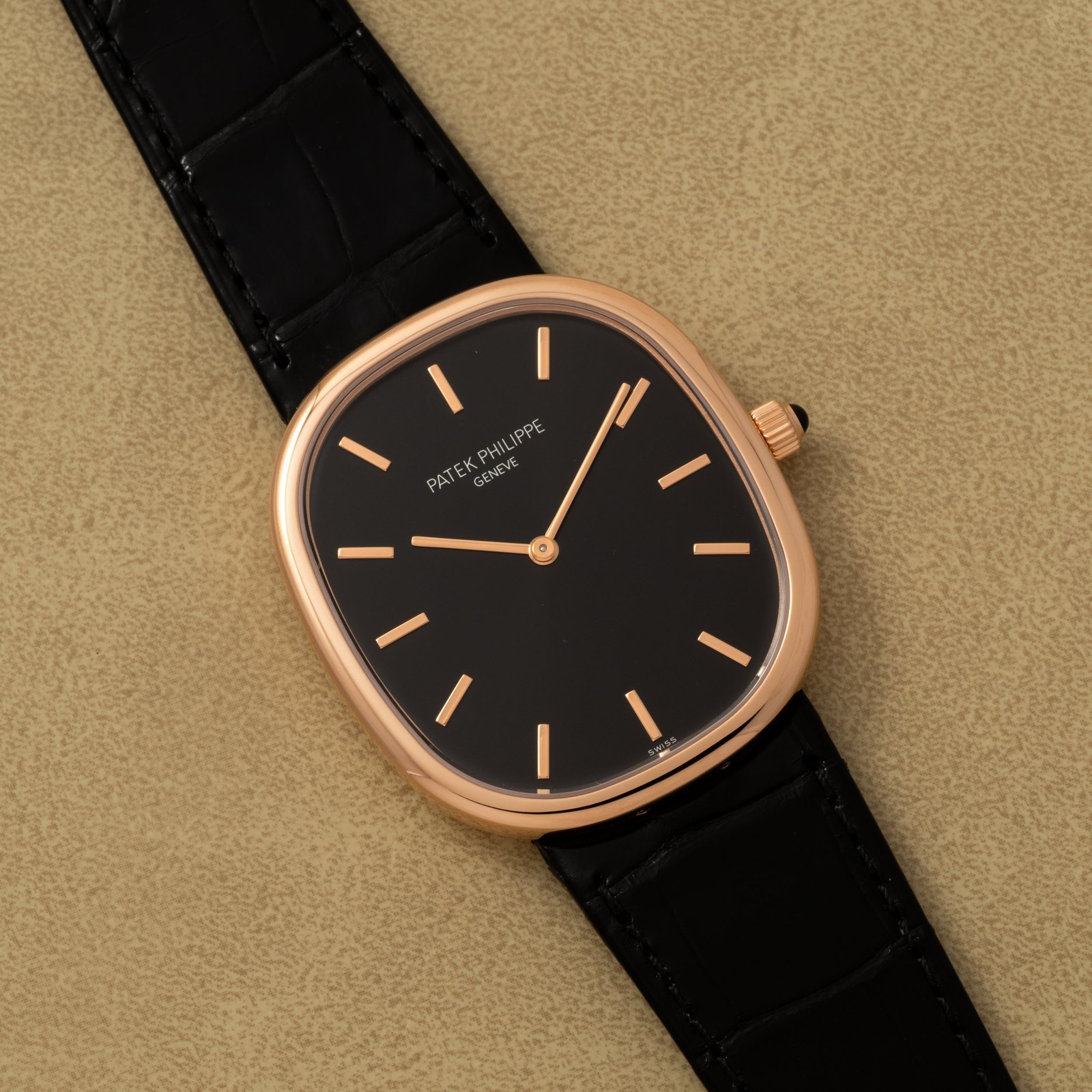
Patek Philippe Ellipse, 2025
- Maker / attribution
- Patek Philippe (maker)
- Date
- 2025
- Historical period
- Contemporary Horology (2010 – Present)
- Country of origin
- Switzerland
- Object type
- Wristwatch
- Stock no.
- 40930813
- Credit line
- Dealer listing, Analog/Shift (40930813)
- Catalogue title (original)
- Patek Philippe Ellipse (English)
View the source record (dealer listing) ↗ (opens another website in a new tab)Suggest a correction
Record summary
Catalogued by Analog/Shift (dealer), New York (stock number 40930813), this is a wristwatch by Patek Philippe, made in Switzerland, dated 2025. The Atlas places it in the Contemporary Horology period (2010 – Present) of its Wristwatches collection. The record is illustrated with 6 photographs.
Assembled from the source record's structured fields. Dates and attributions are given as the source states them; where a field is missing the Atlas leaves it blank rather than estimating.
Catalogue description
Dealer description — Analog/Shift
When Patek Philippe introduced the Golden Ellipse in 1968, it was a revelation. Neither round nor square, the Ellipse redefined the dress watch with its harmonious oval proportions based on the Golden Ratio —that timeless mathematical balance found in art, architecture, and nature itself. It was bold yet understated, modern yet eternal, a daring act of design restraint from a brand celebrated for its mechanical brilliance. Predating the Nautilus by nearly a decade, the Golden Ellipse was Patek Philippe's quiet expression of elegance—an avant-garde choice for those who valued refinement over recognition. Its elliptical form remains one of the most distinctive silhouettes in the maison's history, representing the intersection of geometry, aesthetics, and philosophy. This particular example, dating to 2025, brings that legacy into the present day with remarkable finesse. It features a solid 18K rose gold case paired with a sunburst ebony black dial, its surface radiating light in subtle gradients that shift with every movement of the wrist. The applied baton-style hour markers and delicate "cheveu" hands—both in rose gold—are executed with the precision and restraint that define Patek's best work. The crown is set with a polished onyx cabochon, a touch of quiet luxury that feels distinctly Ellipse. Inside beats Patek Philippe's ultra-thin manual-winding Calibre 240, a movement revered for its elegance, reliability, and whisper-smooth operation. Offered in outstanding, basically unworn condition, this Golden Ellipse comes complete with its box, Certificate of Origin and the rest of its factory goodies. Sleek, sculptural, and steeped in history, it captures the artistic sophistication of the late 1960s while feeling utterly of the moment—part sculpture, part statement —the Golden Ellipse distills the elegance of the era into something irresistibly modern.
Historical context
Contemporary Horology (2010 – Present)
Silicon components, connected watches, optical-lattice research clocks and a thriving independent scene.
Smartwatches became the world's best-selling watches, while mechanical watchmaking focuses on craft, innovation (silicon components, new escapements) and independent makers.
Read the period in the timelineMore wristwatches from this periodEarlier: Mechanical Renaissance
Atlas type guide
Wristwatches
Bracelet watches were worn by women from the early nineteenth century — Breguet made one for Caroline Murat, Queen of Naples, in 1810–12 — but the wristwatch only became a man's instrument with military use and aviation in the early twentieth century. Between the World Wars it overtook the pocket watch; the 1920s and 1930s brought rectangular Art Deco cases, water-resistant cases and the first automatic winding systems.
After 1945 the wristwatch became a carrier of identity — dress watches, sports and dive watches, chronographs, calendars — produced by Swiss, American, Japanese, German, Soviet and Chinese industries. The quartz revolution after 1969 and the mechanical renaissance since the 1990s, including the rise of independent watchmakers, complete the story.
What to look for
- The reference number (between the lugs or inside the case back) and serial number, the starting point for dating.
- The calibre: its maker and number are often stamped under the dial or on the bridge.
- Originality of dial, hands and crown — refinished ('redial') dials are common.
- Case material marks: 18K/750, 14K/585, stainless steel, gold-filled, plated.
Dating clues
- Wire-lug cases: before c. 1925.
- Water-resistant screw-down cases: from 1926.
- Quartz movements: from 1969; sapphire crystals widespread after c. 1980.
General guidance written by the Atlas editors about this kind of object. It is not a statement about this particular piece; for that, rely on the source record above and on physical examination.
Related records

Clocks · 1965–1975
Quartz master clock QM 1, with movement by Patek Phillippe, Switzerland, 1965–1975. Supplied by English Clock Systems.
Science Museum Group, London

Instruments · 1965–1984
Chronometer by Patek Philippe and Kelvin Hughes, England, 1965–1984
Science Museum Group, London

Pocket Watches · c. 1895
Patek Philippe pocket watch, c. 1895
Antiquorum auction archive, Geneva

Pocket Watches · c. 1900
Patek Philippe Chronometro Gondolo, c. 1900
Antiquorum auction archive, Geneva

Wristwatches · c. 2010s
Breguet Type XXI, ref. 3810, c. 2010s (Antiquorum Lot 381-24)
Antiquorum auction archive, Geneva

Wristwatches · c. 2010s
Breguet Type XXI, ref. 3810, c. 2010s (Antiquorum Lot 386-229)
Antiquorum auction archive, Geneva

Wristwatches · Sold in September 2010
Breitling Cosmonaute, ref. A 22322, Sold in September 2010
Antiquorum auction archive, Geneva

Wristwatches · c. 2010
Corum Bubble Chrono, ref. 396.150.20, c. 2010
Antiquorum auction archive, Geneva