
Wristwatches · Wristwatch
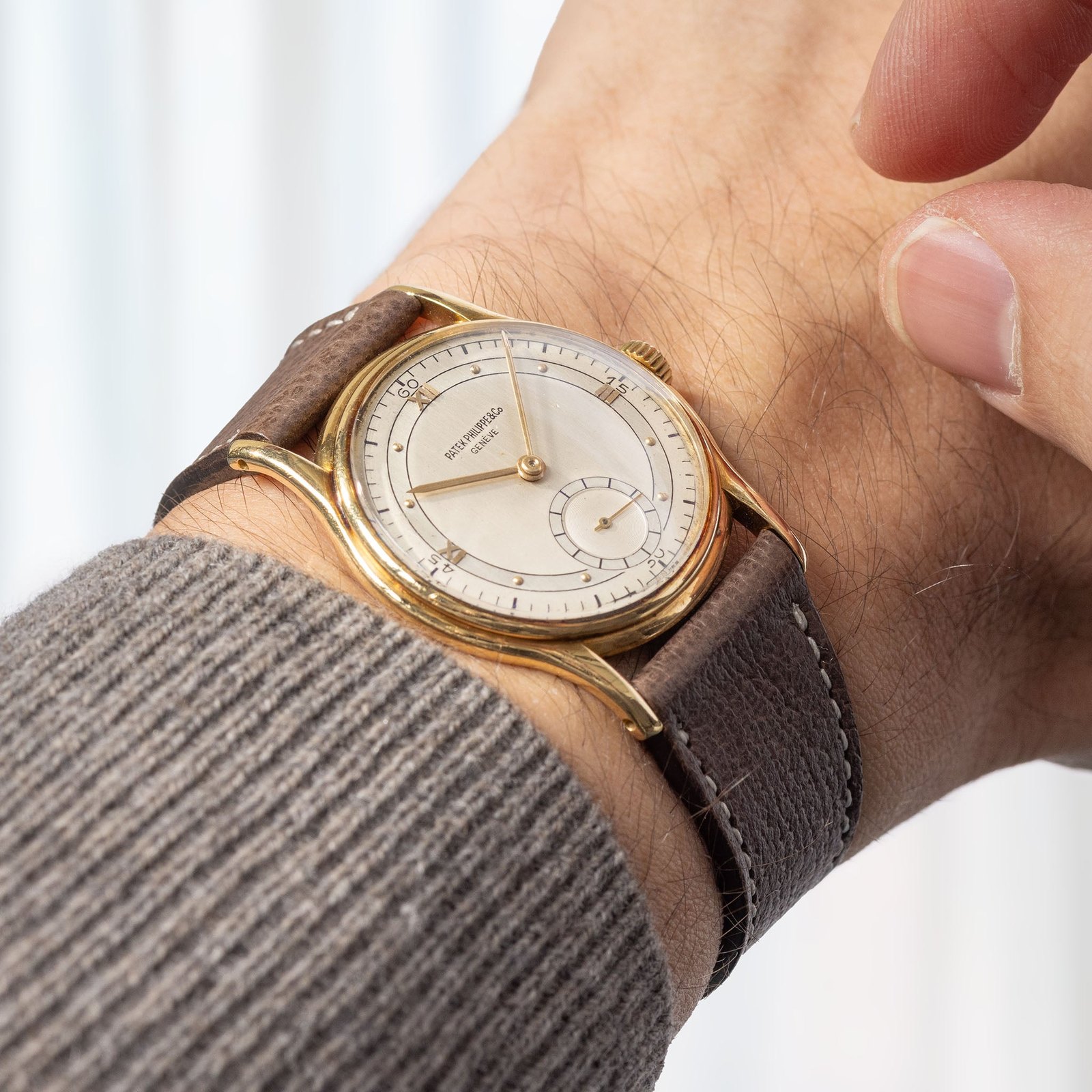
Patek Philippe Calatrava Two-Tone Dial ref. 1527 in 18k Yellow Gold, 1940
- Maker / attribution
- Patek Philippe (maker)
- Date
- 1940
- Historical period
- Golden Age of Mechanical Watchmaking (1900 – 1945)
- Country of origin
- Switzerland
- Object type
- Wristwatch
- Materials / technique
- 18k yellow gold
- Dimensions
- Case 33.5 mm
- Stock no.
- W-3580
- Credit line
- Dealer listing, Bulang & Sons (W-3580)
- Catalogue title (original)
- Patek Philippe Calatrava Two-Tone Dial ref. 1527 in 18k Yellow Gold (English)
View the source record (dealer listing) ↗ (opens another website in a new tab)Suggest a correction
Record summary
Catalogued by Bulang & Sons (dealer), Copenhagen (stock number W-3580), this is a wristwatch by Patek Philippe, made in Switzerland, dated 1940. The Atlas places it in the Golden Age of Mechanical Watchmaking period (1900 – 1945) of its Wristwatches collection. Materials and techniques recorded by the source: 18k yellow gold. Recorded dimensions: Case 33.5 mm. The record is illustrated with 6 photographs.
Assembled from the source record's structured fields. Dates and attributions are given as the source states them; where a field is missing the Atlas leaves it blank rather than estimating.
Catalogue description
Dealer description — Bulang & Sons
Introduced in 1932 with the iconic Reference 96, the Patek Philippe Calatrava stands as the ultimate dress watch — a benchmark of timeless elegance and refined restraint. Created following the Stern family’s acquisition of Patek Philippe during the Great Depression, it embodied a new vision of understated sophistication that continues to define high watchmaking today. The original Ref. 96 marked a decisive shift away from ornate pocket watches toward a modern, elegant, and functional wristwatch, perfectly suited to its era and beyond. In total, over 230 different Calatrava references have been produced since its introduction in 1932. Presented here is a 1940s Reference 1527, housed in a 33.5 mm yellow-gold case with a snap-back caseback and long, elegantly elongated lugs that allow the watch to wear larger on the wrist while maintaining exceptional balance and grace. The caseback features charming hand engraving, which we believe to be a stylized “MCA.” The two-tone silver dial is a study in elegant detail, featuring an enamel minute track and a brushed silver inner ring. Applied Roman numerals at 12, 3, and 9 o’clock are complemented by fine “bullet” markers for the remaining hours, creating a harmonious and highly legible layout. At 6 o’clock sits a small running seconds sub-dial, executed in enamel printing and, surprisingly, rendered in a deep, rich dark blue color — a rare and captivating detail that elevates the dial further. The iconic “Patek Philippe & Co Genève” enamel signature completes the composition exactly as one expects from a true Calatrava. Unlumed stick hands preserve the watch’s pure dress-watch character, and the piece is paired with one of our Bulang & Sons leather straps for a perfectly considered finish. The hand-wound Caliber 12-200 has been fully serviced by our watchmaker and is ready to be worn and enjoyed for many years to come. This is an exceptional opportunity to acquire a beautifully preserved, highly elegant example of what is, in our opinion, the most important dress watch ever made: the Calatrava. Get in touch. Specifications: Patek Philippe Calatrava Reference 1527 33.5 mm 18k yellow gold case with elongated lugs Two tone silver dial with applied Roman numerals and non-lumed hands and small seconds Seldom seen enamel in blue colour Case back stylish engraved 'MCA” Bulang and sons Leather strap Calibre 12-200 hand wound movement Case number 645xxx, 929xxx movement number , dating to the 1940’s Fully serviced by our watchmaker
Historical context
Golden Age of Mechanical Watchmaking (1900 – 1945)
The wristwatch displaces the pocket watch; waterproof cases, self-winding and grand complications.
The wristwatch overtook the pocket watch. Military use in the First World War, aviation, water-resistant cases (1926), automatic winding (1923–31), rectangular Art Deco designs and early chronographs and calendars defined the period.
Read the period in the timelineMore wristwatches from this periodEarlier: Industrial Revolution
Atlas type guide
Wristwatches
Bracelet watches were worn by women from the early nineteenth century — Breguet made one for Caroline Murat, Queen of Naples, in 1810–12 — but the wristwatch only became a man's instrument with military use and aviation in the early twentieth century. Between the World Wars it overtook the pocket watch; the 1920s and 1930s brought rectangular Art Deco cases, water-resistant cases and the first automatic winding systems.
After 1945 the wristwatch became a carrier of identity — dress watches, sports and dive watches, chronographs, calendars — produced by Swiss, American, Japanese, German, Soviet and Chinese industries. The quartz revolution after 1969 and the mechanical renaissance since the 1990s, including the rise of independent watchmakers, complete the story.
What to look for
- The reference number (between the lugs or inside the case back) and serial number, the starting point for dating.
- The calibre: its maker and number are often stamped under the dial or on the bridge.
- Originality of dial, hands and crown — refinished ('redial') dials are common.
- Case material marks: 18K/750, 14K/585, stainless steel, gold-filled, plated.
Dating clues
- Wire-lug cases: before c. 1925.
- Water-resistant screw-down cases: from 1926.
- Quartz movements: from 1969; sapphire crystals widespread after c. 1980.
General guidance written by the Atlas editors about this kind of object. It is not a statement about this particular piece; for that, rely on the source record above and on physical examination.
Related records
Clocks · 1965–1975
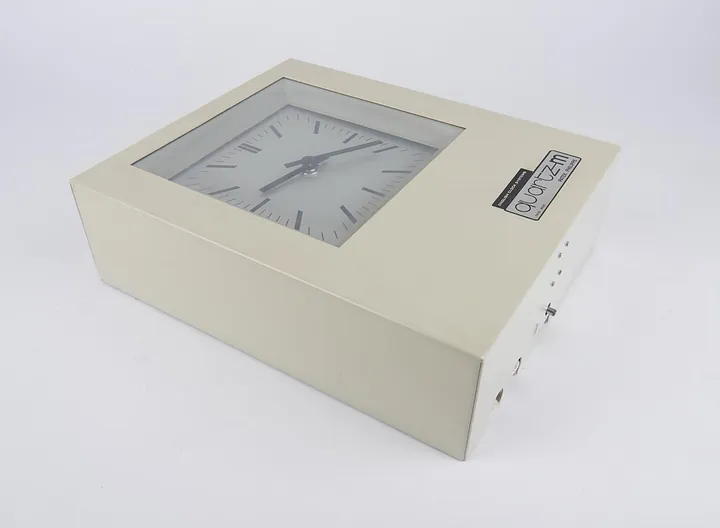
Quartz master clock QM 1, with movement by Patek Phillippe, Switzerland, 1965–1975. Supplied by English Clock Systems.
Science Museum Group, London
Instruments · 1965–1984
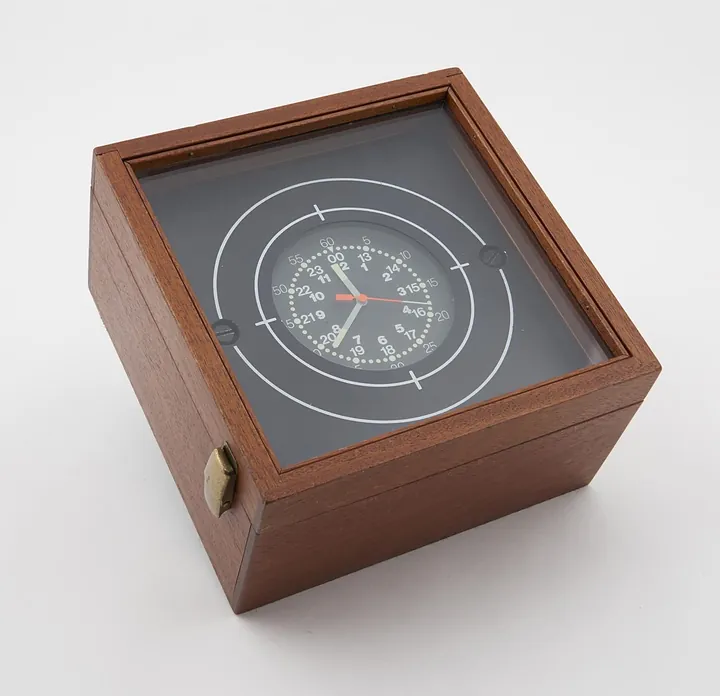
Chronometer by Patek Philippe and Kelvin Hughes, England, 1965–1984
Science Museum Group, London
Pocket Watches · c. 1895
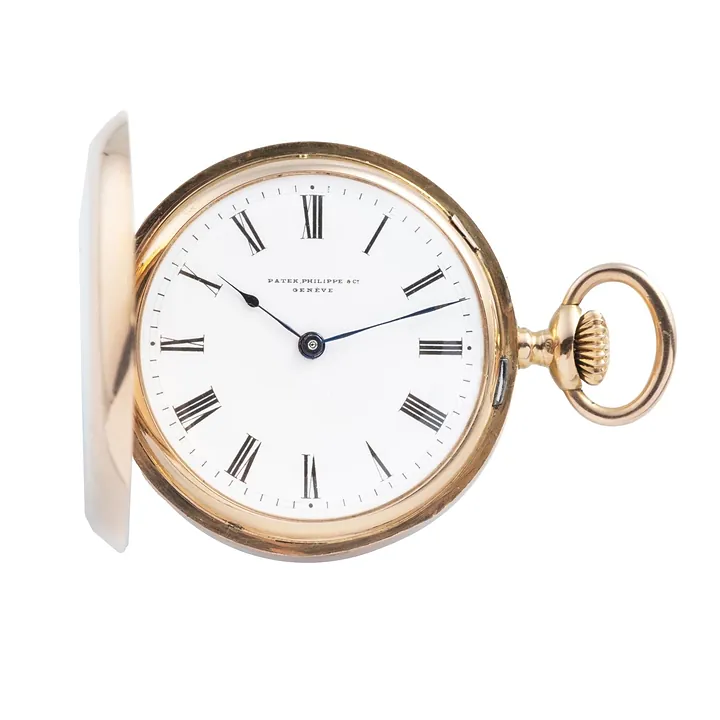
Patek Philippe pocket watch, c. 1895
Antiquorum auction archive, Geneva

Pocket Watches · c. 1900
Patek Philippe Chronometro Gondolo, c. 1900
Antiquorum auction archive, Geneva

Wristwatches · 1931
Rolex 'Oyster Perpetual' rotor self-winding wrist-watch, lever escapement, in steel case with glass in back, Montres Rolex SA, Geneva, Switzerland, 1931
Science Museum Group, London

Wristwatches · 1900–1999
Wristwatch by Certina, Switzerland, 1900–1999
Nordic Museum Foundation

Wristwatches · 1900–1999
Wristwatch by Omega, Västerås, 1900–1999
Nordic Museum Foundation

Wristwatches · 1900–1999
Wristwatch by Universal, Switzerland, 1900–1999
Nordic Museum Foundation