
Wristwatches · Wristwatch
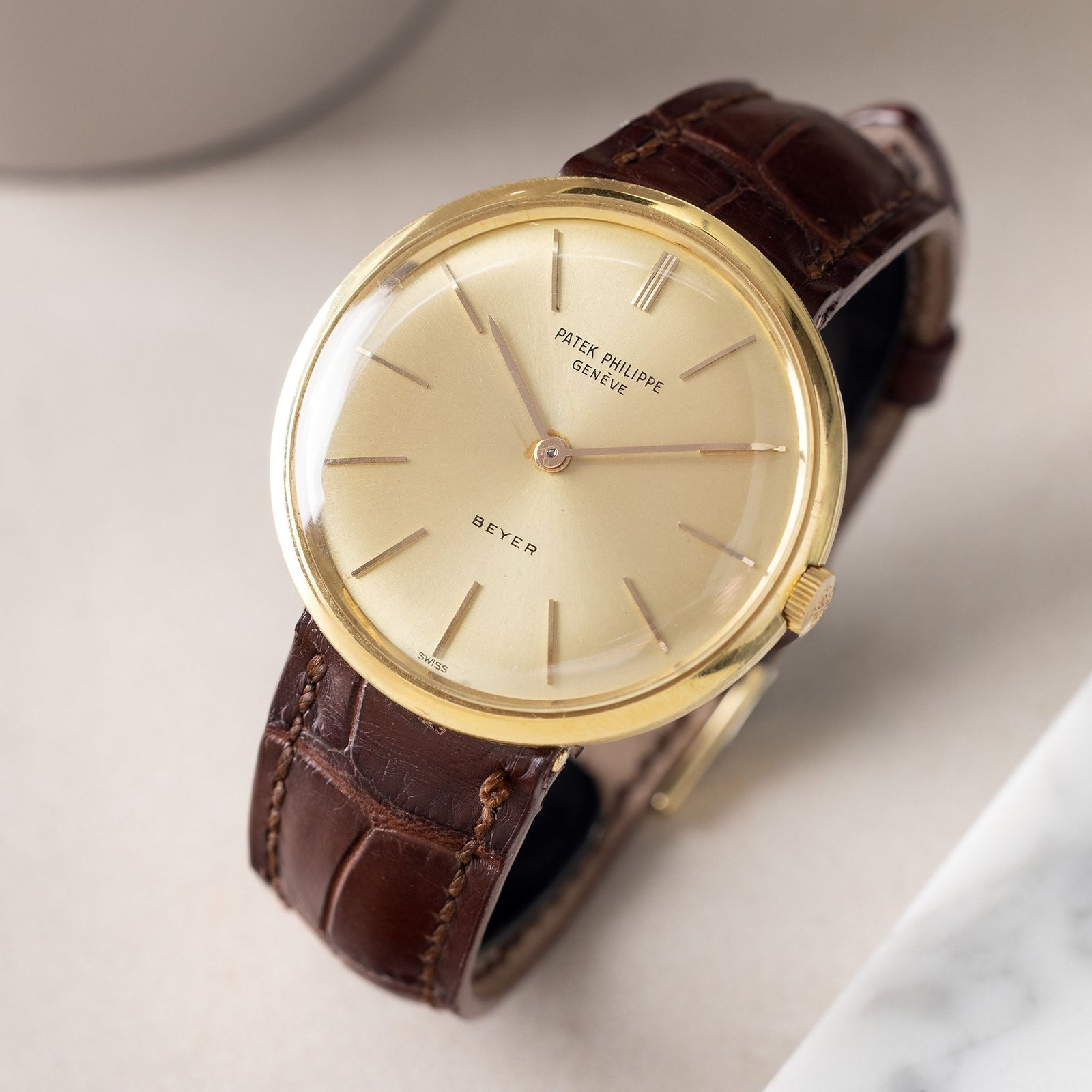
Patek Philippe Calatrava Disco Volante Ref. 2591J in 18k Yellow Gold with Sunburst Beyer Double-Signed Dial and Extract from the Archives, 1962
- Maker / attribution
- Patek Philippe (maker)
- Date
- 1962
- Historical period
- Modern Mechanical Horology (1945 – 1969)
- Country of origin
- Switzerland
- Object type
- Wristwatch
- Materials / technique
- 18k yellow gold
- Dimensions
- Case 34.5 mm
- Stock no.
- W-3937
- Credit line
- Dealer listing, Bulang & Sons (W-3937)
- Catalogue title (original)
- Patek Philippe Calatrava Disco Volante Ref. 2591J in 18k Yellow Gold with Sunburst Beyer Double-Signed Dial and Extract from the Archives (English)
View the source record (dealer listing) ↗ (opens another website in a new tab)Suggest a correction
Record summary
Catalogued by Bulang & Sons (dealer), Copenhagen (stock number W-3937), this is a wristwatch by Patek Philippe, made in Switzerland, dated 1962. The Atlas places it in the Modern Mechanical Horology period (1945 – 1969) of its Wristwatches collection. Materials and techniques recorded by the source: 18k yellow gold. Recorded dimensions: Case 34.5 mm. The record is illustrated with 6 photographs.
Assembled from the source record's structured fields. Dates and attributions are given as the source states them; where a field is missing the Atlas leaves it blank rather than estimating.
Catalogue description
Dealer description — Bulang & Sons
The Patek Philippe Calatrava was introduced in 1932 with the ref. 96, establishing the round, minimalist dress-watch design that would become one of the maison’s defining signatures. Inspired by Bauhaus principles, the Calatrava focused on clean lines, balanced proportions and elegant simplicity. Named after the Calatrava Cross found in Patek Philippe’s emblem, the collection evolved through countless references, materials and dial designs, while always remaining true to the same understated philosophy. More than 90 years later, the Calatrava remains one of the great icons of classic Swiss watchmaking — a perfect example of the idea that sometimes, less really is more. Here we have a lovely and rather rare ref. 2591, featuring a snap-back case measuring 34.5 mm and wonderfully concealed lugs. The combination gives the watch a slightly UFO-like, or “Disco Volante”, appearance — a particularly charming characteristic of this reference. The watch is fitted with a fine winding crown and a beautifully serene, sunburst-finished gold dial, featuring elegant applied stick markers, a raised enamel Patek Philippe signature and slender stick-style hands. But the detail that really makes this one special is the subtle yet important double-signed “Beyer” signature on the lower half of the dial. Beyer Zürich is one of those names that has been quietly woven into the history of Swiss watch collecting for generations. The story began in 1760, making Beyer the oldest specialised watch retailer in Switzerland. Founded by the Beyer family, the business remained family-owned for more than 250 years and became one of the most respected names in Swiss watch retail. The company established itself on Zürich’s Bahnhofstrasse in the late 19th century, a location that would become synonymous with Beyer and its reputation for fine watches and jewellery. Over the generations, Beyer developed close relationships with some of Switzerland’s most important watchmakers, including Patek Philippe, Rolex, IWC and Breguet. For collectors, a Beyer-signed receipt, box, certificate or retailer stamp can therefore add a wonderful piece of provenance to a vintage watch. And there is another reason the name Beyer is so special to watch enthusiasts: beneath the store is the Beyer Clock and Watch Museum, home to an impressive collection tracing the history of timekeeping across the centuries. More than just a retailer, Beyer has become part of Zürich’s horological history itself — a family business that has been selling, servicing and celebrating fine watches since 1760. Patek Philippe has agreed to acquire Beyer Chronometrie in Zürich. The Beyer store at Bahnhofstrasse 31 is scheduled to close at the end of 2026, with the premises set to become a Patek Philippe Salon from the beginning of 2027. Back to our Beyer Patek. It is fitted with a lightly used Patek Philippe leather strap, complete with its period-correct 18k gold pin buckle. The watch and its hand-wound calibre 23-300 have been checked and regulated by our watchmaker. The watch is accompanied by a Patek Philippe Extract from the Archives, confirming its date of sale in 1962. A Patek Philippe with a little extra history attached. Sold through Beyer Zürich in 1962, accompanied by its Extract from the Archives and still fitted with its period-correct 18k gold buckle. With Beyer soon becoming part of the Patek Philippe story itself, this one feels particularly fitting. A lovely piece of horological history, ready for its next chapter. Get in touch! Specifications: Patek Philippe Calatrava Reference 2591 “Disco Volante” 34.5mm 18k yellow gold case with thin bezel and hidden lugs Champagne/gold soleil dial with stick marker, raised enamel signature double signed”Beyer movement no 78xxxxx/ case no 427xxxx dating to 1962 Non lumed stick hands Patek Philippe leather strap, original 18k gold pin buckle Cal. 23-300 hand wound movement Extract of the Archives confirming a date of sale in 1962 Fully checked and regulated by our watchmaker
Historical context
Modern Mechanical Horology (1945 – 1969)
Tool watches for divers, pilots and astronauts; electric watches anticipate the electronic age.
The classic era of the mechanical wristwatch: dive watches, chronographs for motor racing and space flight, GMT watches for jet travel, slim dress watches, automatic calendars, and the rise of Japanese manufacturers alongside Swiss, American, German and Soviet industries.
Read the period in the timelineMore wristwatches from this periodEarlier: Golden Age of Mechanical Watchmaking
Atlas type guide
Wristwatches
Bracelet watches were worn by women from the early nineteenth century — Breguet made one for Caroline Murat, Queen of Naples, in 1810–12 — but the wristwatch only became a man's instrument with military use and aviation in the early twentieth century. Between the World Wars it overtook the pocket watch; the 1920s and 1930s brought rectangular Art Deco cases, water-resistant cases and the first automatic winding systems.
After 1945 the wristwatch became a carrier of identity — dress watches, sports and dive watches, chronographs, calendars — produced by Swiss, American, Japanese, German, Soviet and Chinese industries. The quartz revolution after 1969 and the mechanical renaissance since the 1990s, including the rise of independent watchmakers, complete the story.
What to look for
- The reference number (between the lugs or inside the case back) and serial number, the starting point for dating.
- The calibre: its maker and number are often stamped under the dial or on the bridge.
- Originality of dial, hands and crown — refinished ('redial') dials are common.
- Case material marks: 18K/750, 14K/585, stainless steel, gold-filled, plated.
Dating clues
- Wire-lug cases: before c. 1925.
- Water-resistant screw-down cases: from 1926.
- Quartz movements: from 1969; sapphire crystals widespread after c. 1980.
General guidance written by the Atlas editors about this kind of object. It is not a statement about this particular piece; for that, rely on the source record above and on physical examination.
Related records

Clocks · 1965–1975
Quartz master clock QM 1, with movement by Patek Phillippe, Switzerland, 1965–1975. Supplied by English Clock Systems.
Science Museum Group, London

Instruments · 1965–1984
Chronometer by Patek Philippe and Kelvin Hughes, England, 1965–1984
Science Museum Group, London

Pocket Watches · c. 1895
Patek Philippe pocket watch, c. 1895
Antiquorum auction archive, Geneva

Pocket Watches · c. 1900
Patek Philippe Chronometro Gondolo, c. 1900
Antiquorum auction archive, Geneva

Wristwatches · 1945
Wristwatch by Eterna, 1945
Museum Rotterdam

Wristwatches · c. 1945
Breitling Premier, ref. 790, c. 1945
Antiquorum auction archive, Geneva

Wristwatches · c. 1945
Universal Genève Uni-Compax, ref. 22492, c. 1945
Antiquorum auction archive, Geneva

Wristwatches · c. 1950s
Baume & Mercier wristwatch, c. 1950s
Antiquorum auction archive, Geneva