
Wristwatches · Wristwatch
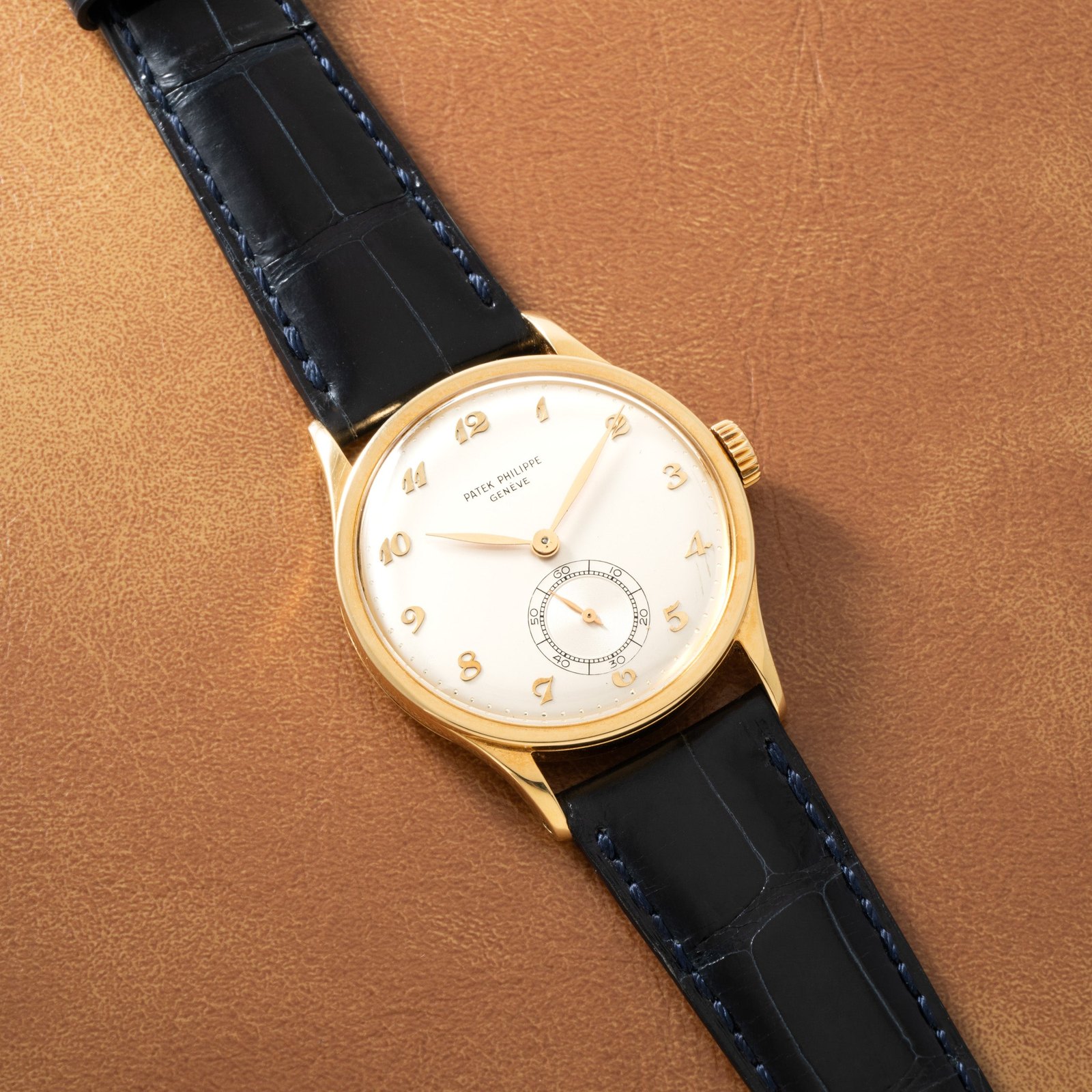
Patek Philippe Calatrava 'Breguet', 1958
- Maker / attribution
- Patek Philippe (maker)
- Date
- 1958
- Historical period
- Modern Mechanical Horology (1945 – 1969)
- Country of origin
- Switzerland
- Object type
- Wristwatch
- Dimensions
- Case 35 mm
- Stock no.
- 40931112
- Credit line
- Dealer listing, Analog/Shift (40931112)
- Catalogue title (original)
- Patek Philippe Calatrava 'Breguet' (English)
View the source record (dealer listing) ↗ (opens another website in a new tab)Suggest a correction
Record summary
Catalogued by Analog/Shift (dealer), New York (stock number 40931112), this is a wristwatch by Patek Philippe, made in Switzerland, dated 1958. The Atlas places it in the Modern Mechanical Horology period (1945 – 1969) of its Wristwatches collection. Recorded dimensions: Case 35 mm. The record is illustrated with 6 photographs.
Assembled from the source record's structured fields. Dates and attributions are given as the source states them; where a field is missing the Atlas leaves it blank rather than estimating.
Catalogue description
Dealer description — Analog/Shift
Some watches are destined to become classics. Others establish the very standards by which classics are judged. The Patek Philippe Calatrava Reference 570 belongs firmly in the latter category. Introduced in 1938 as a larger companion to the legendary Reference 96, the Ref. 570 represented a significant evolution in Patek Philippe’s approach to dress watch design. Measuring approximately 35mm in diameter, it was positively oversized by the standards of the day, earning the affectionate nickname Calatravone, or “large Calatrava,” among collectors. Nearly ninety years later, its proportions remain remarkably contemporary, proof that good design has little interest in the passage of time. Dating to 1958, this exceptional Reference 570J is housed in an elegant yellow gold case, its broad, flat bezel and gracefully elongated lugs providing the perfect framework for a particularly beautiful dial. Finished in a warm, creamy tone that has acquired a wonderful vintage character, it features Breguet numerals, one of the most coveted dial configurations on the reference. Their distinctive, curling forms bring a touch of old-world romance to the otherwise restrained design, while an outer minute track with delicate pearl markers adds another layer of visual interest. It’s a remarkable exercise in balance. The expressive numerals, slender hands, subsidiary seconds display, and discreet Patek Philippe Genève signature occupy the dial with an almost architectural precision. Nothing feels superfluous, yet there’s considerably more personality here than one might expect from such an ostensibly simple dress watch. The case is equally impressive. Its slim bezel allows the dial to take center stage, while the elongated, gently tapered lugs lend the watch an elegant presence on the wrist. The yellow gold has developed the warmth that only decades can impart, and visible hallmarks beneath the lugs and along the case flank speak to the quality of its construction. Inside beats Patek Philippe’s manually wound Calibre 12-400, a beautifully constructed movement that exemplifies the manufacture’s midcentury approach to precision watchmaking. Featuring a traditional subsidiary seconds display at 6 o’clock, the movement combines mechanical refinement with the timeless elegance of classical Swiss horology. Its meticulous finishing and thoughtful architecture are reminders that Patek Philippe’s reputation was built as much on what lies beneath the dial as on the beauty of the watch itself. For collectors, the appeal of the Reference 570 extends well beyond its rarity or historical significance. It represents a moment when Patek Philippe perfected a particular expression of understated luxury, combining exceptional craftsmanship with proportions and detailing that remain relevant generations later. Accompanied by an Extract from the Archives issued by Patek Philippe, this 1958 example offers an additional measure of historical provenance, documenting the watch's details as recorded by the manufacture. And while every vintage Calatrava has its charms, there’s something especially irresistible about a yellow gold Calatravone with Breguet numerals. A little more expressive, a little more romantic, and arguably one of the most beautiful configurations of the greatest dress watch ever made.
Historical context
Modern Mechanical Horology (1945 – 1969)
Tool watches for divers, pilots and astronauts; electric watches anticipate the electronic age.
The classic era of the mechanical wristwatch: dive watches, chronographs for motor racing and space flight, GMT watches for jet travel, slim dress watches, automatic calendars, and the rise of Japanese manufacturers alongside Swiss, American, German and Soviet industries.
Read the period in the timelineMore wristwatches from this periodEarlier: Golden Age of Mechanical Watchmaking
Atlas type guide
Wristwatches
Bracelet watches were worn by women from the early nineteenth century — Breguet made one for Caroline Murat, Queen of Naples, in 1810–12 — but the wristwatch only became a man's instrument with military use and aviation in the early twentieth century. Between the World Wars it overtook the pocket watch; the 1920s and 1930s brought rectangular Art Deco cases, water-resistant cases and the first automatic winding systems.
After 1945 the wristwatch became a carrier of identity — dress watches, sports and dive watches, chronographs, calendars — produced by Swiss, American, Japanese, German, Soviet and Chinese industries. The quartz revolution after 1969 and the mechanical renaissance since the 1990s, including the rise of independent watchmakers, complete the story.
What to look for
- The reference number (between the lugs or inside the case back) and serial number, the starting point for dating.
- The calibre: its maker and number are often stamped under the dial or on the bridge.
- Originality of dial, hands and crown — refinished ('redial') dials are common.
- Case material marks: 18K/750, 14K/585, stainless steel, gold-filled, plated.
Dating clues
- Wire-lug cases: before c. 1925.
- Water-resistant screw-down cases: from 1926.
- Quartz movements: from 1969; sapphire crystals widespread after c. 1980.
General guidance written by the Atlas editors about this kind of object. It is not a statement about this particular piece; for that, rely on the source record above and on physical examination.
Related records

Clocks · 1965–1975
Quartz master clock QM 1, with movement by Patek Phillippe, Switzerland, 1965–1975. Supplied by English Clock Systems.
Science Museum Group, London

Instruments · 1965–1984
Chronometer by Patek Philippe and Kelvin Hughes, England, 1965–1984
Science Museum Group, London

Pocket Watches · c. 1895
Patek Philippe pocket watch, c. 1895
Antiquorum auction archive, Geneva

Pocket Watches · c. 1900
Patek Philippe Chronometro Gondolo, c. 1900
Antiquorum auction archive, Geneva

Wristwatches · 1945
Wristwatch by Eterna, 1945
Museum Rotterdam

Wristwatches · c. 1945
Breitling Premier, ref. 790, c. 1945
Antiquorum auction archive, Geneva

Wristwatches · c. 1945
Universal Genève Uni-Compax, ref. 22492, c. 1945
Antiquorum auction archive, Geneva

Wristwatches · c. 1950s
Baume & Mercier wristwatch, c. 1950s
Antiquorum auction archive, Geneva