
Wristwatches · Wristwatch
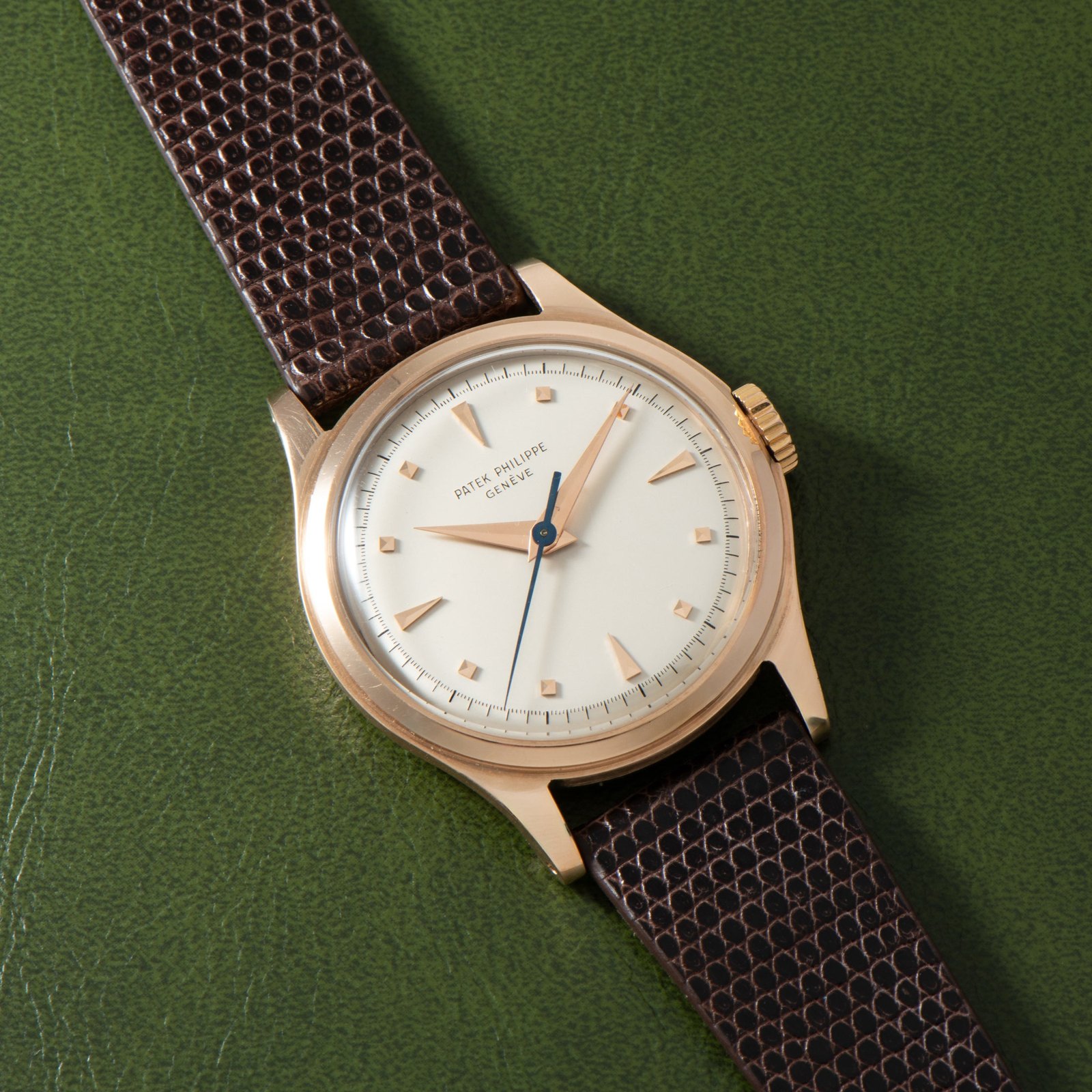
Patek Philippe Calatrava, early 1950s
- Maker / attribution
- Patek Philippe (maker)
- Date
- early 1950s
- Historical period
- Modern Mechanical Horology (1945 – 1969)
- Country of origin
- Switzerland
- Object type
- Wristwatch
- Dimensions
- Case 35 mm
- Stock no.
- 40931074
- Credit line
- Dealer listing, Analog/Shift (40931074)
- Catalogue title (original)
- Patek Philippe Calatrava (English)
View the source record (dealer listing) ↗ (opens another website in a new tab)Suggest a correction
Record summary
Catalogued by Analog/Shift (dealer), New York (stock number 40931074), this is a wristwatch by Patek Philippe, made in Switzerland, dated early 1950s. The Atlas places it in the Modern Mechanical Horology period (1945 – 1969) of its Wristwatches collection. Recorded dimensions: Case 35 mm. The record is illustrated with 6 photographs.
Assembled from the source record's structured fields. Dates and attributions are given as the source states them; where a field is missing the Atlas leaves it blank rather than estimating.
Catalogue description
Dealer description — Analog/Shift
First presented in 1932 with the Reference 96, the Patek Philippe Calatrava is the benchmark for classic men’s dress watches. Though it wouldn't attain the "Calatrava" designation until the 1980s, this groundbreaking reference set the stage for nearly every piece Patek has released since, and became the blueprint for other brands’ approaches to classy men’s timepieces. Heavily influenced by the Bauhaus design philosophy, the Calatrava was then considered extremely modern with its minimalist, ‘less is more’ approach to watch design. Over the years, this dressy collection has evolved, but the look remains unmistakable and iconic, and its rich history provides the vintage and pre-owned enthusiast with a variety of choices in metals, sizes, and tiny details to obsess over. In 1951, for example, Patek Philippe debuted the Reference 2508: A 35mm hand-wound dress watch in a waterproof, screw-down case from Taubert, it's among the most wearable of the vintage Calatrava models — and certainly among the most lovely. With roughly 1,000 pieces produced in yellow gold and far fewer in rose — not to mention just a handful known in stainless steel — it's also incredibly rare. This particular example, a Reference 2508J, dates to the early 1950s. Housed in a 35mm yellow gold case with a correct, unsigned crown, a smooth bezel, and an acrylic crystal, it features a beautifully brushed midcase with clear hallmarks and a 10-sided screw-down caseback. Its silver dial is balanced and lovely: Featuring an outer 1/5th-seconds track, applied yellow gold 'triangle' and 'pyramid' indices, a matching gold 'dauphine' handset, and a blued steel central seconds hand, it boasts the perfect mix of Bauhaus-inspired simplicity and slightly more modern proportions. Inside this exquisitely preserved piece and covered with a dust cover beats the Patek Philippe Calibre 27 SC, a hand-wound movement adjusted to five positions (plus heat, cold, and isochronism) and covered in handsome Geneva striping. Paired to a signed brown alligator-pattern leather strap from Analog:Shift with a signed yellow gold pin buckle, it is, quite frankly, the platonic ideal of a midcentury dress watch. While references such as the 2508 and 2509 long flew under the radar, the market is finally catching up and realizing just how special these watches truly are. Once you strap this incredible example to your wrist, you're bound to come to the same realization.
Historical context
Modern Mechanical Horology (1945 – 1969)
Tool watches for divers, pilots and astronauts; electric watches anticipate the electronic age.
The classic era of the mechanical wristwatch: dive watches, chronographs for motor racing and space flight, GMT watches for jet travel, slim dress watches, automatic calendars, and the rise of Japanese manufacturers alongside Swiss, American, German and Soviet industries.
Read the period in the timelineMore wristwatches from this periodEarlier: Golden Age of Mechanical Watchmaking
Atlas type guide
Wristwatches
Bracelet watches were worn by women from the early nineteenth century — Breguet made one for Caroline Murat, Queen of Naples, in 1810–12 — but the wristwatch only became a man's instrument with military use and aviation in the early twentieth century. Between the World Wars it overtook the pocket watch; the 1920s and 1930s brought rectangular Art Deco cases, water-resistant cases and the first automatic winding systems.
After 1945 the wristwatch became a carrier of identity — dress watches, sports and dive watches, chronographs, calendars — produced by Swiss, American, Japanese, German, Soviet and Chinese industries. The quartz revolution after 1969 and the mechanical renaissance since the 1990s, including the rise of independent watchmakers, complete the story.
What to look for
- The reference number (between the lugs or inside the case back) and serial number, the starting point for dating.
- The calibre: its maker and number are often stamped under the dial or on the bridge.
- Originality of dial, hands and crown — refinished ('redial') dials are common.
- Case material marks: 18K/750, 14K/585, stainless steel, gold-filled, plated.
Dating clues
- Wire-lug cases: before c. 1925.
- Water-resistant screw-down cases: from 1926.
- Quartz movements: from 1969; sapphire crystals widespread after c. 1980.
General guidance written by the Atlas editors about this kind of object. It is not a statement about this particular piece; for that, rely on the source record above and on physical examination.
Related records
Clocks · 1965–1975
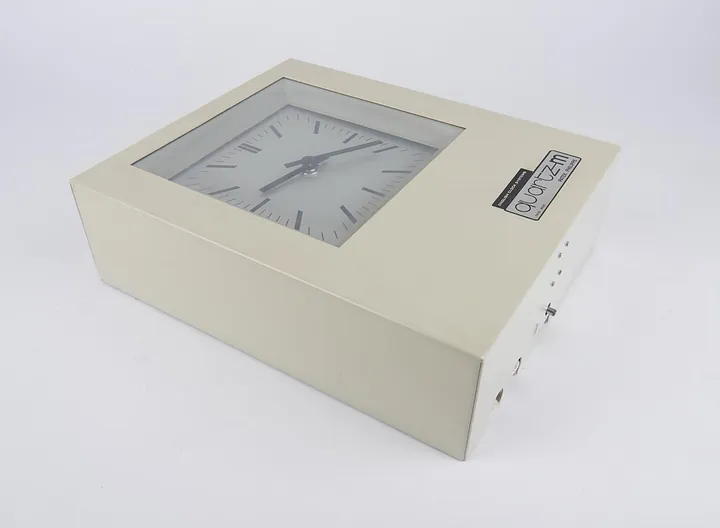
Quartz master clock QM 1, with movement by Patek Phillippe, Switzerland, 1965–1975. Supplied by English Clock Systems.
Science Museum Group, London
Instruments · 1965–1984
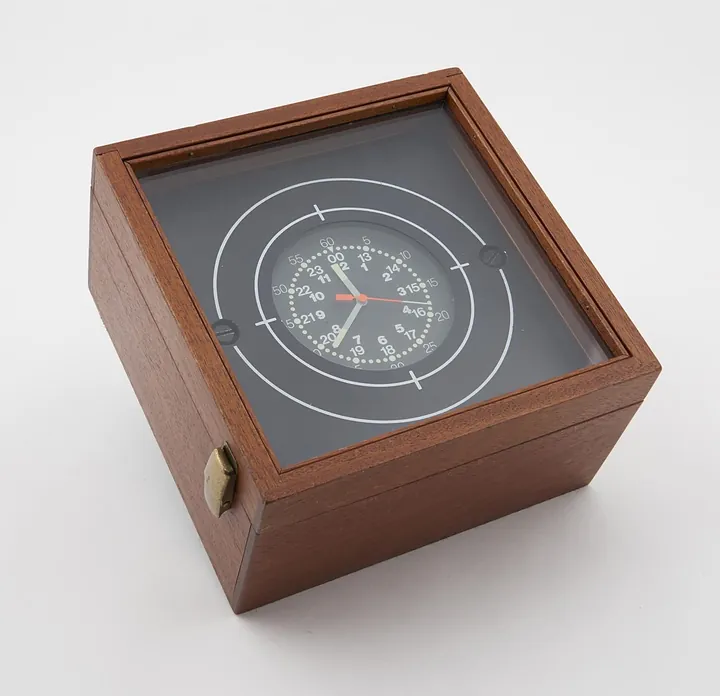
Chronometer by Patek Philippe and Kelvin Hughes, England, 1965–1984
Science Museum Group, London
Pocket Watches · c. 1895
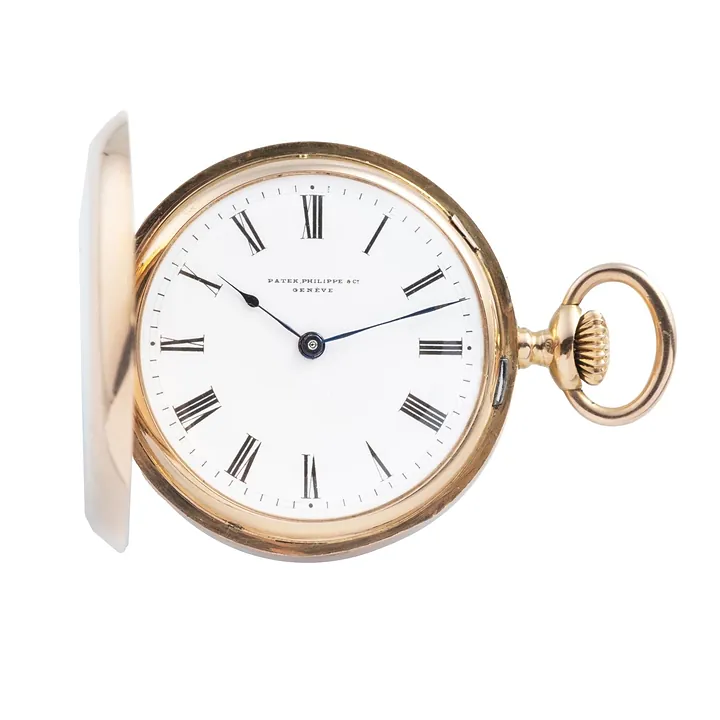
Patek Philippe pocket watch, c. 1895
Antiquorum auction archive, Geneva
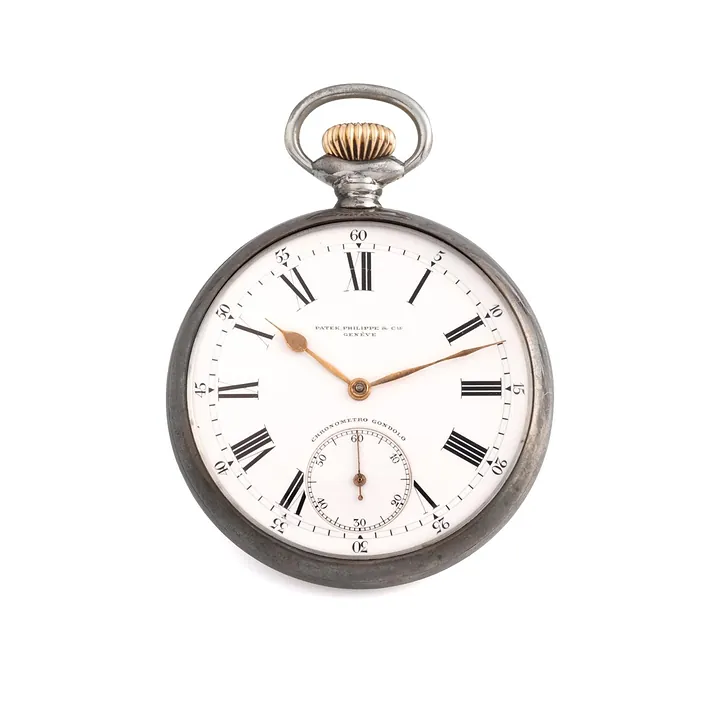
Pocket Watches · c. 1900
Patek Philippe Chronometro Gondolo, c. 1900
Antiquorum auction archive, Geneva

Wristwatches · 1945
Wristwatch by Eterna, 1945
Museum Rotterdam

Wristwatches · c. 1945
Breitling Premier, ref. 790, c. 1945
Antiquorum auction archive, Geneva

Wristwatches · c. 1945
Universal Genève Uni-Compax, ref. 22492, c. 1945
Antiquorum auction archive, Geneva

Wristwatches · c. 1950s
Baume & Mercier wristwatch, c. 1950s
Antiquorum auction archive, Geneva