Clocks · Clock
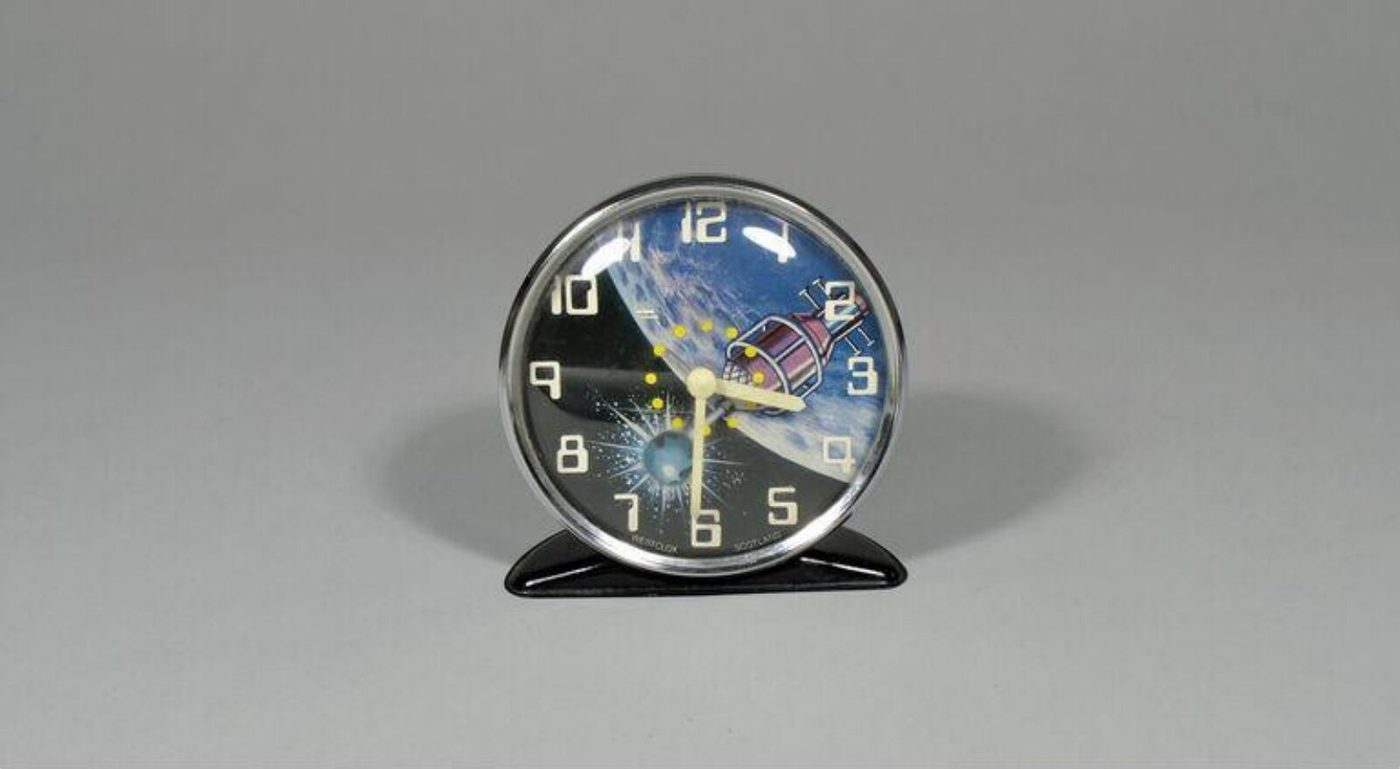
Nursery alarm clock with space-themed design, made in Scotland by Westclox Scotland, 1960s?.
- Maker / attribution
- Westclox Scotland (manufacturers)
- Date
- ca.1965
- Historical period
- Modern Mechanical Horology (1945 – 1969)
- Country of origin
- Unrecorded in source
- Place
- Dumbarton
- Object type
- Clock
- Materials / technique
- Pressed steel, painted black; printed card
- Dimensions
- Height: 12 cm; Diameter: 10.9 cm (face)
- Holding institution
- Victoria and Albert Museum, London
- Accession / object no.
- B.15-2017
Record summary
Held and catalogued by Victoria and Albert Museum, London (object number B.15-2017), this is a clock by Westclox Scotland, made in Dumbarton, dated ca.1965. The Atlas places it in the Modern Mechanical Horology period (1945 – 1969) of its Clocks collection. Materials and techniques recorded by the source: Pressed steel, painted black; printed card. Recorded dimensions: Height: 12 cm; Diameter: 10.9 cm (face). The record is illustrated with 2 photographs.
Assembled from the source record's structured fields. Dates and attributions are given as the source states them; where a field is missing the Atlas leaves it blank rather than estimating.
Catalogue description
V&A — Physical description
Nursery alarm clock with a round face, made from black-painted metal. It stands on a broad, flat foot. The face itself shows a stylised image of a purple spacecraft in orbit around a planet or moon, firing a laser beam at a smaller spherical object, which appears to rotate as the clock moves. The hands are of white-painted metal, the numbers around the edge are shiny and white. The face is covered by a clear acrylic disc. On the reverse of the clock are controls to wind, change the time and operate the clock's alarm.
V&A — Historical context
Science fiction first became a popular genre in the second half of the nineteenth century. Writers such as Jules Verne and H.G. Wells dominated the scene, producing influential classics which remain popular up to the present day. Wide-scale interest in sci-fi was renewed in the 1950s and 1960s, first through fixation on (and fear of) atomic power and weaponry, and then by the Space Race, which was launched in 1957 with the Soviet satellite Sputnik. The popularity of sci-fi waned somewhat in the early 1970s, before it was again revived by the wildly successful Star Wars franchise, which begun in 1977. The brilliant imagination, design and special effects of Star Wars spawned a new generation of interest, as well as many new franchises seeking to capitalise on its popularity.
V&A — Object history
Acquired by the Museum in 2017 [2017/265].
Historical context
Modern Mechanical Horology (1945 – 1969)
Tool watches for divers, pilots and astronauts; electric watches anticipate the electronic age.
Post-war clocks combined new materials and industrial design: plastic and metal cases, battery-powered transistor movements from the late 1950s, and design classics by George Nelson, Max Bill and others. The first caesium atomic clock (1955) moved the definition of time from astronomy to physics.
Read the period in the timelineMore clocks from this periodEarlier: Golden Age of Mechanical Watchmaking
Atlas type guide
Alarm clocks
Alarm work is among the oldest clock functions: monastic clocks woke monks for night prayers, and Renaissance table clocks often carried an alarm disc set by a pin. A separate spring or weight is released at the set time and drives a hammer against a bell. Some early alarms also lit a candle by striking a flint — the 'tinder pistol' alarm.
The cheap, mass-produced alarm clock arrived in the second half of the nineteenth century. American firms such as Seth Thomas and Westclox (the 'Big Ben' of 1910) and German makers such as Junghans and Kienzle made millions of drum-shaped alarms with pin-pallet escapements. Electric, quartz and digital alarm clocks followed in the twentieth century.
What to look for
- A separate alarm-setting dial or disc and an extra winding key.
- Twin bells on top (common after c. 1920) or a bell enclosed in the base.
- Pin-pallet escapements in inexpensive factory alarms.
- Trademarks and patent dates on dial or back.
Dating clues
- Renaissance alarm table clocks: sixteenth to seventeenth centuries.
- Drum alarm clocks: from the 1870s.
- Luminous dials with radium paint: c. 1910–1960.
General guidance written by the Atlas editors about this kind of object. It is not a statement about this particular piece; for that, rely on the source record above and on physical examination.
Related records

Clocks · 1873–2021
Clock, Poland, 1873–2021
The International Center for Information Management Systems and Services
Clocks · 20th century
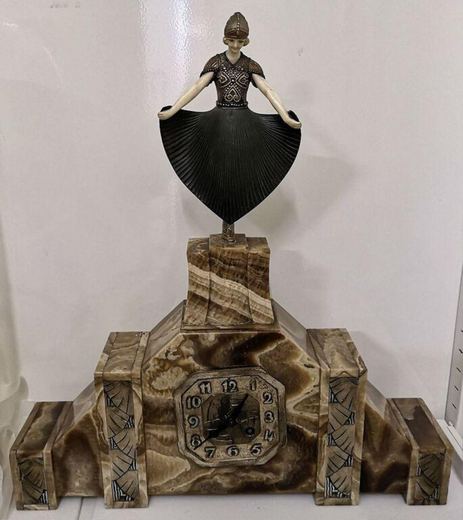
Base Metal, 20th c. Bronze, marble and ivory clock by Chiparus
Victoria and Albert Museum, London
Clocks · 1900–1999
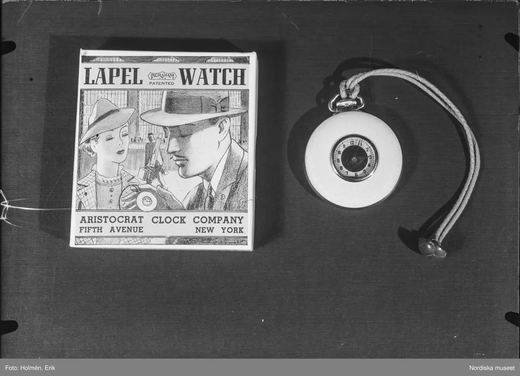
Clock by Erik Holmén, 1900–1999
Nordic Museum Foundation
Clocks · 1900–1999
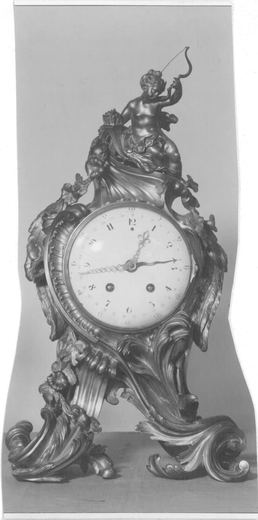
Clock by Französisch (Schule), 1900–1999
Fine Arts Museum Vienna
Clocks · 1900–1999
Clock by Friedrich Mauthe, Germany, 1900–1999 (German Clock Museum Museu_ProvidedCHO_museum_digital_59468__technical_number_)
German Clock Museum
Clocks · 1900–1999
Clock by Friedrich Mauthe, Germany, 1900–1999 (German Clock Museum Museu_ProvidedCHO_museum_digital_59469__technical_number_)
German Clock Museum
Clocks · 1900–1999
Clock by G. H. Lantman, Netherlands, 1900–1999
Royal Institute for Cultural Heritage
Clocks · 1900–1999
Clock by J. Winkelman, Belgium, 1900–1999
Royal Institute for Cultural Heritage