
Instruments · Nocturnal
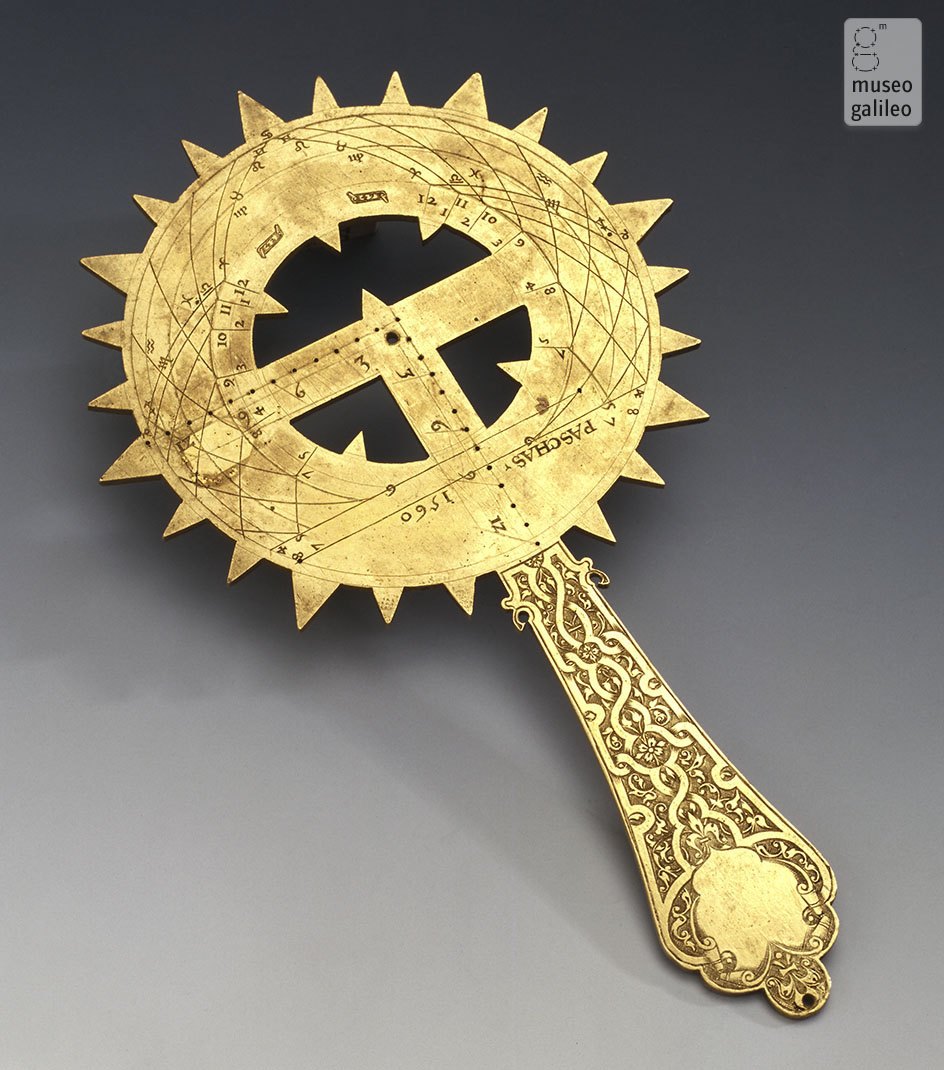
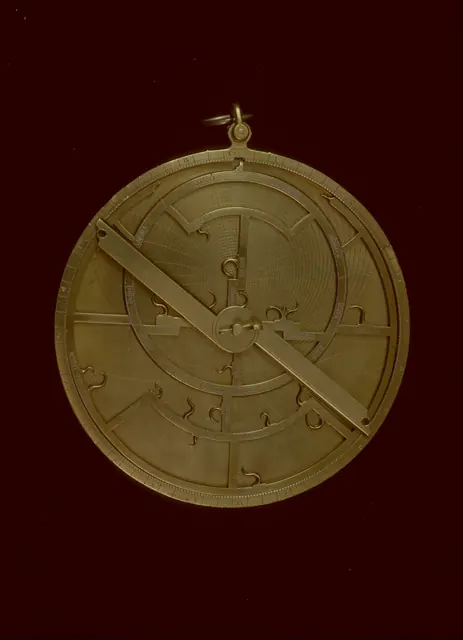
Nocturnal, France, 1560
- Maker / attribution
- Unrecorded in source
- Date
- 1560
- Historical period
- Renaissance Horology (1400 – 1600)
- Country of origin
- France
- Place
- French
- Object type
- Nocturnal
- Materials / technique
- gilt brass
- Dimensions
- 212x129
- Holding institution
- Museo Galileo, Florence
- Accession / object no.
- Inv. 2504
- Credit line
- Museo Galileo, Florence
- Catalogue title (original)
- Nocturnal (English)
View the source record ↗ (opens another website in a new tab)Suggest a correction
Record summary
Held and catalogued by Museo Galileo, Florence (object number Inv. 2504), this is a nocturnal, made in French, France, dated 1560. The Atlas places it in the Renaissance Horology period (1400 – 1600) of its Instruments collection. Materials and techniques recorded by the source: gilt brass. Recorded dimensions: 212x129. The record is illustrated with 2 photographs.
Assembled from the source record's structured fields. Dates and attributions are given as the source states them; where a field is missing the Atlas leaves it blank rather than estimating.
Catalogue description
Catalogue description — Museo Galileo
Combination nocturnal and sundial. Several parts are missing. Comprises a disk with a hole at the center and fitted with a finely tooled handle. On both sides are 27 matching holes. A T-shaped brass strip is placed across the opening. The circumference carries protruding triangular tips. Engraved with the date (1560) and the word "Paschas," which is hard to interpret. Provenance: Medici collections.
Provenance
Medici collections
Historical context
Renaissance Horology (1400 – 1600)
Spring power makes clocks portable; Nuremberg and Augsburg produce the first watches; the Prague Orloj is built.
Instrument-making flourished in Nuremberg, Augsburg, Louvain and London: ivory diptych dials, astronomical compendia, astrolabes and nocturnals for wealthy patrons, navigators and scholars.
Read the period in the timelineMore instruments from this periodEarlier: Medieval Period
Atlas type guide
Nocturnals
A nocturnal tells the time at night from the rotation of the stars around the celestial pole. The user sights Polaris through the central hole and turns a long pointer to align with the 'guard' stars of the Little Bear or the 'pointers' of the Great Bear. A calendar scale set to the date converts that angle to the hour.
Nocturnals were used from the sixteenth to the eighteenth century by navigators and travellers. Many are made of boxwood or brass, with tactile teeth on the hour disc so that the time can be counted in the dark.
What to look for
- A central sighting hole and a long index arm.
- Engraved letters such as 'B' (Bear) or 'BB' indicating which constellation to use.
- Teeth on the hour disc with a longer tooth for midnight.
Dating clues
- Most surviving nocturnals date from about 1550 to 1750.
General guidance written by the Atlas editors about this kind of object. It is not a statement about this particular piece; for that, rely on the source record above and on physical examination.
Related records
Instruments · late 15th century
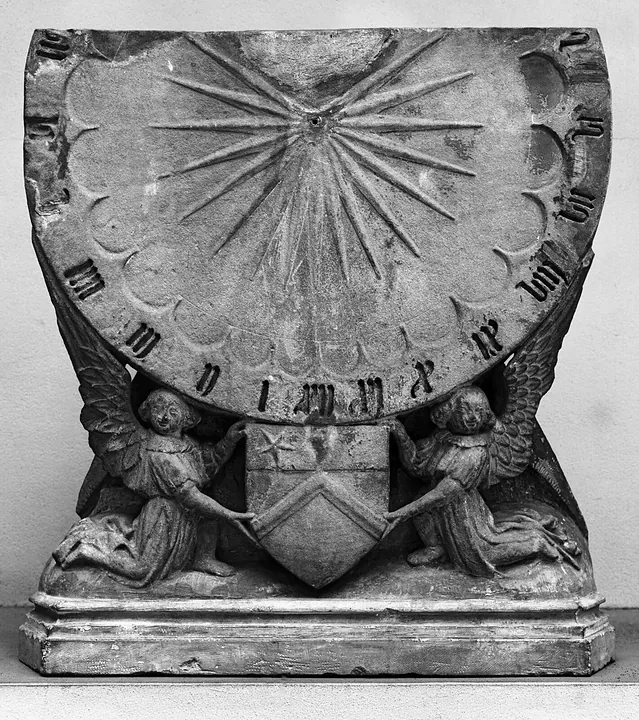
Sundial, stone, northern France, late 15th century
Victoria and Albert Museum, London
Instruments · 1501–1600
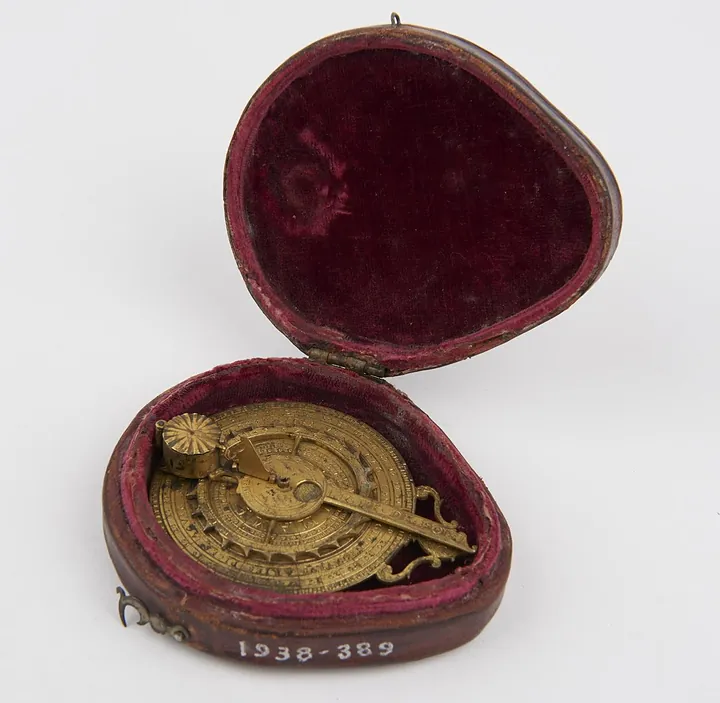
Nocturnal and Sundial etc., gilt metal, French, 16th century, in case
Science Museum Group, London
Instruments · 1584
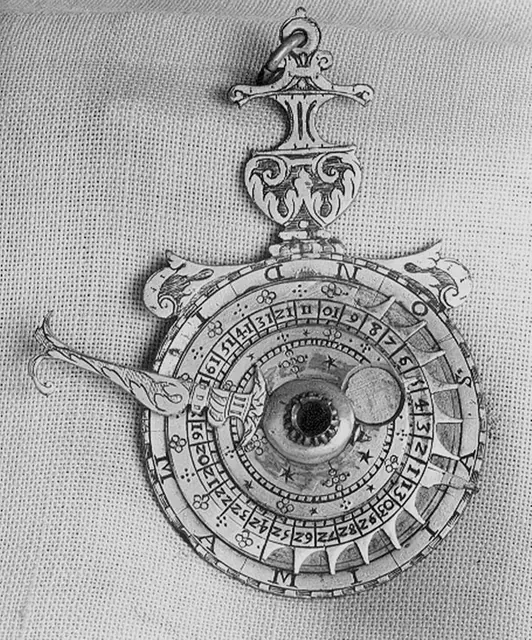
Nocturnal, France, 1584
Royal Institute for Cultural Heritage
Instruments · 1553
Astrolabe, France, 1553
Royal Museums Greenwich
Instruments · 1560
Astrolabe, France, 1560
Royal Museums Greenwich
Instruments · 1591–1600
Astrolabe, France, 1591–1600
Royal Institute for Cultural Heritage
Instruments · c. 1400
Sir John Findlay's 'Fusoris-type' astrolabe
Adler Planetarium, Chicago
Instruments · 1385–1436
A 'Fusoris-type' astrolabe
Adler Planetarium, Chicago