
Wristwatches · Wristwatch
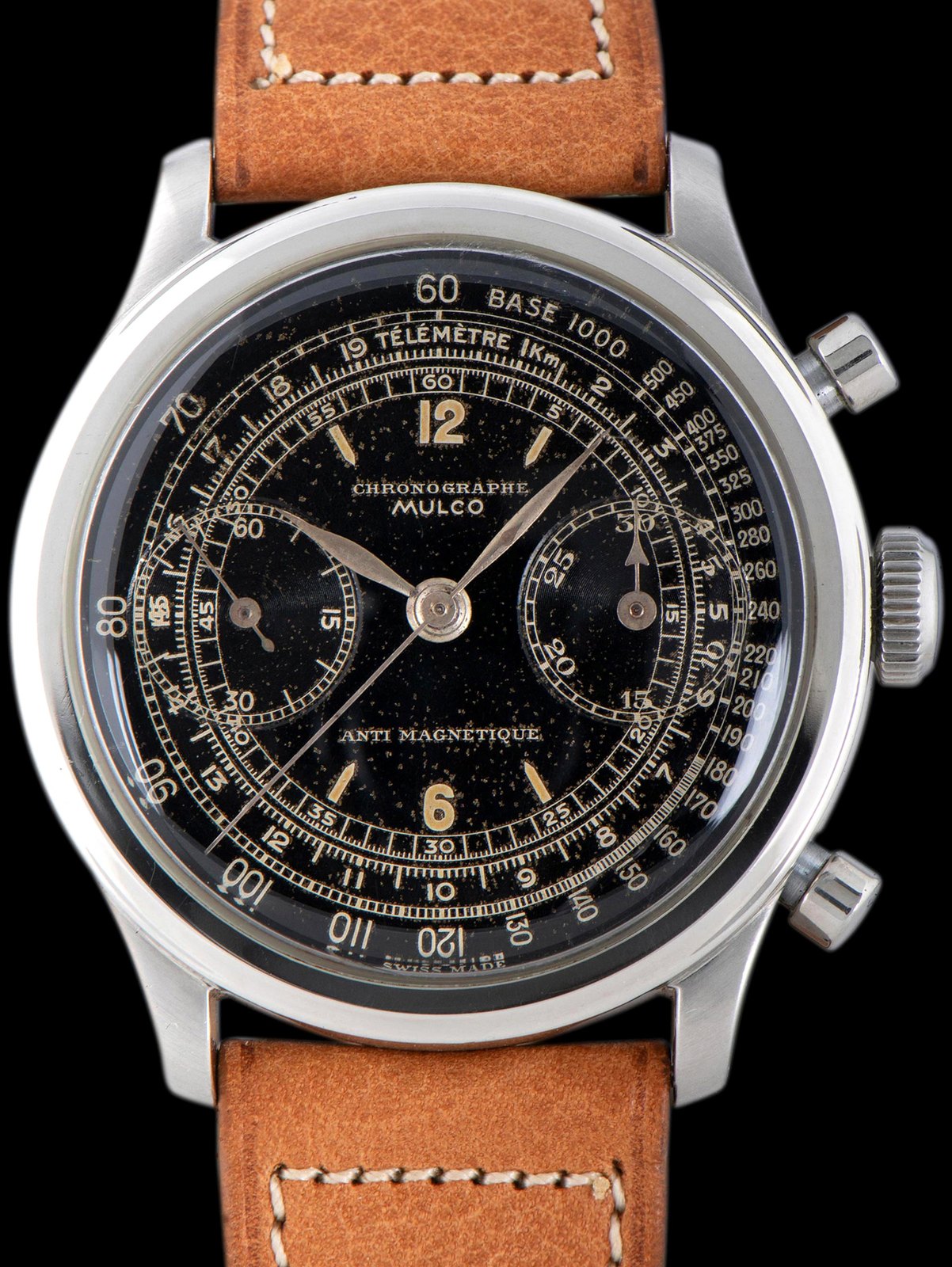
Mulco Clamshell Chronograph "Valjoux Cal. 22" Gilt Dial, 1940s
- Maker / attribution
- Mulco (maker)
- Date
- 1940s
- Historical period
- Golden Age of Mechanical Watchmaking (1900 – 1945)
- Country of origin
- Unrecorded in source
- Object type
- Wristwatch
- Dimensions
- Case 37.5 mm
- Stock no.
- MLCCLMCHRON
- Credit line
- Dealer listing, Craft & Tailored (MLCCLMCHRON)
- Catalogue title (original)
- 1940s Mulco Clamshell Chronograph "Valjoux Cal. 22" Gilt Dial (English)
View the source record (dealer listing) ↗ (opens another website in a new tab)Suggest a correction
Record summary
Catalogued by Craft & Tailored (dealer), Los Angeles (stock number MLCCLMCHRON), this is a wristwatch by Mulco, dated 1940s. The Atlas places it in the Golden Age of Mechanical Watchmaking period (1900 – 1945) of its Wristwatches collection. Recorded dimensions: Case 37.5 mm. The record is illustrated with 6 photographs.
Assembled from the source record's structured fields. Dates and attributions are given as the source states them; where a field is missing the Atlas leaves it blank rather than estimating.
Catalogue description
Dealer description — Craft & Tailored
Though it is widely known that Rolex introduced the first commercially available waterproof watch with the Rolex Oyster in 1926, this innovation was only available in time-only wristwatches. The first waterproof chronograph was invented by Schmitz Frères et Cie, a wristwatch case manufacturer in Grenchen, Switzerland. They submitted a patent (No. 189190) in 1936 for a three-part "waterproof" watch casing design. This innovative concept encloses the movement within a steel "clamshell," which is then inserted into the upper bezel assembly with lugs secured by four screws. While initially implemented by Fortis in 1937, it was Gallet's version, launched in 1938 and dubbed the "Clamshell", that would become the enduring name associated with this design innovation. Along with Fortis, Gallet, and the Mulco presently available, the Clamshell case technology was adopted by numerous brands including Breitling, Doxa, Heuer, and Nivada Grenchen. With a large-for-its-era 37.5mm case and a perfectly aged glossy gilt dial, this Mulco is an aesthetic powerhouse. Housed in this beautifully preserved representation of early watchmaking innovation is a Valjoux cal. 22 chronograph movement. Stock # MLCCLMCHRON Brand Mulco Style "Clamshell" Chronograph Model N/A Serial N/A Size Men's Material Stainless Steel Dial Glossy Black "Gilt" Millimeters 37.5 Strap 2pc Handmade Leather Strap CASE & BRACELET The exceptionally crisp and large case is in downright impressive condition, boasting full, symmetrical lugs that retain original factory proportions with no evidence of over-polishing or warping to the lug holes. The case retains its original small pump-pushers and the unsigned crown is believed to remain original to the watch as well. The case back displays very gentle wear and retains the screws which attach the case components. The watch comes supplied on a 2pc handmade leather strap. DIAL & HANDS The original non-luminous glossy gilt dial is a true work of art, showing subtle, yet very attractive aging throughout but with no elements of damage. All of the hands are original to the watch and remain in excellent condition. ACCESSORIES
Historical context
Golden Age of Mechanical Watchmaking (1900 – 1945)
The wristwatch displaces the pocket watch; waterproof cases, self-winding and grand complications.
The wristwatch overtook the pocket watch. Military use in the First World War, aviation, water-resistant cases (1926), automatic winding (1923–31), rectangular Art Deco designs and early chronographs and calendars defined the period.
Read the period in the timelineMore wristwatches from this periodEarlier: Industrial Revolution
Atlas type guide
Chronographs and split-seconds watches
A chronograph is a watch with an additional seconds hand that can be started, stopped and returned to zero independently of the timekeeping. Louis Moinet built an early example in 1816 and Nicolas Rieussec a recording 'chronographe' in 1821; Adolphe Nicole's heart-shaped reset cam (patented 1862) made the modern return-to-zero possible. Split-seconds (rattrapante) chronographs add a second hand that can be stopped for intermediate times; flyback chronographs restart instantly.
Chronographs were essential tools for doctors (pulsometer scales), artillery (telemeter), engineers and sport. In wristwatches, Valjoux, Venus, Lemania and later the automatic chronographs of 1969 (Zenith El Primero, the Chronomatic Calibre 11 group and Seiko 6139) are milestones.
What to look for
- Push-pieces on the case band or a single button in the crown (monopusher).
- Subsidiary registers for minutes and hours; tachymeter, telemeter or pulsometer scales.
- Column wheel versus cam control visible in the movement.
- Calibre markings of specialist makers (Valjoux, Lemania, Venus, Landeron).
Dating clues
- Pocket chronographs with heart cam reset: after 1862.
- Wrist chronographs: from c. 1910; two-button designs from the 1930s.
- Automatic chronographs: from 1969.
General guidance written by the Atlas editors about this kind of object. It is not a statement about this particular piece; for that, rely on the source record above and on physical examination.
Read next:Flyback chronographChronograph
Related records
Wristwatches · c. 1950s
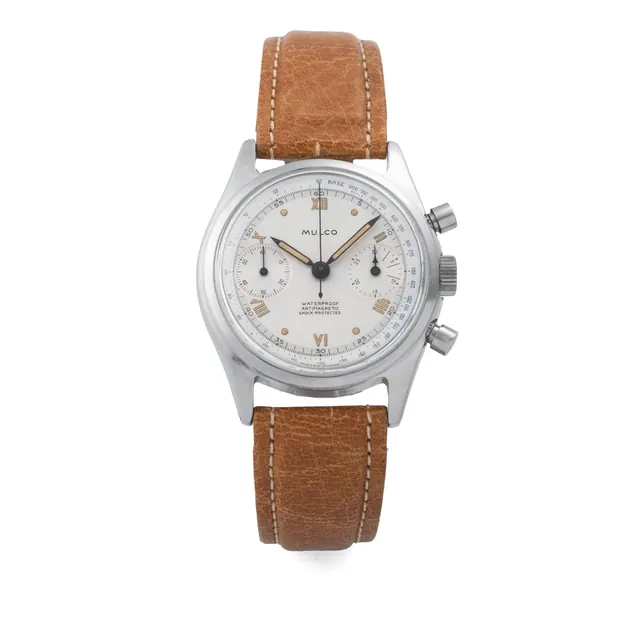
Mulco wristwatch, ref. 281, circa 1950's
Antiquorum auction archive, Geneva
Wristwatches · c. 1960s
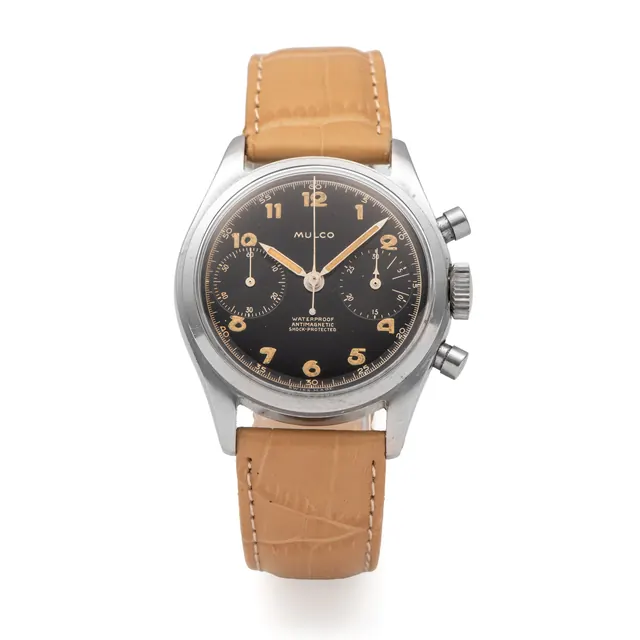
Mulco wristwatch, Waterproof Chronograph Black Dial, circa 1960's
Antiquorum auction archive, Geneva
Wristwatches · c. 1940s
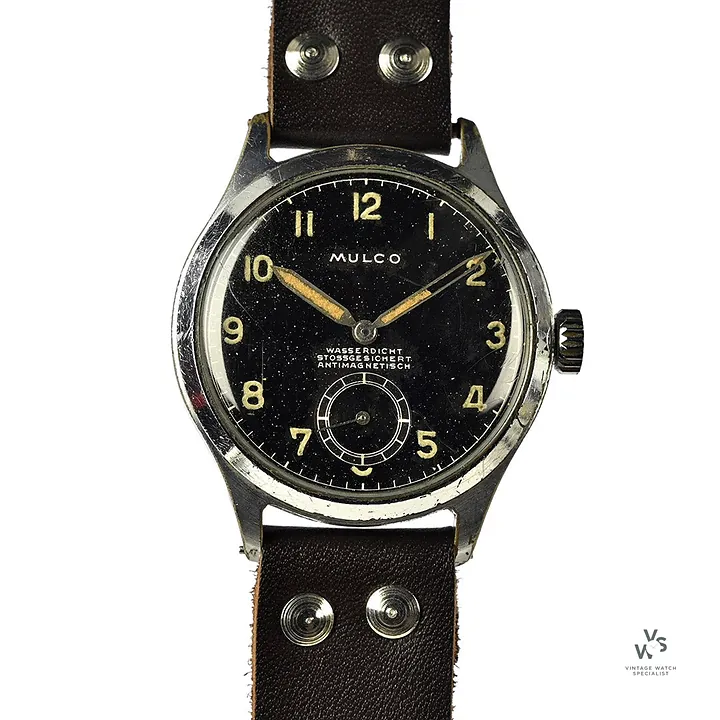
Mulco WW2 German Military Watch (DH) Case Back ref. D 1277 H, circa 1940s
Vintage Watch Specialist (dealer), United Kingdom
Wristwatches · 1940s
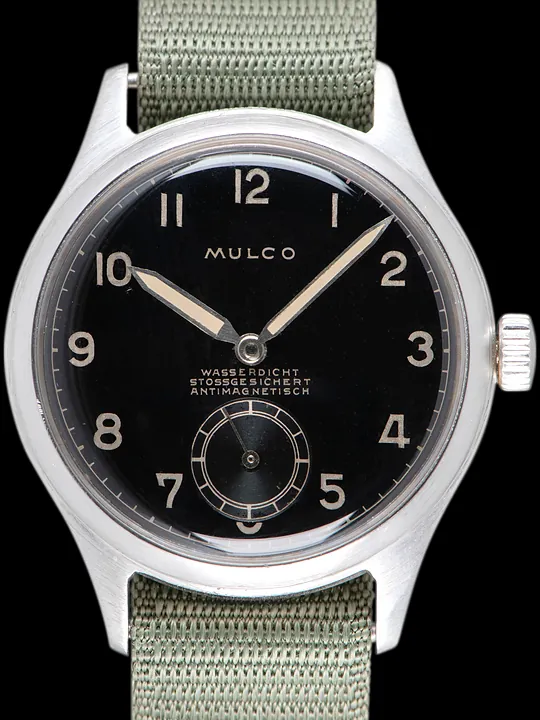
Mulco D.H. Military Watch "Cal. AS 1130", 1940s
Craft & Tailored (dealer), Los Angeles
Wristwatches · 1900–1999
Wristwatch by Mercury, 1900–1999
Modemuseum Hasselt
Wristwatches · 1900–1999
Wristwatch by Nutrix, 1900–1999
Modemuseum Hasselt
Wristwatches · 1920
Wristwatch, 1920
Modemuseum Hasselt

Wristwatches · 1931
Rolex 'Oyster Perpetual' rotor self-winding wrist-watch, lever escapement, in steel case with glass in back, Montres Rolex SA, Geneva, Switzerland, 1931
Science Museum Group, London