
Wristwatches · Wristwatch
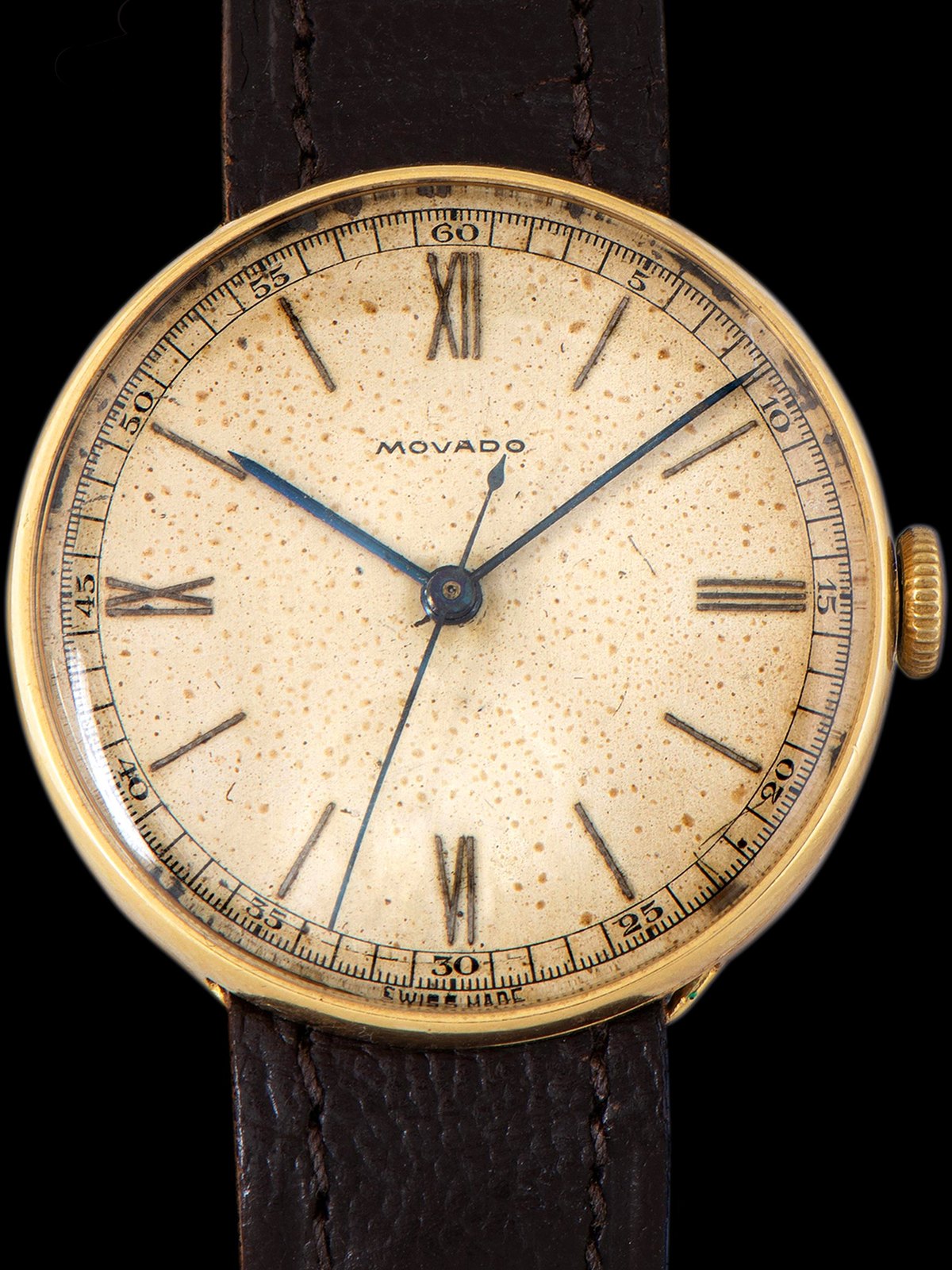
Movado "UFO" Dress Watch 18K YG (Ref. 1794) 'Cal. 150MN', 1930s
- Maker / attribution
- Movado (maker)
- Date
- 1930s
- Historical period
- Golden Age of Mechanical Watchmaking (1900 – 1945)
- Country of origin
- Switzerland
- Object type
- Wristwatch
- Stock no.
- MOVUFO1794
- Credit line
- Dealer listing, Craft & Tailored (MOVUFO1794)
- Catalogue title (original)
- 1930s Movado "UFO" Dress Watch 18K YG (Ref. 1794) 'Cal. 150MN' (English)
View the source record (dealer listing) ↗ (opens another website in a new tab)Suggest a correction
Record summary
Catalogued by Craft & Tailored (dealer), Los Angeles (stock number MOVUFO1794), this is a wristwatch by Movado, made in Switzerland, dated 1930s. The Atlas places it in the Golden Age of Mechanical Watchmaking period (1900 – 1945) of its Wristwatches collection. The record is illustrated with 6 photographs.
Assembled from the source record's structured fields. Dates and attributions are given as the source states them; where a field is missing the Atlas leaves it blank rather than estimating.
Catalogue description
Dealer description — Craft & Tailored
In the world of vintage watches, few brands better illustrate the contrast between past prestige and modern perception than Movado. During the early-to-mid 20th century, Movado stood shoulder to shoulder with the likes of Rolex and Patek Philippe, competing not only in technical innovation but also in design excellence. The brand’s influence on modern watchmaking remains undeniable, and pieces such as this 1930s Movado “UFO” Dress Watch perfectly capture the refined creativity and manufacturing prowess that once defined the maison. With its sculptural, rounded case and elegant proportions, the ref. 1794 embodies the bold yet restrained Art Deco-inspired styling that made Movado one of the era’s most respected manufacturers. Housed in an elegant 18K yellow gold case, this ref. 1794 was manufactured by the famed casemaker Favre & Perret of La Chaux-de-Fonds, one of the most prestigious case manufacturers of the period. Favre & Perret would later go on to produce cases for some of the most celebrated watches ever made, including the Rolex “Padellone” ref. 8171, early Patek Philippe ref. 3940 models, and even the early cases for the ref. 3700 Nautilus. That pedigree is immediately evident here, with the watch’s beautifully executed “UFO” case profile offering an unmistakably sophisticated wrist presence that feels decades ahead of its time. Powering the watch is Movado’s in-house Cal. 150MN movement, a testament to the brand’s commitment to producing reliable, high-grade calibers entirely under their own roof. Altogether, this remarkable timepiece serves as a compelling reminder that vintage Movado was once among the very best in Swiss watchmaking. SPECS Stock # MOVUFO1794 Brand Movado Style Dress Watch "UFO" Model 1794 Serial 15XXXX Size Men's/ Unisex Material 18K Yellow Gold Dial Silver "Aged" Millimeters 32 Strap 2pc Handmade Leather Strap CASE & BRACELET The charming, nearly perfectly circular 18K yellow gold case is in wonderful condition, showing some gentle wear and light evidence of past polishing. The crown is believed to be an early replacement, but it matches the overall aesthetic of the watch perfectly. The fixed strap bars remain in excellent condition. The watch comes supplied on a dark brown leather strap. Please note that due to the fixed strap bars, the strap is also fixed to the watch and can only be replaced with another permanent-style strap. DIAL & HANDS The original cream colored dial with raised markers provides a fantastic vintage aesthetic through its earm wear and patina, showing some light marks and a speckeled staining throughout, but with no major damage present. Completing the watch, the blued steel hands offer a welcomed cool-contrast to the overall warm-toned watch, and remain in excellent condition. ACCESSORIES None. The watch is keeping time, but the service history is unknown. A movement service can be purchased upon request.
Historical context
Golden Age of Mechanical Watchmaking (1900 – 1945)
The wristwatch displaces the pocket watch; waterproof cases, self-winding and grand complications.
The wristwatch overtook the pocket watch. Military use in the First World War, aviation, water-resistant cases (1926), automatic winding (1923–31), rectangular Art Deco designs and early chronographs and calendars defined the period.
Read the period in the timelineMore wristwatches from this periodEarlier: Industrial Revolution
Atlas type guide
Wristwatches
Bracelet watches were worn by women from the early nineteenth century — Breguet made one for Caroline Murat, Queen of Naples, in 1810–12 — but the wristwatch only became a man's instrument with military use and aviation in the early twentieth century. Between the World Wars it overtook the pocket watch; the 1920s and 1930s brought rectangular Art Deco cases, water-resistant cases and the first automatic winding systems.
After 1945 the wristwatch became a carrier of identity — dress watches, sports and dive watches, chronographs, calendars — produced by Swiss, American, Japanese, German, Soviet and Chinese industries. The quartz revolution after 1969 and the mechanical renaissance since the 1990s, including the rise of independent watchmakers, complete the story.
What to look for
- The reference number (between the lugs or inside the case back) and serial number, the starting point for dating.
- The calibre: its maker and number are often stamped under the dial or on the bridge.
- Originality of dial, hands and crown — refinished ('redial') dials are common.
- Case material marks: 18K/750, 14K/585, stainless steel, gold-filled, plated.
Dating clues
- Wire-lug cases: before c. 1925.
- Water-resistant screw-down cases: from 1926.
- Quartz movements: from 1969; sapphire crystals widespread after c. 1980.
General guidance written by the Atlas editors about this kind of object. It is not a statement about this particular piece; for that, rely on the source record above and on physical examination.
Related records
Pocket Watches · c. 1960s
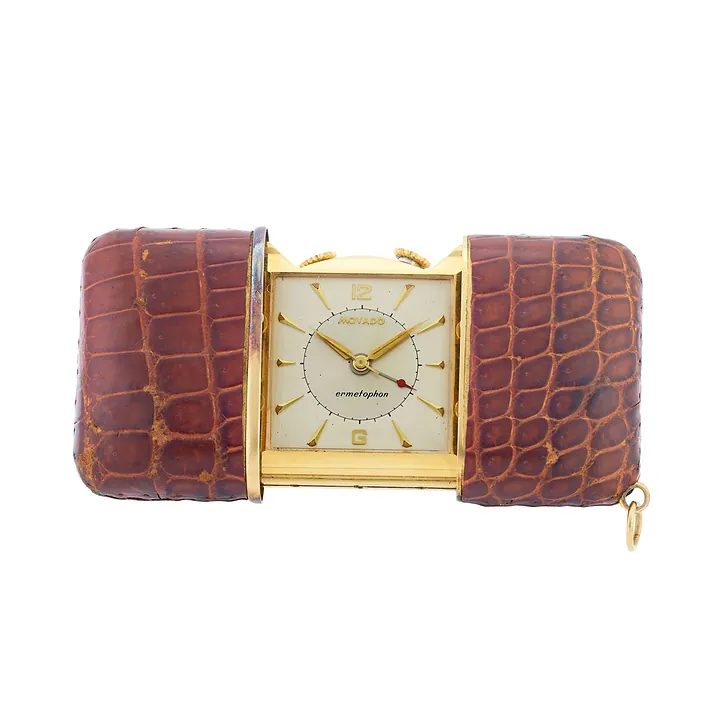
Movado Ermetophone, c. 1960s
Antiquorum auction archive, Geneva
Wristwatches · c. 1920s
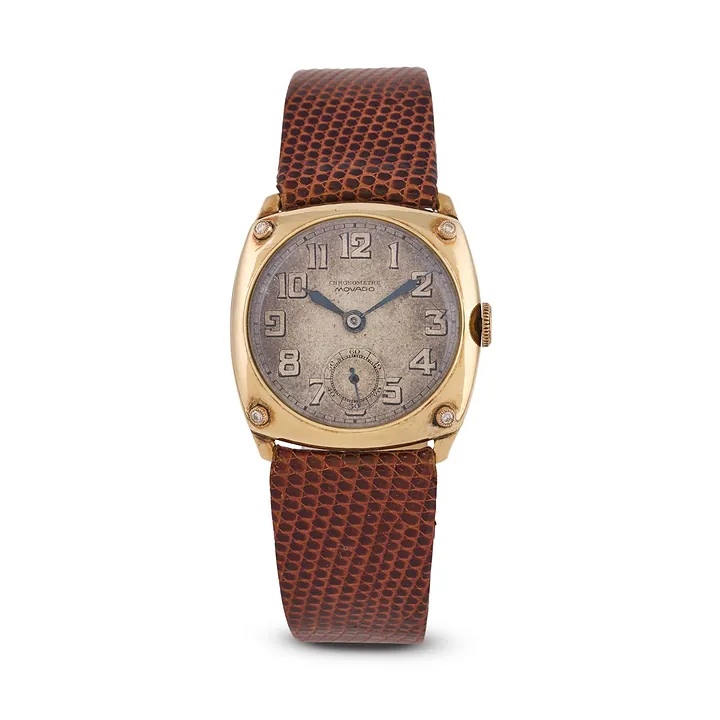
Movado Chronometre, ref. 41536, c. 1920s
Antiquorum auction archive, Geneva
Wristwatches · c. 1930s
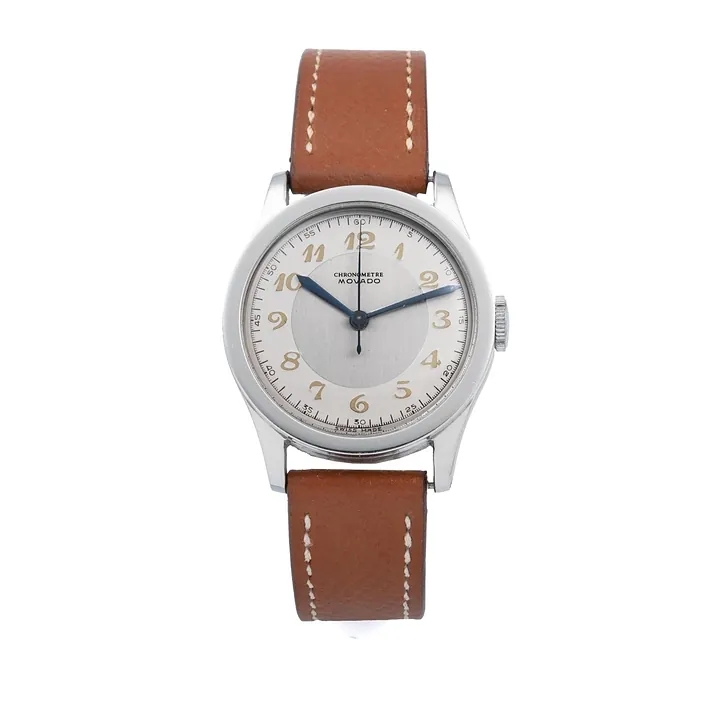
Movado "calatrava", ref. 17726, c. 1930s
Antiquorum auction archive, Geneva
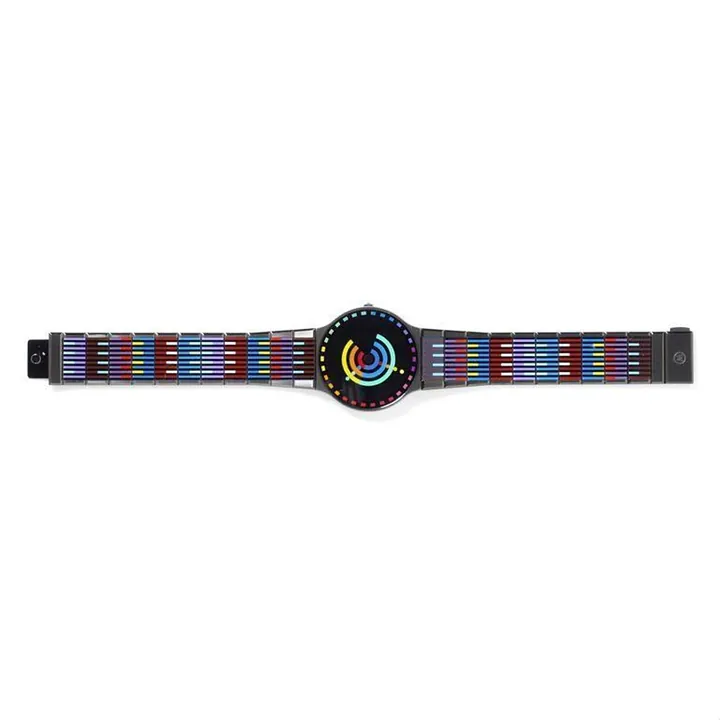
Wristwatches · c.1989
Steel, France and Switzerland, 1989; designed by Yaacov Agam (born 1928) for a limited edition by Movado
Victoria and Albert Museum, London

Wristwatches · 1931
Rolex 'Oyster Perpetual' rotor self-winding wrist-watch, lever escapement, in steel case with glass in back, Montres Rolex SA, Geneva, Switzerland, 1931
Science Museum Group, London

Wristwatches · 1900–1999
Wristwatch by Certina, Switzerland, 1900–1999
Nordic Museum Foundation

Wristwatches · 1900–1999
Wristwatch by Omega, Västerås, 1900–1999
Nordic Museum Foundation

Wristwatches · 1900–1999
Wristwatch by Universal, Switzerland, 1900–1999
Nordic Museum Foundation