
Wristwatches · Wristwatch
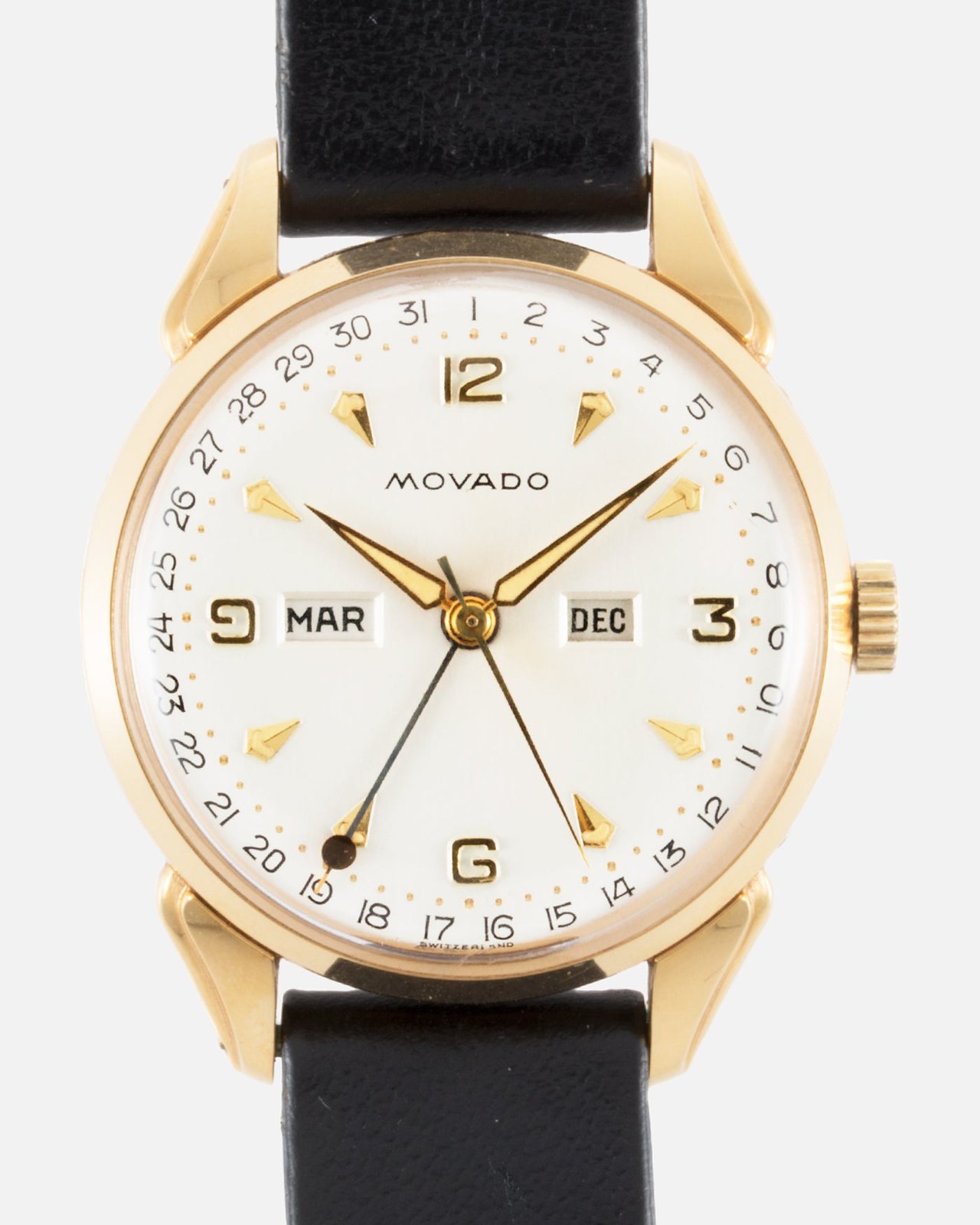
Movado Triple Date LNOS, 1940s
- Maker / attribution
- Movado (maker)
- Date
- 1940s
- Historical period
- Golden Age of Mechanical Watchmaking (1900 – 1945)
- Country of origin
- Switzerland
- Object type
- Wristwatch
- Dimensions
- Case 33 mm
- Stock no.
- Product 1310430920791
- Credit line
- Dealer listing, S.Song Watches (product 1310430920791)
- Catalogue title (original)
- Movado Triple Date LNOS (English)
View the source record (dealer listing) ↗ (opens another website in a new tab)Suggest a correction
Record summary
Catalogued by S.Song Watches (dealer), Seattle (stock number Product 1310430920791), this is a wristwatch by Movado, made in Switzerland, dated 1940s. The Atlas places it in the Golden Age of Mechanical Watchmaking period (1900 – 1945) of its Wristwatches collection. Recorded dimensions: Case 33 mm. The record is illustrated with 6 photographs.
Assembled from the source record's structured fields. Dates and attributions are given as the source states them; where a field is missing the Atlas leaves it blank rather than estimating.
Catalogue description
Dealer description — S.Song Watches
One of the hottest brands in recent times would certainly have to be Movado. I’m not talking about Movado’s of today, where what they make is a far cry of the brand they used to be. Between the 30’s and 70’s, Movado made some of the finest watches in the world. Though most famous for making their M90 and M95 chronograph calibres, they were also pretty damn good at dress watches and this Movado Triple Date is a testament to that. This is a watch that is characteristically 1950’s in its design and certainly one of Movado’s finest. The stand out feature of this watch would have to be its dial design. A silver dial with two apertures displaying the day and month, a fourth hand showing the date on the outer track of the dial and dagger hour markers filled with lume. Furthermore, the sizing of everything from the numerals to the logo is all perfectly proportionate, without being too big. Lume filled hands a lollipop calendar hand top this off to make one of the nicest dial designs of the era. The plated case is very 1950’s in its design. Sized at a svelte 33mm and featuring fancy bevelled lugs, this is a seriously elegant dress watch. With all the design talk out of the way, let’s talk condition. This watch comes complete with its original Movado box, its original strap and buckle and the watch itself is in barely used condition. There is some wear to the strap but other than that the watch is perfect. The dial itself is beautifully preserved and I’m gonna say it- this is the best condition of a Movado Triple Date you will find!
Historical context
Golden Age of Mechanical Watchmaking (1900 – 1945)
The wristwatch displaces the pocket watch; waterproof cases, self-winding and grand complications.
The wristwatch overtook the pocket watch. Military use in the First World War, aviation, water-resistant cases (1926), automatic winding (1923–31), rectangular Art Deco designs and early chronographs and calendars defined the period.
Read the period in the timelineMore wristwatches from this periodEarlier: Industrial Revolution
Atlas type guide
Calendar, moon-phase and perpetual calendar watches
Calendar complications range from a simple date to the perpetual calendar, which automatically allows for months of different lengths and leap years until 2100. Pocket watches with perpetual calendars were made in the eighteenth and nineteenth centuries; Patek Philippe made the first perpetual calendar wristwatch in 1925, and series production followed in 1941. The annual calendar (Patek Philippe, 1996) needs correction only once a year.
Moon-phase displays use a disc with two moons and 59 teeth advanced daily, approximating the 29.5-day lunation; more precise trains reduce the error to one day in over a century.
What to look for
- Apertures or subsidiary dials for day, date, month and leap year.
- Moon disc under a 'bosom' shaped aperture.
- Recessed correctors on the case band for setting the calendar.
Dating clues
- Triple-date wristwatches: popular c. 1940–1955.
- Perpetual calendar wristwatches: from 1925 (unique) and 1941 (series).
General guidance written by the Atlas editors about this kind of object. It is not a statement about this particular piece; for that, rely on the source record above and on physical examination.
Related records
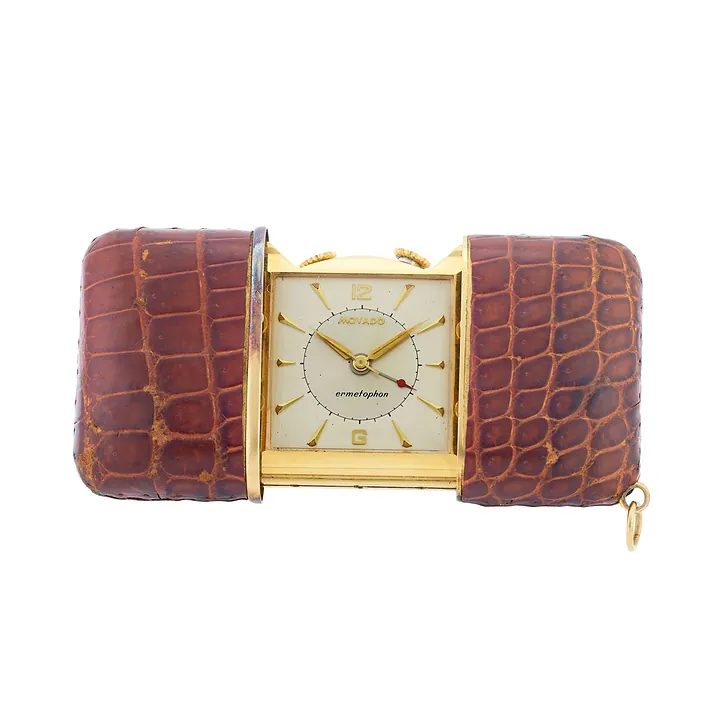
Pocket Watches · c. 1960s
Movado Ermetophone, c. 1960s
Antiquorum auction archive, Geneva
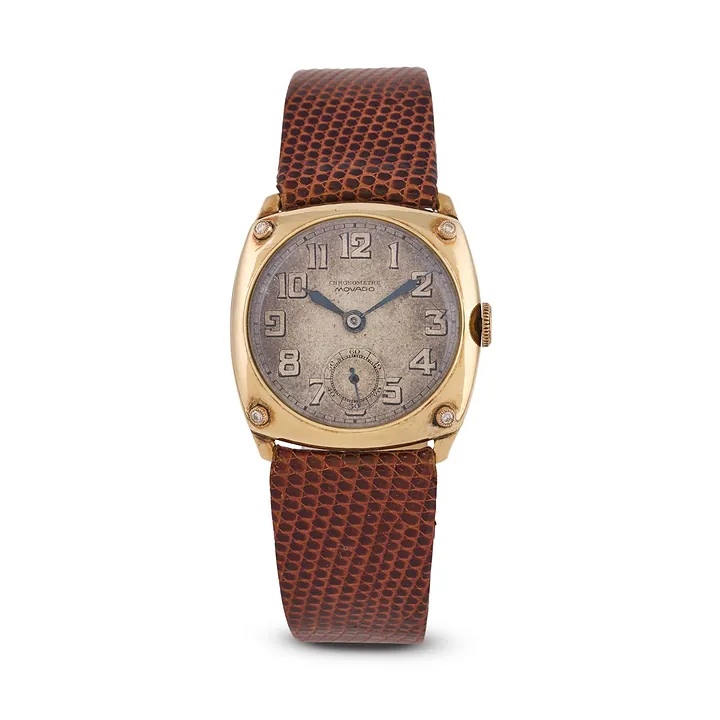
Wristwatches · c. 1920s
Movado Chronometre, ref. 41536, c. 1920s
Antiquorum auction archive, Geneva
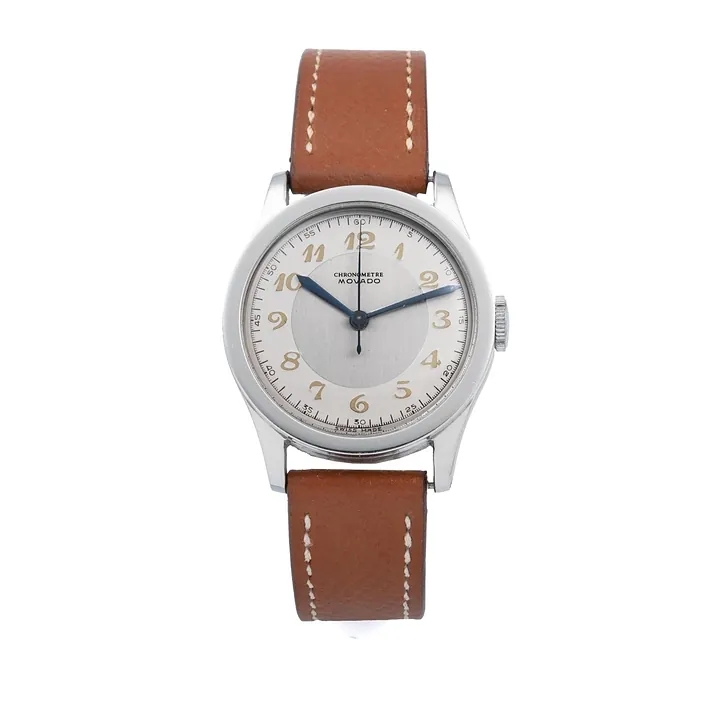
Wristwatches · c. 1930s
Movado "calatrava", ref. 17726, c. 1930s
Antiquorum auction archive, Geneva
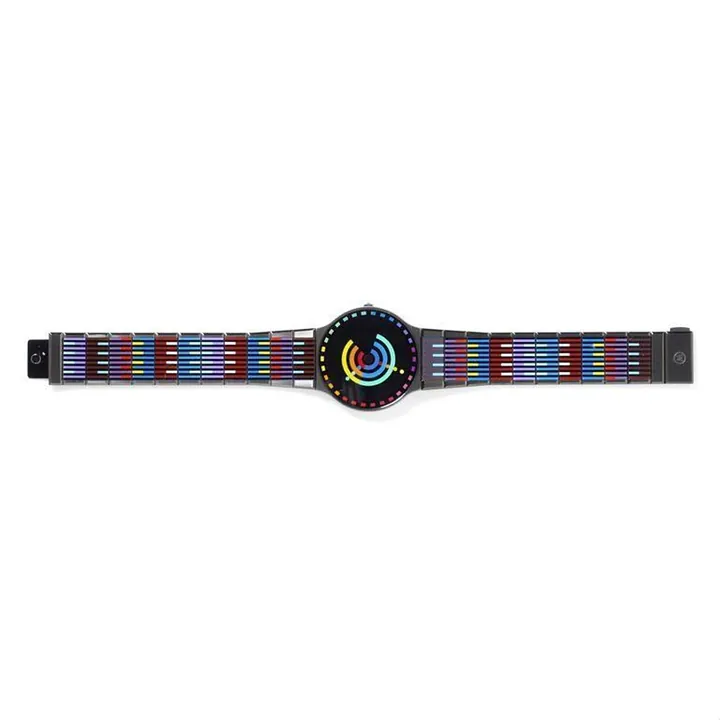
Wristwatches · c.1989
Steel, France and Switzerland, 1989; designed by Yaacov Agam (born 1928) for a limited edition by Movado
Victoria and Albert Museum, London

Wristwatches · 1931
Rolex 'Oyster Perpetual' rotor self-winding wrist-watch, lever escapement, in steel case with glass in back, Montres Rolex SA, Geneva, Switzerland, 1931
Science Museum Group, London

Wristwatches · 1900–1999
Wristwatch by Certina, Switzerland, 1900–1999
Nordic Museum Foundation
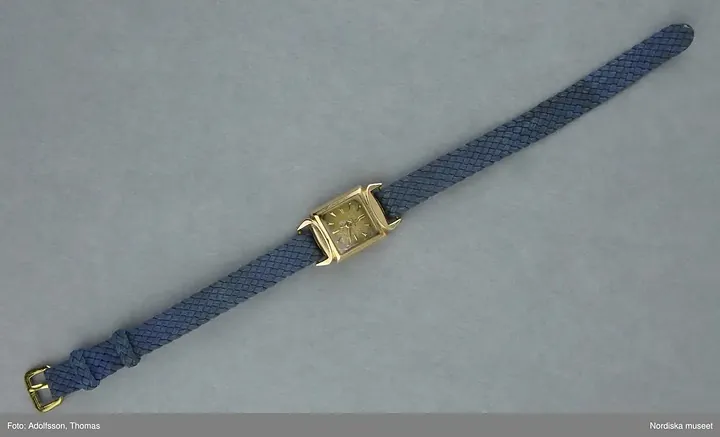
Wristwatches · 1900–1999
Wristwatch by Omega, Västerås, 1900–1999
Nordic Museum Foundation
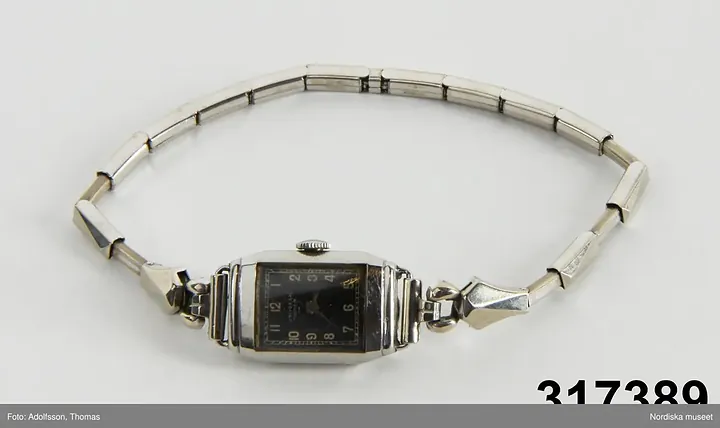
Wristwatches · 1900–1999
Wristwatch by Universal, Switzerland, 1900–1999
Nordic Museum Foundation