
Wristwatches · Wristwatch
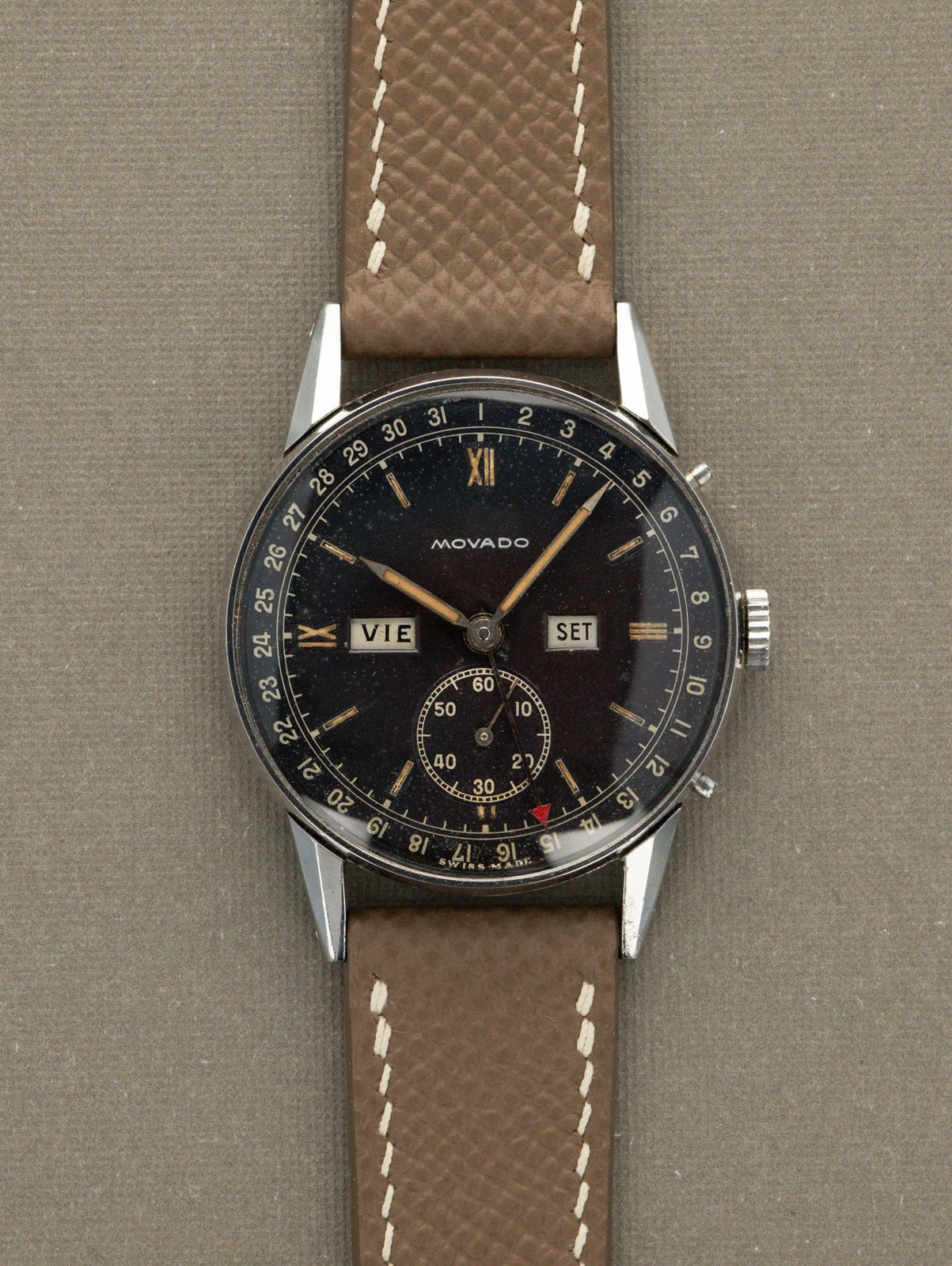
Movado Calendograf ref. 14776, Gloss Black Patina Dial
- Maker / attribution
- Movado (maker)
- Date
- c. 1950s
- Historical period
- Modern Mechanical Horology (1945 – 1969)
- Country of origin
- Switzerland
- Object type
- Wristwatch
- Dimensions
- Case 32 mm
- Stock no.
- OC3369
- Credit line
- Dealer listing, Oliver & Clarke (OC3369)
- Catalogue title (original)
- Movado Calendograf Ref. 14776 - Gloss Black Patina Dial Unpolished (English)
View the source record (dealer listing) ↗ (opens another website in a new tab)Suggest a correction
Record summary
Catalogued by Oliver & Clarke (dealer), United Kingdom (stock number OC3369), this is a wristwatch by Movado, made in Switzerland, dated c. 1950s. The Atlas places it in the Modern Mechanical Horology period (1945 – 1969) of its Wristwatches collection. Recorded dimensions: Case 32 mm. The record is illustrated with 6 photographs.
Assembled from the source record's structured fields. Dates and attributions are given as the source states them; where a field is missing the Atlas leaves it blank rather than estimating.
Catalogue description
Dealer description — Oliver & Clarke
While it may be hard to imagine based upon their product line today, Movado Factories (yes, that was the full name) once made watches that were beautifully designed, exceptionally-well made, and respected on a level that matched the very best manufacturers. Some of their more sought-after models include the M90 and M95 chronographs of the 1940s - 1970s, the Sub-Sea range, and both time-only and complicated pieces that utilized case designs shared with brands like Patek Philippe, Mido, and DOXA. The piece that we have here, a Calendograf, is one of Movado's many calendar and triple calendar models. Dating to circa the 1950s, it features a 32mm stainless steel case with long, faceted lugs, 'micro-pushers' on the right case profile, and a snapback caseback. The dial inside, once a deep glossy black, has begun to change to a deep, rich brown. Not quite 'tropical,' but on its way. The printing and the patinated indices are excellent and are complimented by a matching handset. The symmetrical layout of the dial is wonderful, with the Movado text on the top, day and month apertures flanking the center post, and a running seconds register on the lower half. Of course, this piece is powered by Movado's fantastic in-house Calibre 475 manually-wound movement. Both M95 and M90 chronographs have become extremely coveted by collectors, and its just a patter of time until collectors begin to realize the incredible value that these complicated calendar watches offer. In our opinion, and we know there are a handful of other dealers and enthusiasts out there that share this viewpoint, there are not many brands that get design this right. Simple as that.
Historical context
Modern Mechanical Horology (1945 – 1969)
Tool watches for divers, pilots and astronauts; electric watches anticipate the electronic age.
The classic era of the mechanical wristwatch: dive watches, chronographs for motor racing and space flight, GMT watches for jet travel, slim dress watches, automatic calendars, and the rise of Japanese manufacturers alongside Swiss, American, German and Soviet industries.
Read the period in the timelineMore wristwatches from this periodEarlier: Golden Age of Mechanical Watchmaking
Atlas type guide
Wristwatches
Bracelet watches were worn by women from the early nineteenth century — Breguet made one for Caroline Murat, Queen of Naples, in 1810–12 — but the wristwatch only became a man's instrument with military use and aviation in the early twentieth century. Between the World Wars it overtook the pocket watch; the 1920s and 1930s brought rectangular Art Deco cases, water-resistant cases and the first automatic winding systems.
After 1945 the wristwatch became a carrier of identity — dress watches, sports and dive watches, chronographs, calendars — produced by Swiss, American, Japanese, German, Soviet and Chinese industries. The quartz revolution after 1969 and the mechanical renaissance since the 1990s, including the rise of independent watchmakers, complete the story.
What to look for
- The reference number (between the lugs or inside the case back) and serial number, the starting point for dating.
- The calibre: its maker and number are often stamped under the dial or on the bridge.
- Originality of dial, hands and crown — refinished ('redial') dials are common.
- Case material marks: 18K/750, 14K/585, stainless steel, gold-filled, plated.
Dating clues
- Wire-lug cases: before c. 1925.
- Water-resistant screw-down cases: from 1926.
- Quartz movements: from 1969; sapphire crystals widespread after c. 1980.
General guidance written by the Atlas editors about this kind of object. It is not a statement about this particular piece; for that, rely on the source record above and on physical examination.
Related records
Pocket Watches · c. 1960s
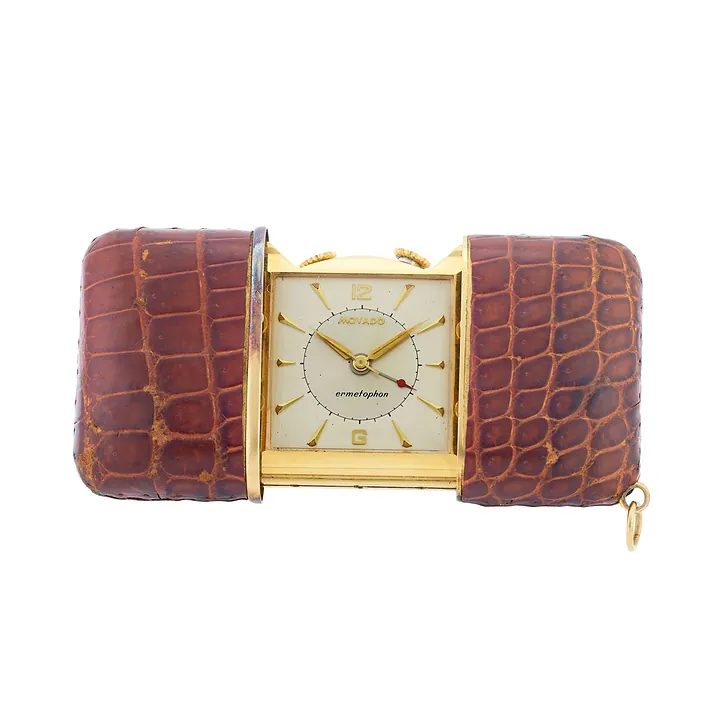
Movado Ermetophone, c. 1960s
Antiquorum auction archive, Geneva
Wristwatches · c. 1920s
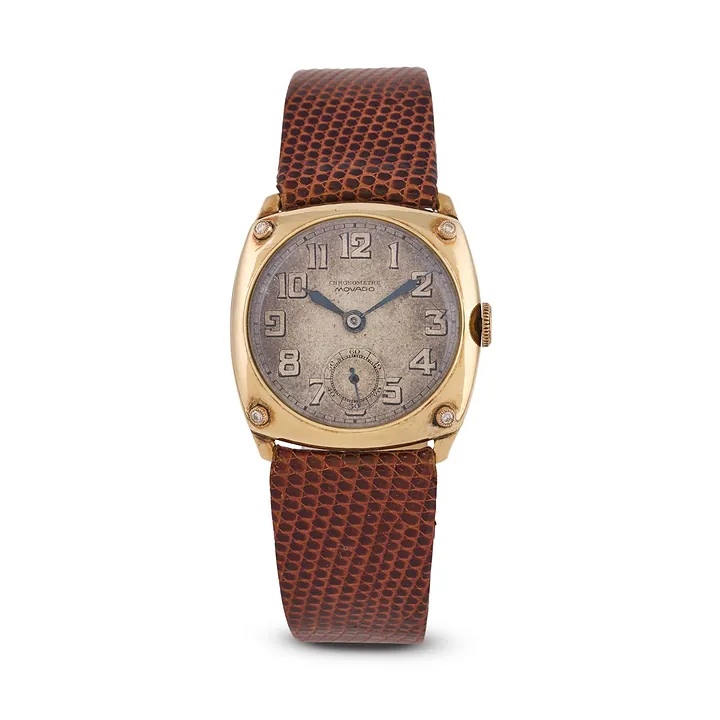
Movado Chronometre, ref. 41536, c. 1920s
Antiquorum auction archive, Geneva
Wristwatches · c. 1930s
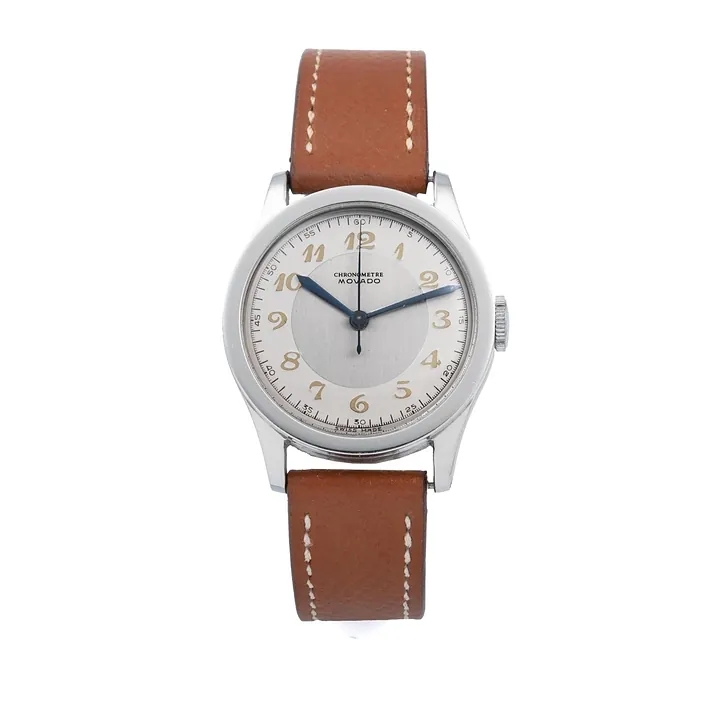
Movado "calatrava", ref. 17726, c. 1930s
Antiquorum auction archive, Geneva
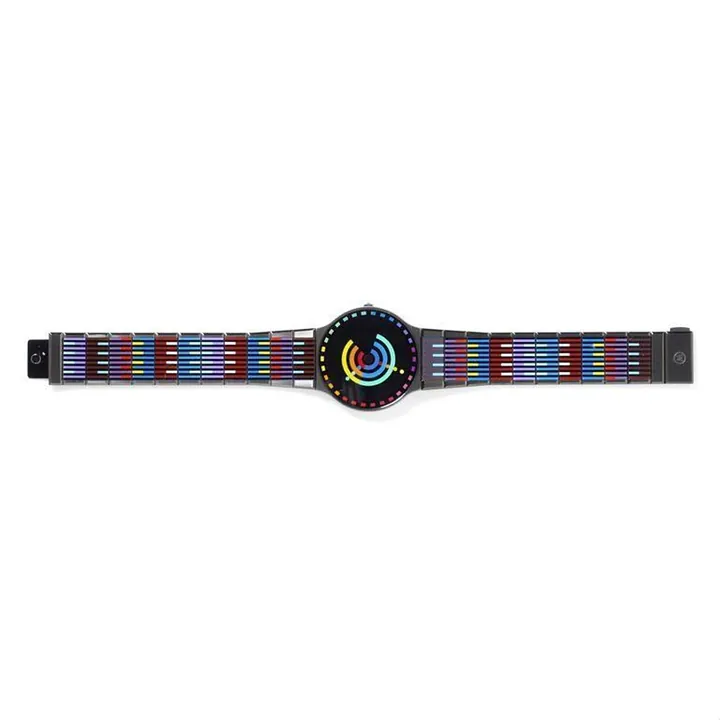
Wristwatches · c.1989
Steel, France and Switzerland, 1989; designed by Yaacov Agam (born 1928) for a limited edition by Movado
Victoria and Albert Museum, London

Wristwatches · 1945
Wristwatch by Eterna, 1945
Museum Rotterdam

Wristwatches · c. 1945
Breitling Premier, ref. 790, c. 1945
Antiquorum auction archive, Geneva

Wristwatches · c. 1945
Universal Genève Uni-Compax, ref. 22492, c. 1945
Antiquorum auction archive, Geneva

Wristwatches · c. 1950s
Baume & Mercier wristwatch, c. 1950s
Antiquorum auction archive, Geneva