Clocks · Longcase clock
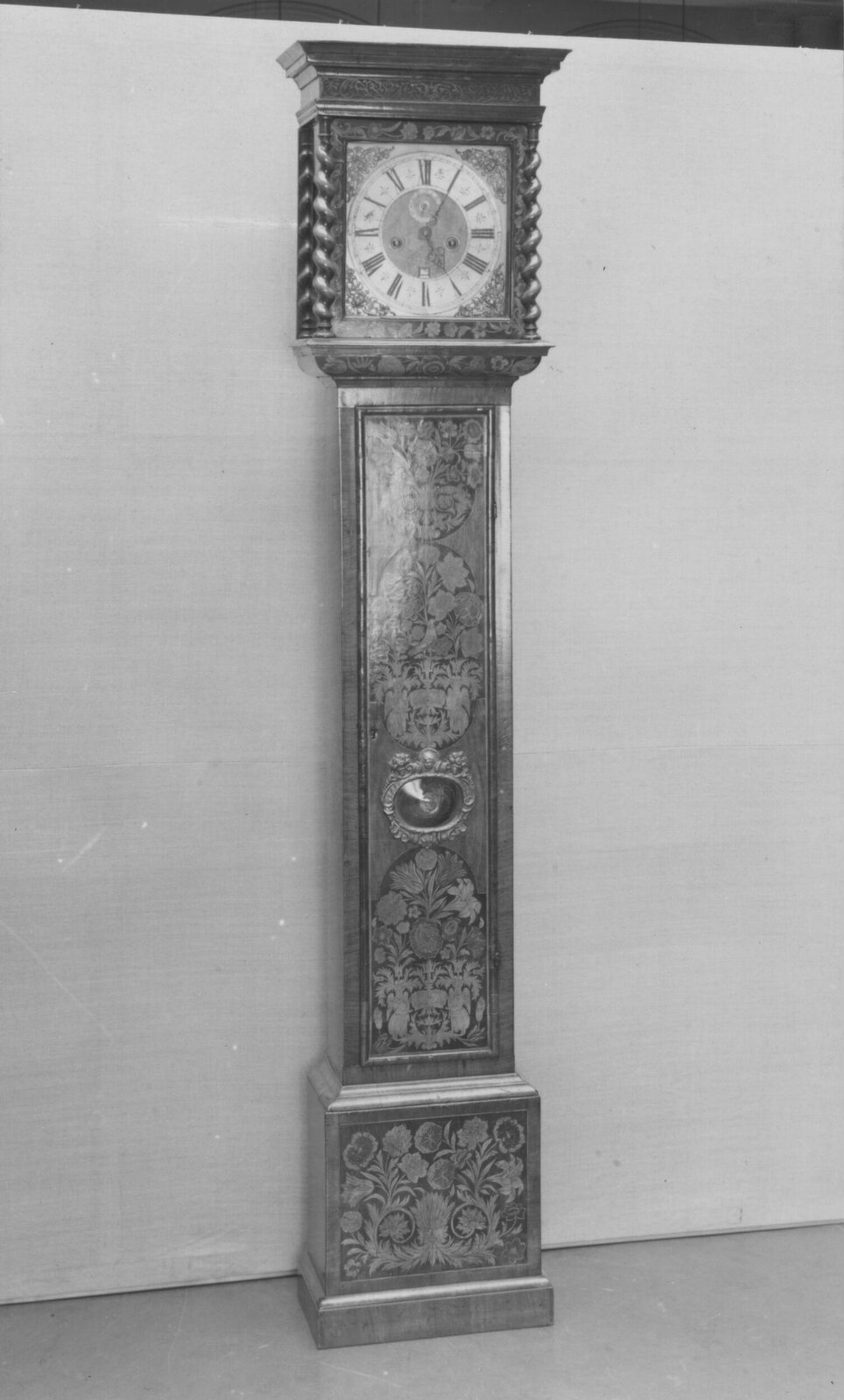
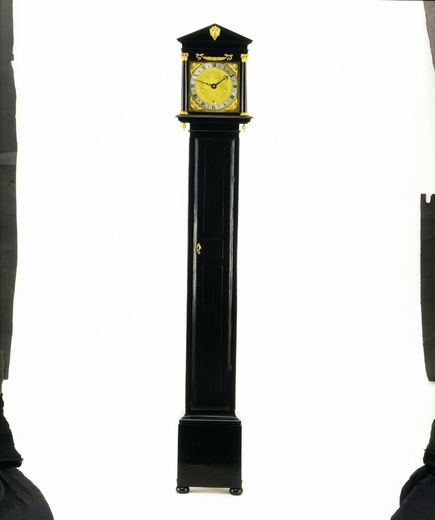
MONTH-GOING LONG CASE CLOCK Marquetry of walnut and other woods Inscribed ‘Edward Speakman Londoni fecit’, made about 1700
- Maker / attribution
- Edward Speakman (made)
- Date
- c.1700
- Historical period
- Early Modern Horology (1600 – 1750)
- Country of origin
- England
- Place
- London
- Object type
- Longcase clock
- Materials / technique
- walnut, brass
- Dimensions
- Height: 205.7 cm; Width: 45 cm; Depth: 24.5 cm; Weight: 8.95 kg (w.14:6 Lead weight 10/10/2025 NH); Weight: 8.95 kg (w.14:7 Lead weight 10/10/2025 NH)
- Holding institution
- Victoria and Albert Museum, London
- Accession / object no.
- W.14:2-1956
- Credit line
- Bequeathed by Miss E. Rothwell
Record summary
Held and catalogued by Victoria and Albert Museum, London (object number W.14:2-1956), this is a longcase clock by Edward Speakman, made in London, England, dated c.1700. The Atlas places it in the Early Modern Horology period (1600 – 1750) of its Clocks collection. Materials and techniques recorded by the source: walnut, brass. Recorded dimensions: Height: 205.7 cm; Width: 45 cm; Depth: 24.5 cm; Weight: 8.95 kg (w.14:6 Lead weight 10/10/2025 NH); Weight: 8.95 kg (w.14:7 Lead weight 10/10/2025 NH). The record is illustrated with 3 photographs.
Assembled from the source record's structured fields. Dates and attributions are given as the source states them; where a field is missing the Atlas leaves it blank rather than estimating.
Catalogue description
V&A — Summary
Edward Speakman was apprenticed to his father William in 1682, and became free of the Clockmakers’ Company in 1691, working until 1711 in Newgate Street in the City of London. His father became Master of the Clockmakers’ Company in 1701. The lenticle frame on this clock is unusually ornate, cast in brass and showing cornucopiae and a cherub’s head, while the lenticle itself is made from bottle glass. A “bull’s-eye” made of bottle glass is a feature found only on some early long case clocks. The spiral columns on either side of the clock face are also worthy of note, as they turn in opposite directions so as to complement each other. Spiral columns are also usually only found on clocks made before 1700. The clock has an anchor escapement. The brass and steel weight driven two train movement has hour striking controlled by an external countwheel. Three names engraved on the dial plate ’John Andrew Thos Wheeler and John Benson’ may record some kind of earlier collaboration with the maker. Thomas Wheeler was Master of the Clockmakers’ Company in 1684 and died in 1694. John Andrews, free of the Clockmakers’ Company in 1688, worked in Leadenhall Street. In 1662 one John Benson was recorded as a ‘Graver’ in a survey conducted by the Clockmakers’ Company.
V&A — Physical description
Dial: Nominally eleven inch square. Brass dial plate with ringed winding holes and seconds aperture, matted centre with curly engraving around calendar aperture behind which is silvered calendar ring. Cherubs head spandrels screwed to corners of dial plate, silvered chapter ring and subsidiary seconds ring pinned at back of dial plate. Minute ring set in from edge of chapter ring by a scale having Arabic five minute numerals, the double figures being split either side of an extended five minute stroke. No half quarter marks. Roman hour numerals. Quarter hour divisions with half hour marks of arrow heads and semi-circles. Signed between VII and V on chapter ring Edw Speakman Londini fecit . Seconds ring with its scale of Arabic five seconds numerals mirrors chapter ring with extended strokes at five second intervals, but is sufficiently small in diameter to expose a portion of matted dial centre between bottom of ring and central aperture of the dial. Concealed by the chapter ring adjacent to the calendar aperture, the dial plate is engraved: John Andrews Thó Weeler John Benson . Dial attached to front plate by four dial feet pinned to movement. Hands: Pierced and carved steel minute and hour hands, small seconds hand with slight chamfer to outside surface. Movement: Month duration brass and steel, weight driven, two train movement. Hour striking on bell controlled by outside countwheel mounted external to backplate and driven via a brass pinion mounted on an extension of the striking pin wheel. Going train with recoil anchor escapement. Five pillar movement, each slender pillar having fins and semi-circular central knop, being riveted to backplate, pinned at front. Three pillars are located towards the top of movement, two at the bottom. Collets where used to mount wheels on arbors, of semi-circular profile; arbors swell towards centres, excepting the striking pin wheel, itself having a parallel arbor and distinctive pulley-shaped collet. Where visible without dismantling, scribe lines present on wheel faces. Particularly noticeable on striking side is tendency of gear teeth pitch to become significantly finer higher up the train. Pallets, embracing 8½ teeth, are of broad appearance with noticeable pads and are mounted on pallet arbor with a semi-circular collet. Unused holes on backcock. Vacant holes on frontplate by present pallet arbor hole. Plugged holes, some threaded, evident on backplate and backcock. Additional vacant holes by fly arbor and calendar post. Hour wheel bridge of lenticular shape coming to a point at each foot. Description and notes by Francis Brodie, c. 2008
V&A — Object history
Edward Speakman longcase clock Bequeathed by Miss E Rothwell formerly of Stone House Old Barn, Halsted, Knockholt, Kent. She was the daughter of the painter S Rothwell, who was a close friend of J Burgess. Notes from R.P. 2610 3 September 1956 Notification of Miss Rothwell's bequest of objects formerly in the collection of Wm Edwardes Miller includes "1) Grandfather clock - inlaid - by Edward Speakman". Miller died in 1940; he is described in a letter dated 17/5/40 from Miss Rothwell to Mr Bedford as "my wonderful guardian & companion". Miller was a F.S.A. 15 September 1956 memo, Hayward to the Director reports that "the clock by Edward Speakman, which has a walnut case inlaid with lforal marquetry of about 1700, is worthy of acceptance". Comments : Dial: Its size, being not twelve inches, in combination with the comparatively narrow outer Arabic five minute scale with its restrained numerals and extended divisions would suggest a date towards the end of the 17th century. That the seconds ring does not occupy all the available matted dial centre is another earlier detail; the start of the 18th century is associated with enlarging seconds rings. Of considerable interest are the engraved names on the dial plate, normally concealed under the chapter ring. It is not unknown for names to be concealed on the dial, sometimes under attached plaques, etc. and in this case may be a record of some kind of collaboration. Hands: The style of the hands, the surface profiling and the extent of the piercing of the minute hand are all indicative of later 17th century practice. Movement: Characteristic details typical of this period are shape of the pillars, collets and the scribe lines on wheels. That the pitch of the gears becomes finer up the train is usually a feature of earlier work; development and simplification in later manufacture meant that fewer gear cutter profiles were used in forming the teeth. Alternatively, the design of the month going train in the Speakman could account for this particular feature. The striking pin wheel arbor and collet are questionable owing to their profiles but it is possible that any alterations to them are old. The shape of the pallets, with their broad arms and distinct pads are more typical of 19th or 20th century work, and taken in combination with the vacant holes referred to above are evidence that the present pallets are a later replacement, now at a lower height than the originals. Concealed names: Thomas Wheeler was apprenticed to Nicholas Coxeter (Master 1671) in 1647, becoming free of the Clockmakers' Company in 1647 (C.E. Atkins, "Register of Apprentices of the Worshipful Company of Clockmakers", 1931). Wheeler became a Steward in 1670, Renter Warden 1680, Upper Warden 1682 and Master of the Clockmakers' Company in 1684 ("Freemen of the Worshipful Company of Clockmakers", 1984, Pub. G. Daniels). Died 1694 (G.H. Baillie, "Watchmakers and Clockmakers of the World", 1982, N.A.G. Press, London). John Andrews was apprenticed to Nathaniel Pyne in 1680 then turned over to Samuel Staunton (C.E. Atkins, "Register of Apprentices of the Worshipful Company of Clockmakers", 1931). Pyne was apprenticed to Thomas Wheeler in 1667 (C.E. Atkins, "Register of Apprentices of the Worshipful Company of Clockmakers", 1931). Andrews became free of the Clockmakers' Company in 1688 ("Freemen of the Worshipful Company of Clockmakers", 1984, Pub. G. Daniels). Leadenhall Street (G.H. Baillie, "Watchmakers and Clockmakers of the World", 1982, N.A.G. Press, London). John Benson was apprenticed to Richard Masterson (subscriber for incorporation of the Clockmakers' Company) in 1652, becoming free in 1669 (C.E. Atkins, "Register of Apprentices of the Worshipful Company of Clockmakers", 1931; G.H. Baillie, "Watchmakers and Clockmakers of the World", 1982, N.A.G. Press, London; "Freemen of the Worshipful Company of Clockmakers", 1984, Pub. G. Daniels). In the 1662 Clockmakers' Company survey, John Benson was recorded as a Graver, but no address given (H. Clarke (compiler), "...list of all the clockmakers...in the City of London", Dated 26 June 1662, Compiled ca. 1813, Guildhall manuscript Ms 3974). Description and notes by Francis Brodie, c. 2008
Historical context
Early Modern Horology (1600 – 1750)
Huygens' pendulum and balance spring transform accuracy; English makers develop the anchor and deadbeat escapements.
Huygens's pendulum (1656–57) improved clock accuracy from about a quarter of an hour to under a minute a day. The anchor escapement (c. 1670) and the long seconds pendulum created the longcase clock; London makers such as Fromanteel, Knibb, Tompion and Quare led European clockmaking, and French makers created the Boulle pendule.
Read the period in the timelineMore clocks from this periodEarlier: Renaissance Horology
Atlas type guide
Longcase (tall-case or grandfather) clocks
The longcase clock was born from two seventeenth-century innovations: Christiaan Huygens's pendulum (1656–57) and the anchor escapement (c. 1670). A long seconds pendulum, nearly a metre long, swings with a small arc, and enclosing it together with the driving weights in a tall wooden case protected the mechanism and created a new piece of furniture. London makers such as Ahasuerus Fromanteel, Thomas Tompion and Joseph Knibb set the pattern.
By the eighteenth century longcase clocks were made throughout Britain, the Netherlands, Scandinavia (the Swedish Mora clock), France (the Comtoise from the Franche-Comté), Germany and colonial America. Eight-day movements with two weights became standard in better clocks; thirty-hour clocks with one weight and a rope or chain were cheaper alternatives.
What to look for
- Winding holes in the dial: two (eight-day, going and striking) or none (thirty-hour, pulled up by a chain).
- Brass dials with applied chapter rings (earlier) versus painted iron 'white' dials (after c. 1770 in Britain).
- Moon-phase arches, date apertures, seconds dials and maker's name on the dial.
- Case woods and style: ebonised, walnut marquetry, lacquer, oak or mahogany; regional styles from London, Lancashire, Scotland or America.
- Whether the movement and dial match the case — 'marriages' are common.
Dating clues
- Square brass dials suggest c. 1670–1720; arched brass dials c. 1715–1790.
- Painted (white) dials were made by Birmingham dial-makers from about 1772.
- Comtoise clocks with repoussé pendulums are mostly nineteenth century.
General guidance written by the Atlas editors about this kind of object. It is not a statement about this particular piece; for that, rely on the source record above and on physical examination.
Read next:Anchor escapement
Related records
Clocks · 1598-1603
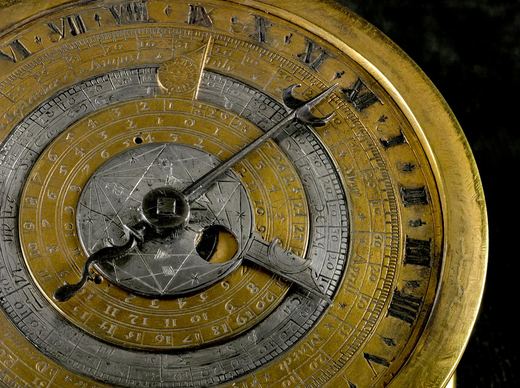
Circular table-clock with calendrical and lunar indications made by Nicholas Vallin in London between 1598 and 1603.
Science Museum Group, London
Clocks · 1611
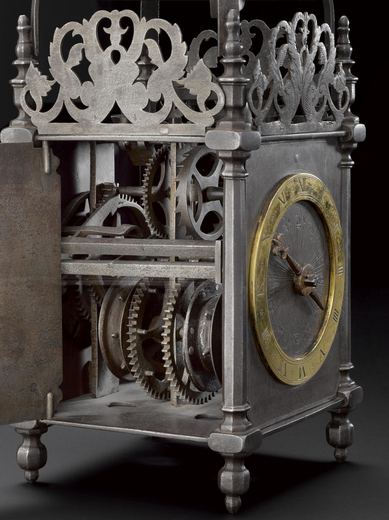
English iron lantern clock, with wheel balance, by John Holloway, Market Lavington, Wiltshire, England, 1611.
Science Museum Group, London
Clocks · 1630
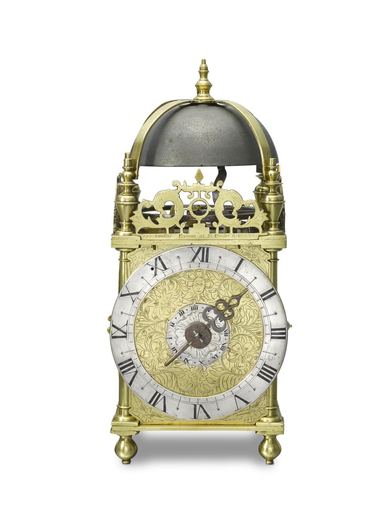
Lantern clock by Forman, Francis, England, 1630
Science Museum Group, London
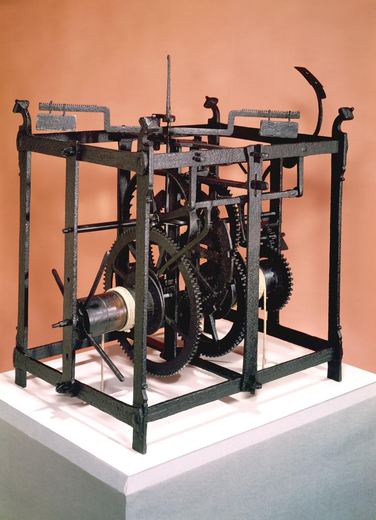
Clocks · 1632-1640
Turret clock, England, 1632-1640
Science Museum Group, London
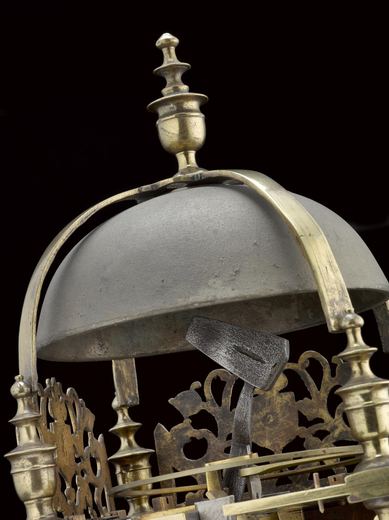
Clocks · 1645-1655
Balance-wheel brass lantern clock, with two driving weights and one counterweight, by Thomas Knifton, Cross Keys, Lothbury, London, England, 1645-1655.
Science Museum Group, London
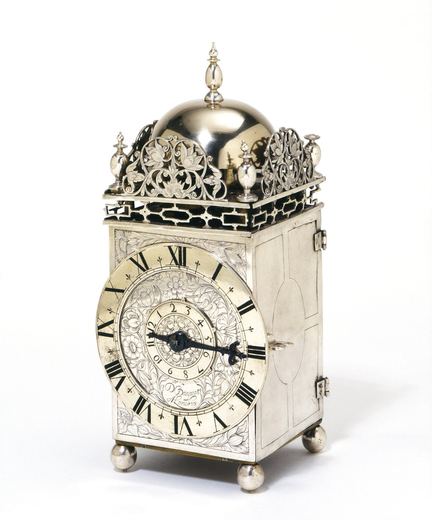
Clocks · ca. 1650
Lantern alarm clock, silver, by David Bouquet, circa 1650
Victoria and Albert Museum, London
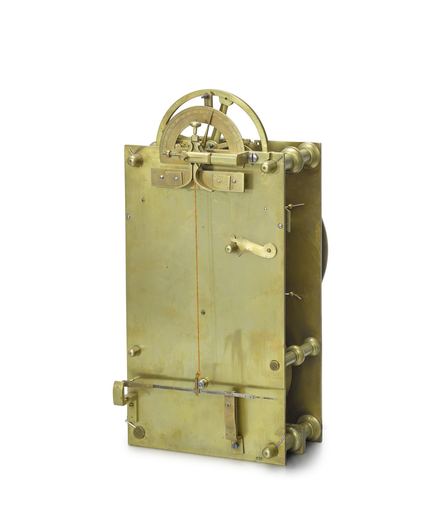
Clocks · 1650-1660
Lantern clock by Closon, Peter, England, 1650-1660
Science Museum Group, London
Clocks · ca. 1660
Longcase clock, ca. 1660, English, made by Ahasuerus Fromanteel
Victoria and Albert Museum, London