
Wristwatches · Wristwatch
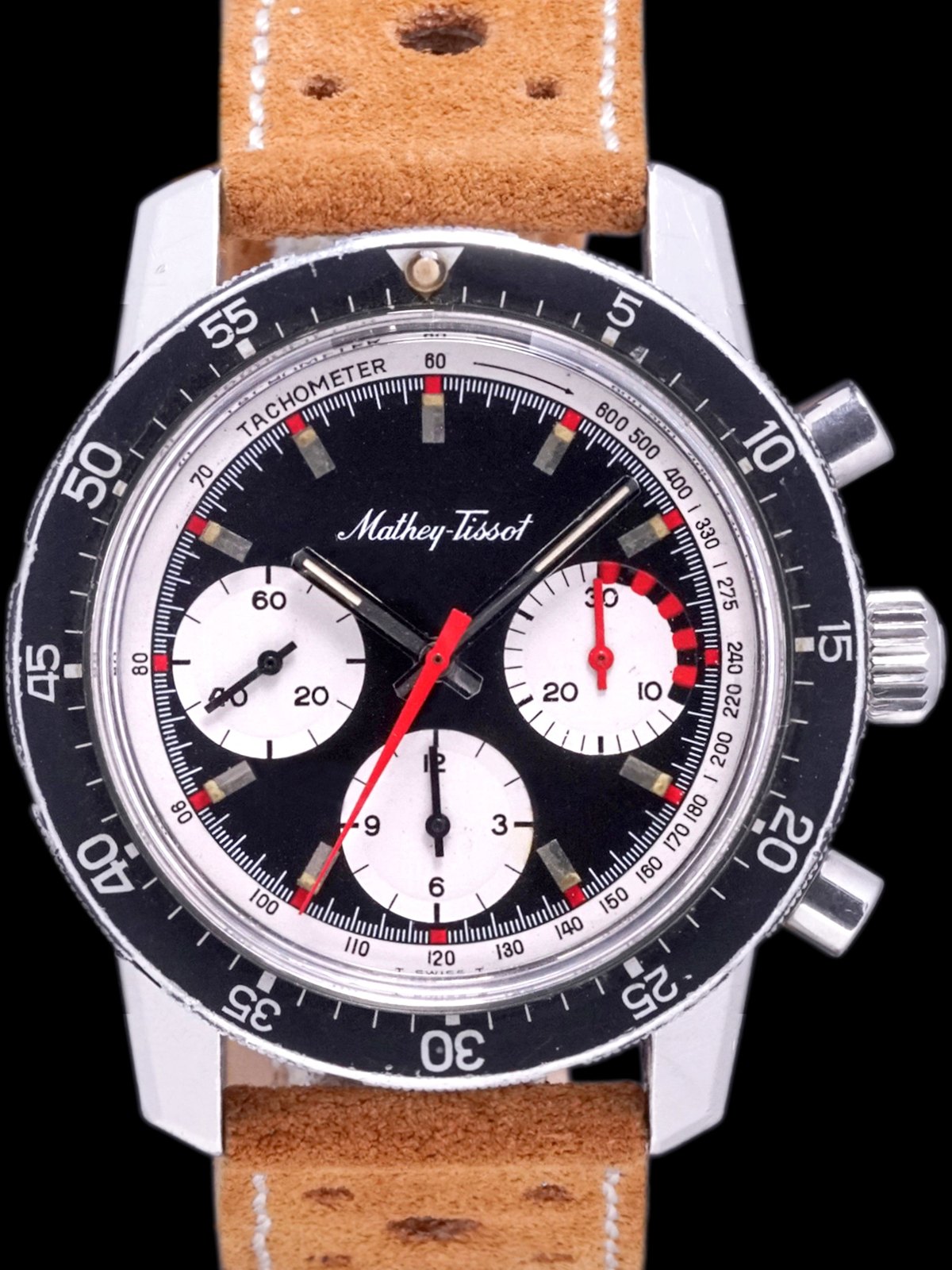
Mathey-Tissot Chronograph "Exotic Dial" Valjoux Cal. 726, 1970
- Maker / attribution
- Mathey-Tissot (maker)
- Date
- 1970
- Historical period
- Quartz Revolution (1969 – 1990)
- Country of origin
- Unrecorded in source
- Object type
- Wristwatch
- Stock no.
- MTHTST726
- Credit line
- Dealer listing, Craft & Tailored (MTHTST726)
- Catalogue title (original)
- 1970 Mathey-Tissot Chronograph "Exotic Dial" Valjoux Cal. 726 (English)
View the source record (dealer listing) ↗ (opens another website in a new tab)Suggest a correction
Record summary
Catalogued by Craft & Tailored (dealer), Los Angeles (stock number MTHTST726), this is a wristwatch by Mathey-Tissot, dated 1970. The Atlas places it in the Quartz Revolution period (1969 – 1990) of its Wristwatches collection. The record is illustrated with 6 photographs.
Assembled from the source record's structured fields. Dates and attributions are given as the source states them; where a field is missing the Atlas leaves it blank rather than estimating.
Catalogue description
Dealer description — Craft & Tailored
Mathey-Tissot was founded in Les Ponts de Martel, Switzerland in the year 1886 and specialized in manufacturing repeater and chronograph movements. Throughout the brand's early years Mathey-Tissot was contracted to produce wristwatches for the British military and then later for the United States military in WWI and again for both nations in WWII. It is believed amongst collectors that the manufacturer of the famous Breguet Type XX military pilot chronograph was actually Mathey-Tissot. The Mathey-Tissot chronograph featuring the Valjoux cal. 726 is one of the most notable and sought-after watches produced by the brand. Featuring a Singer manufactured "exotic dial", reminiscent of the Rolex Paul Newman Daytonas of the era, with a matte black center dial, white sub-dials and "tachometer" scale on the outer track, and red accents that jump off the dial. The case is very similar to the Heuer compression cases manufactured by EPSA during the same era, though the Mathey-Tissot cases feature a screw-back case design. The Valjoux cal. 726 is a beautiful workhorse chronograph movement that was an improved design of the well-known Valjoux 72. Stock # MTHTST726 Brand Mathey-Tissot Style Chronograph Model Cal. 726 Serial 33XXXX Size Men's Material Stainless Steel Dial Matte Black "Reverse Panda" W/ Red Millimeters 40 Strap 2pc Handmade Leather Strap CASE & BRACELET The impressive case is believed to remain unpolished featuring strong factory bevels, chamfers, and finishing with honest signs of use. The original bi-directional bezel is in excellent original condition, retaining its tritium pearl at the 12 o'clock position and has achieved a charming dark grey fade. The case retains its original pump-pushers and Mathey-Tissot signed crown. The case back retains all of its factory markings in deep and crisp condition, the case back does exhibit some tool marks and scratches from a previous service. The watch will come supplied on a 2pc handmade leather strap. DIAL & HANDS The exotic matte black "reverse panda" Singer dial is exceptionally well preserved, showing no blemishes or major signs of age. The printed text all remains intact and in excellent condition. The white sub-dials remain bright with only minimal signs of age. The tritium topped markers have achieved a handsome golden coloration and exhibit no degradation when inspected under U.V. light. The original tritium hands have aged slightly lighter than the dial and remain in superb original condition, showing no degradation under U.V. light inspection. ACCESSORIES None. The watch is keeping time and functioning perfectly, previous service history is unknown.
Historical context
Quartz Revolution (1969 – 1990)
Seiko's Astron begins mass quartz timekeeping; traditional industries contract sharply.
Quartz and digital watches transformed the market after 1969. Swiss employment collapsed, Japanese and Hong Kong production soared, and the Swatch (1983) helped the Swiss industry recover; mechanical watches survived as luxury goods.
Read the period in the timelineMore wristwatches from this periodEarlier: Modern Mechanical Horology
Atlas type guide
Chronographs and split-seconds watches
A chronograph is a watch with an additional seconds hand that can be started, stopped and returned to zero independently of the timekeeping. Louis Moinet built an early example in 1816 and Nicolas Rieussec a recording 'chronographe' in 1821; Adolphe Nicole's heart-shaped reset cam (patented 1862) made the modern return-to-zero possible. Split-seconds (rattrapante) chronographs add a second hand that can be stopped for intermediate times; flyback chronographs restart instantly.
Chronographs were essential tools for doctors (pulsometer scales), artillery (telemeter), engineers and sport. In wristwatches, Valjoux, Venus, Lemania and later the automatic chronographs of 1969 (Zenith El Primero, the Chronomatic Calibre 11 group and Seiko 6139) are milestones.
What to look for
- Push-pieces on the case band or a single button in the crown (monopusher).
- Subsidiary registers for minutes and hours; tachymeter, telemeter or pulsometer scales.
- Column wheel versus cam control visible in the movement.
- Calibre markings of specialist makers (Valjoux, Lemania, Venus, Landeron).
Dating clues
- Pocket chronographs with heart cam reset: after 1862.
- Wrist chronographs: from c. 1910; two-button designs from the 1930s.
- Automatic chronographs: from 1969.
General guidance written by the Atlas editors about this kind of object. It is not a statement about this particular piece; for that, rely on the source record above and on physical examination.
Read next:Flyback chronographChronograph
Related records
Wristwatches · c. 1940s
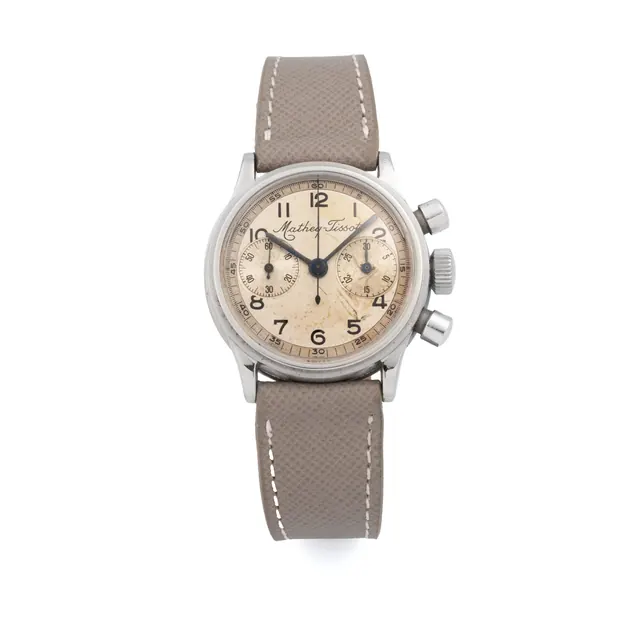
Mathey-Tissot wristwatch, Snap-Back Case, circa 1940's
Antiquorum auction archive, Geneva
Wristwatches · c. 1965
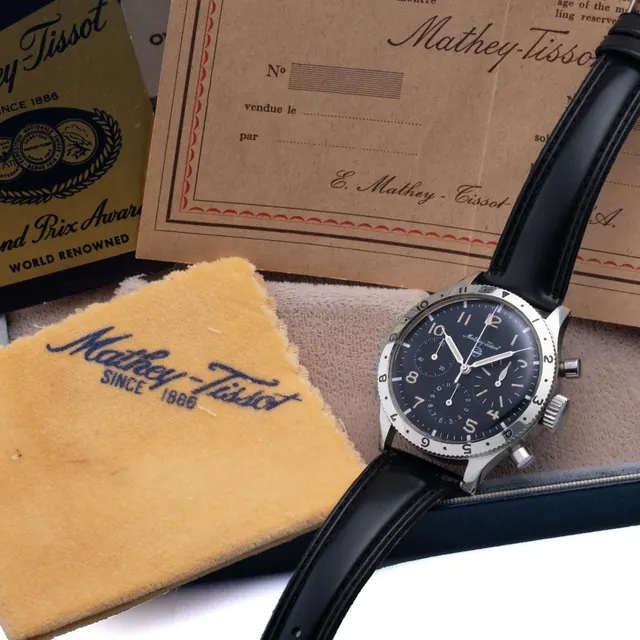
Mathey-Tissot wristwatch, Type Xx 3 Counters, circa 1965
Antiquorum auction archive, Geneva

Wristwatches · 1970
Wristwatch by Heno, Switzerland, 1970
Museum Rotterdam
Wristwatches · 1970s
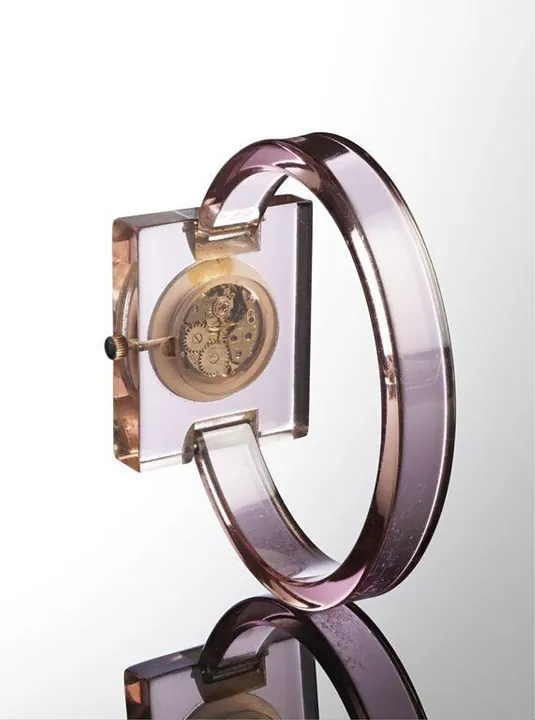
Wristwatch, plastic, by Gucci; Italy, 1970s.
Victoria and Albert Museum, London
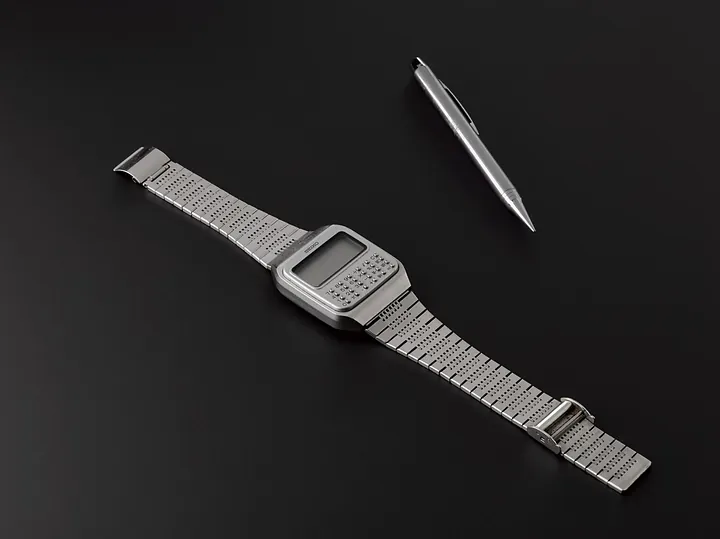
Wristwatches · 1978
Calculator wristwatch by Suwa Seikosha Co. Limited, Japan, 1978
Science Museum Group, London
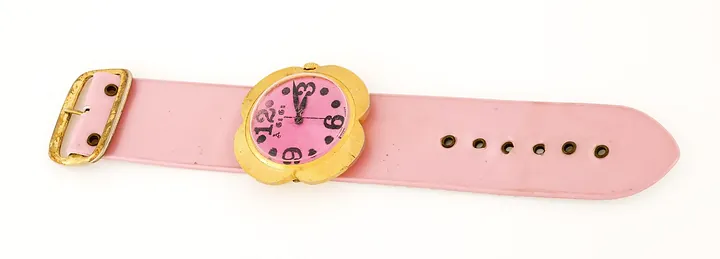
Wristwatches · 1980
Wristwatch, 1980 (no. 71413)
Museum Rotterdam
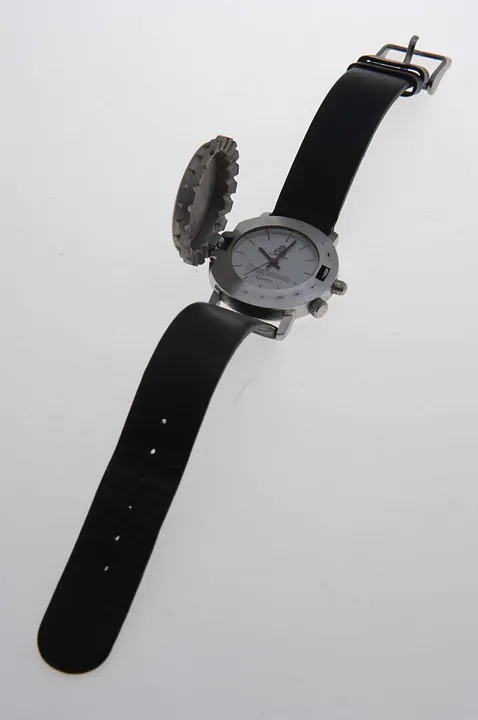
Wristwatches · 1980
Wristwatch, 1980 (no. 91477)
Museum Rotterdam
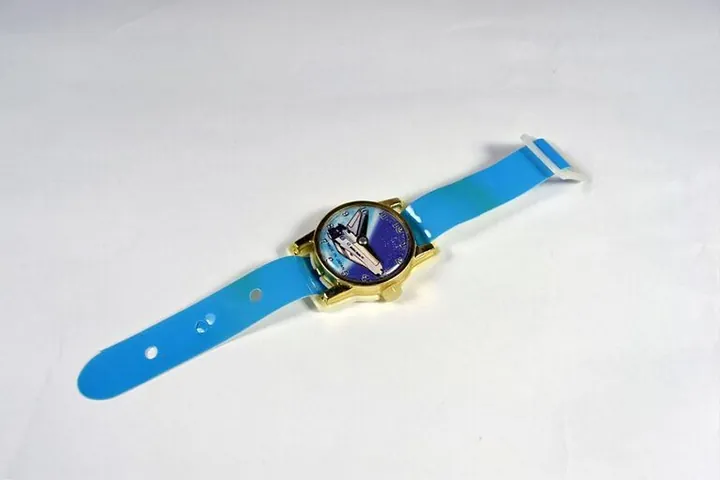
Wristwatches · 1980–1982
Wristwatch, Space Shuttle; plastic, Japan, 1970-1979?
Victoria and Albert Museum, London