Clocks · Clock
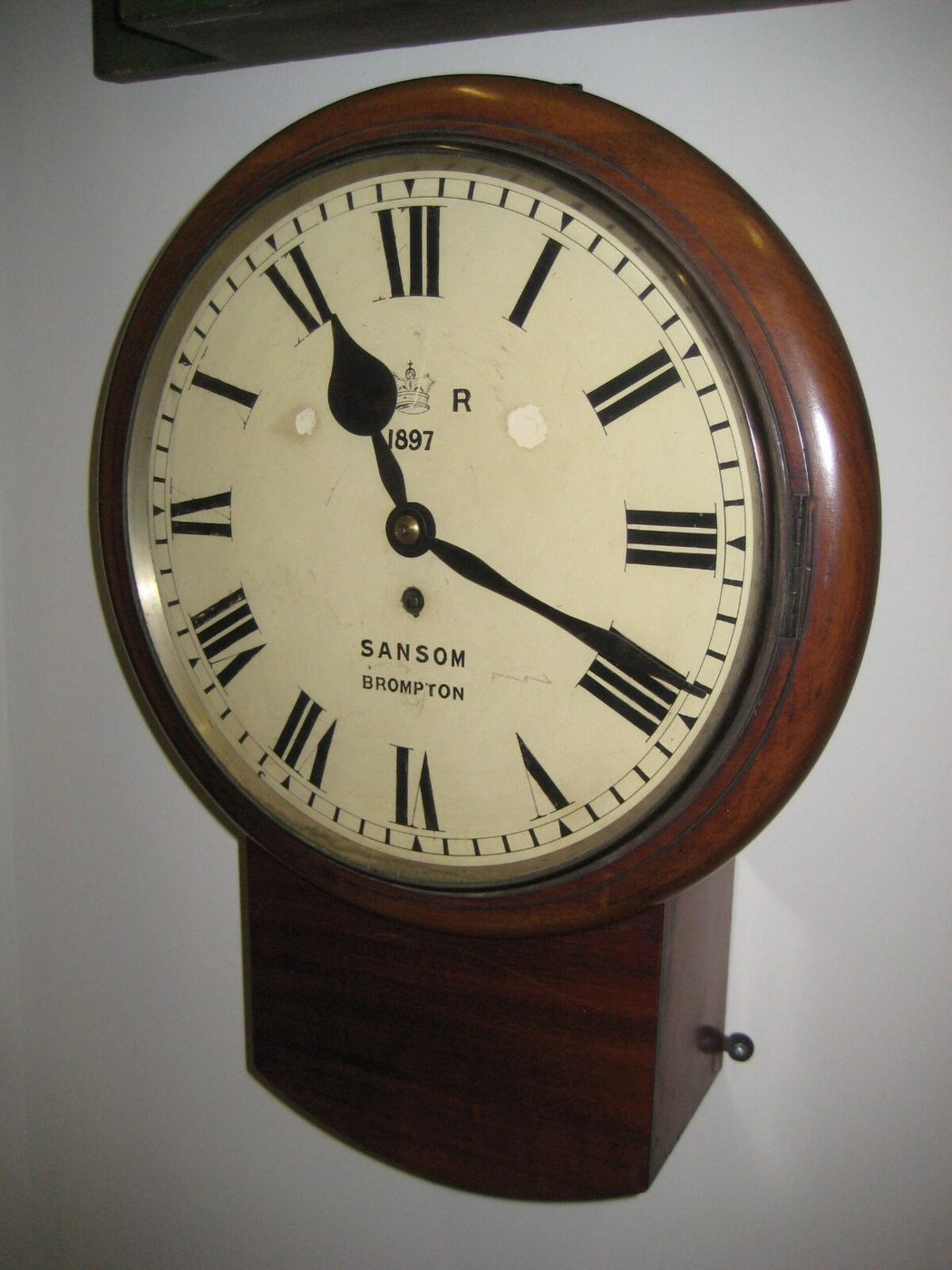
Mahogany wall clock with enamel dial, from Furniture offices, part of the early furnishings of the V&A; made 1890-1900, probably in London.
- Maker / attribution
- C. Sansom (maker)
- Date
- 1890-1900
- Historical period
- Industrial Revolution (1850 – 1900)
- Country of origin
- England
- Place
- London
- Object type
- Clock
- Materials / technique
- Mahogany and enamel with brass movement
- Dimensions
- Height: 50.5 cm; Width: 37 cm; Depth: 14.5 cm
- Holding institution
- Victoria and Albert Museum, London
- Accession / object no.
- W.2-2003
Record summary
Held and catalogued by Victoria and Albert Museum, London (object number W.2-2003), this is a clock by C. Sansom, made in London, England, dated 1890-1900. The Atlas places it in the Industrial Revolution period (1850 – 1900) of its Clocks collection. Materials and techniques recorded by the source: Mahogany and enamel with brass movement. Recorded dimensions: Height: 50.5 cm; Width: 37 cm; Depth: 14.5 cm. The record is illustrated with 1 photograph.
Assembled from the source record's structured fields. Dates and attributions are given as the source states them; where a field is missing the Atlas leaves it blank rather than estimating.
Catalogue description
V&A — Summary
This is a typical 19th-century office wall-clock, purchased for use in the offices of the Victoria and Albert Museum (known at that time as the South Kensington Museum). Above the hands on the clock face is a crown with the initials VR (Victoria Regina) and the date 1897, indicating that the clock was made for official government use during the reign of Queen Victoria. Below the winding hole is the name 'SANSOM, BROMPTON', a local clockmaking firm which supplied several clocks to the Museum. The clock hung in the Chief Warder's office in the 1950s and was later used in the offices of the Department of Furniture and Woodwork. This and other selected items of museum furniture have been taken into the permanent collections as illustrations of the kind of plain, good quality furnishings supplied for public offices during the reign of Queen Victoria.
V&A — Physical description
Wall-clock with cream enamel dial backing on to and partially hiding a small rectangular mahogany clock case with a curved base. The dial has Roman numerals and two black hands. Above the hands is a crown with the initials 'VR' and the date 1897. Below the winding hole is written 'SANSOM, BROMPTON'. On either side of the crown are circular holes in the enamel, touched in with white paint. There is an iron loop at the top of the case and a mirror plate either side of the case for hanging the clock on the wall. There is a door in the right-hand side and a trap door in the base of the case.
V&A — Object history
This clock hung on the wall of the Furniture Department offices until the offices moved to merge with Textiles and Dress in 2003. Presumed to be an early Museum furnishing.
V&A — Production note
Marked with name
Inscriptions & marks
1079 V&A Museum Mr................ 18-4.23 underneath: 3 labels stuck one on top of another: top one: V&A Museum Chief Warders Office w/o 5985 15.6.53 69 (within circle)
Historical context
Industrial Revolution (1850 – 1900)
American interchangeable-parts manufacture; railroad time standards; Swiss and German factory systems.
Factory production transformed the clock into an everyday object. American makers (Seth Thomas, Ansonia, Waterbury) and German factories (Junghans, Gustav Becker, Lenzkirch) sold millions of shelf, wall and alarm clocks worldwide; France produced standardised Paris movements and carriage clocks; electric time distribution began.
Read the period in the timelineMore clocks from this periodEarlier: Precision & Scientific Horology
Atlas type guide
Regulators, wall and Vienna clocks
A regulator is a precision pendulum clock used as a time standard in observatories, workshops and railway offices. Typical features are a deadbeat or Graham escapement, a temperature-compensated pendulum (mercury jar, gridiron or later invar), maintaining power and a regulator dial that separates hours, minutes and seconds. George Graham's deadbeat escapement (c. 1715) and his mercury pendulum, together with Harrison's gridiron, set the pattern for two centuries.
Wall clocks span a much wider range: the elegant Viennese Laterndluhr and Dachluhr of the Biedermeier period, the Dutch stoelklok and staartklok, English 'dial' clocks used in schools, offices and railway stations, and mass-produced spring and weight wall clocks from Germany (Gustav Becker, Junghans, Kienzle) and America.
What to look for
- Deadbeat escapement and compensated pendulum (gridiron rods, mercury jar or wood rod).
- A regulator dial with a large central minute hand and separate hour and seconds dials.
- Vienna regulators: glazed cases, slender pendulum, small weights, enamel two-piece dials.
- German factory trademarks stamped on the backplate (e.g. Gustav Becker anchor and crown, Junghans star).
Dating clues
- Graham-type deadbeat regulators: from c. 1720.
- Viennese Laterndluhr: c. 1800–1850.
- German factory 'Vienna-style' regulators: c. 1870–1930; Gustav Becker serial numbers allow close dating.
General guidance written by the Atlas editors about this kind of object. It is not a statement about this particular piece; for that, rely on the source record above and on physical examination.
Related records
Clocks · 1830-1870
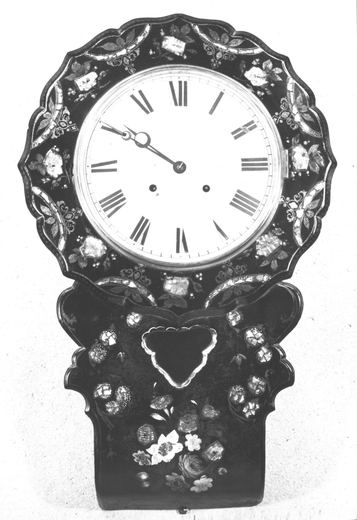
Wall clock in a papier mâché case with painted decoration. English, mid 19th century.
Victoria and Albert Museum, London
Clocks · 1840-1900
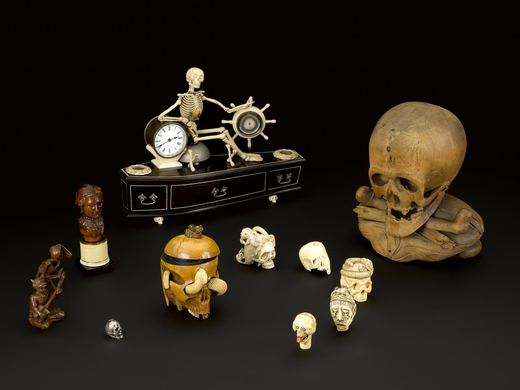
Alarm clock, mounted on model of coffin with skeleton, probably English, 1840-1900
Science Museum Group, London
Clocks · 1840-1880
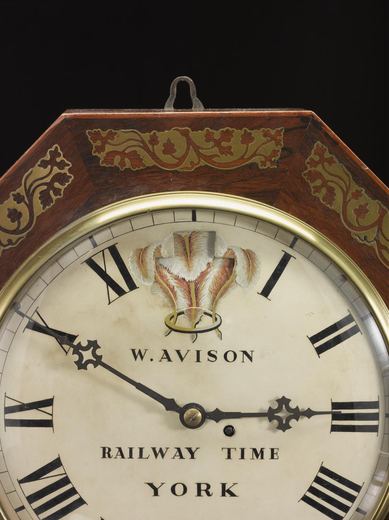
Wall Clock in octagonal case with Prince of Wales Feathers above makers name "W. Avison, Railway Time, York", made by William Avison, England, 1840-1880.
Science Museum Group, London
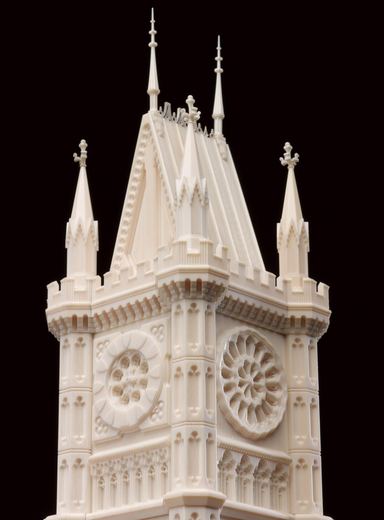
Clocks · 1843-1884
One ivory gothic clock tower & travelling case, by Holtzapffel and Company, London, England, 1843-1884
Science Museum Group, London
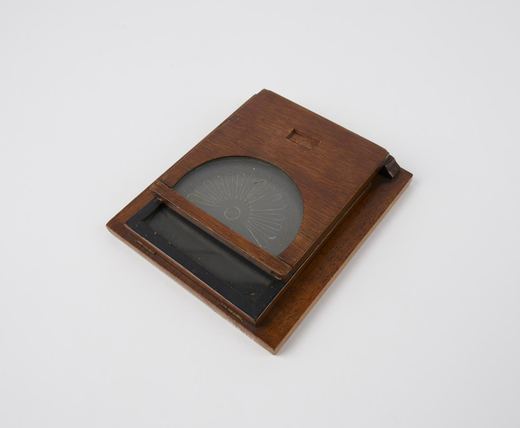
Clocks · 1845-1855
Clock by Darker, W. H., England, 1845-1855
Science Museum Group, London
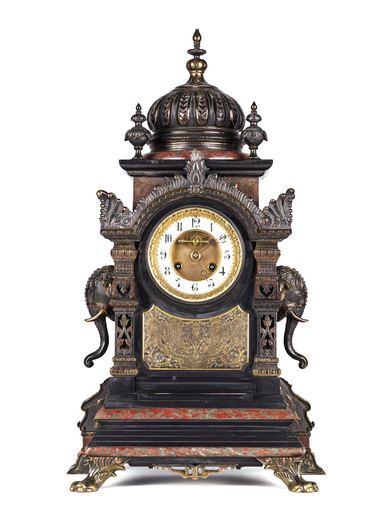
Clocks · 1845-1855
Clock, England, 1845-1855
Science Museum Group, London
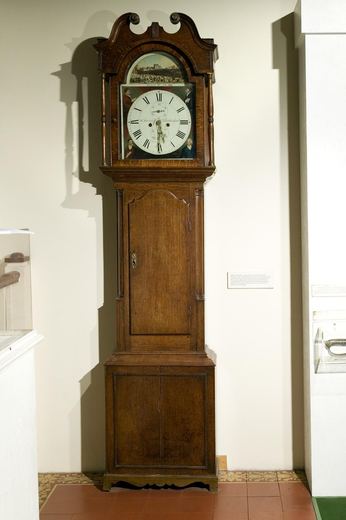
Clocks · 1845-1855
Longcase clock commemorating the Peterloo Massacre of 1819, made by W. Stancliffe, Barkisland.
Science Museum Group, London
Clocks · 1850-1900
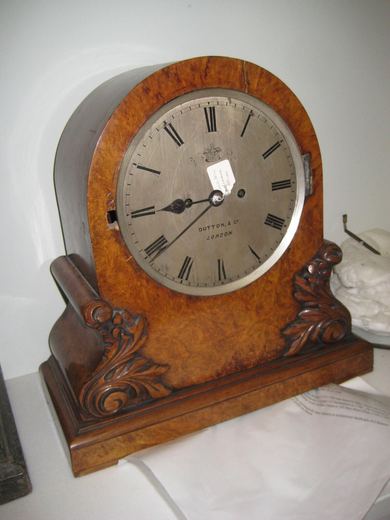
Case veneered in burr walnut, with arched top; from the early furnishings of the V&A
Victoria and Albert Museum, London