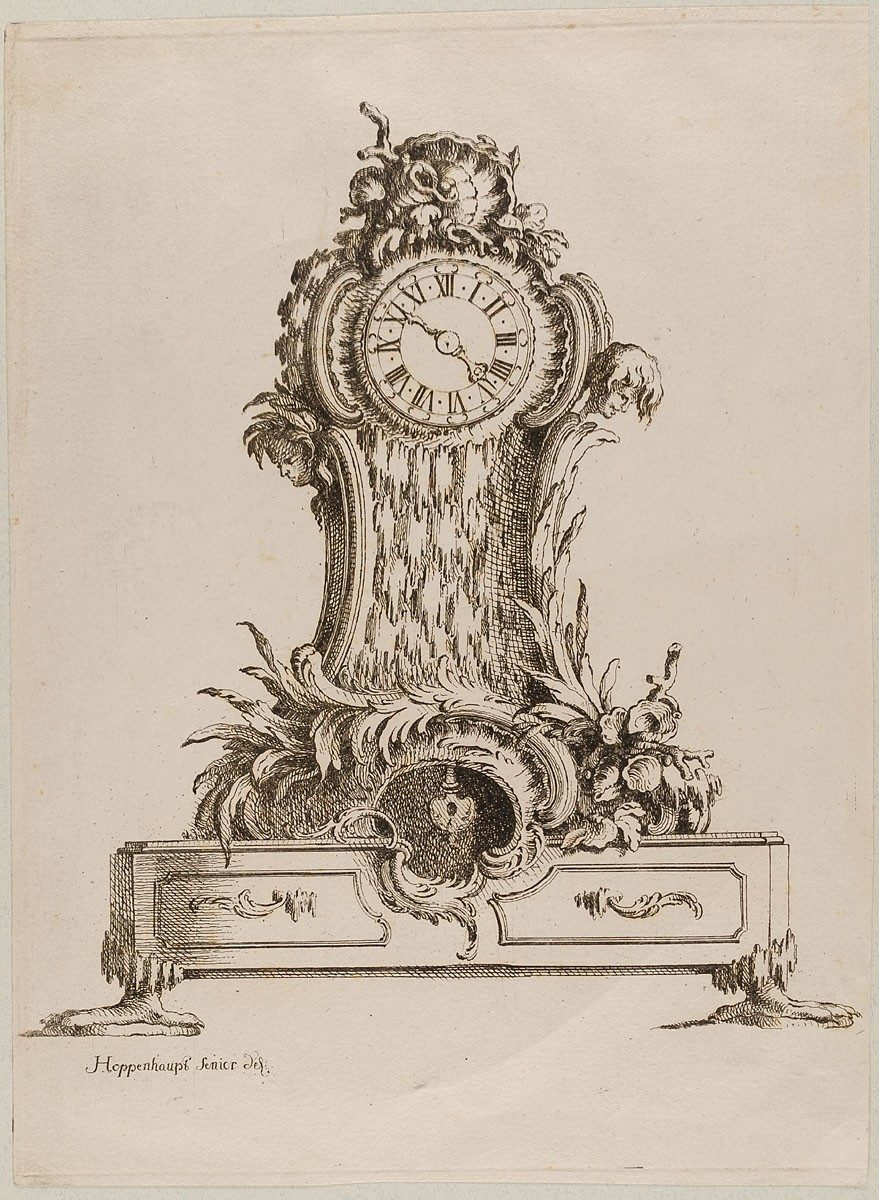
Clocks · Longcase clock
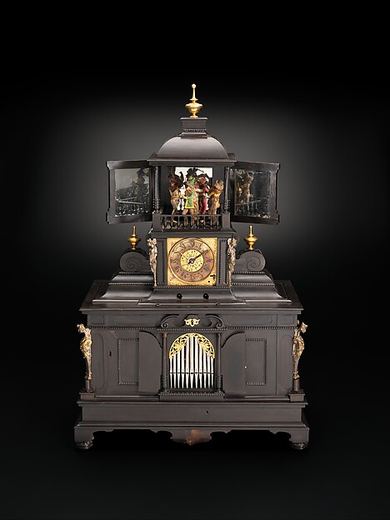
Longcase clock by Johann Michael Hoppenhaupt, Germany, 1740–1750 (Museum of Arts and Crafts, Hamburg item_OKOZOAL6CGJVDBJDZX5MSYGEDXHOI4RF)
- Maker / attribution
- Johann Michael Hoppenhaupt (creator)
- Date
- 1740–1750
- Historical period
- Early Modern Horology (1600 – 1750)
- Country of origin
- Germany
- Place
- Berlin B
- Object type
- Longcase clock
- Holding institution
- Museum of Arts and Crafts, Hamburg
- Accession / object no.
- item_OKOZOAL6CGJVDBJDZX5MSYGEDXHOI4RF
- Catalogue title (original)
- Floor clock on a broad base, leaf from a sequence (English)
Record summary
Held and catalogued by Museum of Arts and Crafts, Hamburg (object number item_OKOZOAL6CGJVDBJDZX5MSYGEDXHOI4RF), this is a longcase clock by Johann Michael Hoppenhaupt, made in Berlin B, Germany, dated 1740–1750. The Atlas places it in the Early Modern Horology period (1600 – 1750) of its Clocks collection. The record is illustrated with 1 photograph.
Assembled from the source record's structured fields. Dates and attributions are given as the source states them; where a field is missing the Atlas leaves it blank rather than estimating.
Catalogue description
The source record does not include a narrative description. The structured fields above are reproduced from it.
Historical context
Early Modern Horology (1600 – 1750)
Huygens' pendulum and balance spring transform accuracy; English makers develop the anchor and deadbeat escapements.
Huygens's pendulum (1656–57) improved clock accuracy from about a quarter of an hour to under a minute a day. The anchor escapement (c. 1670) and the long seconds pendulum created the longcase clock; London makers such as Fromanteel, Knibb, Tompion and Quare led European clockmaking, and French makers created the Boulle pendule.
Read the period in the timelineMore clocks from this periodEarlier: Renaissance Horology
Atlas type guide
Longcase (tall-case or grandfather) clocks
The longcase clock was born from two seventeenth-century innovations: Christiaan Huygens's pendulum (1656–57) and the anchor escapement (c. 1670). A long seconds pendulum, nearly a metre long, swings with a small arc, and enclosing it together with the driving weights in a tall wooden case protected the mechanism and created a new piece of furniture. London makers such as Ahasuerus Fromanteel, Thomas Tompion and Joseph Knibb set the pattern.
By the eighteenth century longcase clocks were made throughout Britain, the Netherlands, Scandinavia (the Swedish Mora clock), France (the Comtoise from the Franche-Comté), Germany and colonial America. Eight-day movements with two weights became standard in better clocks; thirty-hour clocks with one weight and a rope or chain were cheaper alternatives.
What to look for
- Winding holes in the dial: two (eight-day, going and striking) or none (thirty-hour, pulled up by a chain).
- Brass dials with applied chapter rings (earlier) versus painted iron 'white' dials (after c. 1770 in Britain).
- Moon-phase arches, date apertures, seconds dials and maker's name on the dial.
- Case woods and style: ebonised, walnut marquetry, lacquer, oak or mahogany; regional styles from London, Lancashire, Scotland or America.
- Whether the movement and dial match the case — 'marriages' are common.
Dating clues
- Square brass dials suggest c. 1670–1720; arched brass dials c. 1715–1790.
- Painted (white) dials were made by Birmingham dial-makers from about 1772.
- Comtoise clocks with repoussé pendulums are mostly nineteenth century.
General guidance written by the Atlas editors about this kind of object. It is not a statement about this particular piece; for that, rely on the source record above and on physical examination.
Related records
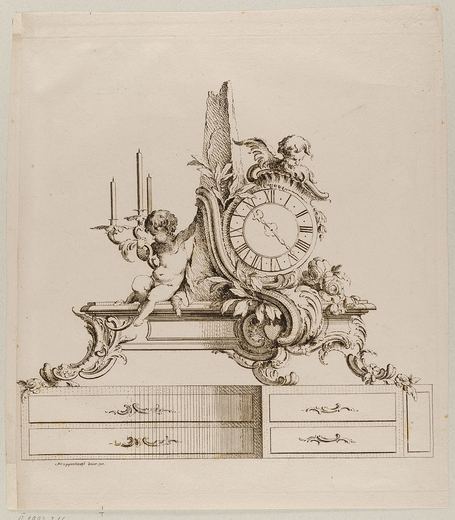
Clocks · 1740–1750
Longcase clock by Johann Michael Hoppenhaupt, Germany, 1740–1750 (Museum of Arts and Crafts, Hamburg item_7OCZYRAQFYNQEPFCMPKXOKJ4X3KIPBQ7)
Museum of Arts and Crafts, Hamburg
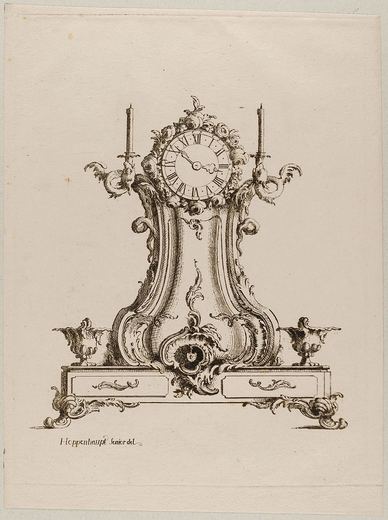
Clocks · 1740–1750
Longcase clock by Johann Michael Hoppenhaupt, Germany, 1740–1750 (Museum of Arts and Crafts, Hamburg item_HXVTYMTFVZYOX4GOLX44BYRHNIV7XHER)
Museum of Arts and Crafts, Hamburg
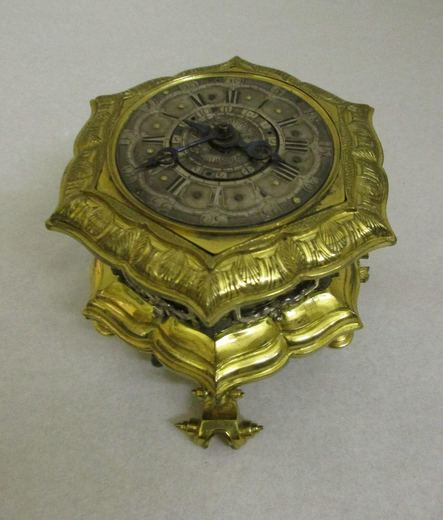
Clocks · 1600-1700
Clock, Germany, 1600-1700
Victoria and Albert Museum, London
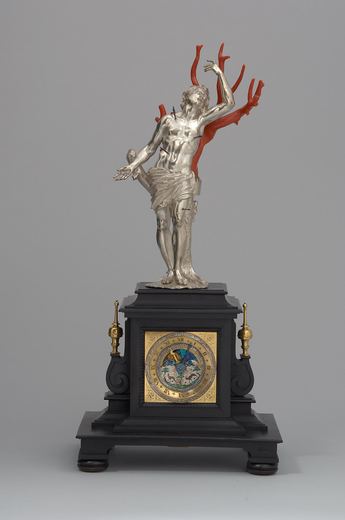
Clocks · 1600–1699
Table clock by #Hans_Christoph_II._Fesenmair_Künstler/in, Germany, 1600–1699
Fine Arts Museum Vienna
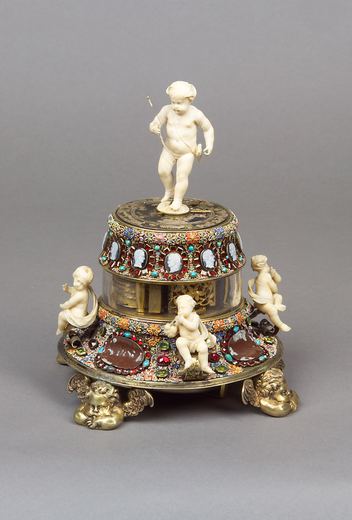
Clocks · 1600–1699
Table clock by Hans Jakob Mair (artist), Germany, 1600–1699
Fine Arts Museum Vienna
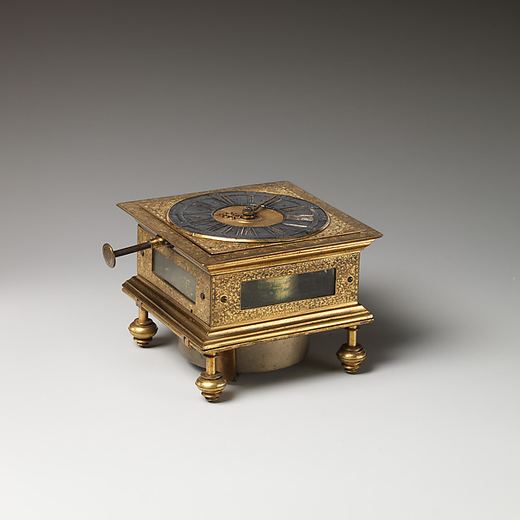
Clocks · 17th century
Table clock by Johann Heinrich Kleinschmidt, Germany, 17th century
The Metropolitan Museum of Art, New York
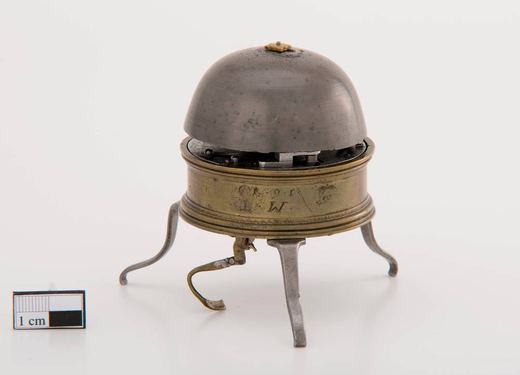
Clocks · 1600–1699
Table clock by unbekannt, deutsch, 17. Jh.; Uhrmacher, Germany, 1600–1699
Dresden State Art Collections. Royal Cabinet of Mathematical and Physical Instruments
Clocks · ca. 1625
Musical clock with spinet and organ by Veit Langenbucher, Germany, ca. 1625
The Metropolitan Museum of Art, New York