Clocks · Longcase clock
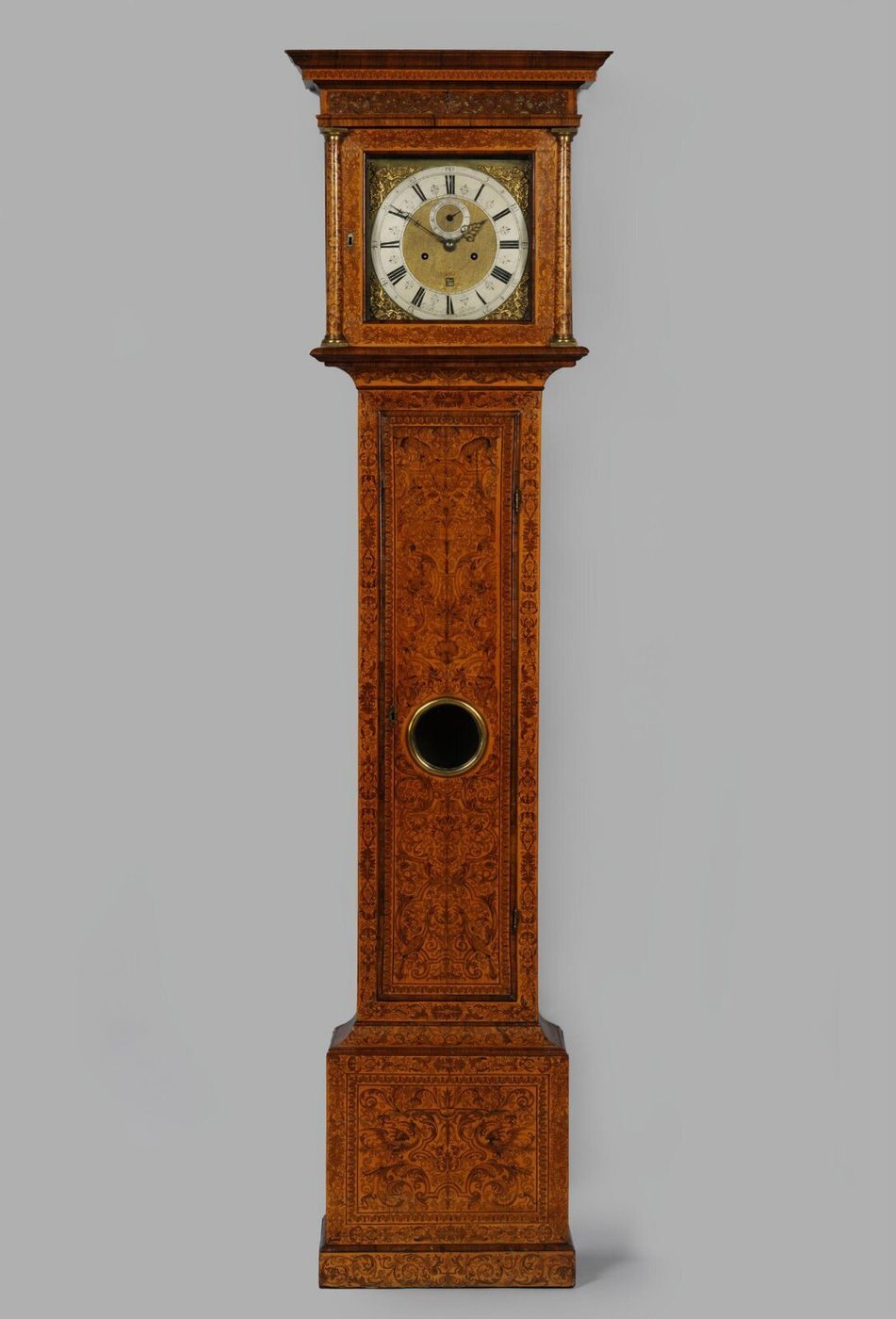
Longcase clock by James Beverly, England, ca. 1700
- Maker / attribution
- James Beverly (made)
- Date
- ca. 1700
- Historical period
- Early Modern Horology (1600 – 1750)
- Country of origin
- England
- Place
- London
- Object type
- Longcase clock
- Materials / technique
- Oak and softwood with marquetry of walnut, sycamore(?) and other woods, with brass mounts
- Dimensions
- Height: 221.5 cm; Width: 57 cm; Depth: 31.3 cm; Length: 98 cm (rod); Thickness: 0.8 cm (rod)
- Holding institution
- Victoria and Albert Museum, London
- Accession / object no.
- W.19:1-1952
- Credit line
- Bequeathed by V B Crowther-Beynon
Record summary
Held and catalogued by Victoria and Albert Museum, London (object number W.19:1-1952), this is a longcase clock by James Beverly, made in London, England, dated ca. 1700. The Atlas places it in the Early Modern Horology period (1600 – 1750) of its Clocks collection. Materials and techniques recorded by the source: Oak and softwood with marquetry of walnut, sycamore(?) and other woods, with brass mounts. Recorded dimensions: Height: 221.5 cm; Width: 57 cm; Depth: 31.3 cm; Length: 98 cm (rod); Thickness: 0.8 cm (rod). The record is illustrated with 4 photographs.
Assembled from the source record's structured fields. Dates and attributions are given as the source states them; where a field is missing the Atlas leaves it blank rather than estimating.
Catalogue description
V&A — Summary
The marquetry on the case is particularly fine, displaying a mixture of arabesques, birds and dragons. The extremely fine matting in the centre of the clock face was probably made using a roller. The fact that the maker’s name is inscribed on the dial between the numbers VII and V indicates that it is not a very early clock, on which the maker’s name is more commonly found beneath the dial and is therefore visible only when the door to the face is opened. It was also more common on early long case clocks for the maker’s name and place of work to be followed by the Latin word “fecit”, meaning “made (by)”. This too became outmoded as long case clockmaking progressed through the late 17th century. James Beverly was apprenticed to Robert Doore in 1684. He became free of the joined the Clockmakers’ Company in 1691. The weight driven, two train movement has an externally mounted count wheel which controls the hour striking on a single bell. It has a locking-plate striking train. The anchor escapement has been partially replaced and the mechanism is made from steel and brass.
V&A — Physical description
Month-going longcase clock, the case with marquetry in arabesque designs, of walnut and other woods on an oak carcase, the silvered dial with Roman numerals engraved in black, Inscribed ‘James Beverly London. The movement is of brass and steel, weight driven, with a two-train movement Case : Hood of architectural form with corner columns on a straight-sided case, on a stepped base. The hood, which is connected to the body of the case with an ogee moulding, decorated with arabesque marquetry, has a ¾ column at either side of the front and similar ¼ columns at the back, each with brass bases and capitals, and veneered with arabesque marquetry. The frame of the glass is similarly decorated and has a small brass keyhole escutcheon. Above this is a frieze filled with an arabesque fretted design, above which is a moulded cornice. The straight-sided case is connected to its base by a concave moulding. The front surfaces of both decorated with marquetry of arabesques, birdlike creatures and Berainesque motifs. The sides have plain veneer (of walnut) with panels outlined in stringing. A cross-banded bead edges the door panel, which has a round glass window framed in a band of brass, and a small brass keyhole escutcheon. The marquetry ground was identified visually (2015) as possibly sycamore. The hood columns would have been veneered using a traditional technique of 'wrapping' the spindle with marquetry on paper, glue-soaked and heated to be flexible. Description and notes by Francis Brodie, c. 2008 Dial : Twelve inch square. Brass dial plate with matted centre and square calendar aperture bordered by an engraved drapery pattern, behind which is silvered calendar ring. Twin cherubs with crown spandrels screwed to corners of dial plate with silvered chapter ring and subsidiary seconds ring pinned at back of dial plate. Narrow minute ring set in from edge of chapter ring by a comparatively broad scale of Arabic five minute numerals, the double figures lying either side of each extended five minute stroke. Half quarter marks in the form of small semi-circles. Roman hour numerals. Quarter hour band with half hour marks of arrow head and semi-circle pattern. Signed between VII and V on chapter ring James Beverly London. Seconds ring with relatively broad scale of Arabic five seconds numerals mirrors chapter ring with extended divisions at five second intervals and occupies most of the upper dial space between inside of the chapter ring and top of hour hand. Dial attached by four dial feet pinned to movement frontplate. Hands : Pierced steel hour and minute hands, small seconds hand. Hour hand with carved and bevelled surfaces. Movement : Month going, brass and steel, weight driven, two train movement. Hour striking on bell controlled by a crossed out countwheel mounted external to backplate on an extension of the striking intermediate arbor. Going train with recoil anchor escapement. Five pillar movement, each pillar having fins and a semi-circular central knop, being riveted to the backplate and pinned at the front plate. Exterior surface of front plate retains scribe lines used in laying out of wheelwork. Collets where used to mount wheels on arbors are mostly of a flattened, semi-circular profile; escape wheel collet is of a double sectioned profile. Arbors swell slightly towards centre. Where visible without dismantling, scribe lines present on faces of wheels and Intermediate pinions. Crossings on minute wheel and cannon pinion appear virtually left as cast with little attempt at cleaning up. Mounted on pallet arbor with double profiled collet, pallets - embracing 7½ teeth of the escape wheel - are broad with shallow drops to pads. Plugs of brass are evident in front plate by pallet arbor pivot hole, in back cock and by steady pin holes in the back plate. Visible on back plate is a plugged screw hole and steady pin hole adjacent to hammer spring foot. Hour wheel bridge of lenticular shape coming to a point at each foot. Steelwork is mostly plain and with flat surfaces; countwheel detent has small bevel between junction of curved and straight sections.
V&A — Historical context
Arabesque Marquetry: Arabesque (‘filigree’, ‘endive’ or ‘seaweed’) marquetry appeared in England from about 1686. It uses dense, two-dimensional patterns developed of highly stylised foliate scrollwork, usually in two colours, with no attempt at the naturalism of floral marquetry. Whereas in floral marquetry the various elements were cut out and assembled piece by piece, arabesque marquetry was cut in a single operation, using a ‘packet’ of veneer sheets, producing marquetry that is dark on light, or light on dark (also known as premiere- and contre-partie). The most common woods are box or holly, and walnut. English arabesque marquetry is particularly associated with the work of Gerrit Jensen (fl. 1667-1715), who continued to supply ‘markatree’ (as it was known) for the Royal palaces in Queen Anne’s reign. Longcase clocks continued to be made with arabesque marquetry into the 1720s. See A. Bowett, English Furniture 1660-1714, 199-201 Comparable Clocks: A floral marquetry long-case clock was sold by Allan Smith Antique Clocks between 2005 and 2013. The following information about Beverly was extracted from www.allansmithantiqueclocks.co.uk (accessed on 07/02/2014): James Beverly (sometimes spelt Beverley), recorded born circa 1670, apprenticed in June 1684 to Robert Dore (Doore) until 1691, but not freed.
V&A — Object history
This came to the Museum as part of a bequest by Mr V.B. Crowther-Benyon F.S.A. (See Registered File 52/1176 on Nominal File MA/1/C3396). The Museum nos. for the bequest of furniture run from W.14 to W. 23-1952. He also bequeathed paintings, miniatures and other items, including a beadwork basket to the Museum. The correspondence suggests that all the items had been inherited by Mr Crowther-Benyon. Display History Displayed at Ham House by c1959. Displayed in the Cliffords Inn period room, c1976-83 Stored 1985-2015 Displayed gallery 54 from 2016 Notes from R.P. 52/1176 7 October 1926 minute paper, H Clifford Smith Smith met Crowther-Beynon at the Society of Antiquaries and learned that, as he was the last of his family, he intended to bequeath his inherited furniture to the Museum. Among items selected by Smith as "of special interest and importance" is "A walnut tall case clock decorated with seaweed marquetry. By James Beverly, London. About 1700". 12/5/52 Bequest Form lists among 11 articles bequeathed: "1 long case clock of walnut & other woods marquetry. By James Beverley, London. About 1700 W19-1952". The description "decorated with seaweed" is crossed out. 20/10/26 R.P. 8019 Minute Papers lists items selected by HCS for bequest to the Museum by Crowther Beynon. It is from "Furniture which he had inherited". Smith selected pieces he considered "of special interest and importance" including the tall case clock by Beverley about 1700. The Director (Brackett) calls the bequest "a valuable addition to our collections". Object sampling carried out by Jo Darrah, V&A Science; drawer/slide reference 1/112. Remarks: Dial: Indicative of the early 18th century owing to its size, twelve inches tending to supersede the earlier smaller sizes. The layout of the minute scales seen here towards the edge of the chapter ring had become widely adopted by ca.1690 onwards whilst the relative thicknesses of the scale and minute divisions suggest is more typical of the early 18th century. Interestingly, the extended five minute (and second) division into the outer band is a survival of an earlier design. That the seconds ring occupies so large an area in the dial centre indicates later practice. Finally, the type of spandrel employed here is linked to ca.1700 onwards. Hands: The design of the hour hand with its carved and bevelled surfaces is in keeping with the dial but the minute hand with its twin apertures combined with little surface relief is closer in style to the end of the 18th century. Movement: Late 17th century details include the pillar profiles and scribe lines on wheels and pinions. The combination of month duration and striking controlled by countwheel may be found on better quality clocks of this period, with a tendency to abandon longer running times as the 18th century progresses. Predominantly plain steelwork marks the start of a trend to reduce the decoration of parts that would not normally be visible to the owner. Likewise, the motion work wheels have not had their crossings finished again to save effort and time. It is also proof (if needed) that crossings were cast into the wheels at this date. That the arbors tend to a more parallel profile (assuming they are original), and taken in combination with the shape of the wheel collets, indicates two possibilities. One, characteristic features specific to this maker, or two, an anticipation of 18th century developments. Elsewhere, the profile of the collets on pallet and escape arbors, the style of pallets and the presence of related plugged holes in the plate all lead to the conclusion that the escapement has been altered, whilst the back cock lowered. Original pallets might have had deeper arms; the present style and collets are commonly associated with the 19th century onwards. Unused holes by the hammer spring imply that this component has, at the very least, been moved and even replaced at some time. Record: James Beverley was apprenticed to Robert Doore in 1684, becoming free of the Clockmakers' Company in 1691 (C.E. Atkins, "Register of Apprentices of the Worshipful Company of Clockmakers", 1931; "Freemen of the Worshipful Company of Clockmakers", 1984, Pub. G. Daniels). Description and notes by Francis Brodie, c. 2008
V&A — Production note
Inscribed ‘James Beverly London’, about 1700.
V&A gallery label
LONG-CASE CLOCK ENGLISH; about 1690 Marquetry of walnut and various woods. Inscribed: JAMES BEVERLY-LONDON
V&A gallery label
MONTH-GOING LONG CASE CLOCK Marquetry of Walnut and other woods on an oak carcase Inscribed 'James Beverly London', about 1700 Bequeathed by V. B. Crowther-Beynon Museum number: W.19-1952 James Beverly was apprenticed to Robert Doore in 1684. He became a member of the Clockmakers' Company in 1691. The marquetry on the case is particularly fine, displaying a mixture of arabesques, birds and dragons. The extremely fine matting in the centre of the clock face was probably made using a roller. The fact that the maker's name is inscribed on the dial between the numbers VII and V indicates that the clock dates from about 1700. Before that date the maker's name is more commonly found beneath the dial and is therefore visible only when the door to the face is opened. It was also common on long case clocks made before 1700 for the maker's name and place of work to be followed by the Latin word "fecit", meaning "made (by)". This too became outmoded as long case clockmaking progressed. The weight driven, two train movement has an externally mounted count wheel which controls the hour striking on a single bell. It has a locking-plate striking train. The anchor escapement has been partially replaced and the mechanism is made from steel and brass. [Clock store label]
Historical context
Early Modern Horology (1600 – 1750)
Huygens' pendulum and balance spring transform accuracy; English makers develop the anchor and deadbeat escapements.
Huygens's pendulum (1656–57) improved clock accuracy from about a quarter of an hour to under a minute a day. The anchor escapement (c. 1670) and the long seconds pendulum created the longcase clock; London makers such as Fromanteel, Knibb, Tompion and Quare led European clockmaking, and French makers created the Boulle pendule.
Read the period in the timelineMore clocks from this periodEarlier: Renaissance Horology
Atlas type guide
Longcase (tall-case or grandfather) clocks
The longcase clock was born from two seventeenth-century innovations: Christiaan Huygens's pendulum (1656–57) and the anchor escapement (c. 1670). A long seconds pendulum, nearly a metre long, swings with a small arc, and enclosing it together with the driving weights in a tall wooden case protected the mechanism and created a new piece of furniture. London makers such as Ahasuerus Fromanteel, Thomas Tompion and Joseph Knibb set the pattern.
By the eighteenth century longcase clocks were made throughout Britain, the Netherlands, Scandinavia (the Swedish Mora clock), France (the Comtoise from the Franche-Comté), Germany and colonial America. Eight-day movements with two weights became standard in better clocks; thirty-hour clocks with one weight and a rope or chain were cheaper alternatives.
What to look for
- Winding holes in the dial: two (eight-day, going and striking) or none (thirty-hour, pulled up by a chain).
- Brass dials with applied chapter rings (earlier) versus painted iron 'white' dials (after c. 1770 in Britain).
- Moon-phase arches, date apertures, seconds dials and maker's name on the dial.
- Case woods and style: ebonised, walnut marquetry, lacquer, oak or mahogany; regional styles from London, Lancashire, Scotland or America.
- Whether the movement and dial match the case — 'marriages' are common.
Dating clues
- Square brass dials suggest c. 1670–1720; arched brass dials c. 1715–1790.
- Painted (white) dials were made by Birmingham dial-makers from about 1772.
- Comtoise clocks with repoussé pendulums are mostly nineteenth century.
General guidance written by the Atlas editors about this kind of object. It is not a statement about this particular piece; for that, rely on the source record above and on physical examination.
Read next:Anchor escapement
Related records
Clocks · 1598-1603
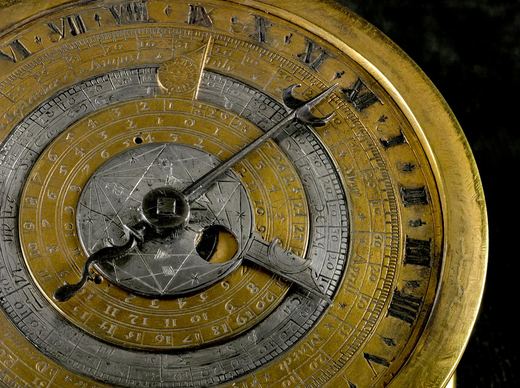
Circular table-clock with calendrical and lunar indications made by Nicholas Vallin in London between 1598 and 1603.
Science Museum Group, London
Clocks · 1611
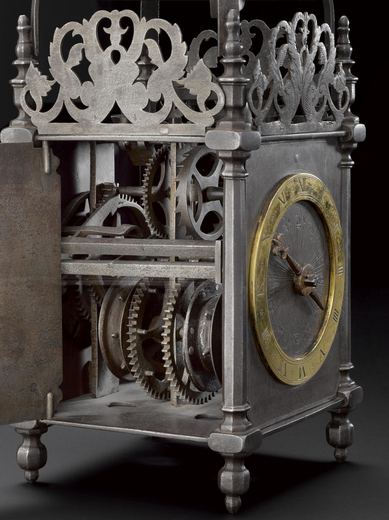
English iron lantern clock, with wheel balance, by John Holloway, Market Lavington, Wiltshire, England, 1611.
Science Museum Group, London
Clocks · 1630
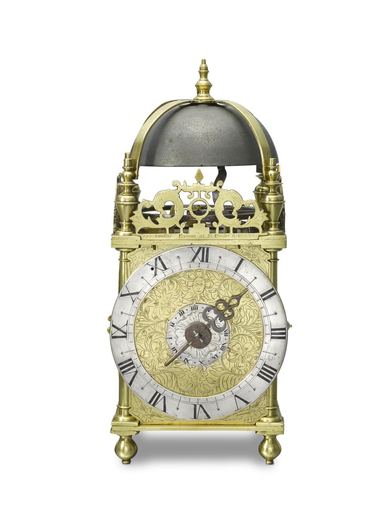
Lantern clock by Forman, Francis, England, 1630
Science Museum Group, London
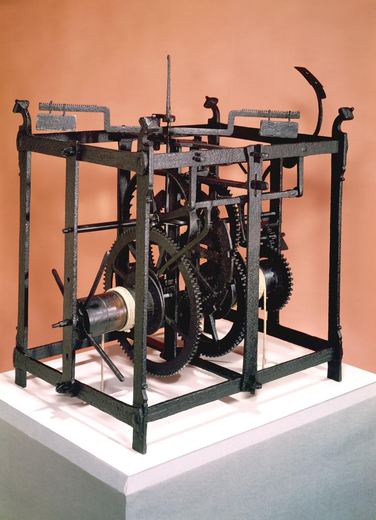
Clocks · 1632-1640
Turret clock, England, 1632-1640
Science Museum Group, London
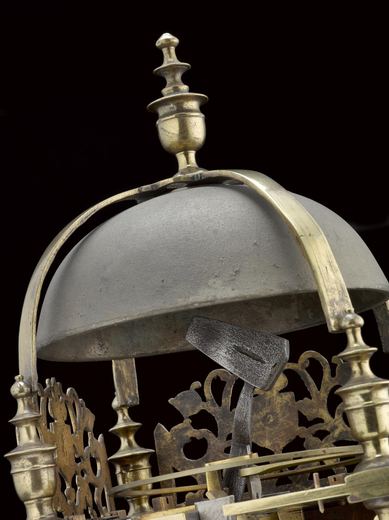
Clocks · 1645-1655
Balance-wheel brass lantern clock, with two driving weights and one counterweight, by Thomas Knifton, Cross Keys, Lothbury, London, England, 1645-1655.
Science Museum Group, London
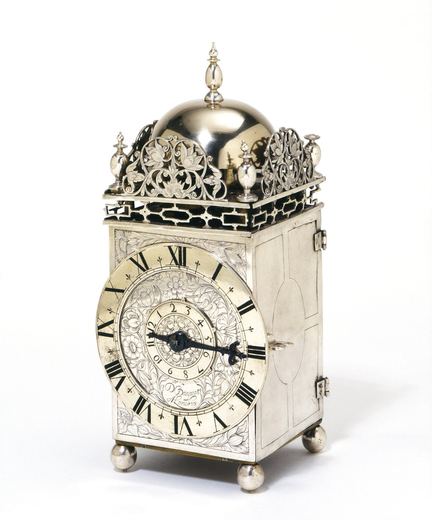
Clocks · ca. 1650
Lantern alarm clock, silver, by David Bouquet, circa 1650
Victoria and Albert Museum, London
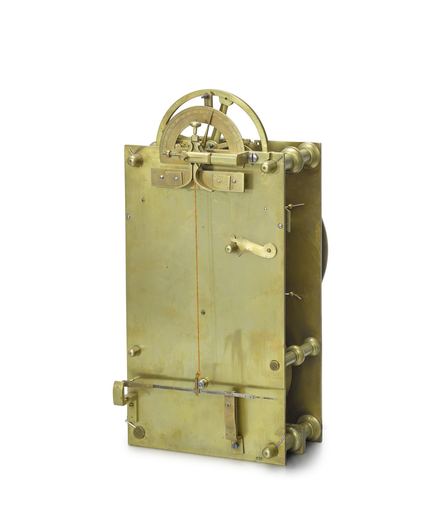
Clocks · 1650-1660
Lantern clock by Closon, Peter, England, 1650-1660
Science Museum Group, London
Clocks · ca. 1660
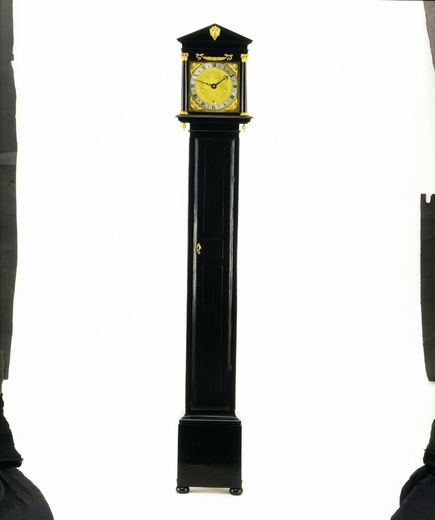
Longcase clock, ca. 1660, English, made by Ahasuerus Fromanteel
Victoria and Albert Museum, London