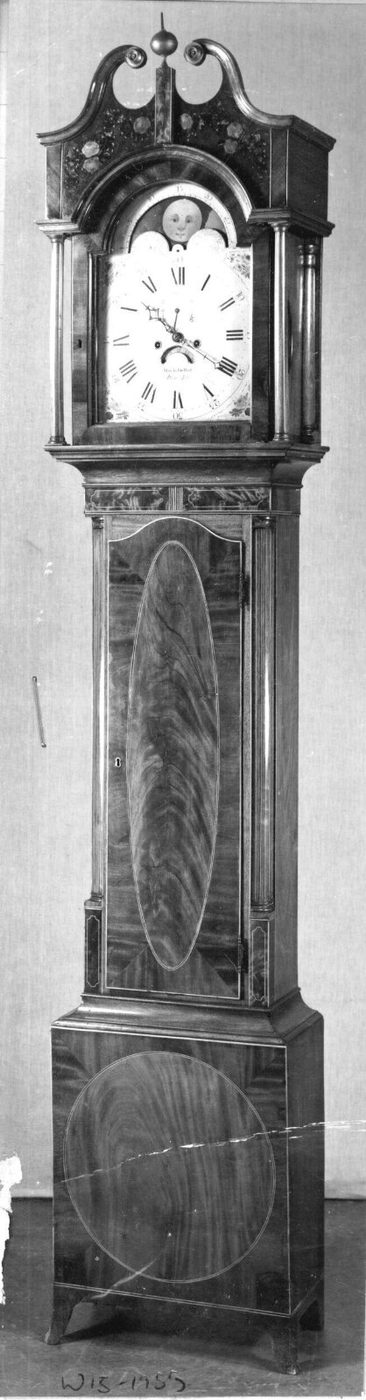
Clocks · Longcase clock
Longcase clock by Henry Mitchell, United States, ca. 1790
- Maker / attribution
- Henry Mitchell (made); Jordan Mott (made)
- Date
- ca. 1790
- Historical period
- Precision & Scientific Horology (1750 – 1850)
- Country of origin
- United States
- Place
- New York
- Object type
- Longcase clock
- Materials / technique
- Case of mahogany inlaid with satinwood and painted, brass and steel movement
- Dimensions
- Height: 250 cm (approx); Width: 51.5 cm; Depth: 26 cm (approx); Weight: 5.95 kg (W.13:3 weight 10/10/2025 NH); Weight: 5.5 kg (W.13:4 weight 10/10/2025 NH)
- Holding institution
- Victoria and Albert Museum, London
- Accession / object no.
- W.13:1 to 7-1955
Record summary
Held and catalogued by Victoria and Albert Museum, London (object number W.13:1 to 7-1955), this is a longcase clock by Henry Mitchell, made in New York, United States, dated ca. 1790. The Atlas places it in the Precision & Scientific Horology period (1750 – 1850) of its Clocks collection. Materials and techniques recorded by the source: Case of mahogany inlaid with satinwood and painted, brass and steel movement. Recorded dimensions: Height: 250 cm (approx); Width: 51.5 cm; Depth: 26 cm (approx); Weight: 5.95 kg (W.13:3 weight 10/10/2025 NH); Weight: 5.5 kg (W.13:4 weight 10/10/2025 NH). The record is illustrated with 2 photographs.
Assembled from the source record's structured fields. Dates and attributions are given as the source states them; where a field is missing the Atlas leaves it blank rather than estimating.
Catalogue description
V&A — Summary
This clock is an interesting example of a longcase clock in use in the United States in the first years of the new nation. A piece of paper pasted inside the door suggests that it was acquired in 1785 for a young bride, Sarah Onderbank, who married David Richard Floyd of Long Island. The name on the dial, however, is of a partnership of clockmakers that seems only to have started in about 1790, lastin guntil 1809, so it is possible that the label records a slightly vague family history. Despite the name of Mitchell & Mott and th place name of New York, it is not at all certain that the clock was made in the new country. It is possible that both the movement and the very elegant case may have been imported from Britain.
V&A — Physical description
A longcase clock, the case veneered in mahogany with stringing of satinwood, with an oval panel in the door and a circular panel on the base, the arched dial painted, the cresting of the hood also painted with flowers. North American, by Mitchell & Mott, New York, about 1785. Dial: Break arch painted iron dial, notionally 13 inches square; the arch extending upwards 5½ inches. Painted Roman hour numerals, Arabic minute numerals in multiples of five separated by dots representing the minutes. Separate, subsidiary seconds ring below twelve with painted Arabic numbers at ten-second intervals, the outside bordered with dots for each second. Semi- circular calendar aperture located above six with white and gold detailed border. The date is indicated by Arabic numerals engraved on a painted disc carried behind the dial. In the four corners of the main body of the dial, painted representations of flowers are bordered by triangles of raised, gold-coloured gesso having characteristic semi-circular form. The arch carries a rotating lunar disc bordered by semi-circular projections of globes, the left showing the Americas, the right Europe and Africa. Lines of latitude and longitude are clearly marked. Two stylised painted faces serve to show the phase of the moon against the two semi-circular globes. Between the faces are painted scenes, one of a sailing ship, the other a rocky island bordered by a house and tower. The moon's age is indicated by Arabic numbers painted on the fixed portion forming the dial arch. “Mitchell & Mott New York ” is painted below the calendar aperture. Steel, pierced hands, simple seconds hand. The dial is attached to the movement by a plain, iron falseplate, located between the movement and the dial. Movement: Brass and steel weight driven two-train movement, of eight-day duration with rack striking on bell, regulated by a long pendulum of one second period. The four pillars with a bulbous centre of circular profile and semi-circular profile at the plate edges are riveted to the back plate and pinned at the front. The four spoke train wheels have semi-circular to star-shaped crossings, with remnants of scribe lines for filing to shape. Wheel collets in the form of a rounded ‘T’ profile. Arbors are near parallel in section. The escapement is of the anchor recoil type embracing 6½ teeth of the escape wheel. Generally well finished. The back of the main dial carries a lever arrangement for advancing the moon disc and ratchets to secure the position of the moon and calendar discs. Description and notes by Francis Brodie, c. 2008
V&A — Object history
North American Longcase clock by Mitchell & Mott of New York, purchased from Mrs Derek Cooper, The Cedars, Windlesham, Surrey 22 February 1955 letter, Joan Cooper to the V & A offers early American furniture "from my great-grandfather's house in Albany, N.Y…..(it) would be before 1840…possibly earlier". It includes "a mahogany long-case clock by Mitchell & Mott of which I have the history from 1785". 10 March 1955 minute paper, Lowe to Molesworth describes Mrs Cooper's American furniture as "disappointing…of poor quality and extremely ugly". The only possible exception is the long case clock, though even this was not of top quality. The minute paper describes the clock "Mahogany with satinwood banding. Cresting with floral painting by Mitchell and Mott, New York". According to Mrs Cooper and to a document pasted inside the door This clock was brought into their family by Sarah Ondernouk at the time of her marriage in 1785 and remained at the family house at Fort Neck until 1927. This is odd, for according to Nutting's Furniture Treasury, the firm of Mitchell and Mott was not established until 1793. 23 March 1955 letter, Joan Cooper to Ashton explains that the clock was the property of her mother, Mrs Barnardiston. She asks £50 for the clock and a chair. 14 June 1955 purchase listed as "long-case clock North American, late 18th century. Mahogany with satinwood banding". Remarks : A debate exists as to whether early (pre-1800) longcases were made in America, or imported complete, or imported as parts from England, subsequently being assembled by American craftsmen over there. The M&M painted dial has the style of early examples made by Wilson of Birmingham, England. Osborne and Wilson (painted dial partners) dissolved their partnership in 1777; Wilson then exported dials to America (Bruce R. Forman, “The American White Painted Dial, a Pictorial Essay”, NAWCC Bulletin, February 1996, Vol. 38/1, No. 300, pp3-13). Forman reckoned that prior to about 1800, most American clockmakers relied on imported dials; it is interesting that the M&M dial shows features that fit with so-called Period One dials (those up to about 1800) (Bruce R. Forman, “The American White Painted Dial, a Pictorial Essay”, NAWCC Bulletin, February 1996, Vol. 38/1, No. 300, pp3-13). After 1807, trade between England and America became difficult. The latitude and longitude scales on the flattened globes of the M&M show divisions but are devoid of numbers; it is thought that American dials have numbered divisions (Brian Loomes, “White Dial Clocks”, 1981, David and Charles). However, one illustration of a Massachusetts clock dial does show the same detail around the calendar aperture as that on the M&M (M.F. Tennant, “Longcase Painted Dials”, 1995, N.A.G. Press). Of course, it could be that the illustrated dial was also an import. That the falseplate (a device for fitting a painted dial to the movement) has no name of the dial maker cast into it may not be significant; Forman describes a dial with an American name painted on but clearly with English features mounted on an unnamed falseplate (Bruce R. Forman, “The American White Painted Dial, a Pictorial Essay”, NAWCC Bulletin, February 1996, Vol. 38/1, No. 300, pp3-13). Recent communication with an American colleague suggests that one American maker imported English movements, but documentary evidence for this cannot be unearthed. The M&M movement really is in the style of an English brass longcase movement of c.1800. Other personal communications might suggest that later nineteenth century chronometers from the Liverpool area were sometimes exported as parts to America, then finished in the English manner over there. Description and notes by Francis Brodie, c. 2008
Inscriptions & marks
Mitchell & Mott New York; This clock was brought to Fort Neck, South Oyster Bay, (now Massepequa, Nassau County) Long Island, State of New York, by Sarah Onderdonk, the bride of David Richard Floyd, in 1785
Historical context
Precision & Scientific Horology (1750 – 1850)
Harrison solves longitude; Mudge invents the lever; Breguet's Paris workshop defines the modern watch.
The age of the deadbeat escapement, compensated pendulums and observatory regulators. Domestic clocks spread through the middle classes: English longcase and bracket clocks, French gilt-bronze mantel clocks, Viennese Biedermeier wall clocks, Black Forest painted-shield clocks, and the first American shelf clocks.
Read the period in the timelineMore clocks from this periodEarlier: Early Modern Horology
Atlas type guide
Longcase (tall-case or grandfather) clocks
The longcase clock was born from two seventeenth-century innovations: Christiaan Huygens's pendulum (1656–57) and the anchor escapement (c. 1670). A long seconds pendulum, nearly a metre long, swings with a small arc, and enclosing it together with the driving weights in a tall wooden case protected the mechanism and created a new piece of furniture. London makers such as Ahasuerus Fromanteel, Thomas Tompion and Joseph Knibb set the pattern.
By the eighteenth century longcase clocks were made throughout Britain, the Netherlands, Scandinavia (the Swedish Mora clock), France (the Comtoise from the Franche-Comté), Germany and colonial America. Eight-day movements with two weights became standard in better clocks; thirty-hour clocks with one weight and a rope or chain were cheaper alternatives.
What to look for
- Winding holes in the dial: two (eight-day, going and striking) or none (thirty-hour, pulled up by a chain).
- Brass dials with applied chapter rings (earlier) versus painted iron 'white' dials (after c. 1770 in Britain).
- Moon-phase arches, date apertures, seconds dials and maker's name on the dial.
- Case woods and style: ebonised, walnut marquetry, lacquer, oak or mahogany; regional styles from London, Lancashire, Scotland or America.
- Whether the movement and dial match the case — 'marriages' are common.
Dating clues
- Square brass dials suggest c. 1670–1720; arched brass dials c. 1715–1790.
- Painted (white) dials were made by Birmingham dial-makers from about 1772.
- Comtoise clocks with repoussé pendulums are mostly nineteenth century.
General guidance written by the Atlas editors about this kind of object. It is not a statement about this particular piece; for that, rely on the source record above and on physical examination.
Related records
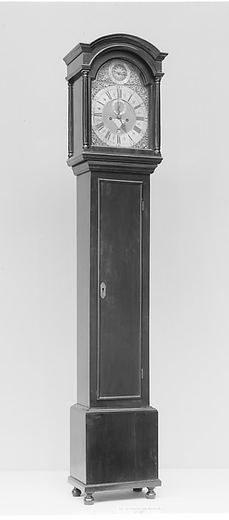
Clocks · 1740–60
Tall clock by Samuel Bagnall, United States, 1740–60
The Metropolitan Museum of Art, New York
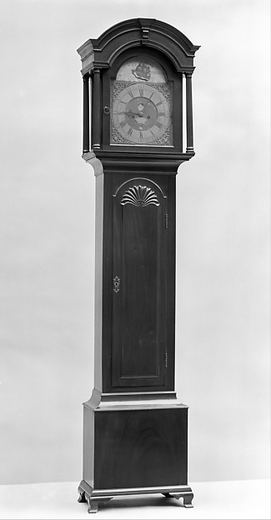
Clocks · 1750–60
Tall clock by Gawen Brown, United States, 1750–60
The Metropolitan Museum of Art, New York
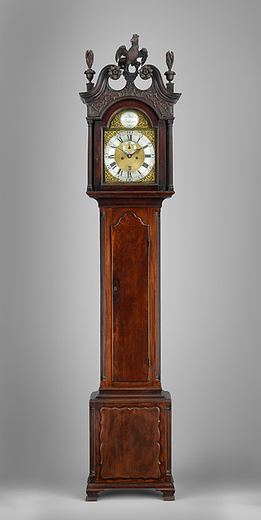
Clocks · 1765–75
Clock by Edward Duffield, United States, 1765–75
The Metropolitan Museum of Art, New York
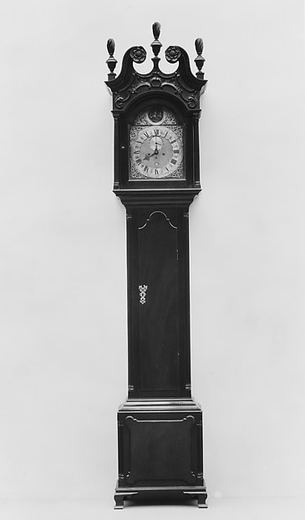
Clocks · 1767–71
Tall clock by William Huston, United States, 1767–71
The Metropolitan Museum of Art, New York
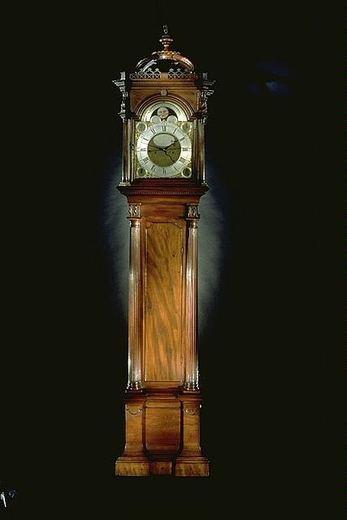
Clocks · 1769
Clock by Ellicott, Joseph, United States, 1769
National Museum of American History, Smithsonian Institution, Washington DC
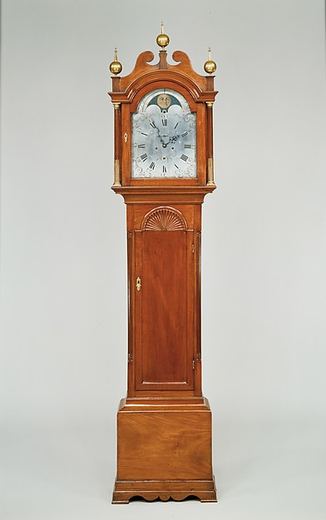
Clocks · 1772
Tall clock by Benjamin Willard, United States, 1772
The Metropolitan Museum of Art, New York
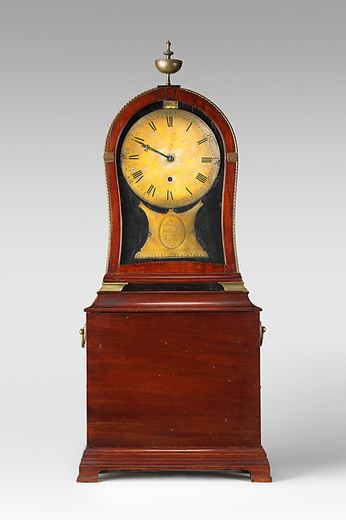
Clocks · 1780–90
"balloon" shelf clock by Simon Willard, United States, 1780–90
The Metropolitan Museum of Art, New York
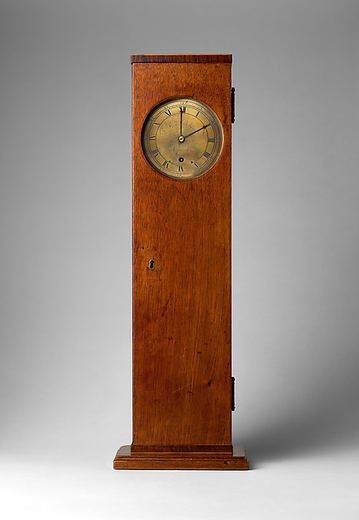
Clocks · ca. 1786
Shelf clock by Levi Hutchins, United States, ca. 1786
The Metropolitan Museum of Art, New York