
Wristwatches · Wristwatch
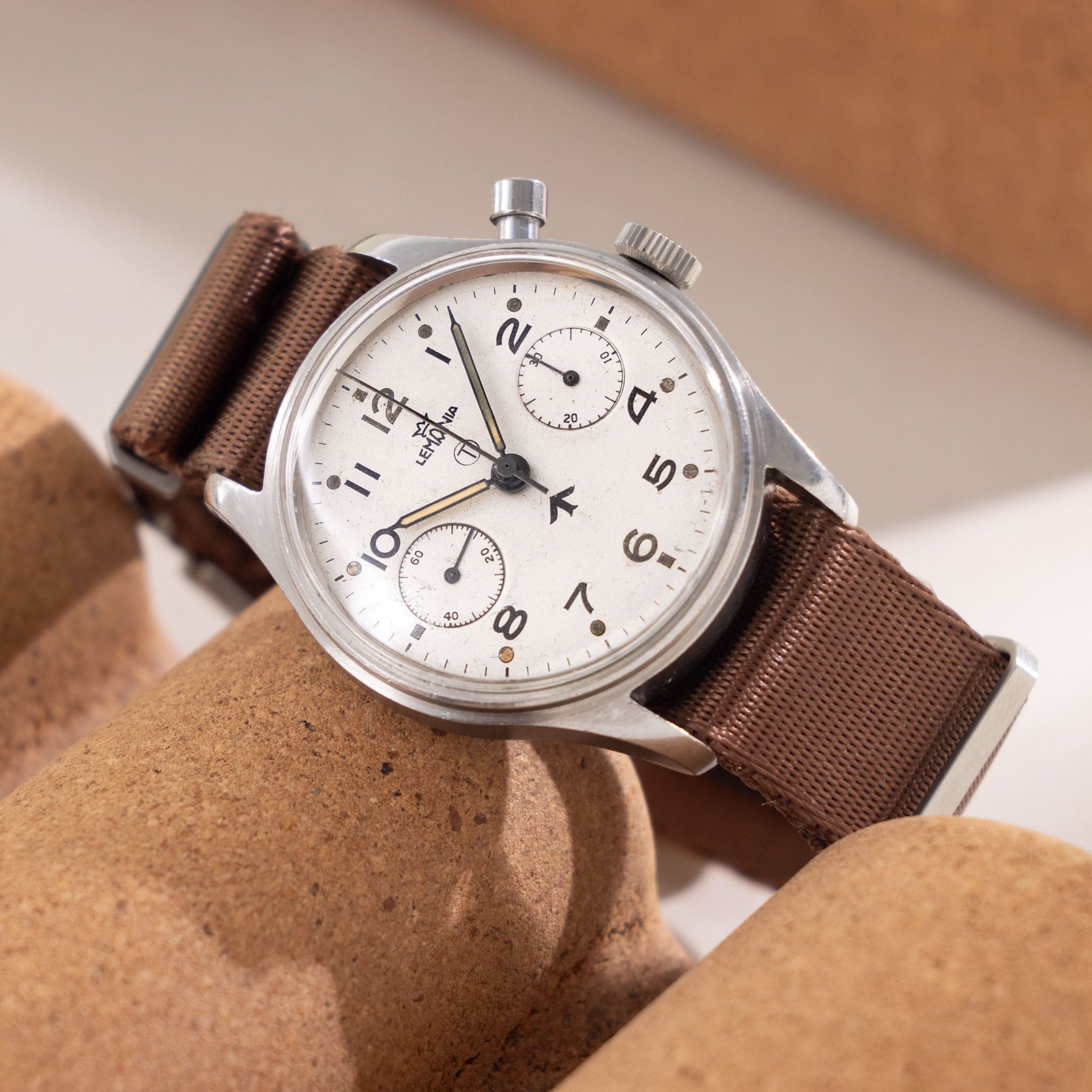
Lemania Monopusher Military Chronograph silver dial 15CHT, 1950s
- Maker / attribution
- Lemania (maker)
- Date
- 1950s
- Historical period
- Modern Mechanical Horology (1945 – 1969)
- Country of origin
- Switzerland
- Object type
- Wristwatch
- Materials / technique
- silver
- Dimensions
- Case 38.5 mm
- Stock no.
- W-2932
- Credit line
- Dealer listing, Bulang & Sons (W-2932)
- Catalogue title (original)
- Lemania Monopusher Military Chronograph silver dial 15CHT (English)
View the source record (dealer listing) ↗ (opens another website in a new tab)Suggest a correction
Record summary
Catalogued by Bulang & Sons (dealer), Copenhagen (stock number W-2932), this is a wristwatch by Lemania, made in Switzerland, dated 1950s. The Atlas places it in the Modern Mechanical Horology period (1945 – 1969) of its Wristwatches collection. Materials and techniques recorded by the source: silver. Recorded dimensions: Case 38.5 mm. The record is illustrated with 6 photographs.
Assembled from the source record's structured fields. Dates and attributions are given as the source states them; where a field is missing the Atlas leaves it blank rather than estimating.
Catalogue description
Dealer description — Bulang & Sons
Throughout much of the 20th century, wristwatches were a standard part of soldiers’ issued gear, often designed to be as straightforward and functional as possible. In contrast, chronographs are inherently more complex. However, their integrated stopwatch functionality sometimes met the military's specific needs. One of the earliest examples tailored for military use diverges from typical expectations: collectors commonly refer to it as the “Military Mono-pusher Chronograph.” These watches were crafted solely as practical tools, primarily worn by air force and navy personnel from various countries over the years. While there were different models produced by various manufacturers, the fundamental design included a 38.5mm case, a silver white dial, and chronograph features operated by a single pusher. The mono-pusher chronograph predates the popular two-pusher system introduced by Breitling and offers a more straightforward design. While it sacrifices some of the functionality provided by dual buttons—where one is used to start and stop and the other to reset, the mono-pusher consolidates all those functions into a single button. By the time these mono-pusher chronographs were commissioned for military use, the two-button system was already well established, if not as widespread as it is today, with various models being made for military purposes. This raises an interesting question: why did military contracts often specify these particular mono-pusher models when a more “modern” option was available? It could be that the additional mechanical complexity and the extra vulnerability from another opening in the case weren’t seen as justifiable. Alternatively, the higher cost of two-button chronographs might have been a factor. While we may not know the definitive answer, we do know that these mono-pusher examples first emerged in the 1930s and continued to be ordered and produced well into the 1970s. The British Ministry of Defense (Or MOD) commissioned watches that would establish a standard, working with manufacturers like Lemania, Rodania, Breitling, and Omega. While Breitling and Omega are more widely known today, it's Lemania that deserves special attention. When watch enthusiasts think of Lemania, they often recall the remarkable chronograph movements that powered some of history’s most celebrated timepieces, typically bearing the names of other brands like Omega, Patek Philippe, and Vacheron Constantin. However, Lemania also produced complete watches, and many of the vintage military monopusher chronographs available today feature the Lemania name on the dial, driven by the manually wound Lemania caliber 15 series movements. What we have here is a classic mono-pusher chronograph featuring a clean silver dial, marked with a kings cross to signify its military purpose, along with a circled “T” indicating the use of tritium lume. The case is in great condition, especially considering its years of military service, and the dial remains impressively clean. With its utilitarian yet stylish syringe hands and contrasting luminous and painted Arabic numerals, this watch is not only incredibly wearable but also undeniably cool! The case-back is adorned with the kings cross and the 0552/924 NATO stock numbers. This watch is driven by the robust handwound Lemania 15CHT movement that has been fully serviced by our watchmaker , we paired this with a nice single pass strap . Don't miss out on the chance to own this lovely Lemania mono-pusher military chronograph! With its rich history and unique design, it's a piece that not only tells time but also tells a story. Reach out today to add this rare and stylish timepiece to your collection! Specifications: Lemania Monopusher Chronograph 38mm steel fixed lugs case Dating to the 1950s Case-back with Millitary markings/Nato stock numbers 0552/924-33xx 55xx Silver vertical brushed dial with Kings cross and circled 'T' Lemania 15CHT manual wind movement Comes on the pictured Single Pass strap Fully serviced by our watchmaker
Historical context
Modern Mechanical Horology (1945 – 1969)
Tool watches for divers, pilots and astronauts; electric watches anticipate the electronic age.
The classic era of the mechanical wristwatch: dive watches, chronographs for motor racing and space flight, GMT watches for jet travel, slim dress watches, automatic calendars, and the rise of Japanese manufacturers alongside Swiss, American, German and Soviet industries.
Read the period in the timelineMore wristwatches from this periodEarlier: Golden Age of Mechanical Watchmaking
Atlas type guide
Chronographs and split-seconds watches
A chronograph is a watch with an additional seconds hand that can be started, stopped and returned to zero independently of the timekeeping. Louis Moinet built an early example in 1816 and Nicolas Rieussec a recording 'chronographe' in 1821; Adolphe Nicole's heart-shaped reset cam (patented 1862) made the modern return-to-zero possible. Split-seconds (rattrapante) chronographs add a second hand that can be stopped for intermediate times; flyback chronographs restart instantly.
Chronographs were essential tools for doctors (pulsometer scales), artillery (telemeter), engineers and sport. In wristwatches, Valjoux, Venus, Lemania and later the automatic chronographs of 1969 (Zenith El Primero, the Chronomatic Calibre 11 group and Seiko 6139) are milestones.
What to look for
- Push-pieces on the case band or a single button in the crown (monopusher).
- Subsidiary registers for minutes and hours; tachymeter, telemeter or pulsometer scales.
- Column wheel versus cam control visible in the movement.
- Calibre markings of specialist makers (Valjoux, Lemania, Venus, Landeron).
Dating clues
- Pocket chronographs with heart cam reset: after 1862.
- Wrist chronographs: from c. 1910; two-button designs from the 1930s.
- Automatic chronographs: from 1969.
General guidance written by the Atlas editors about this kind of object. It is not a statement about this particular piece; for that, rely on the source record above and on physical examination.
Read next:Flyback chronographChronograph
Related records
Instruments · 1950–1970
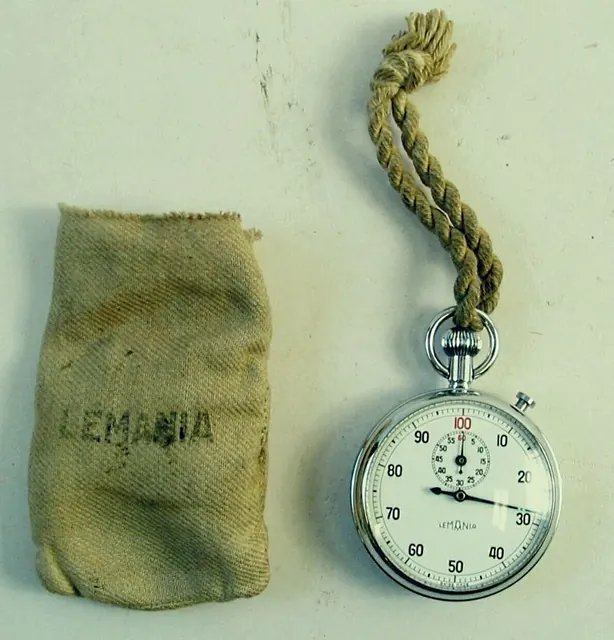
Stopwatch by Lemania, Switzerland, 1950–1970
Museokeskus Vapriikki
Wristwatches · c. 1970s
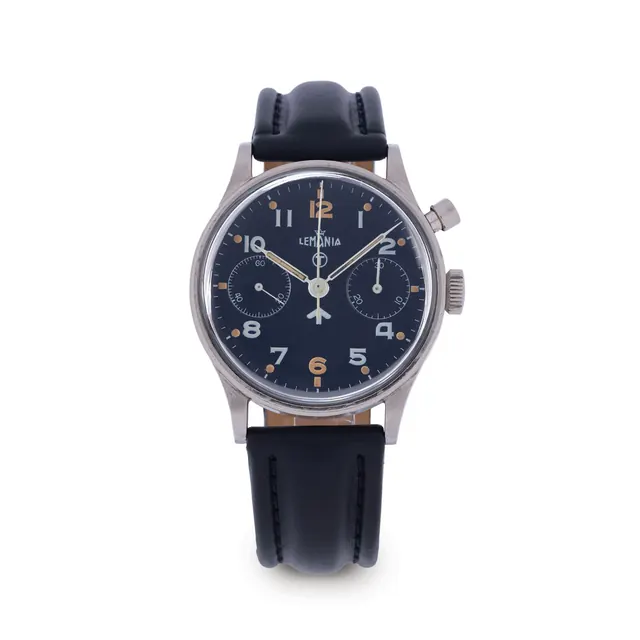
Lemania wristwatch, Series 2 Monopusher Chronograph, circa 1970s
Antiquorum auction archive, Geneva
Wristwatches · c. 1960s-1980s
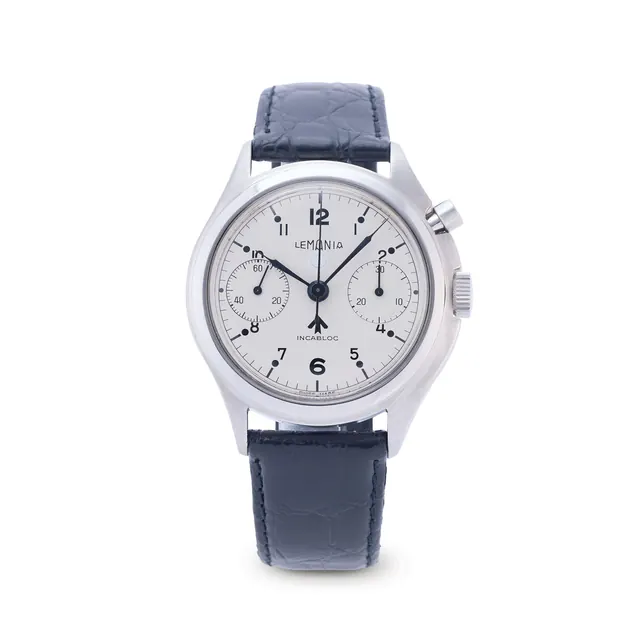
Lemania wristwatch, ref. 35-64, Series 3 Monopusher Chronograph, circa 1960s-1980s
Antiquorum auction archive, Geneva
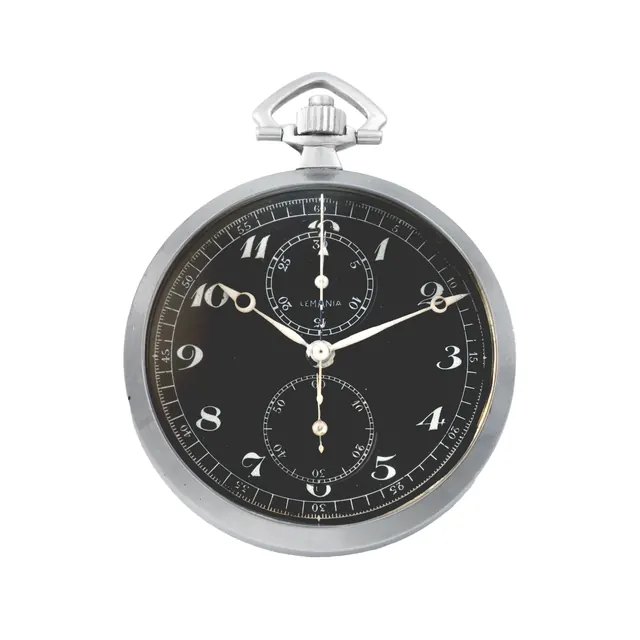
Pocket Watches · c. 1940
Lemania pocket watch, Single Button Chronograph, circa 1940
Antiquorum auction archive, Geneva

Wristwatches · 1945
Wristwatch by Eterna, 1945
Museum Rotterdam

Wristwatches · c. 1945
Breitling Premier, ref. 790, c. 1945
Antiquorum auction archive, Geneva

Wristwatches · c. 1945
Universal Genève Uni-Compax, ref. 22492, c. 1945
Antiquorum auction archive, Geneva

Wristwatches · c. 1950s
Baume & Mercier wristwatch, c. 1950s
Antiquorum auction archive, Geneva