
Wristwatches · Wristwatch
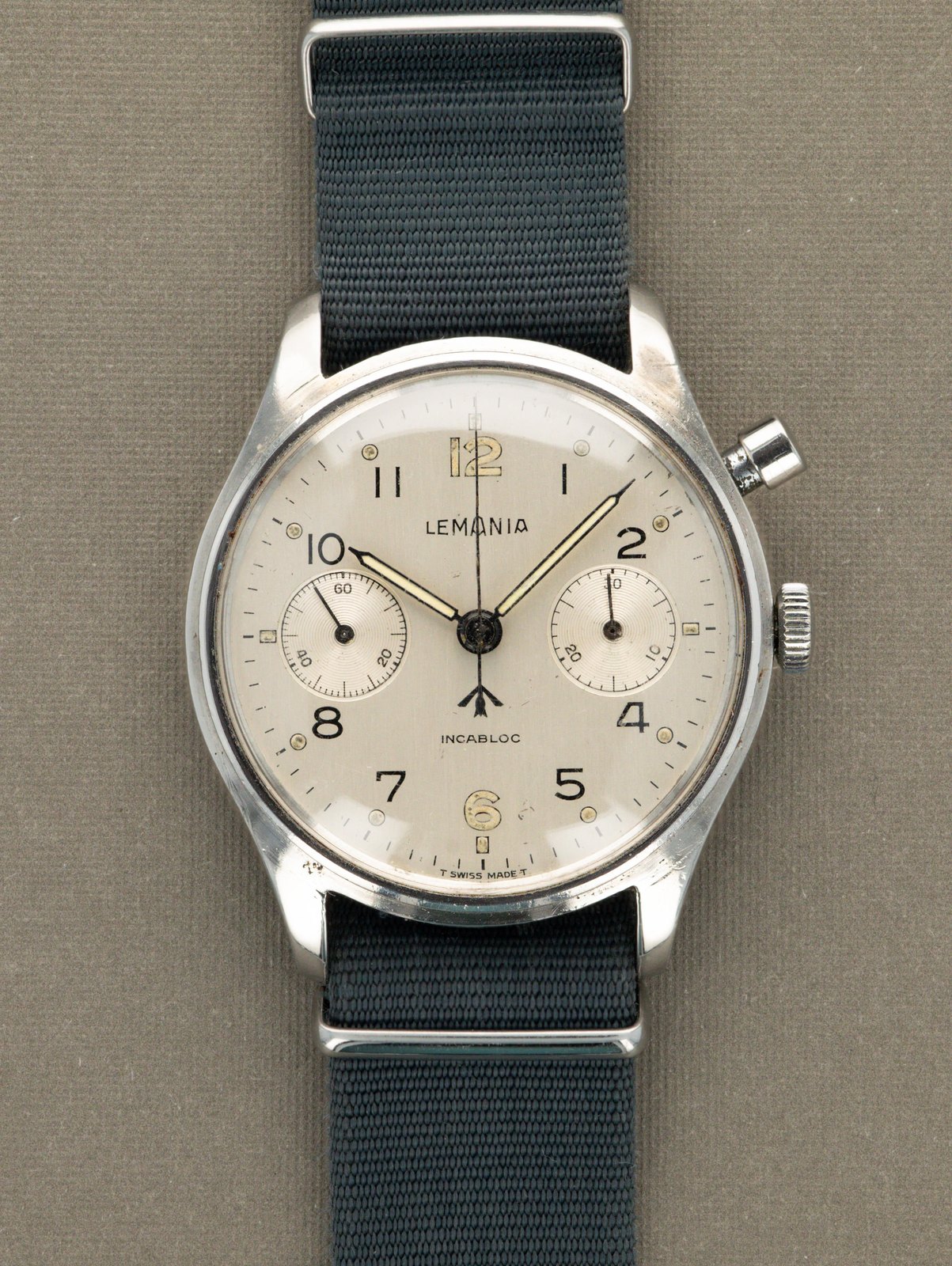
Lemania H.S.9 Monopusher Chronograph, 'Brushed' Silver Dial British Military Issued
- Maker / attribution
- Lemania (maker)
- Date
- c. 1960s
- Historical period
- Modern Mechanical Horology (1945 – 1969)
- Country of origin
- Switzerland
- Object type
- Wristwatch
- Materials / technique
- silver
- Dimensions
- Case 38 mm
- Stock no.
- OC3075
- Credit line
- Dealer listing, Oliver & Clarke (OC3075)
- Catalogue title (original)
- Lemania H.S.9 Monopusher Chronograph - 'Brushed' Silver Dial British Military Issued (English)
View the source record (dealer listing) ↗ (opens another website in a new tab)Suggest a correction
Record summary
Catalogued by Oliver & Clarke (dealer), United Kingdom (stock number OC3075), this is a wristwatch by Lemania, made in Switzerland, dated c. 1960s. The Atlas places it in the Modern Mechanical Horology period (1945 – 1969) of its Wristwatches collection. Materials and techniques recorded by the source: silver. Recorded dimensions: Case 38 mm. The record is illustrated with 6 photographs.
Assembled from the source record's structured fields. Dates and attributions are given as the source states them; where a field is missing the Atlas leaves it blank rather than estimating.
Catalogue description
Dealer description — Oliver & Clarke
Lemania can trace its roots back to the Vallée de Joux, where it was founded in 1884 by Alfred Lugrin, a former Jaeger-LeCoultre craftsman with a talent for complicated movements. Operating first under his own name, Lugrin built a modest but formidable reputation through his chronograph work before his son-in-law Marius Meylan took the reins around 1930 and renamed the company Lemania. Survival through the Great Depression came by joining forces with Omega and Tissot in 1932, and it was within the newly-formed alliance that Lemania's true legacy was forged: Every Omega chronograph movement for the next four decades, including the the iconic Calibre .321, would be supplied or closely based off Lemania calibres. The Quartz Crisis of the 1970s nearly unravelled it all, and by 1981 Lemania had separated from the group and reborn itself as Nouvelle Lemania. A decade later, Breguet brought it into the fold, and when the Swatch Group absorbed Breguet in 1999, the Lemania name was quietly retired — though its workshops now forming movements for Manufacture Breguet. The piece that we have here is a monopusher chronograph issued to the British Military. Dating to circa the 1960s, this piece is excellent overall condition given its past history. It features a wonderfully-sized 38mm case with a winding crown at the 3 o'clock position, a single 'pump' pusher at 2 o'clock, and a screw-down caseback with the appropriate military engravings. Inside, the silver dial is nicely preserved, showing only faint wear across the surface, with excellent text, patinated markers, and that desirable 'broad arrow' logo prominently featured on the lower half. The correct 'syringe' handset has been replaced — very likely under contract service as is the case with many military watches throughout history. Not only is this a piece of history, but when compared to other military-issued pieces from other brands, this actually is fantastic value, and they sure don't grow on trees!
Historical context
Modern Mechanical Horology (1945 – 1969)
Tool watches for divers, pilots and astronauts; electric watches anticipate the electronic age.
The classic era of the mechanical wristwatch: dive watches, chronographs for motor racing and space flight, GMT watches for jet travel, slim dress watches, automatic calendars, and the rise of Japanese manufacturers alongside Swiss, American, German and Soviet industries.
Read the period in the timelineMore wristwatches from this periodEarlier: Golden Age of Mechanical Watchmaking
Atlas type guide
Chronographs and split-seconds watches
A chronograph is a watch with an additional seconds hand that can be started, stopped and returned to zero independently of the timekeeping. Louis Moinet built an early example in 1816 and Nicolas Rieussec a recording 'chronographe' in 1821; Adolphe Nicole's heart-shaped reset cam (patented 1862) made the modern return-to-zero possible. Split-seconds (rattrapante) chronographs add a second hand that can be stopped for intermediate times; flyback chronographs restart instantly.
Chronographs were essential tools for doctors (pulsometer scales), artillery (telemeter), engineers and sport. In wristwatches, Valjoux, Venus, Lemania and later the automatic chronographs of 1969 (Zenith El Primero, the Chronomatic Calibre 11 group and Seiko 6139) are milestones.
What to look for
- Push-pieces on the case band or a single button in the crown (monopusher).
- Subsidiary registers for minutes and hours; tachymeter, telemeter or pulsometer scales.
- Column wheel versus cam control visible in the movement.
- Calibre markings of specialist makers (Valjoux, Lemania, Venus, Landeron).
Dating clues
- Pocket chronographs with heart cam reset: after 1862.
- Wrist chronographs: from c. 1910; two-button designs from the 1930s.
- Automatic chronographs: from 1969.
General guidance written by the Atlas editors about this kind of object. It is not a statement about this particular piece; for that, rely on the source record above and on physical examination.
Read next:Flyback chronographChronograph
Related records
Instruments · 1950–1970
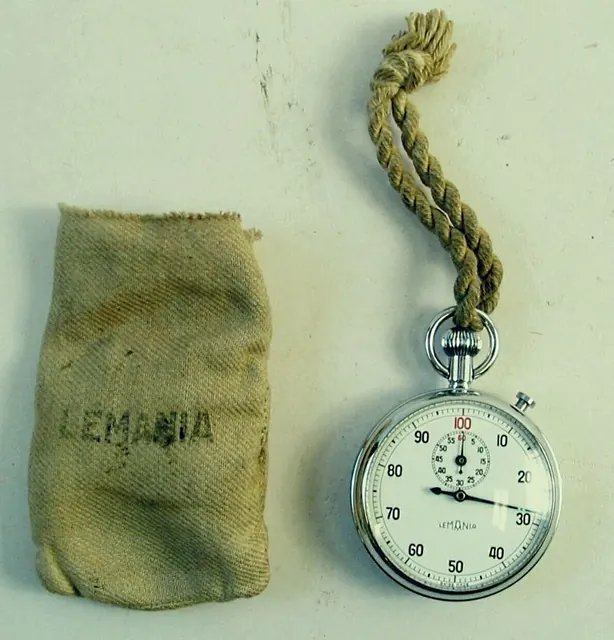
Stopwatch by Lemania, Switzerland, 1950–1970
Museokeskus Vapriikki
Wristwatches · c. 1970s
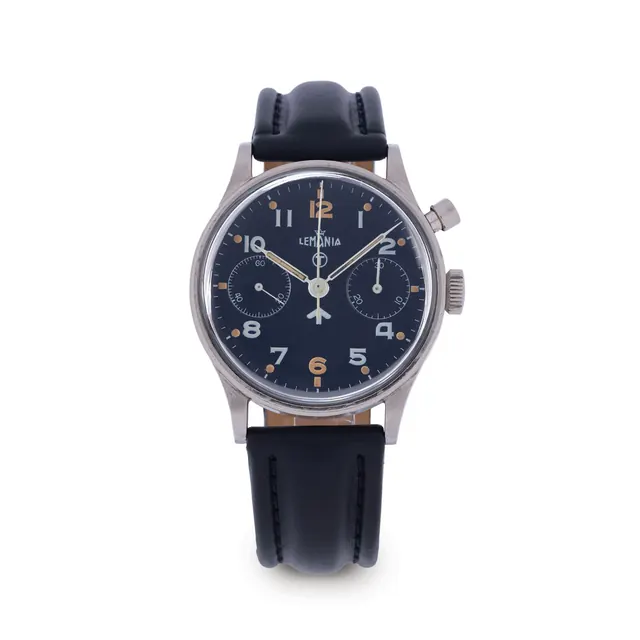
Lemania wristwatch, Series 2 Monopusher Chronograph, circa 1970s
Antiquorum auction archive, Geneva
Wristwatches · c. 1960s-1980s
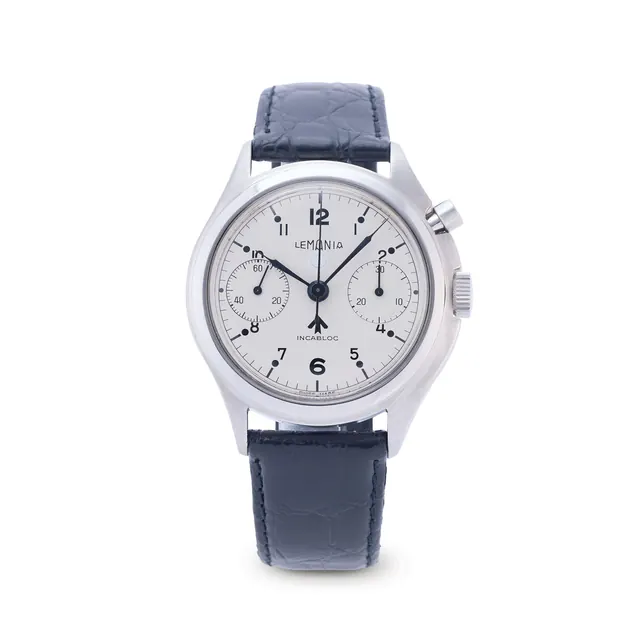
Lemania wristwatch, ref. 35-64, Series 3 Monopusher Chronograph, circa 1960s-1980s
Antiquorum auction archive, Geneva
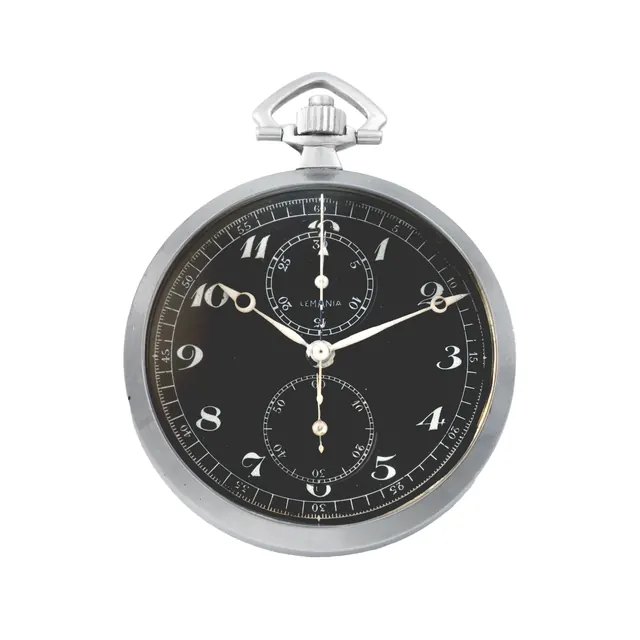
Pocket Watches · c. 1940
Lemania pocket watch, Single Button Chronograph, circa 1940
Antiquorum auction archive, Geneva

Wristwatches · 1945
Wristwatch by Eterna, 1945
Museum Rotterdam

Wristwatches · c. 1945
Breitling Premier, ref. 790, c. 1945
Antiquorum auction archive, Geneva

Wristwatches · c. 1945
Universal Genève Uni-Compax, ref. 22492, c. 1945
Antiquorum auction archive, Geneva

Wristwatches · c. 1950s
Baume & Mercier wristwatch, c. 1950s
Antiquorum auction archive, Geneva