
Wristwatches · Wristwatch
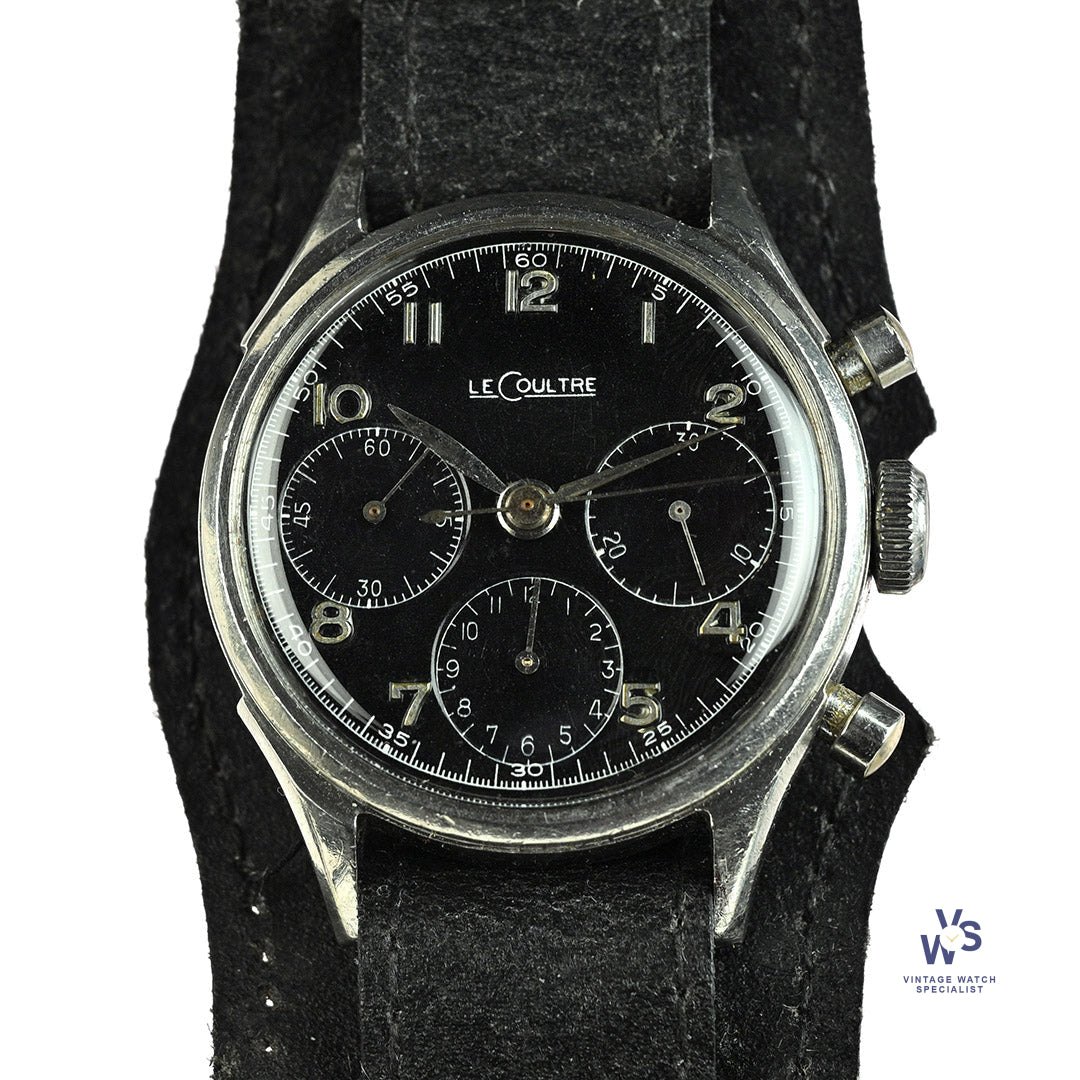
LeCoultre Three Register Chronograph, Valjoux 72, Black Gloss Dial, circa 1940s
- Maker / attribution
- LeCoultre (maker)
- Date
- c. 1940s
- Historical period
- Golden Age of Mechanical Watchmaking (1900 – 1945)
- Country of origin
- Switzerland
- Object type
- Wristwatch
- Stock no.
- vws4158
- Credit line
- Dealer listing, Vintage Watch Specialist (vws4158)
- Catalogue title (original)
- LeCoultre Three Register Chronograph - Valjoux 72 - Black Gloss Dial - c.1940s (English)
View the source record (dealer listing) ↗ (opens another website in a new tab)Suggest a correction
Record summary
Catalogued by Vintage Watch Specialist (dealer), United Kingdom (stock number vws4158), this is a wristwatch by LeCoultre, made in Switzerland, dated c. 1940s. The Atlas places it in the Golden Age of Mechanical Watchmaking period (1900 – 1945) of its Wristwatches collection. The record is illustrated with 6 photographs.
Assembled from the source record's structured fields. Dates and attributions are given as the source states them; where a field is missing the Atlas leaves it blank rather than estimating.
Catalogue description
Dealer description — Vintage Watch Specialist
A Striking LeCoultre Stainless Steel Three-Register Chronograph with Valjoux 72 Movement (c. 1940s–50s) LeCoultre refers to the American-market name used by the Swiss manufacture founded by Antoine LeCoultre in 1833 in the Vallée de Joux. For much of the early to mid-20th century, watches sold in the United States were signed simply LeCoultre , without the Jaeger name, due to distribution and trademark arrangements. These LeCoultre watches share the same in-house movements and craftsmanship as their European counterparts and are now highly regarded for their quality, elegance and historical significance. What's on Offer This LeCoultre three-register chronograph is a highly desirable mid-century example, combining classic design with one of the most respected chronograph movements of the era. Housed in a well-proportioned stainless steel case, the watch presents beautifully, with light, even wear that remains entirely sympathetic to its age and use. The case retains strong lines and a confident presence on the wrist, while the pump pushers sit neatly at the flanks, operating smoothly and positively. The rich black dial is exceptionally well balanced, featuring applied Arabic numerals that add depth and visual interest. Three evenly spaced subsidiary registers give the dial its iconic chronograph symmetry, while the central chronograph seconds hand sweeps cleanly around the outer seconds track, allowing elapsed time to be read with clarity and precision. The overall layout is both functional and visually striking, offering that perfect blend of tool-watch purpose and refined vintage charm. Inside, the watch is powered by the legendary Valjoux 72 chronograph movement, a calibre revered by collectors for its reliability, smooth operation and historical significance.
Historical context
Golden Age of Mechanical Watchmaking (1900 – 1945)
The wristwatch displaces the pocket watch; waterproof cases, self-winding and grand complications.
The wristwatch overtook the pocket watch. Military use in the First World War, aviation, water-resistant cases (1926), automatic winding (1923–31), rectangular Art Deco designs and early chronographs and calendars defined the period.
Read the period in the timelineMore wristwatches from this periodEarlier: Industrial Revolution
Atlas type guide
Chronographs and split-seconds watches
A chronograph is a watch with an additional seconds hand that can be started, stopped and returned to zero independently of the timekeeping. Louis Moinet built an early example in 1816 and Nicolas Rieussec a recording 'chronographe' in 1821; Adolphe Nicole's heart-shaped reset cam (patented 1862) made the modern return-to-zero possible. Split-seconds (rattrapante) chronographs add a second hand that can be stopped for intermediate times; flyback chronographs restart instantly.
Chronographs were essential tools for doctors (pulsometer scales), artillery (telemeter), engineers and sport. In wristwatches, Valjoux, Venus, Lemania and later the automatic chronographs of 1969 (Zenith El Primero, the Chronomatic Calibre 11 group and Seiko 6139) are milestones.
What to look for
- Push-pieces on the case band or a single button in the crown (monopusher).
- Subsidiary registers for minutes and hours; tachymeter, telemeter or pulsometer scales.
- Column wheel versus cam control visible in the movement.
- Calibre markings of specialist makers (Valjoux, Lemania, Venus, Landeron).
Dating clues
- Pocket chronographs with heart cam reset: after 1862.
- Wrist chronographs: from c. 1910; two-button designs from the 1930s.
- Automatic chronographs: from 1969.
General guidance written by the Atlas editors about this kind of object. It is not a statement about this particular piece; for that, rely on the source record above and on physical examination.
Read next:Flyback chronographChronograph
Related records
Wristwatches · c. 1960s
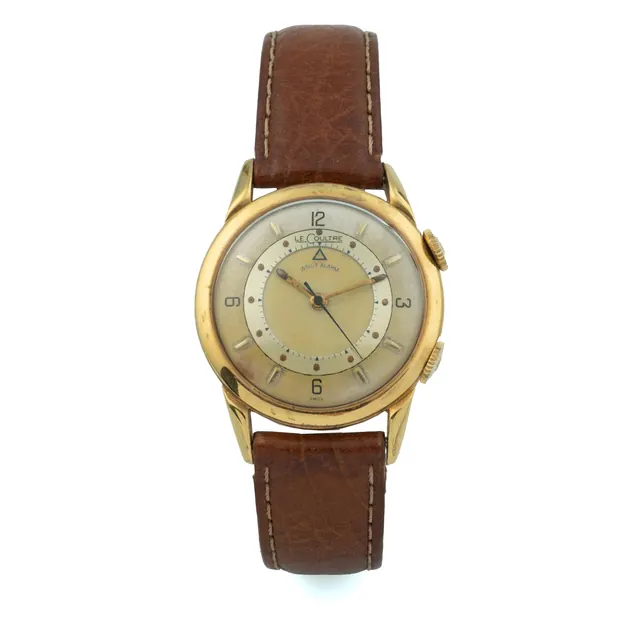
LeCoultre wristwatch, Memovox, circa 1960's
Antiquorum auction archive, Geneva
Wristwatches · c. 1960s
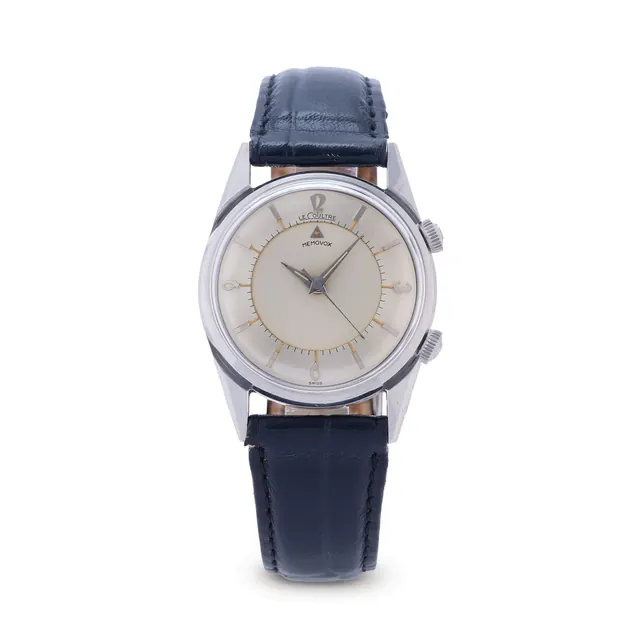
LeCoultre wristwatch, ref. 2404, Menovox Alarm, circa 1960’s
Antiquorum auction archive, Geneva
Clocks · c. 1960-1970s
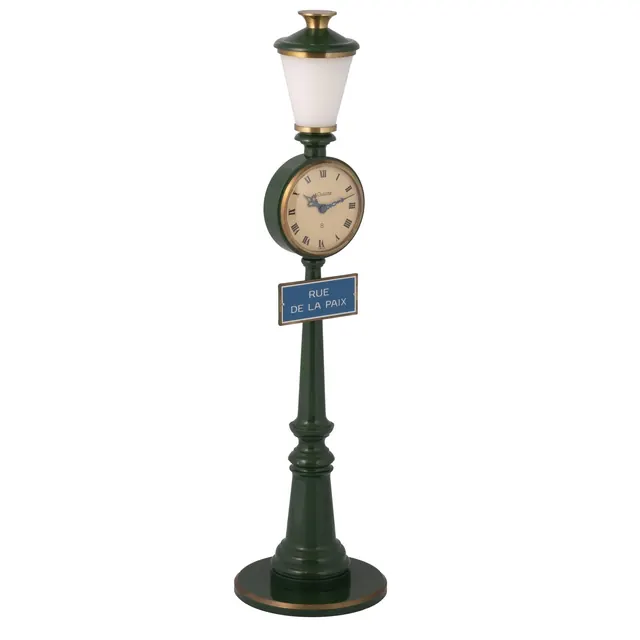
LeCoultre table clock, ref. 397, Rue de la Paix Gilt Brass, circa 1960-1970s
Antiquorum auction archive, Geneva
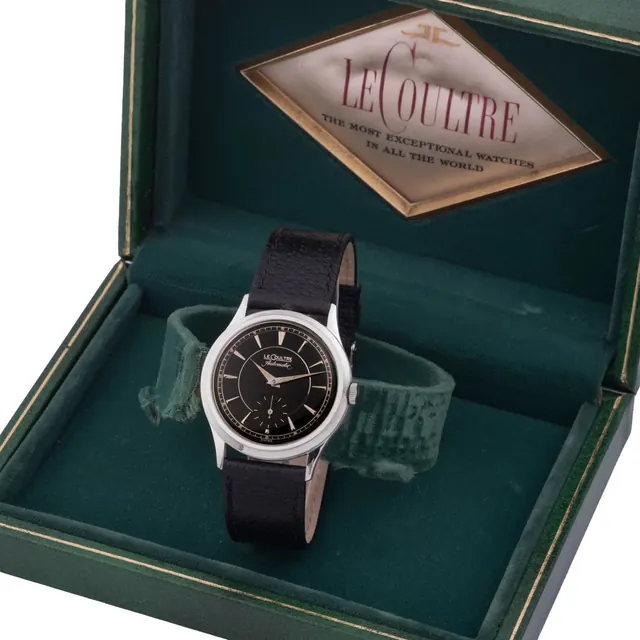
Wristwatches · c. 1956
LeCoultre wristwatch, circa 1956
Antiquorum auction archive, Geneva

Wristwatches · 1931
Rolex 'Oyster Perpetual' rotor self-winding wrist-watch, lever escapement, in steel case with glass in back, Montres Rolex SA, Geneva, Switzerland, 1931
Science Museum Group, London

Wristwatches · 1900–1999
Wristwatch by Certina, Switzerland, 1900–1999
Nordic Museum Foundation
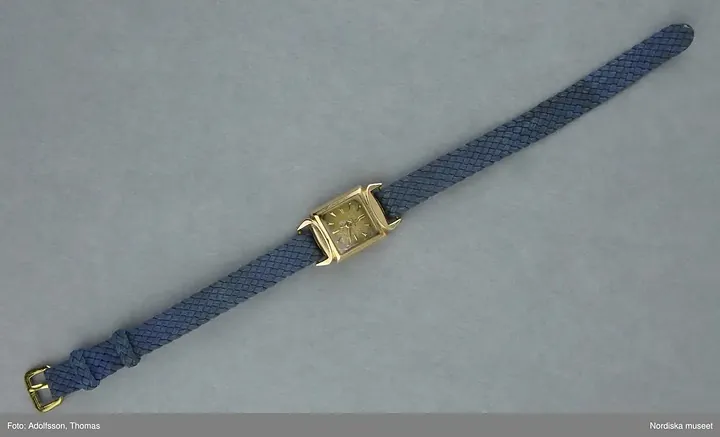
Wristwatches · 1900–1999
Wristwatch by Omega, Västerås, 1900–1999
Nordic Museum Foundation
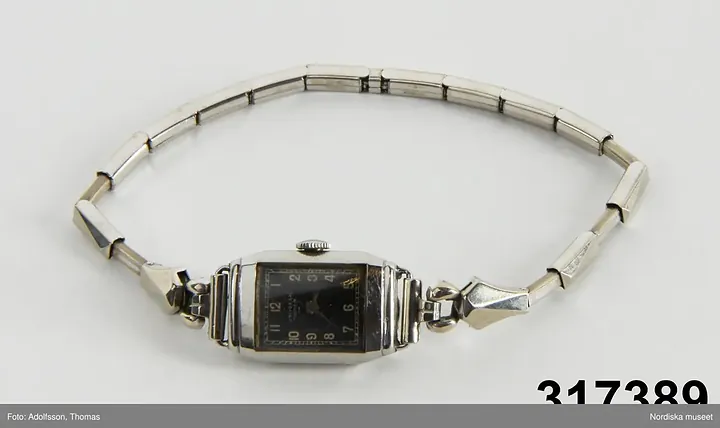
Wristwatches · 1900–1999
Wristwatch by Universal, Switzerland, 1900–1999
Nordic Museum Foundation