Clocks · Clock
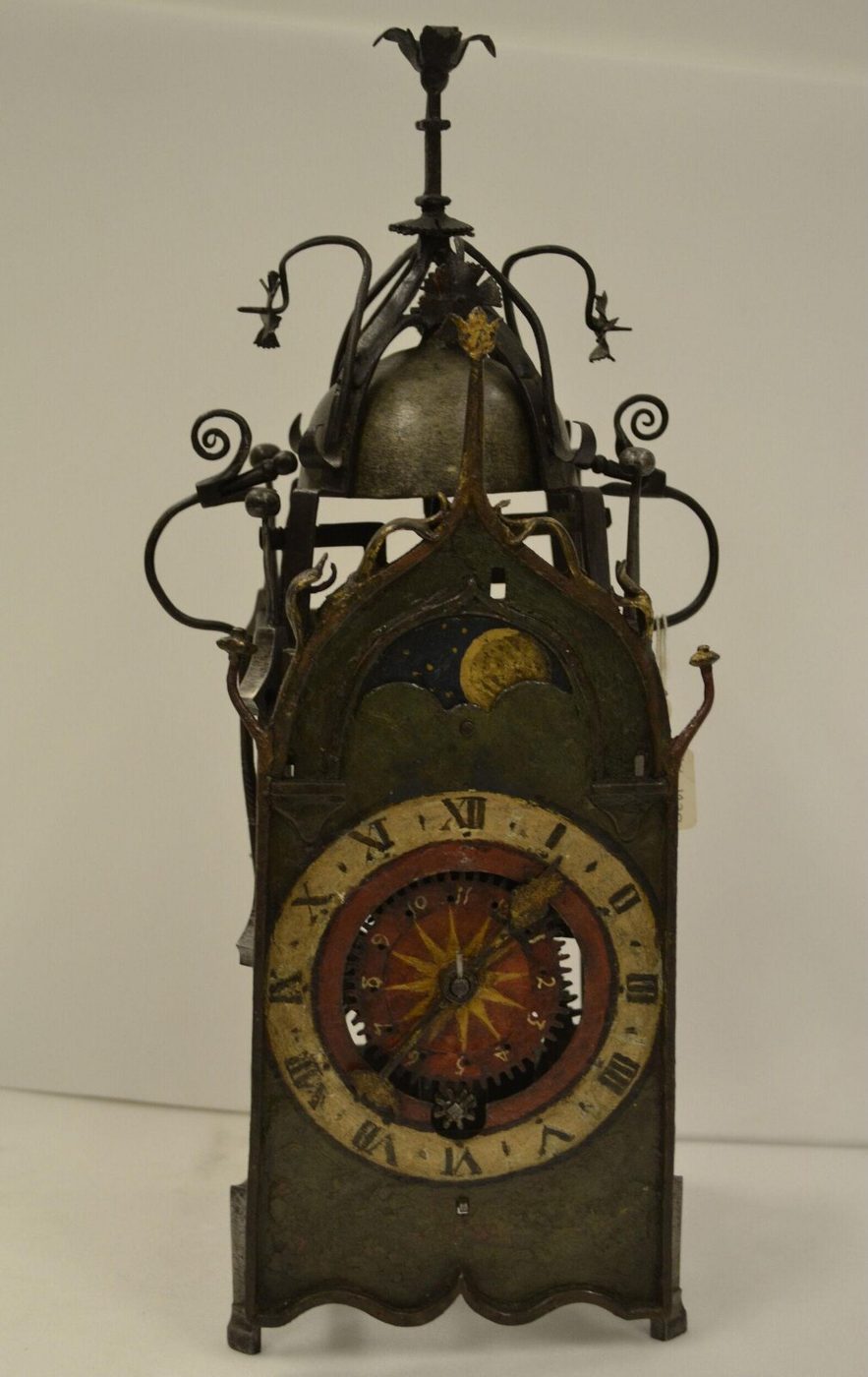
Lantern clock with clock weights
- Maker / attribution
- Erhard Liechti
- Date
- 1579
- Historical period
- Renaissance Horology (1400 – 1600)
- Country of origin
- Unrecorded in source
- Place
- Winterthur
- Object type
- Clock
- Materials / technique
- Wrought iron with painted dial
- Dimensions
- Depth: 170 mm; Height: 426 mm; Width: 195 mm
- Holding institution
- Victoria and Albert Museum, London
- Accession / object no.
- M.6:1 to 3-1932
Record summary
Held and catalogued by Victoria and Albert Museum, London (object number M.6:1 to 3-1932), this is a clock by Erhard Liechti, made in Winterthur, dated 1579. The Atlas places it in the Renaissance Horology period (1400 – 1600) of its Clocks collection. Materials and techniques recorded by the source: Wrought iron with painted dial. Recorded dimensions: Depth: 170 mm; Height: 426 mm; Width: 195 mm. The record is illustrated with 3 photographs.
Assembled from the source record's structured fields. Dates and attributions are given as the source states them; where a field is missing the Atlas leaves it blank rather than estimating.
Catalogue description
V&A — Physical description
CASE: Posted frame with four corner pillars, angled and with deeply-cut Gothic mouldings at the top and near the middle, the pillars splayed out at the bottom and ending in vertical slightly-moulded feet and each surmounted by a finial with ball top. The pillars linked by a horizontal strap 11.4cm square at the top and a similar strap 12.7cm at the bottom. Signed in pointille on the lower strap “EL 1579” (for Erhard Liechti). DIAL: painted dial-plate with moulded crocketed ogee top enclosing a lunar dial, and with shaped and moulded bottom. White chapter-ring 12.1cm diameter, 1.3cm broad, with Roman hours and diamond-shaped half-hour marks. Central hole (7.4cm diameter), occupied by a rotating disk (7.0cm diameter) with 48 teeth at its circumference and driven by an 8T wheel above VI. Attached to the disc is the hour-hand, one end of which is literally in the form of a hand with pointing forefinger and the other end a shaped balancing piece. The disc with a 12-pointed gilt sunburst and now numbered 1 to 12 clockwise in Arabic; beside each numeral is a small hole for insertion of an alarm pin. (The numbering should be anti-clockwise). Within the arch, a moon-phase aperture through which is seen a rotating disc with one of two effigies of the full moon on a deep-blue background with gilt fixed stars. MOVEMENT: The movement trains mounted between three vertical strips that are 2.2cm wide. The bell contained within four stepped straps, decorated by florets and surmounted by a finial ending in four down-turned petals. Both main trains weight-driven, with spiked pulleys and ratchet wheels. Going train and at front, with verge escapement, crown-wheel and foliot balance (these last two probably renewals). The great wheel rotates once every two hours and carries two pairs of release pins, one pair on either side of the wheels, each lifting its own “nag’s head”. The rear nag’s head gives a single stroke at the half-hours, by direct operation from the right-hand bell-hammer. The nag’s head at the front releases the striking train, which is at the rear of the movement, with an external count-wheel with internal teeth. Alarm train at the top front, with a grooved pulley coaxial with a crown-wheel driving a verge and double-ended hammer. There is at present no connection between this alarm and the alarm dial. Both bell-hammers are ornate, and each includes a scroll. The moon-phase disc is driven by two stages of reduction gearing from the hour-hand arbor, the gearing being 5/50, 5/59.
V&A — Historical context
The Liechti family of clockmakers were active for more than 300 years. Ulrich (died 1627) and Andreas I (1562-1621) were the sons of Erhard Liechti, and at the latter's death in 1591 they jointly continued the workshop, a partnership which lasted until 1599 or shortly afterwards. Two other clocks signed by Erhard and dated 1572 and 1580 are in the Gewerbe Museum, Winterthur
V&A — Object history
Given by W.E.Miller
Inscriptions & marks
“EL 1579”
Historical context
Renaissance Horology (1400 – 1600)
Spring power makes clocks portable; Nuremberg and Augsburg produce the first watches; the Prague Orloj is built.
Spring power made the domestic clock portable. Augsburg and Nuremberg produced gilt-brass table clocks, often with astronomical dials and alarms; weight-driven Gothic wall clocks and English lantern clocks served households. Clocks of this period have foliot or balance-wheel control and usually only an hour hand.
Read the period in the timelineMore clocks from this periodEarlier: Medieval Period
Atlas type guide
Lantern, chamber and Gothic clocks
Domestic weight-driven clocks were made in southern Germany, Switzerland, Italy and Flanders from the fifteenth century. These 'Gothic' or chamber clocks have an open iron frame with corner posts, a verge escapement controlled by a foliot or balance wheel, and often an alarm or hour striking on a bell mounted above.
In England the lantern clock appeared around 1600: a brass posted-frame clock with a bell on top under decorative frets, hung on a hook or set on a wall bracket. After about 1658 many were converted to pendulum control, so originality of the escapement is a key question for any surviving example.
What to look for
- Iron (continental) or brass (English) posted frames with turned corner pillars and finials.
- A single hour hand — minute hands are rare before the pendulum era.
- Evidence of conversion: plugged holes, replaced escapement wheels or later pendulums.
- Fret designs and engraving on the dial centre, which help date English lantern clocks.
Dating clues
- Continental Gothic chamber clocks: c. 1450–1650.
- English lantern clocks: c. 1600–1720, with provincial examples later.
- Short 'bob' pendulum conversions after 1658; long pendulums with anchor escapement after c. 1670.
General guidance written by the Atlas editors about this kind of object. It is not a statement about this particular piece; for that, rely on the source record above and on physical examination.
Read next:Anchor (recoil) escapement
Related records
Clocks · 1400–1499
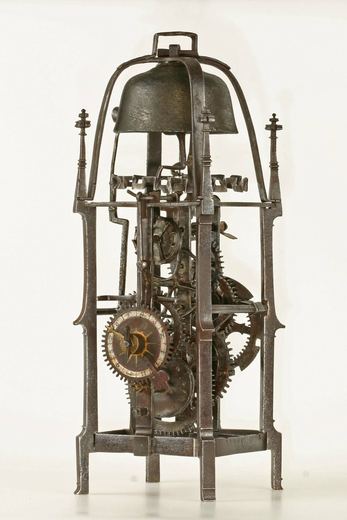
Alarm clock, Germany, 1400–1499
German Clock Museum
Clocks · Mid-15th century
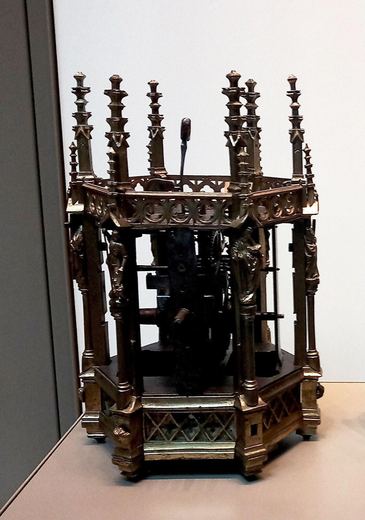
Clock with iron movement in gilt brass case. Burgundian; mid-15th-century (with later restorations).
Victoria and Albert Museum, London
Clocks · 1400-1499
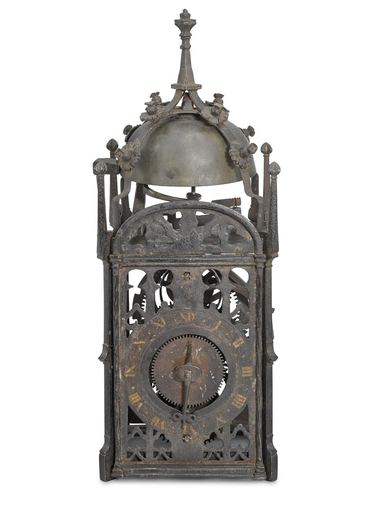
Lantern clock, Germany, 1400-1499
Science Museum Group, London
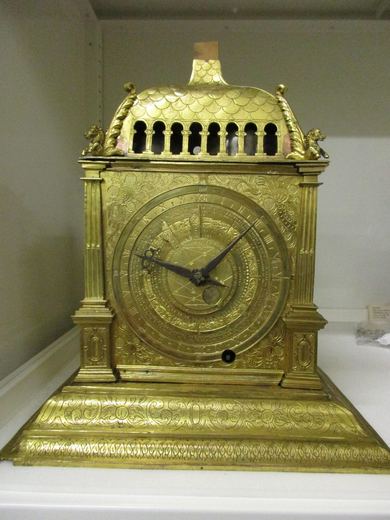
Clocks · 1500-1600
An astronomical clock in a gilt-bronze case, Venetian, sixteenth century.
Victoria and Albert Museum, London
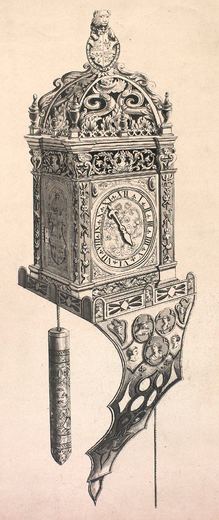
Clocks · 1500–1599
Bracket clock by Anne Boleyn, United Kingdom, 1500–1599
Archaeology Data Service
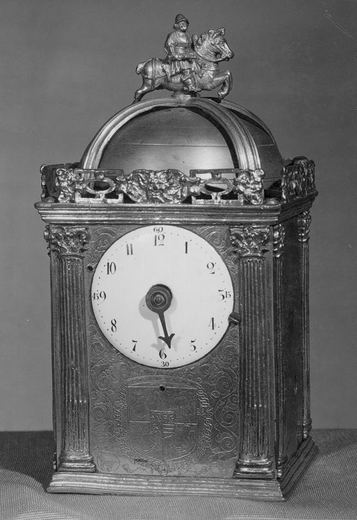
Clocks · 1500–1599
Clock by P. Plantart, Belgium, 1500–1599
Royal Institute for Cultural Heritage
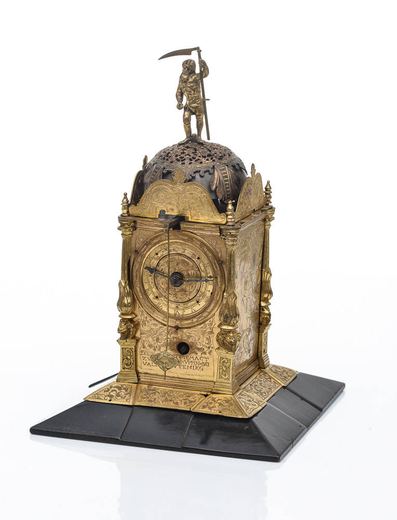
Clocks · 1500–1599
Table clock by Rutenieg, Valentin (um 1550) (Uhrmacher), Germany, 1500–1599
City Museum Berlin
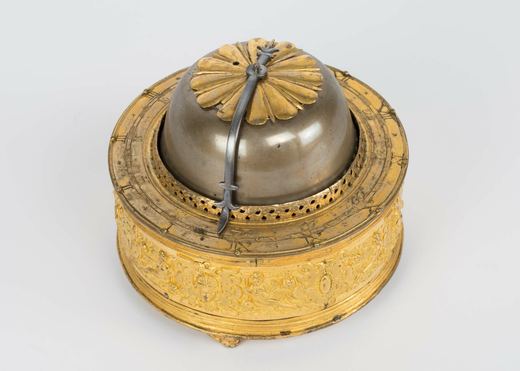
Clocks · 1500–1599
Table clock, Denmark, 1500–1599
German Clock Museum