
Wristwatches · Wristwatch
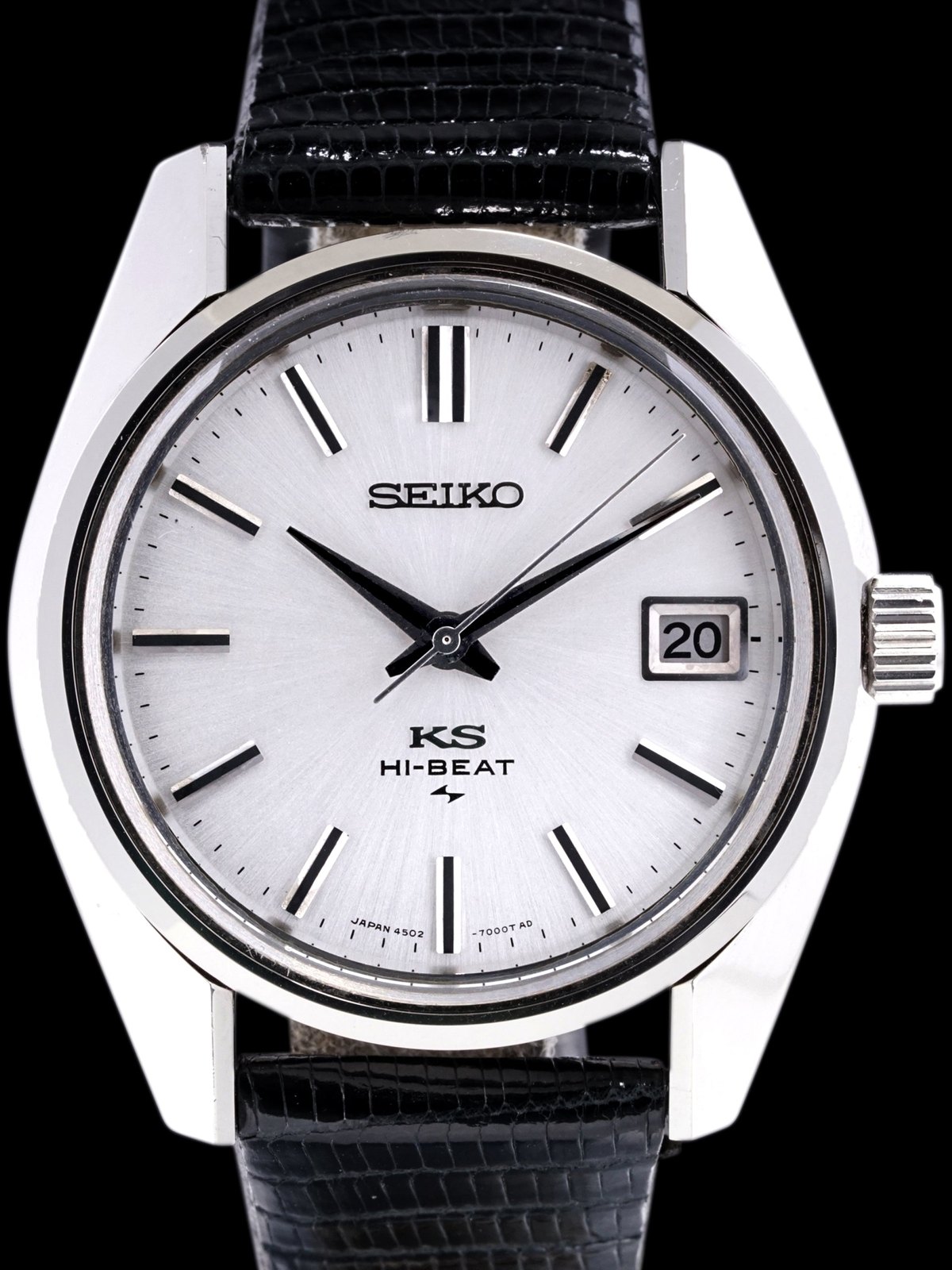
King Seiko HI-Beat (Ref. 4502-7001), 1973
- Maker / attribution
- Seiko (maker)
- Date
- 1973
- Historical period
- Quartz Revolution (1969 – 1990)
- Country of origin
- Japan
- Object type
- Wristwatch
- Dimensions
- Case 36 mm
- Stock no.
- KSKO45027001
- Credit line
- Dealer listing, Craft & Tailored (KSKO45027001)
- Catalogue title (original)
- 1973 King Seiko HI-Beat (Ref. 4502-7001) (English)
View the source record (dealer listing) ↗ (opens another website in a new tab)Suggest a correction
Record summary
Catalogued by Craft & Tailored (dealer), Los Angeles (stock number KSKO45027001), this is a wristwatch by Seiko, made in Japan, dated 1973. The Atlas places it in the Quartz Revolution period (1969 – 1990) of its Wristwatches collection. Recorded dimensions: Case 36 mm. The record is illustrated with 6 photographs.
Assembled from the source record's structured fields. Dates and attributions are given as the source states them; where a field is missing the Atlas leaves it blank rather than estimating.
Catalogue description
Dealer description — Craft & Tailored
Fans of Seiko have almost certainly heard the fascinating story of inter-company competition between King Seiko and Grand Seiko during the 1960s and 1970s. Back then, Seiko had two separate factories creating its watches, with Grand Seiko produced at the Suwa factory and King Seiko produced by the Daini factory. Seiko’s objective behind having its two factories compete against each other was to promote progress through competition, with the end goal of building the best timepieces possible. King Seiko watches were produced from approximately 1961 until 1975 and this particular King Seiko Hi-Beat ref. 4502-7001 dates to 1973, making it among the final examples of the Daini factory’s line of luxury Seiko watches. The “Hi-Beat” name is due to the manually-wound caliber 4502A movement, which beats at a frequency of 36,000bph and offers greater precision from within the watch’s angular “Grammar of Design” case. SPECS Stock # KSKO45027001 Brand King Seiko Style HI-Beat Model 4502-7001 Serial 37XXXXX Size Men's Material Stainless Steel Dial Silver Millimeters 36 Bracelet 2pc Patent Lizard Strap W/ King Seiko Buckle CASE & BRACELET The 36mm stainless steel case is in excellent overall condition and retains its crisp lines, sharp angles, and the distinct broad lugs that define Seiko’s Grammar of Design philosophy. While the case of the King Seiko Hi-Beat ref. 4502-7001 is not the exact same as the famed 44GS case, it shares an incredibly similar overall appearance that is unique to Seiko. Completing the watch is a two-piece patent lizard skin strap fitted with a stainless steel King Seiko signed buckle DIAL & HANDS The original silver dial is in exceptional condition and features a subtle sunburst pattern with faceted, applied hour markers and a framed date window at the 3 o’clock location. All of the dial fittings, along with the faceted dauphine hands are finished to the exceptional standards that are associated with King Seiko watches, and since neither the dial nor the hands feature any luminescent material, there is nothing to interrupt their brilliantly polished surfaces. ACCESSORIES None. Watch is functioning perfectly and keeping time, previous service history is unknown.
Historical context
Quartz Revolution (1969 – 1990)
Seiko's Astron begins mass quartz timekeeping; traditional industries contract sharply.
Quartz and digital watches transformed the market after 1969. Swiss employment collapsed, Japanese and Hong Kong production soared, and the Swatch (1983) helped the Swiss industry recover; mechanical watches survived as luxury goods.
Read the period in the timelineMore wristwatches from this periodEarlier: Modern Mechanical Horology
Atlas type guide
Wristwatches
Bracelet watches were worn by women from the early nineteenth century — Breguet made one for Caroline Murat, Queen of Naples, in 1810–12 — but the wristwatch only became a man's instrument with military use and aviation in the early twentieth century. Between the World Wars it overtook the pocket watch; the 1920s and 1930s brought rectangular Art Deco cases, water-resistant cases and the first automatic winding systems.
After 1945 the wristwatch became a carrier of identity — dress watches, sports and dive watches, chronographs, calendars — produced by Swiss, American, Japanese, German, Soviet and Chinese industries. The quartz revolution after 1969 and the mechanical renaissance since the 1990s, including the rise of independent watchmakers, complete the story.
What to look for
- The reference number (between the lugs or inside the case back) and serial number, the starting point for dating.
- The calibre: its maker and number are often stamped under the dial or on the bridge.
- Originality of dial, hands and crown — refinished ('redial') dials are common.
- Case material marks: 18K/750, 14K/585, stainless steel, gold-filled, plated.
Dating clues
- Wire-lug cases: before c. 1925.
- Water-resistant screw-down cases: from 1926.
- Quartz movements: from 1969; sapphire crystals widespread after c. 1980.
General guidance written by the Atlas editors about this kind of object. It is not a statement about this particular piece; for that, rely on the source record above and on physical examination.
Related records
Wristwatches · 1967
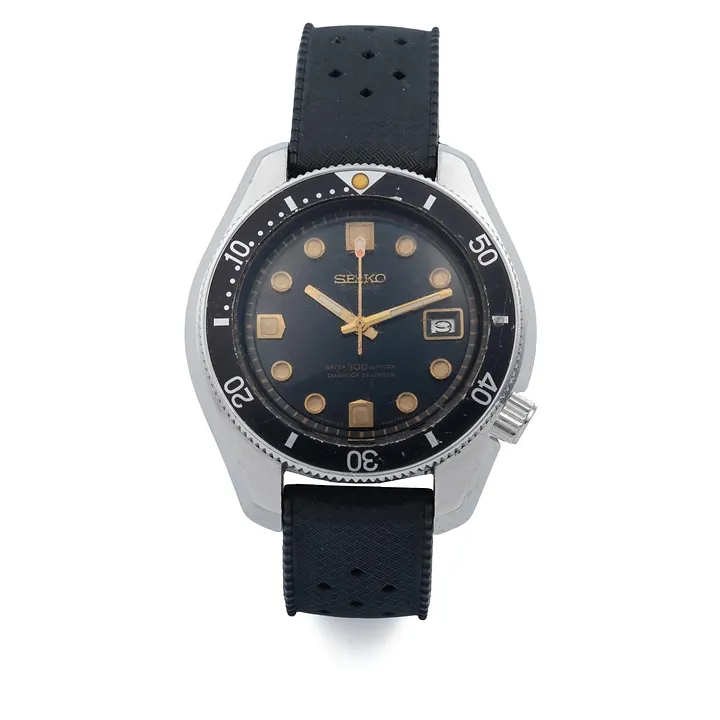
Seiko 300 M, ref. 6215-7000, 1967
Antiquorum auction archive, Geneva
Wristwatches · 1967
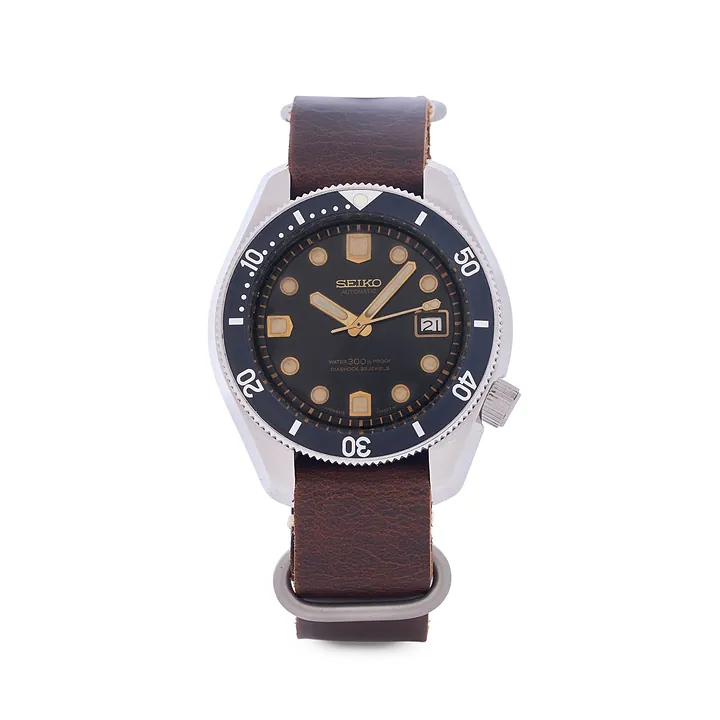
Seiko 300 Meter Diver, ref. 6215-7000, 1967
Antiquorum auction archive, Geneva
Wristwatches · c. 1968
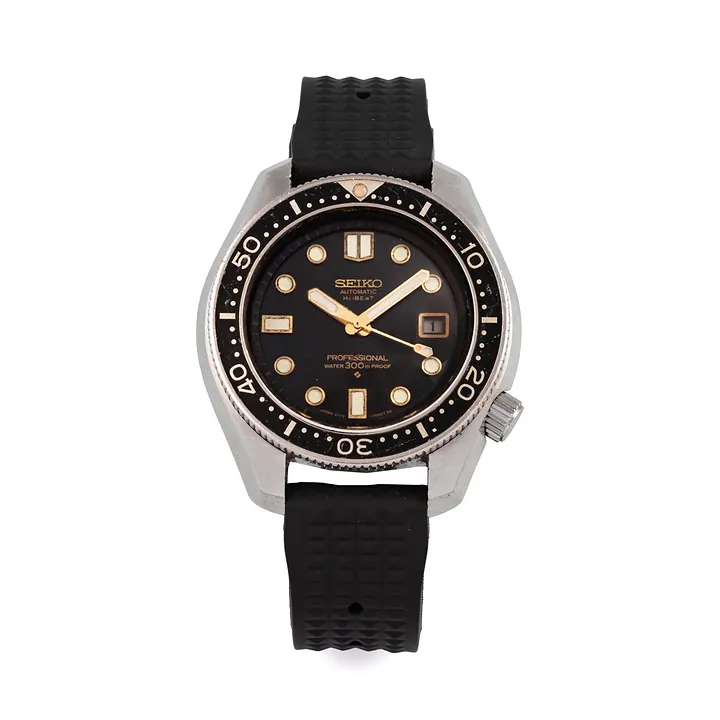
Seiko Hi-Beat, ref. 6159-7000, c. 1968
Antiquorum auction archive, Geneva
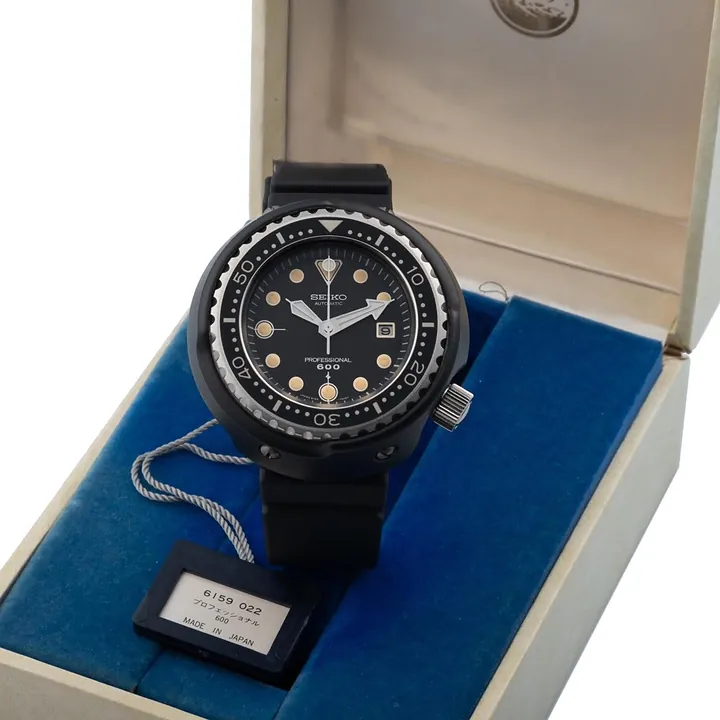
Wristwatches · 1975
Seiko Tuna Professional 600, ref. 6159-7010, 1975
Antiquorum auction archive, Geneva
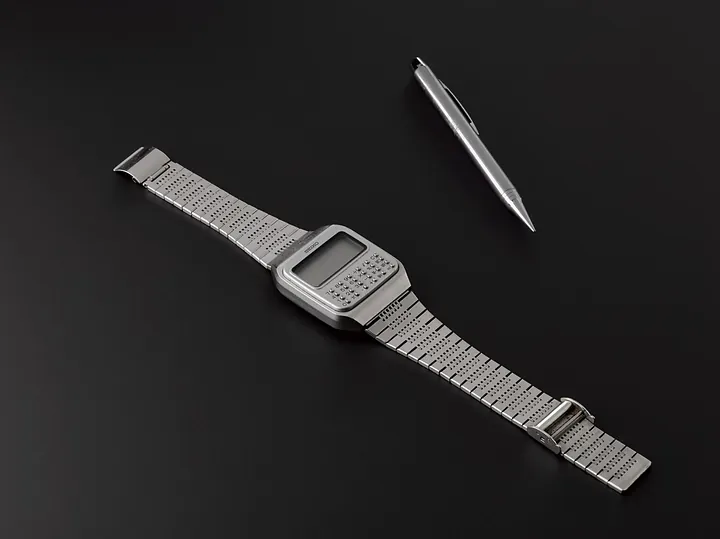
Wristwatches · 1978
Calculator wristwatch by Suwa Seikosha Co. Limited, Japan, 1978
Science Museum Group, London
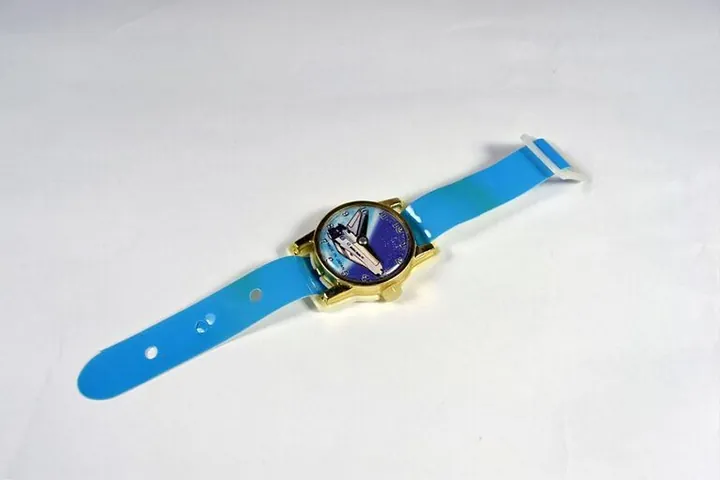
Wristwatches · 1980–1982
Wristwatch, Space Shuttle; plastic, Japan, 1970-1979?
Victoria and Albert Museum, London
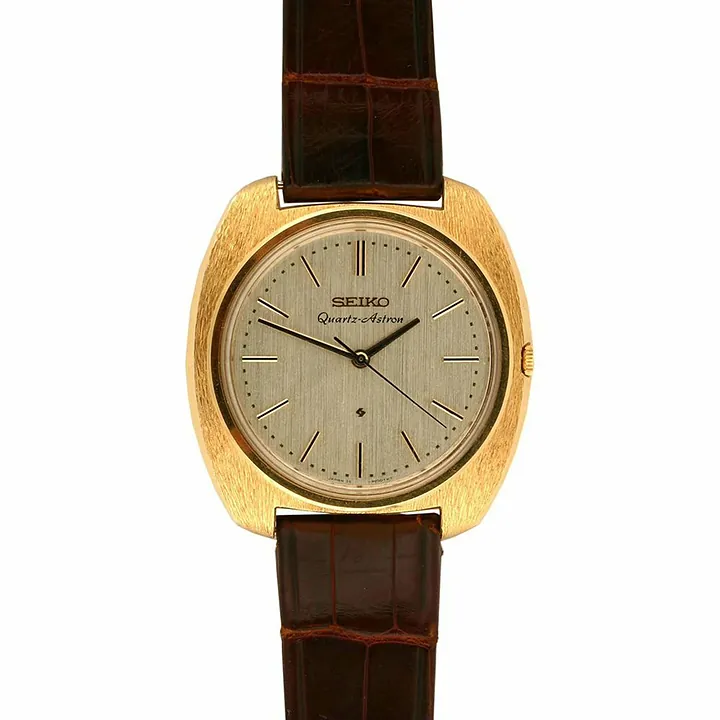
Wristwatches · 1969
Wristwatch, Japan, 1969 (no. 29912)
German Clock Museum
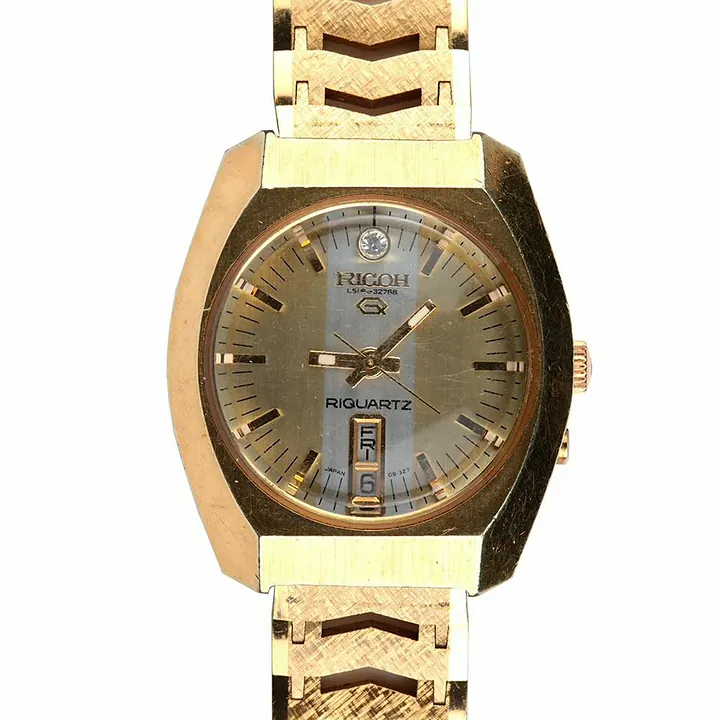
Wristwatches · c. 1972
Wristwatch, Japan, c. 1972
German Clock Museum