
Wristwatches · Wristwatch
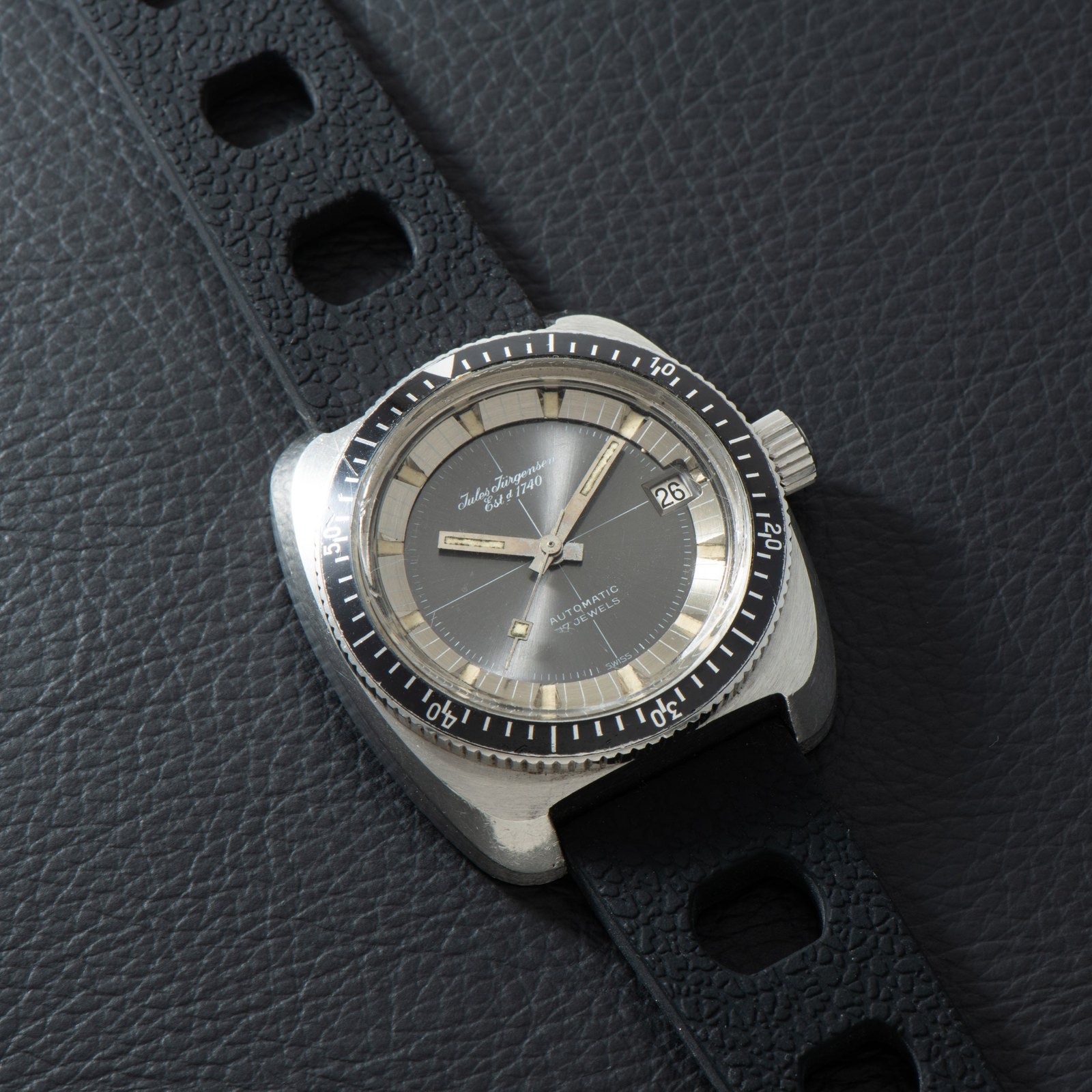
Jules Jurgensen Diver, 1970s
- Maker / attribution
- Jules Jurgensen (maker)
- Date
- 1970s
- Historical period
- Quartz Revolution (1969 – 1990)
- Country of origin
- Unrecorded in source
- Object type
- Wristwatch
- Dimensions
- Case 36 mm
- Stock no.
- 40993392
- Credit line
- Dealer listing, Analog/Shift (40993392)
- Catalogue title (original)
- Jules Jurgensen Diver (English)
View the source record (dealer listing) ↗ (opens another website in a new tab)Suggest a correction
Record summary
Catalogued by Analog/Shift (dealer), New York (stock number 40993392), this is a wristwatch by Jules Jurgensen, dated 1970s. The Atlas places it in the Quartz Revolution period (1969 – 1990) of its Wristwatches collection. Recorded dimensions: Case 36 mm. The record is illustrated with 6 photographs.
Assembled from the source record's structured fields. Dates and attributions are given as the source states them; where a field is missing the Atlas leaves it blank rather than estimating.
Catalogue description
Dealer description — Analog/Shift
The history of watchmaking under the Jurgensen name goes all the way back to the 1700s to the family's progenitor, Jorgen Jurgensen, a runaway farm boy who became the apprentice to (and later, the business partner of) a heralded watchmaker in Locle, Switzerland. Jorgen's son, Urban, followed in his father's footsteps, studying below some of the best watchmakers of the era in Switzerland, Paris and London. By the time Jules was born in 1808, the family name was enmeshed with clock and watchmaking. Jules furthered the prestige by designing and achieving patents that became benchmarks of style and function for pocket watches, so much so that they were incorporated into many American pocket watches right through to the late 1800s. The Jurgensen name continued to resonate throughout Europe well into the mid-1900s, despite having been sold to an American company in the late 1930s. By 1960, the brand had lost much of it's production capabilities and were using more Swiss contract parts to produce their timepieces. But what the brand never lost sight of was building unique and interesting timepieces capable of stirring all walks of enthusiasts. This particular piece, likely from the 1970s, caught our eye immediately. Most overt is the incredible 36mm cushion case with wide flanks and a rotating bezel, but the grey dial is really the star of the show. The dial, sporting the storied Jules Jurgensen name, bears an inner chapter ring with beautifully patinaed indices. With the inclusion of a date function at 3:00, this one is a head-turner that is sure to be a pleasure to wear on the regular.
Historical context
Quartz Revolution (1969 – 1990)
Seiko's Astron begins mass quartz timekeeping; traditional industries contract sharply.
Quartz and digital watches transformed the market after 1969. Swiss employment collapsed, Japanese and Hong Kong production soared, and the Swatch (1983) helped the Swiss industry recover; mechanical watches survived as luxury goods.
Read the period in the timelineMore wristwatches from this periodEarlier: Modern Mechanical Horology
Atlas type guide
Dive and water-resistant watches
Keeping water and dust out of a wristwatch was a long-standing challenge. Rolex's screw-down Oyster case (1926) and Omega's Marine (1932) were landmarks; in the early 1950s Blancpain's Fifty Fathoms and Rolex's Submariner defined the professional dive watch with rotating bezels for timing dives, luminous dials and high water resistance. The ISO 6425 standard (1982) later codified what a 'diver's watch' must do.
Dive watches became icons of post-war design and exploration, and their evolution — helium escape valves, ceramic bezels, saturation-diving depth ratings — records the history of underwater work.
What to look for
- Unidirectional or bidirectional rotating bezel with minute markings.
- Screw-down crown and case back; depth rating printed on the dial.
- Luminous hands and markers (radium before c. 1960, tritium c. 1960–1998, then Super-LumiNova).
- Reference numbers on the case between the lugs or inside the back.
Dating clues
- Screw-down Oyster cases: from 1926.
- Professional dive watches: from 1953.
- Tritium 'T' marks on dials: c. 1960–1998.
General guidance written by the Atlas editors about this kind of object. It is not a statement about this particular piece; for that, rely on the source record above and on physical examination.
Related records
Wristwatches · 1970s
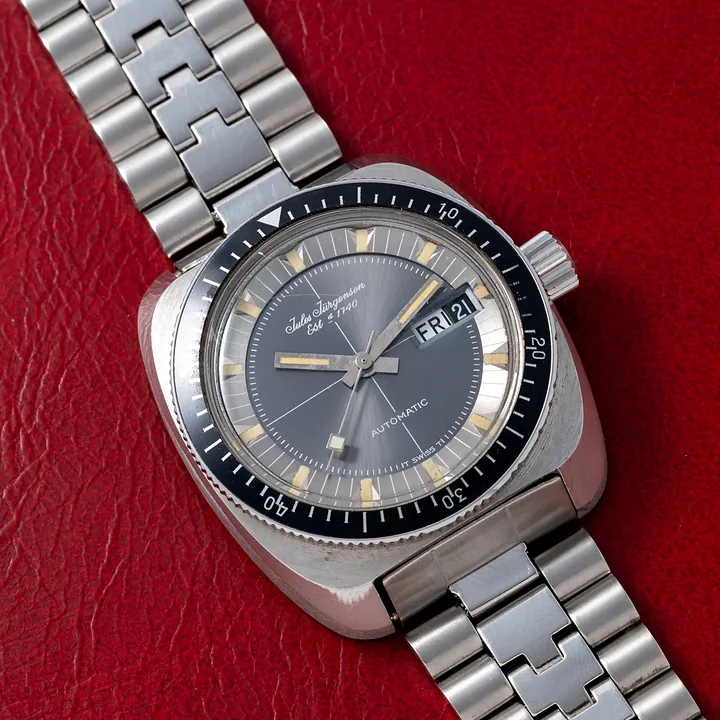
Jules Jurgensen Diver, 1970s
Analog/Shift (dealer), New York
Wristwatches · 1970s
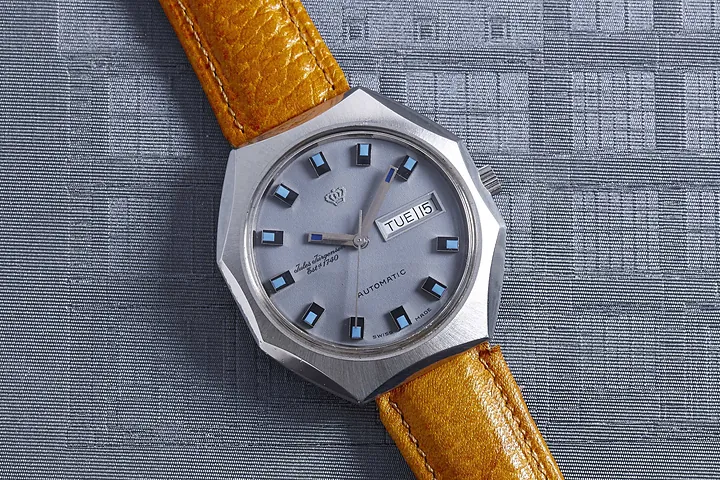
Jules Jurgensen Day-Date, 1970s
Analog/Shift (dealer), New York
Pocket Watches · c. 1880s
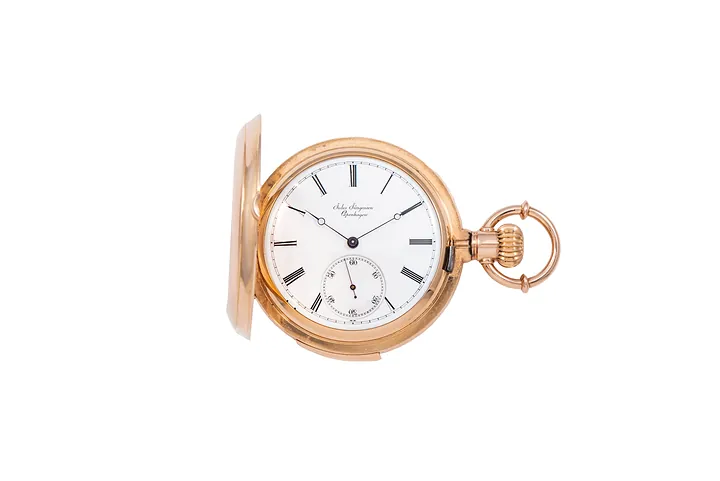
Jules Jurgensen Minute Repeater Pocketwatch, c. 1880s
Analog/Shift (dealer), New York
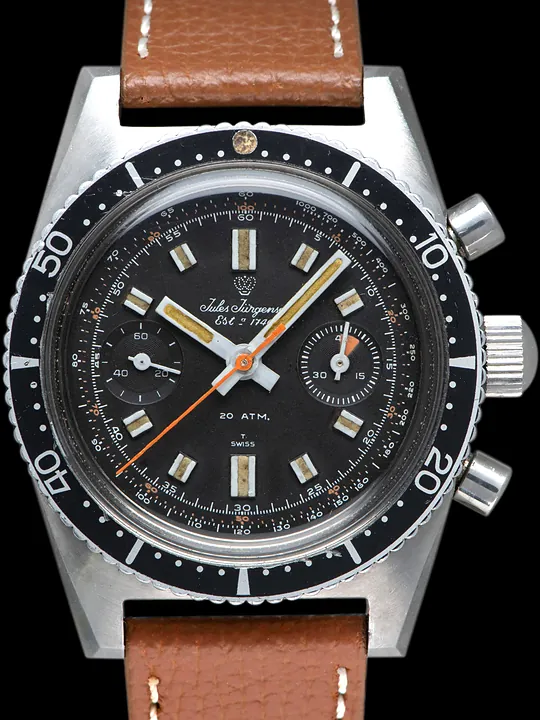
Wristwatches · 1970s
Jules Jurgensen Diving Chronograph "Landeron Cal. 248", 1970s
Craft & Tailored (dealer), Los Angeles

Wristwatches · 1970
Wristwatch by Heno, Switzerland, 1970
Museum Rotterdam
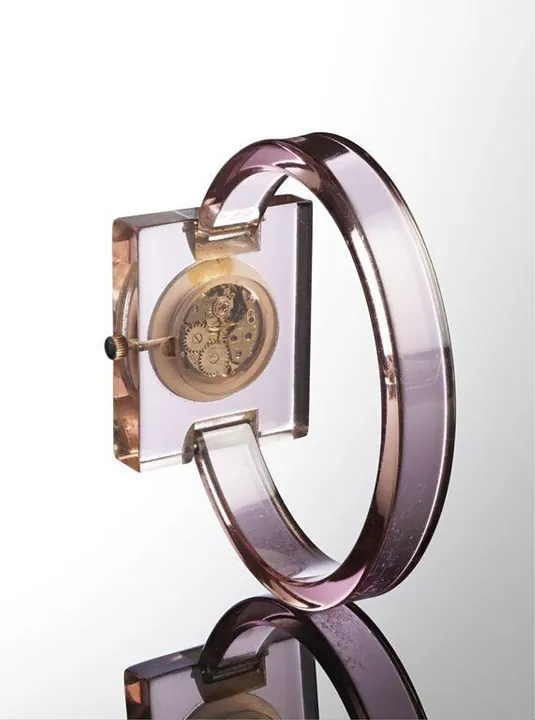
Wristwatches · 1970s
Wristwatch, plastic, by Gucci; Italy, 1970s.
Victoria and Albert Museum, London
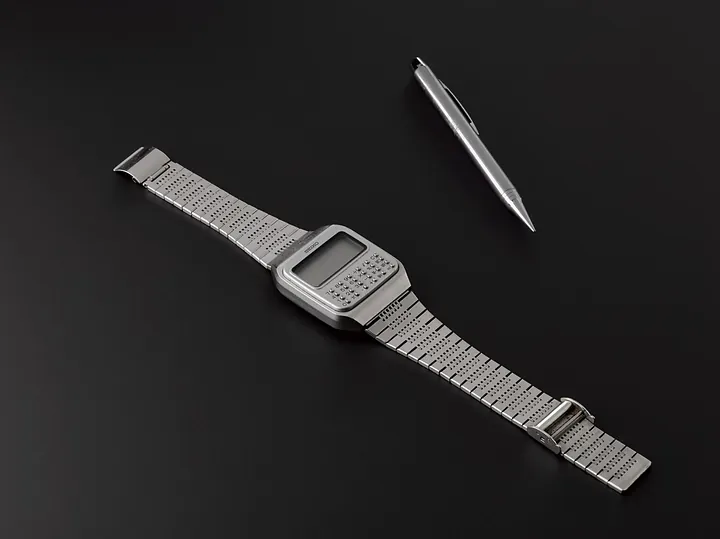
Wristwatches · 1978
Calculator wristwatch by Suwa Seikosha Co. Limited, Japan, 1978
Science Museum Group, London
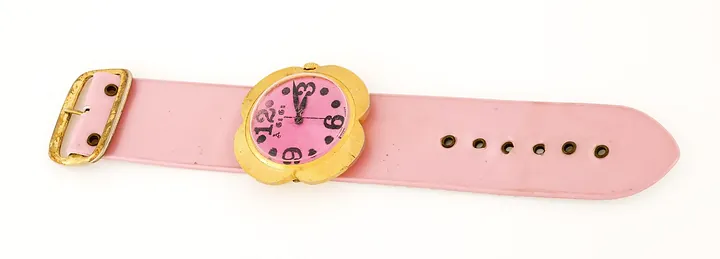
Wristwatches · 1980
Wristwatch, 1980 (no. 71413)
Museum Rotterdam