
Wristwatches · Wristwatch
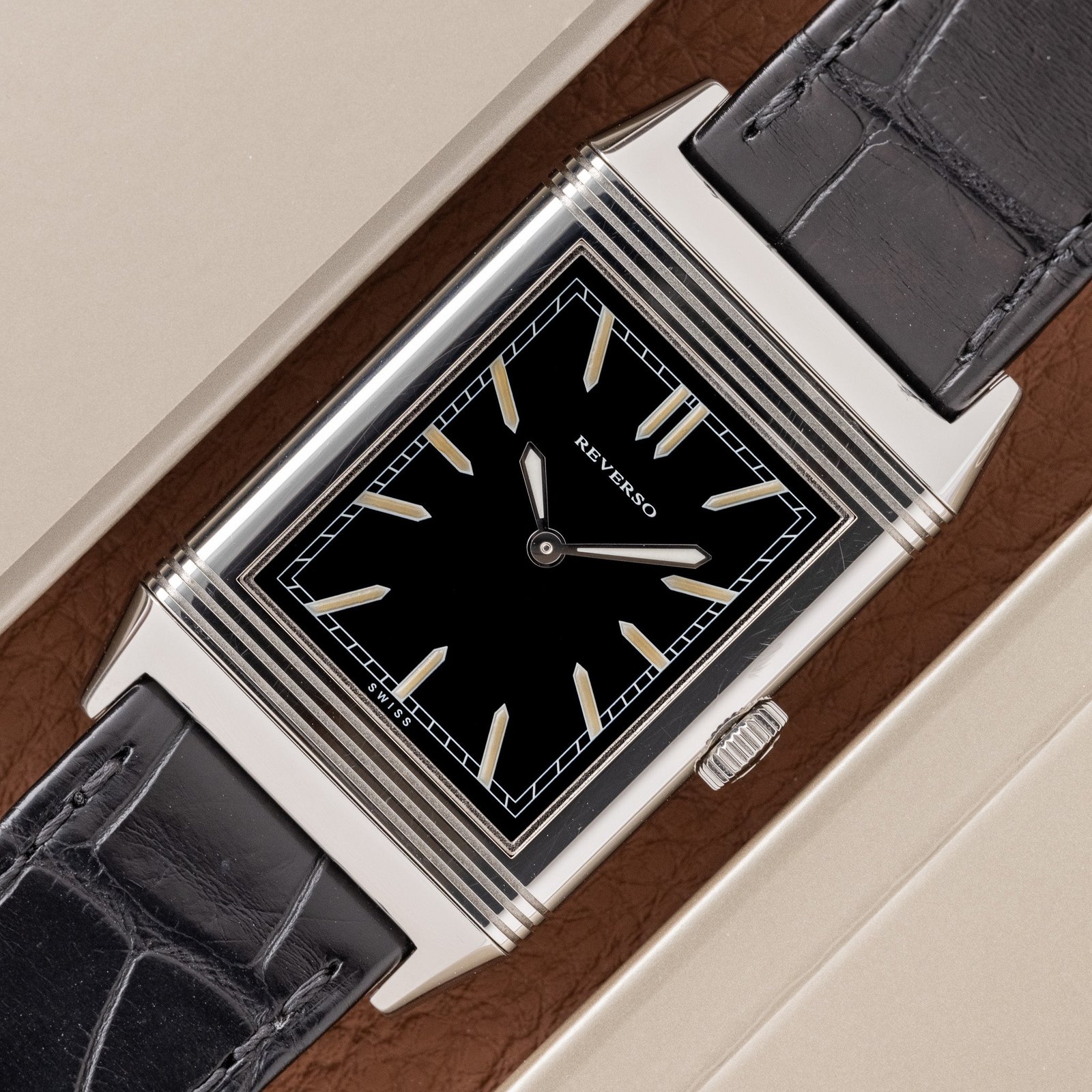
Jaeger-LeCoultre Reverso Tribute to 1931 (Ref. Q2788570), 2014
- Maker / attribution
- Jaeger-LeCoultre (maker)
- Date
- 2014
- Historical period
- Contemporary Horology (2010 – Present)
- Country of origin
- Switzerland
- Object type
- Wristwatch
- Dimensions
- Case 46.8 mm
- Stock no.
- Product 8365685866679
- Credit line
- Dealer listing, Huntington Company (product 8365685866679)
- Catalogue title (original)
- 2014 Jaeger-LeCoultre Reverso Tribute to 1931 - Box and Papers (Ref. Q2788570) (English)
View the source record (dealer listing) ↗ (opens another website in a new tab)Suggest a correction
Record summary
Catalogued by Huntington Company (dealer) (stock number Product 8365685866679), this is a wristwatch by Jaeger-LeCoultre, made in Switzerland, dated 2014. The Atlas places it in the Contemporary Horology period (2010 – Present) of its Wristwatches collection. Recorded dimensions: Case 46.8 mm. The record is illustrated with 6 photographs.
Assembled from the source record's structured fields. Dates and attributions are given as the source states them; where a field is missing the Atlas leaves it blank rather than estimating.
Catalogue description
Dealer description — Huntington Company
History and Significance The Reverso Tribute to 1931 was introduced as a faithful modern interpretation of one of Jaeger-LeCoultre’s most historically important designs. The original Reverso was created in 1931 in response to British officers stationed in India who needed a watch that could withstand the rigors of polo. Jaeger-LeCoultre’s solution was ingenious: a reversible case that could slide and flip, protecting the dial while preserving elegant proportions suitable for formal wear. This Tribute model stays remarkably close to those early examples. The elongated rectangular case, triple gadroons, and restrained dial layout intentionally echo the earliest Reversos produced in the 1930s. Unlike later Reverso variations that grew thicker or more decorative, the Tribute to 1931 emphasizes purity of line and historical accuracy. It captures the spirit of the original far more closely than most modern rectangular watches. Produced in relatively limited numbers and offered as a collector-focused reference, this model appeals to enthusiasts who value design lineage over complication. The solid reversible caseback also preserves the original intent of the Reverso, offering a clean canvas rather than a display window. As tastes continue to shift back toward thinner, historically grounded watches, the Tribute to 1931 stands as one of the most honest modern Reversos Jaeger-LeCoultre has produced. Writer’s Thoughts This is a watch that rewards restraint. On the wrist it feels slim, elegant, and purposefully understated, exactly as a Reverso should. The proportions are excellent and the reversible case mechanism feels precise and satisfying. As a complete set from 2014, this example checks every box for someone looking for a historically correct Reverso that still feels modern and wearable today. Our Promise Every watch we offer is carefully inspected and verified for authenticity. We stand behind the integrity of each piece and represent it accurately and transparently. Our goal is to ensure complete confidence when purchasing from Huntington Company. Specifications Brand: Jaeger-LeCoultre Model: Reverso Tribute to 1931 (Ref. Q2788570) Year: 2014 Case Material: Stainless steel Case Size: 46.8mm x 27.4mm Dial: Black dial with applied baton markers Crystal: Sapphire Movement: Manual winding Jaeger-LeCoultre movement Strap/Bracelet: Black leather strap Buckle/Clasp: Stainless steel butterfly clasp Condition Case: Stainless steel case shows light surface wear consistent with careful use. Minor hairlines are visible along the case sides and gadroons under close inspection with no signs of structural damage. Bezel: Smooth bezel displays light hairlines visible in reflected light with no deep marks or dents. Crystal: Sapphire crystal is clean with no chips, cracks, or scratches observed. Dial: Dial is in perfect condition with no signs of wear, discoloration, or damage. Hands: Original hands are clean and well preserved with no corrosion or blemishes. Strap/Bracelet: Leather strap shows light wear consistent with normal use. Buckle/Clasp: Original Jaeger-LeCoultre buckle shows light handling marks and functions properly.
Historical context
Contemporary Horology (2010 – Present)
Silicon components, connected watches, optical-lattice research clocks and a thriving independent scene.
Smartwatches became the world's best-selling watches, while mechanical watchmaking focuses on craft, innovation (silicon components, new escapements) and independent makers.
Read the period in the timelineMore wristwatches from this periodEarlier: Mechanical Renaissance
Atlas type guide
Wristwatches
Bracelet watches were worn by women from the early nineteenth century — Breguet made one for Caroline Murat, Queen of Naples, in 1810–12 — but the wristwatch only became a man's instrument with military use and aviation in the early twentieth century. Between the World Wars it overtook the pocket watch; the 1920s and 1930s brought rectangular Art Deco cases, water-resistant cases and the first automatic winding systems.
After 1945 the wristwatch became a carrier of identity — dress watches, sports and dive watches, chronographs, calendars — produced by Swiss, American, Japanese, German, Soviet and Chinese industries. The quartz revolution after 1969 and the mechanical renaissance since the 1990s, including the rise of independent watchmakers, complete the story.
What to look for
- The reference number (between the lugs or inside the case back) and serial number, the starting point for dating.
- The calibre: its maker and number are often stamped under the dial or on the bridge.
- Originality of dial, hands and crown — refinished ('redial') dials are common.
- Case material marks: 18K/750, 14K/585, stainless steel, gold-filled, plated.
Dating clues
- Wire-lug cases: before c. 1925.
- Water-resistant screw-down cases: from 1926.
- Quartz movements: from 1969; sapphire crystals widespread after c. 1980.
General guidance written by the Atlas editors about this kind of object. It is not a statement about this particular piece; for that, rely on the source record above and on physical examination.
Related records
Clocks · 1937–1938
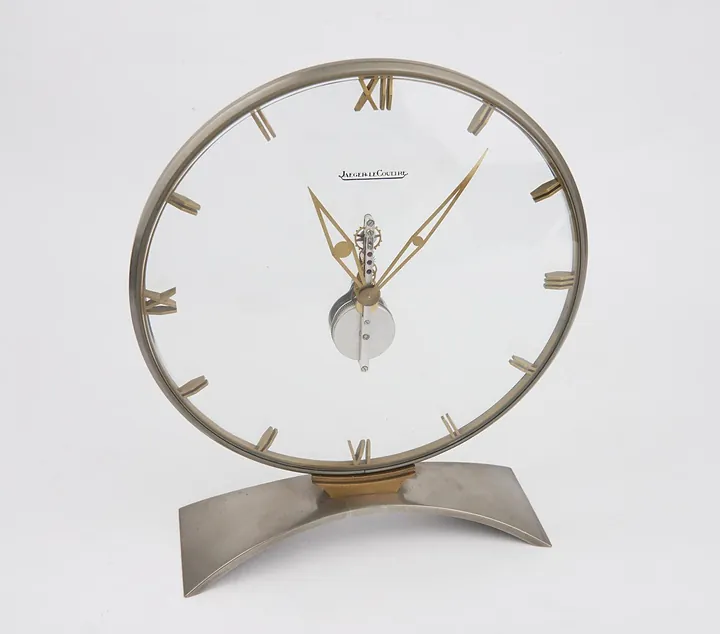
Skeleton clock by Jaeger-LeCoultre, Switzerland, 1937–1938
Science Museum Group, London
Movements & Components · 1953
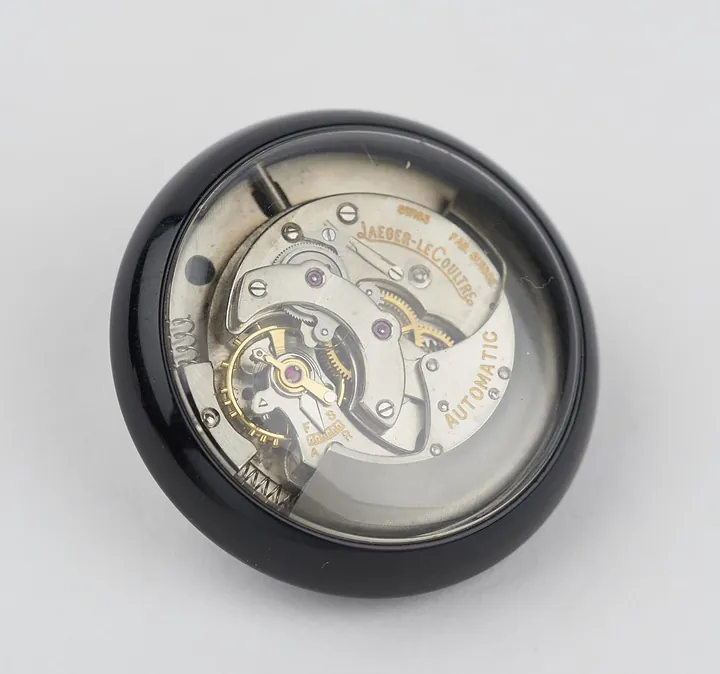
Automatic watch movement, Jaeger-LeCoultre, 1953, Geneva, Switzerland, showing self-winding mechanism
Science Museum Group, London
Wristwatches · 1953
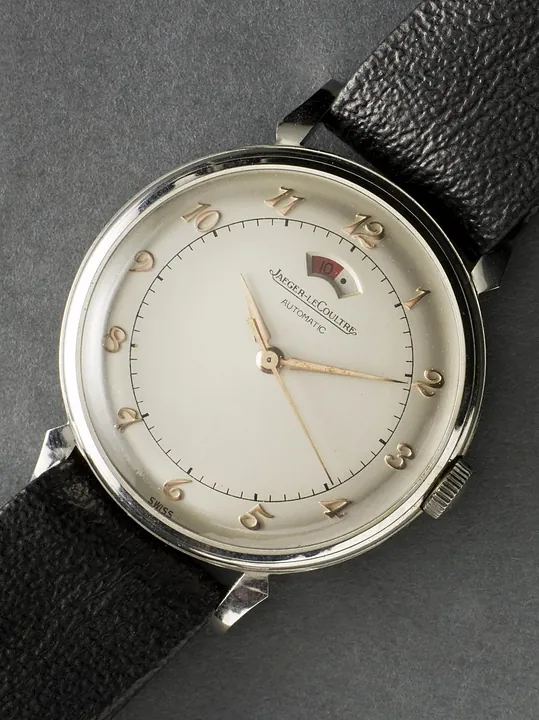
Automatic Wrist-watch, Jaeger-LeCoultre, Geneva, Switzerland, with reserve power indicator complete in steel case, 1953. Back numbered 564556.
Science Museum Group, London
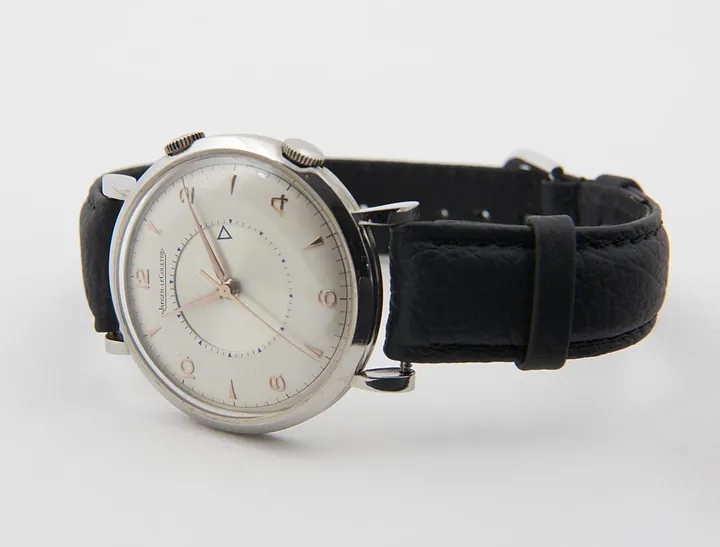
Wristwatches · 1953
Wrist-watch, 'Memovox' alarm, Jaeger-LeCoultre, Geneva, Switzerland, complete in steel case, 1953.
Science Museum Group, London

Wristwatches · c. 2010s
Breguet Type XXI, ref. 3810, c. 2010s (Antiquorum Lot 381-24)
Antiquorum auction archive, Geneva

Wristwatches · c. 2010s
Breguet Type XXI, ref. 3810, c. 2010s (Antiquorum Lot 386-229)
Antiquorum auction archive, Geneva

Wristwatches · Sold in September 2010
Breitling Cosmonaute, ref. A 22322, Sold in September 2010
Antiquorum auction archive, Geneva

Wristwatches · c. 2010
Corum Bubble Chrono, ref. 396.150.20, c. 2010
Antiquorum auction archive, Geneva