
Wristwatches · Wristwatch
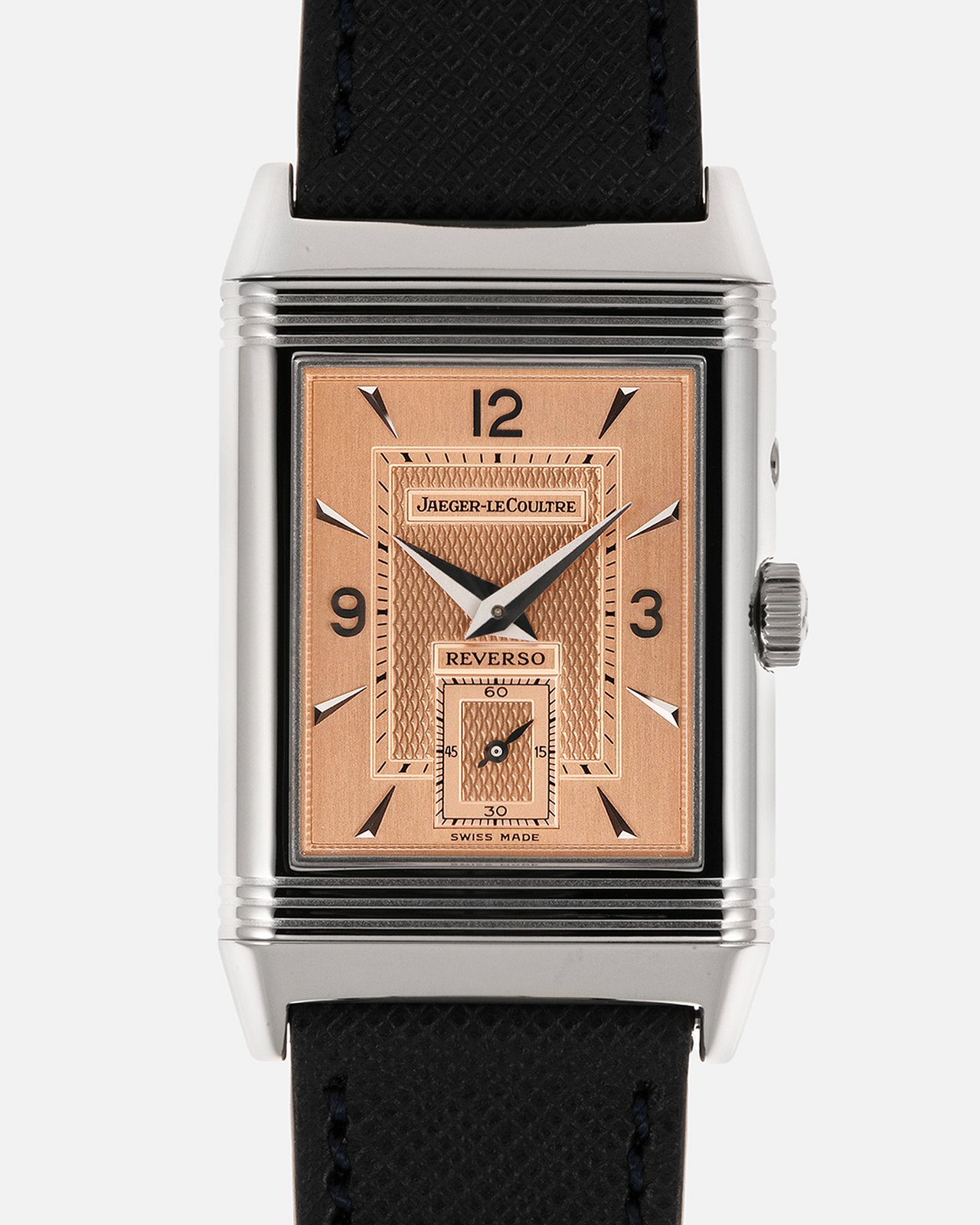
Jaeger-LeCoultre Reverso Duoface Japan Edition 270.0.54A White And Rose Gold, 1990s
- Maker / attribution
- Jaeger-LeCoultre (maker)
- Date
- 1990s
- Historical period
- Mechanical Renaissance (1990 – 2010)
- Country of origin
- Japan
- Object type
- Wristwatch
- Materials / technique
- rose gold
- Stock no.
- Product 7486536810583
- Credit line
- Dealer listing, S.Song Watches (product 7486536810583)
- Catalogue title (original)
- Jaeger-LeCoultre Reverso Duoface Japan Edition 270.0.54A White And Rose Gold (English)
View the source record (dealer listing) ↗ (opens another website in a new tab)Suggest a correction
Record summary
Catalogued by S.Song Watches (dealer), Seattle (stock number Product 7486536810583), this is a wristwatch by Jaeger-LeCoultre, made in Japan, dated 1990s. The Atlas places it in the Mechanical Renaissance period (1990 – 2010) of its Wristwatches collection. Materials and techniques recorded by the source: rose gold. The record is illustrated with 6 photographs.
Assembled from the source record's structured fields. Dates and attributions are given as the source states them; where a field is missing the Atlas leaves it blank rather than estimating.
Catalogue description
Dealer description — S.Song Watches
Created by Jacques-David LeCoultre in 1931, the Reverso was initially conceived to withstand the harsh beating a watch would endure during a game of polo. Today, it has evolved into a dress watch thanks to its now-classical aesthetic and graceful design. Unique in that its case can be opened, slid along a rail, flipped around on its vertical axis, and snapped back into place so that its caseback faces out with its dial against the wrist, the Reverso's eponymous function gave Jaeger LeCoultre a powerful medium to experiment and develop. Originally designed to make the most of its signature flip-action by adding a second dial, the Duoface was conceived as a way to enhance the Reverso's practicality as a functional timepiece—without compromising its elegant, dressy character. First introduced in 1994 within the newly released Grande Taille case, the inaugural Duoface featured a dual-dial setup: a lighter-toned "home" dial and a darker secondary dial, allowing the wearer to track time in two different time zones. In essence, it was a sophisticated take on a dual-time watch. Today, we’re thrilled to offer an exceptionally uncommon example: the Reverso Duoface 270.0.54A Japan Edition, presented in a striking and uncommon two-tone format unlike any other Reverso we've encountered to date. Starting with its case construction, the Reverso Duoface sports a case based on the golden ratio, which is a ratio between two dimensions that equals 1.618. Also known mathematically as the divine proportion, it is, in general terms, a ratio that is known to be pleasing to the human eye. Like the previous Japan-only editions we’ve listed, this example we have here also emanates a bit of a “Dr Jekyll and Mr Hyde” energy, and you will see why in a minute. On one side, you will find a stunning salmon-colored dial featuring a guilloché centre and a small seconds sub-dial at 6:00, all set within the primarily white gold segment of the case. Flip it over, and a black Clous De Paris guilloché dial greets you, complete with a day/night indicator at 6:00 and matching rose gold hands and hour markers that echo the design on the reverse side. Both dials are beautiful, eye-catching, and full of personality in their own unique way, each complementing the contrasting metals of the case. You see, while the term "two-tone" typically conjures images of seamlessly blended contrasting metals, this execution is a bit different from what we’re used to. From the sides of the case, you can see the rose gold section peeking out in a way that feels intentionally segmented—almost as if it is deliberately divided into two distinct personalities. The result is visually arresting and deeply intriguing, making it a conversation piece that draws you in for a closer look. Two watches in one, literally. The Reverso Duoface is an incredibly versatile timepiece that allows the user two different watch faces to match one’s outfit or the mood of the day. Made in a limited edition of only 250 pieces, this particular example is quite a rare one, which makes it the perfect watch for any connoisseur who is looking for something unique and off the beaten path. Furthermore, Jaeger-LeCoultre Reverso showcases its horological heritage with a robust and exceptional manual-wound, in-house movement. While it's hidden beneath both dials, the Cal. 854 features the same high-quality architecture and finishing that has earned Jaeger LeCoultre its deserved moniker, "the watchmaker's watchmaker". A very fitting title, if you ask me. While any limited edition Reverso can be considered rare, I find that Japan-editions tend to be especially elusive, as they rarely make it out of the domestic market. This particular watch was never publicised outside of Japan, and even with our experience listing several Japan-only editions over the years, this is the first time we have encountered one like this in person. It is so obscure that many collectors are not even aware of its existence, making the opportunity to offer one a genuine delight for us.
Historical context
Mechanical Renaissance (1990 – 2010)
Mechanical watches return as cultural objects; independent watchmaking flourishes.
Mechanical watches returned as cultural and luxury objects. Complications, tourbillons and new materials proliferated; independent watchmakers such as George Daniels, F.P. Journe and Philippe Dufour revived artisanal watchmaking; collecting vintage watches became a major field.
Read the period in the timelineMore wristwatches from this periodEarlier: Quartz Revolution
Atlas type guide
Wristwatches
Bracelet watches were worn by women from the early nineteenth century — Breguet made one for Caroline Murat, Queen of Naples, in 1810–12 — but the wristwatch only became a man's instrument with military use and aviation in the early twentieth century. Between the World Wars it overtook the pocket watch; the 1920s and 1930s brought rectangular Art Deco cases, water-resistant cases and the first automatic winding systems.
After 1945 the wristwatch became a carrier of identity — dress watches, sports and dive watches, chronographs, calendars — produced by Swiss, American, Japanese, German, Soviet and Chinese industries. The quartz revolution after 1969 and the mechanical renaissance since the 1990s, including the rise of independent watchmakers, complete the story.
What to look for
- The reference number (between the lugs or inside the case back) and serial number, the starting point for dating.
- The calibre: its maker and number are often stamped under the dial or on the bridge.
- Originality of dial, hands and crown — refinished ('redial') dials are common.
- Case material marks: 18K/750, 14K/585, stainless steel, gold-filled, plated.
Dating clues
- Wire-lug cases: before c. 1925.
- Water-resistant screw-down cases: from 1926.
- Quartz movements: from 1969; sapphire crystals widespread after c. 1980.
General guidance written by the Atlas editors about this kind of object. It is not a statement about this particular piece; for that, rely on the source record above and on physical examination.
Related records
Clocks · 1937–1938
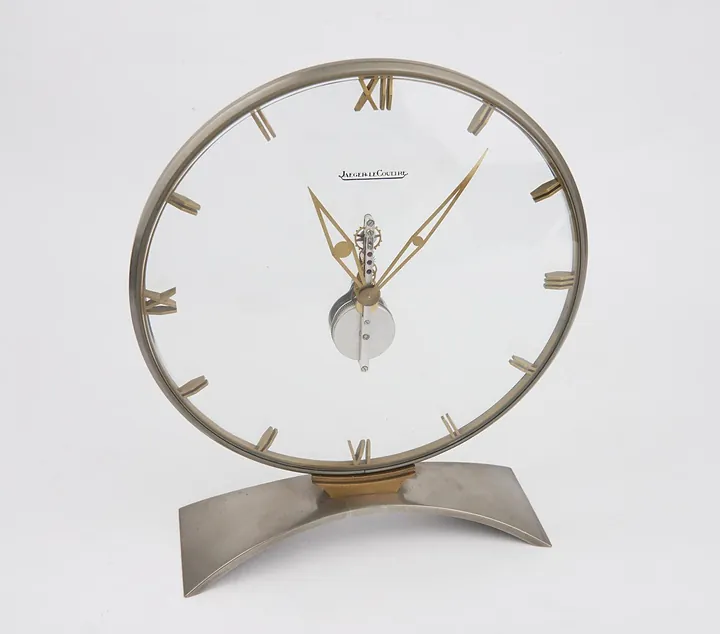
Skeleton clock by Jaeger-LeCoultre, Switzerland, 1937–1938
Science Museum Group, London
Movements & Components · 1953
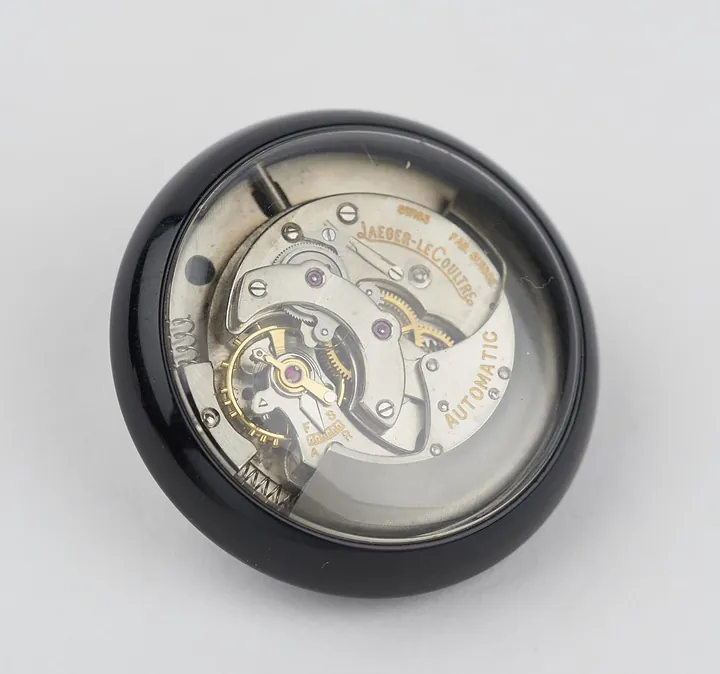
Automatic watch movement, Jaeger-LeCoultre, 1953, Geneva, Switzerland, showing self-winding mechanism
Science Museum Group, London
Wristwatches · 1953
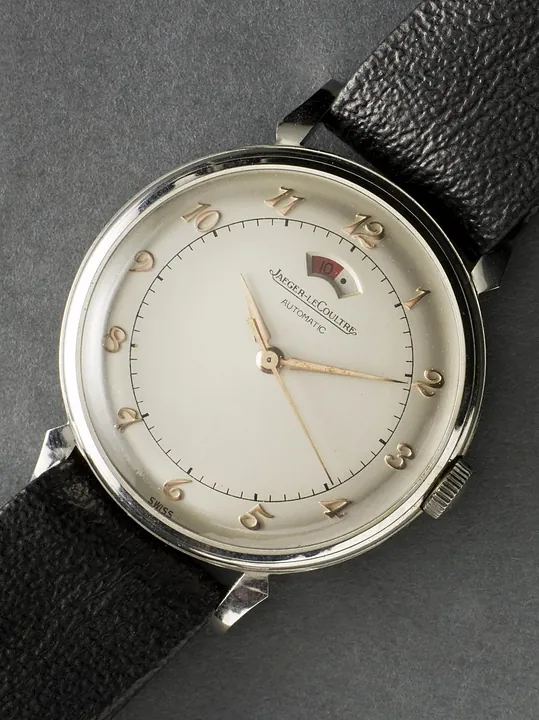
Automatic Wrist-watch, Jaeger-LeCoultre, Geneva, Switzerland, with reserve power indicator complete in steel case, 1953. Back numbered 564556.
Science Museum Group, London
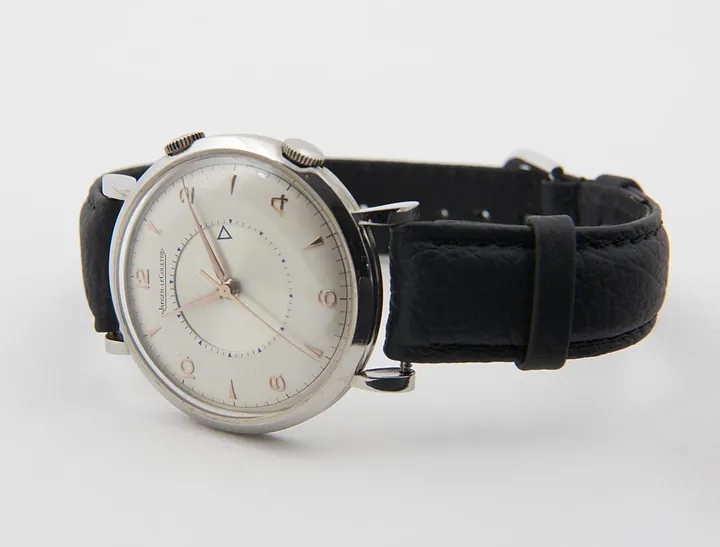
Wristwatches · 1953
Wrist-watch, 'Memovox' alarm, Jaeger-LeCoultre, Geneva, Switzerland, complete in steel case, 1953.
Science Museum Group, London
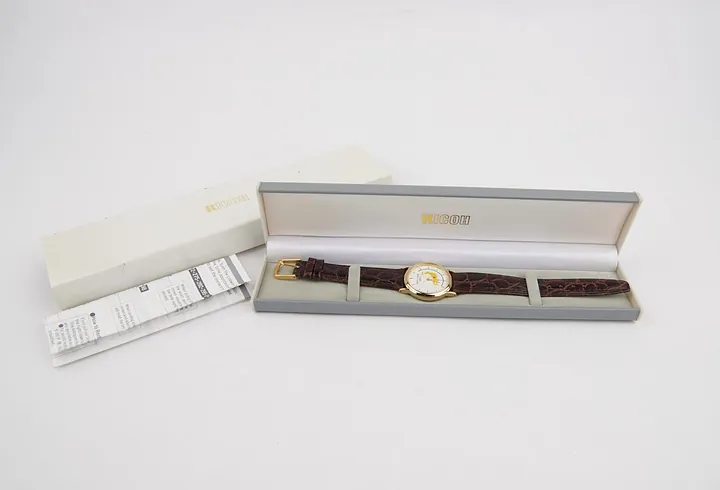
Wristwatches · 1990–1996
Wristwatch by Ricoh Elemex Corporation, Japan, 1990–1996
Science Museum Group, London
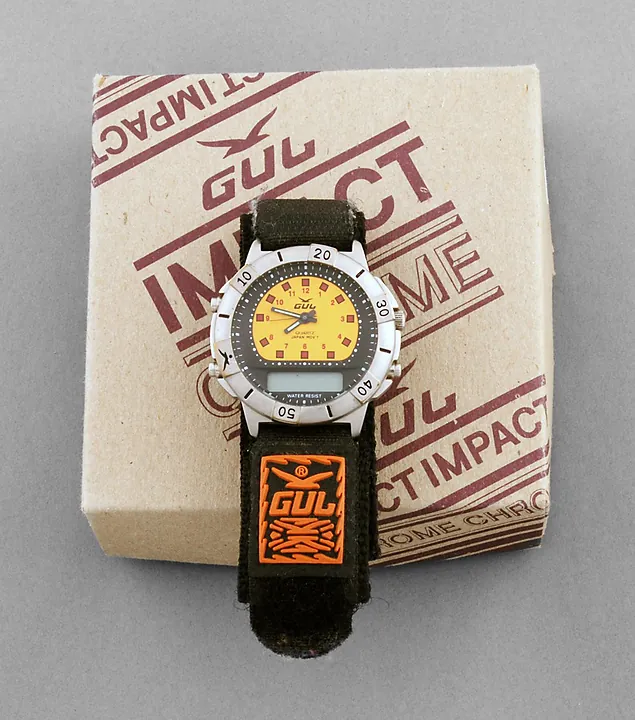
Wristwatches · 1990
Wristwatch, Japan, 1990
Blekinge Museum
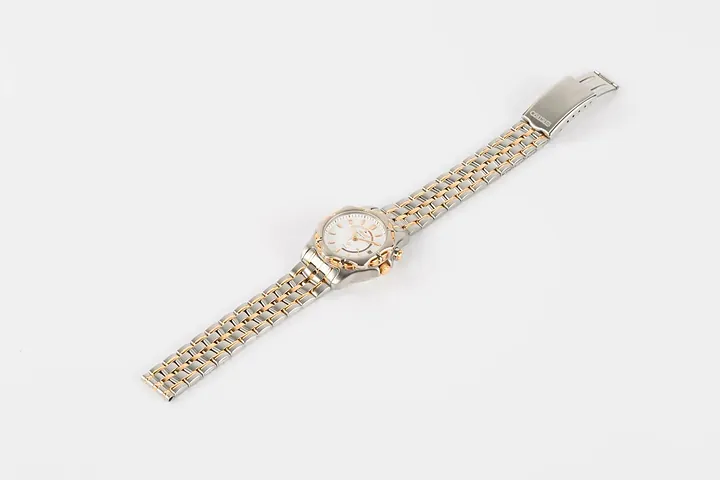
Wristwatches · 1995
Wristwatch, Japan, 1995 (no. 57932)
German Clock Museum
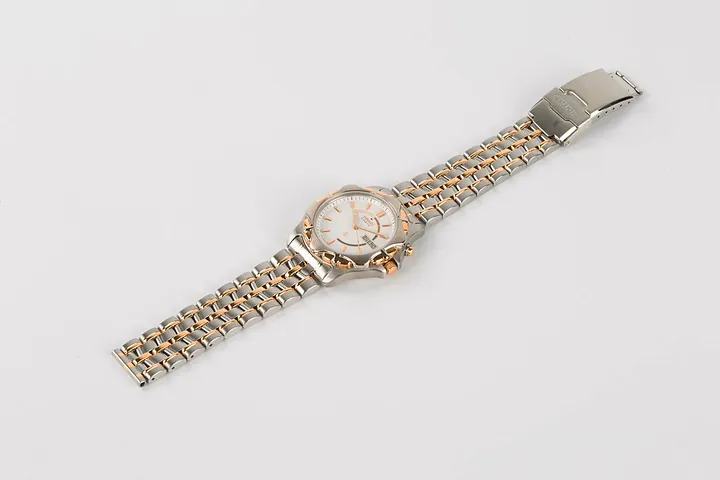
Wristwatches · 1995
Wristwatch, Japan, 1995 (no. 57933)
German Clock Museum