
Wristwatches · Wristwatch
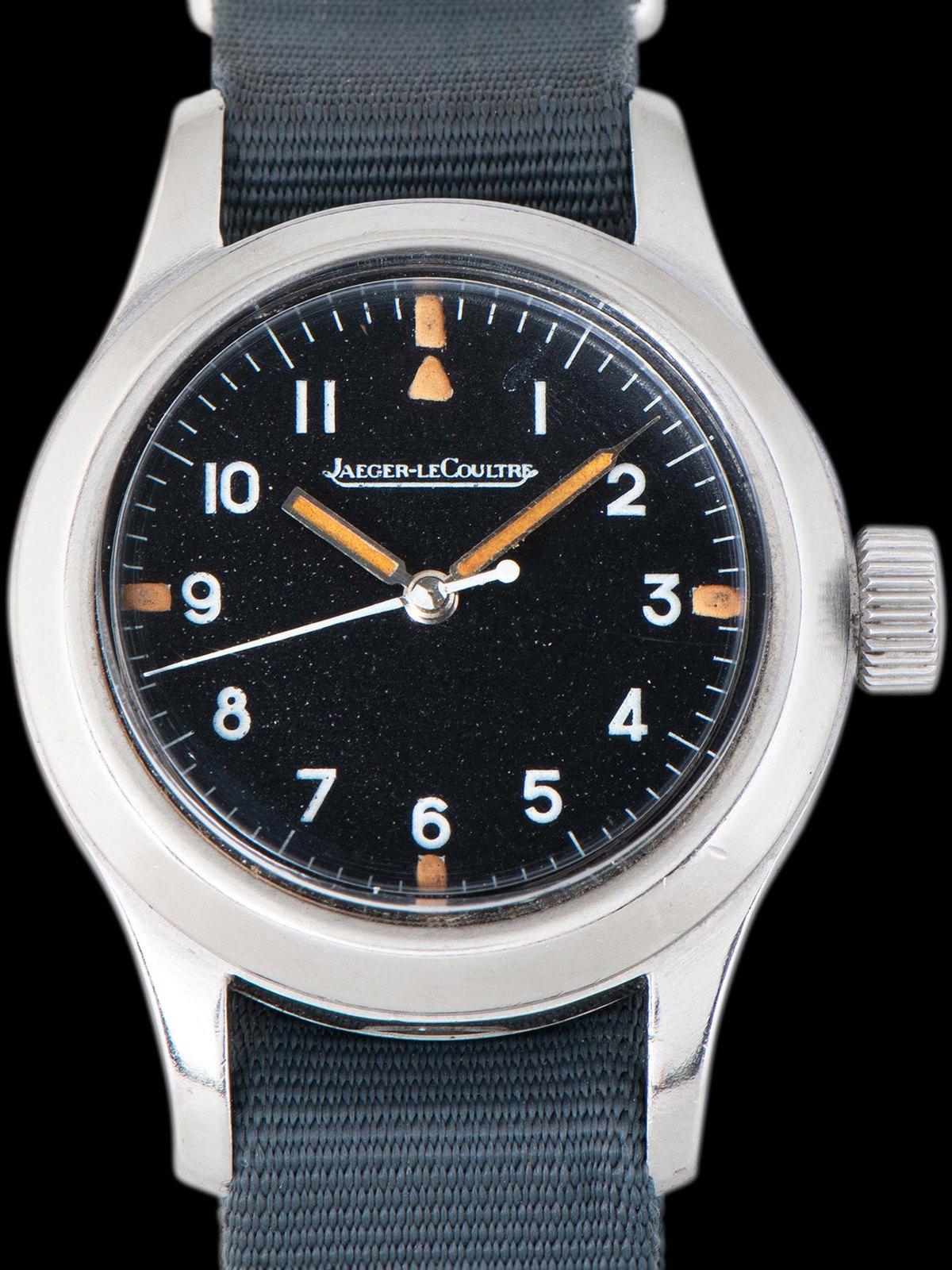
Jaeger-LeCoultre Mark XI (Ref. G6B/346) "Royal Australian Air Force", 1953
- Maker / attribution
- Jaeger-LeCoultre (maker)
- Date
- 1953
- Historical period
- Modern Mechanical Horology (1945 – 1969)
- Country of origin
- Switzerland
- Object type
- Wristwatch
- Stock no.
- JLCMKXIRAAF
- Credit line
- Dealer listing, Craft & Tailored (JLCMKXIRAAF)
- Catalogue title (original)
- 1953 Jaeger-LeCoultre Mark XI (Ref. G6B/346) "Royal Australian Air Force" (English)
View the source record (dealer listing) ↗ (opens another website in a new tab)Suggest a correction
Record summary
Catalogued by Craft & Tailored (dealer), Los Angeles (stock number JLCMKXIRAAF), this is a wristwatch by Jaeger-LeCoultre, made in Switzerland, dated 1953. The Atlas places it in the Modern Mechanical Horology period (1945 – 1969) of its Wristwatches collection. The record is illustrated with 6 photographs.
Assembled from the source record's structured fields. Dates and attributions are given as the source states them; where a field is missing the Atlas leaves it blank rather than estimating.
Catalogue description
Dealer description — Craft & Tailored
The Jaeger-LeCoultre Mark XI was born from strict military necessity. Introduced under the British Ministry of Defence’s G6B/346 specification in 1947, the Mark XI set a new benchmark for accuracy, durability, and anti-magnetic performance in navigation watches. Produced by Jaeger-LeCoultre and IWC Schaffhausen, JLC’s run concluded in 1953—making examples like this among the last and most desirable. This watch was issued to the Royal Australian Air Force as part of the second 1953 batch, one of just 600 pieces, with correct “G6B/346,” “RA AF,” and “/53” caseback engravings. The Royal Australian Air Force-issued Mark XI distinguishes itself from its Royal Air Force counterpart through a handful of subtle but meaningful updates. Most notably, RAAF examples utilize spring bars in place of the fixed bars found on RAF-issued watches, allowing for greater strap versatility. Jaeger-LeCoultre also introduced slight variations in handsets, with this example featuring a syringe minute hand paired with a rectangular hour hand. Additionally, the RAAF models were fitted with a flat crystal rather than the domed plexiglass seen on earlier RAF pieces, a practical refinement that improves legibility while reducing glare in active use. Powering the watch is the Calibre 488/SBr, a chronometer-grade movement with hacking seconds, tested over 44 days at the Royal Greenwich Observatory, and protected by an inner iron cage for anti-magnetic resistance. Purpose-built and highly refined, the Mark XI remains one of the most important military watches ever produced; this rare RAAF example stands out for both its condition and scarcity. SPECS Stock # JLCMKXIRAAF Brand Jaeger-LeCoultre Style Mark XI Model G6B/346 Serial 33X / 91XXXX Size Men's Material Stainless Steel Dial Matte Black Millimeters 36 Strap Vintage Blue Phoenix NATO Strap CASE & BRACELET The wonderful fixed spring bar case, featuring elongated lugs, displays minimal evidence of prior polishing, with light signs of honest wear. The flat crystal is original to the watch and exhibits light crazing. The unsigned crown is believed to remain original to the watch. The case back displays all of its military markings in deep, legible condition, with some minor tool marks present. The watch comes supplied on a vintage Phoenix NATO strap. DIAL & HANDS The matte black dial is remarkably well-preserved, only showing light aging in the form of speckling and some minor stains, though no actual damage is present. The white Arabic numerals and text are in excellent condition and remain bright. The radium markers have developed a vivid orange "pumpkin" patina and exhibit no notable degradation when inspected under UV light. The original hands have been professionally restored to match the patina of the dial. ACCESSORIES None. The watch is keeping time perfectly, previous service history is unknown.
Historical context
Modern Mechanical Horology (1945 – 1969)
Tool watches for divers, pilots and astronauts; electric watches anticipate the electronic age.
The classic era of the mechanical wristwatch: dive watches, chronographs for motor racing and space flight, GMT watches for jet travel, slim dress watches, automatic calendars, and the rise of Japanese manufacturers alongside Swiss, American, German and Soviet industries.
Read the period in the timelineMore wristwatches from this periodEarlier: Golden Age of Mechanical Watchmaking
Atlas type guide
Military, pilot and travel watches
The wristwatch owes much of its adoption by men to warfare and aviation. Wristlets — small pocket watches soldered with lugs and worn on a strap — were used in colonial campaigns and became standard equipment in the First World War, with protective grilles over the crystal ('shrapnel guards'). Louis Cartier's Santos (1904), designed for the aviator Alberto Santos-Dumont, is often cited as an early purpose-made pilot's watch.
In the Second World War governments specified watches in detail: the German B-Uhr observation watches, the American A-11, and the British 'W.W.W.' (the 'Dirty Dozen' set of 1945). After the war, jet travel brought GMT and world-time watches, which show two or more time zones at once — Louis Cottier's world-time mechanism and the Rolex GMT-Master (1955) are examples.
What to look for
- Military markings on the case back: broad arrow, issue numbers, 'W.W.W.', 'A.T.P.'
- High-legibility black dials with luminous Arabic numerals; oversized crowns for gloved hands.
- 24-hour hands and rotating 24-hour bezels or city rings on GMT/world-time watches.
- Wire lugs on early wristlets converted from pocket watches.
Dating clues
- Wire-lug wristlets: c. 1900–1925.
- Military specifications of the Second World War: 1939–1945.
- GMT and world-time wristwatches: mainly after 1950.
General guidance written by the Atlas editors about this kind of object. It is not a statement about this particular piece; for that, rely on the source record above and on physical examination.
Related records
Clocks · 1937–1938
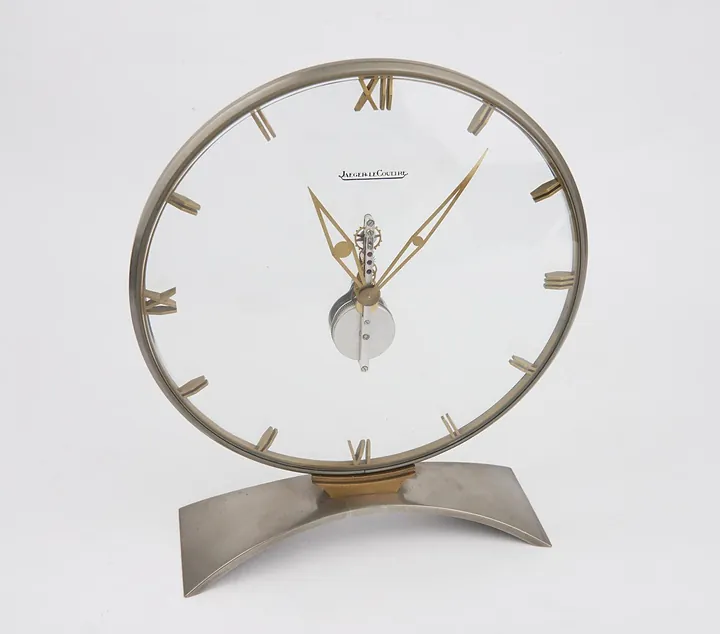
Skeleton clock by Jaeger-LeCoultre, Switzerland, 1937–1938
Science Museum Group, London
Movements & Components · 1953
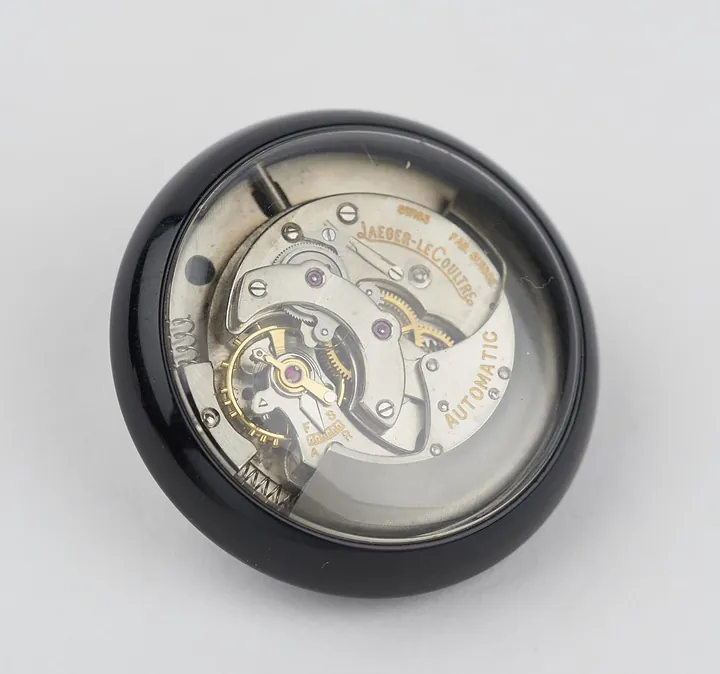
Automatic watch movement, Jaeger-LeCoultre, 1953, Geneva, Switzerland, showing self-winding mechanism
Science Museum Group, London
Wristwatches · 1953
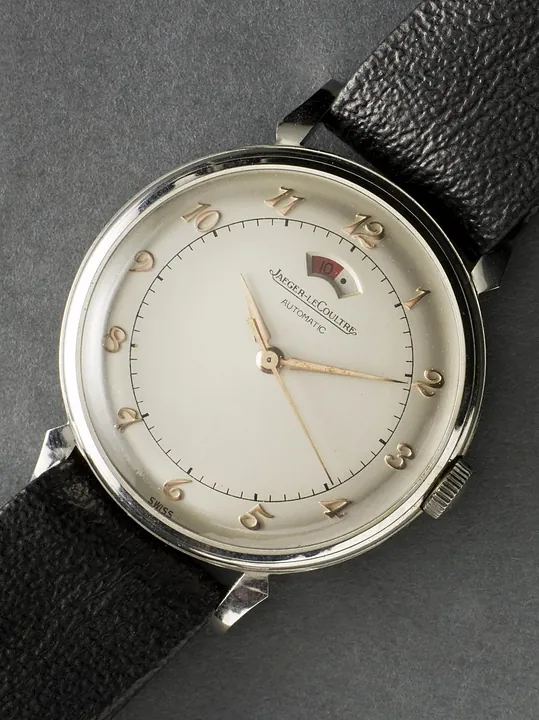
Automatic Wrist-watch, Jaeger-LeCoultre, Geneva, Switzerland, with reserve power indicator complete in steel case, 1953. Back numbered 564556.
Science Museum Group, London
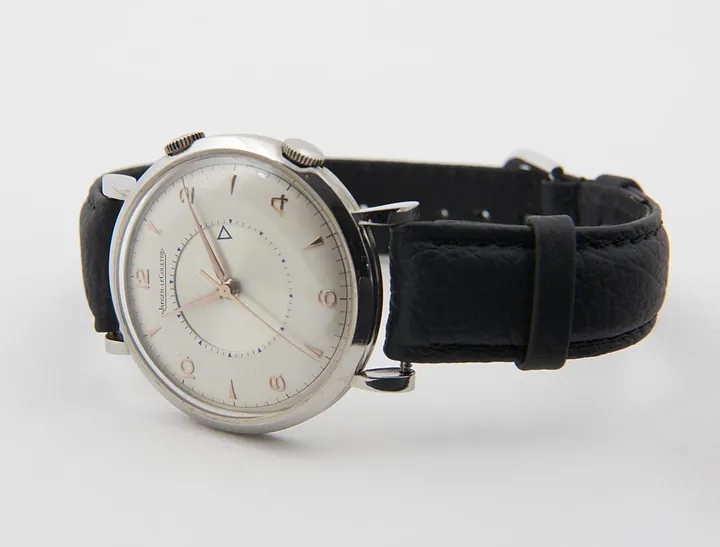
Wristwatches · 1953
Wrist-watch, 'Memovox' alarm, Jaeger-LeCoultre, Geneva, Switzerland, complete in steel case, 1953.
Science Museum Group, London

Wristwatches · 1945
Wristwatch by Eterna, 1945
Museum Rotterdam

Wristwatches · c. 1945
Breitling Premier, ref. 790, c. 1945
Antiquorum auction archive, Geneva

Wristwatches · c. 1945
Universal Genève Uni-Compax, ref. 22492, c. 1945
Antiquorum auction archive, Geneva

Wristwatches · c. 1950s
Baume & Mercier wristwatch, c. 1950s
Antiquorum auction archive, Geneva