
Wristwatches · Wristwatch
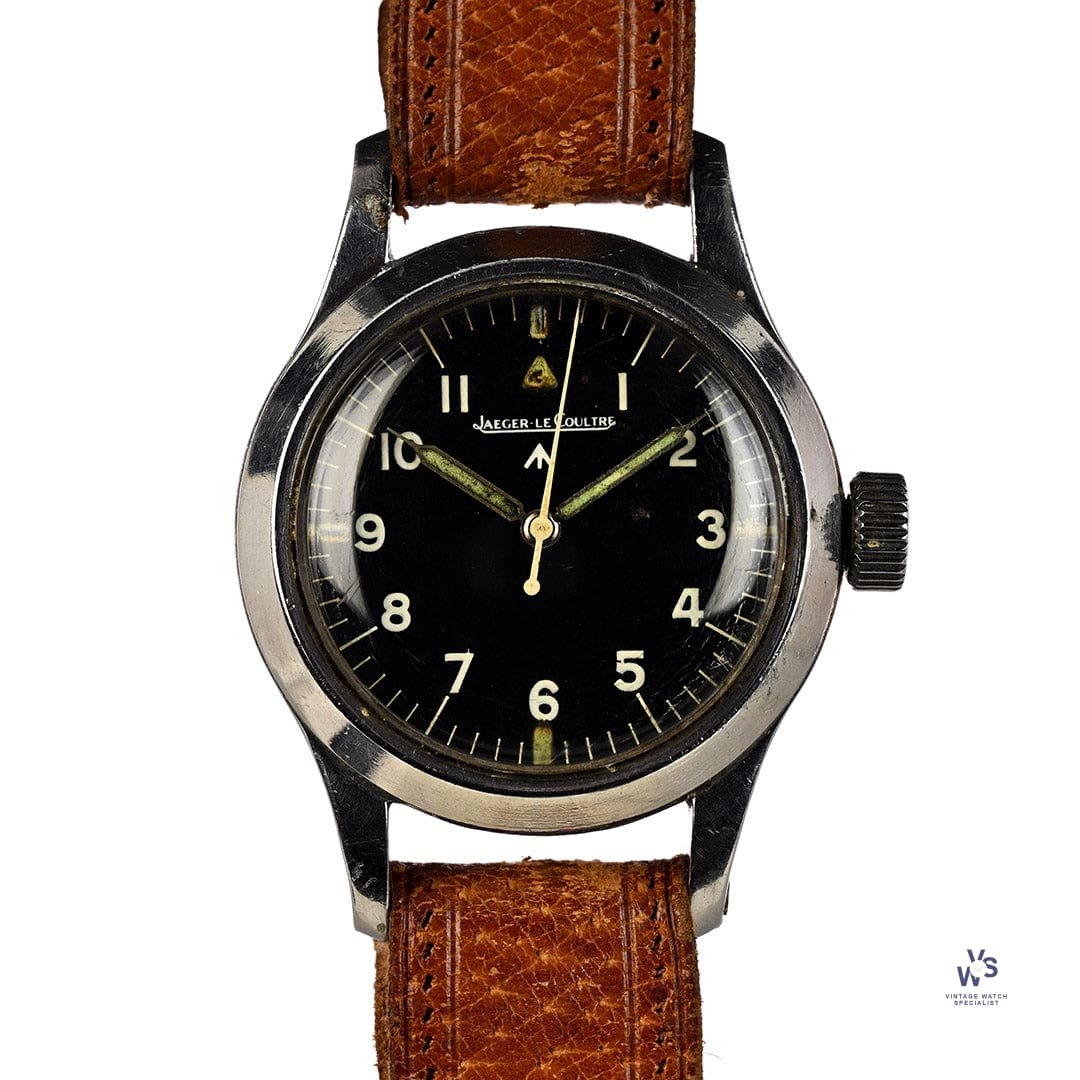
Jaeger LeCoultre, Mark XI, Case Back ref. 6B/346 3803/48, circa 1948
- Maker / attribution
- Jaeger-LeCoultre (maker)
- Date
- c. 1948
- Historical period
- Modern Mechanical Horology (1945 – 1969)
- Country of origin
- Switzerland
- Object type
- Wristwatch
- Stock no.
- vws3712cs
- Credit line
- Dealer listing, Vintage Watch Specialist (vws3712cs)
- Catalogue title (original)
- Jaeger LeCoultre - Mark XI - Case Back Reference 6B/346 3803/48 - c.1948 (English)
View the source record (dealer listing) ↗ (opens another website in a new tab)Suggest a correction
Record summary
Catalogued by Vintage Watch Specialist (dealer), United Kingdom (stock number vws3712cs), this is a wristwatch by Jaeger-LeCoultre, made in Switzerland, dated c. 1948. The Atlas places it in the Modern Mechanical Horology period (1945 – 1969) of its Wristwatches collection. The record is illustrated with 6 photographs.
Assembled from the source record's structured fields. Dates and attributions are given as the source states them; where a field is missing the Atlas leaves it blank rather than estimating.
Catalogue description
Dealer description — Vintage Watch Specialist
A Rare and Collectable Jaeger Le Coultre RAF Issued Mark 11 6B Watch in Fantastic Original Condition, 1948 The Jaeger-LeCoultre 6B Mark II is a legendary military timepiece with a rich history, originally designed for the British Royal Air Force (RAF) during the 1940s. The watch was created as part of the RAF’s strict specifications for precision, durability, and legibility, making it a vital tool for pilots during World War II. Jaeger-LeCoultre was one of the primary suppliers of these watches, with the 6B Mark II becoming one of the most iconic military watches of its time. The watch featured a clean, easy-to-read dial with luminous markers, a robust stainless steel case, and a manual movement designed for reliability under extreme conditions. Its accurate timekeeping was essential for navigation and coordination during air missions. Though only a limited number were produced, the 6B Mark II remains a symbol of military watchmaking, admired by collectors for its historical significance and timeless design. What's of Offer Designed for precision and durability, we are delighted to offer this watch in such exemplary condition. This watch features a robust stainless steel case, a highly legible rich black dial with luminous Arabic numerals, and syringe hands coated with radium for visibility in low-light conditions. The movement inside is Jaeger-LeCoultre’s Caliber 488/SBr, an antimagnetic, hacking movement engineered to strict military specifications. The watch's clean and functional design, combined with a brown leather strap, exudes vintage appeal. The fixed lugs are in great condition and ensure secure attachment, while the domed shatterproof acrylic crystal enhances durability and is also in good shape. The 6B/346 3803/48 engraving signifies its RAF designation, making it a sought-after collector’s item among enthusiasts of military horology. The Mark 11 remains an enduring icon of aviation history, blending rugged performance with the timeless craftsmanship of Jaeger-LeCoultre. This is a rare opportunity to purchase such a lovely piece in this wonderful condition. We are told by the previous owner who is originally from the UK but has now lived in Australia for many years, that the watch was originally bought by him in London about 1966/67 from a shop, Scientific and Technical in Tottenham Court Road, London. The Jaeger watch was probably worn by him for less than 10 years. Certainly by the time he arrived in Australia in 1980 it was consigned to a drawer where it has been ever since (over 40 years). It was serviced by a qualified horologist in Sydney in 2021 and was "in good working order" and the movement was stated to be "in AAA condition" the watch still has not been used since this service which is why it was thought it should be sold so the next custodian can enjoy it. We have also looked over the watch which has been regulated and checked over and we are pleased to report it is running really well. The watch has not been messed with as can also be seen from the lack of ANY historic service marks inside the case back. So fresh to market and in superb condition, don’t miss this opportunity to own a piece of military history.
Historical context
Modern Mechanical Horology (1945 – 1969)
Tool watches for divers, pilots and astronauts; electric watches anticipate the electronic age.
The classic era of the mechanical wristwatch: dive watches, chronographs for motor racing and space flight, GMT watches for jet travel, slim dress watches, automatic calendars, and the rise of Japanese manufacturers alongside Swiss, American, German and Soviet industries.
Read the period in the timelineMore wristwatches from this periodEarlier: Golden Age of Mechanical Watchmaking
Atlas type guide
Wristwatches
Bracelet watches were worn by women from the early nineteenth century — Breguet made one for Caroline Murat, Queen of Naples, in 1810–12 — but the wristwatch only became a man's instrument with military use and aviation in the early twentieth century. Between the World Wars it overtook the pocket watch; the 1920s and 1930s brought rectangular Art Deco cases, water-resistant cases and the first automatic winding systems.
After 1945 the wristwatch became a carrier of identity — dress watches, sports and dive watches, chronographs, calendars — produced by Swiss, American, Japanese, German, Soviet and Chinese industries. The quartz revolution after 1969 and the mechanical renaissance since the 1990s, including the rise of independent watchmakers, complete the story.
What to look for
- The reference number (between the lugs or inside the case back) and serial number, the starting point for dating.
- The calibre: its maker and number are often stamped under the dial or on the bridge.
- Originality of dial, hands and crown — refinished ('redial') dials are common.
- Case material marks: 18K/750, 14K/585, stainless steel, gold-filled, plated.
Dating clues
- Wire-lug cases: before c. 1925.
- Water-resistant screw-down cases: from 1926.
- Quartz movements: from 1969; sapphire crystals widespread after c. 1980.
General guidance written by the Atlas editors about this kind of object. It is not a statement about this particular piece; for that, rely on the source record above and on physical examination.
Related records
Clocks · 1937–1938
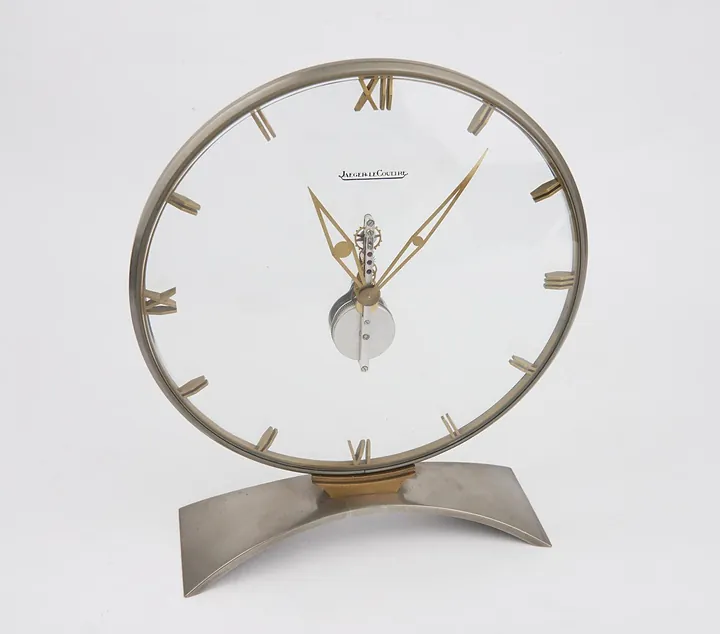
Skeleton clock by Jaeger-LeCoultre, Switzerland, 1937–1938
Science Museum Group, London
Movements & Components · 1953
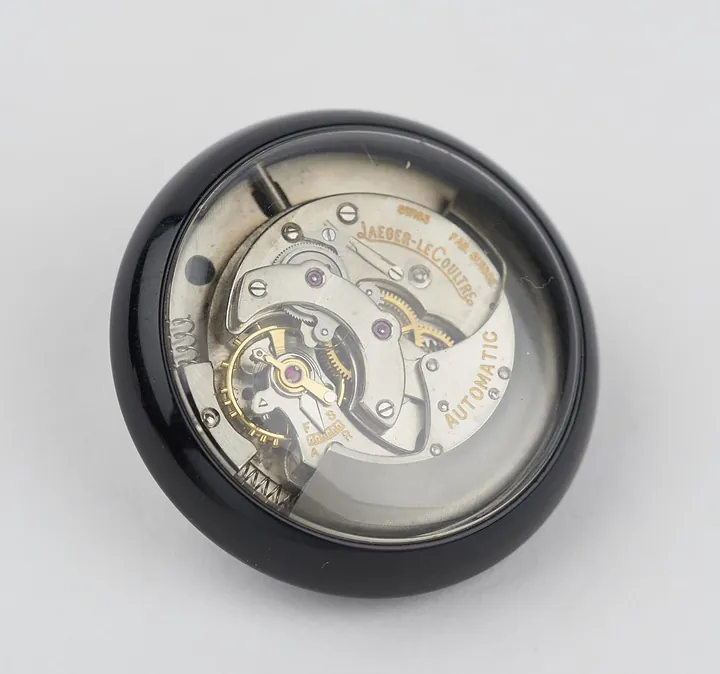
Automatic watch movement, Jaeger-LeCoultre, 1953, Geneva, Switzerland, showing self-winding mechanism
Science Museum Group, London
Wristwatches · 1953
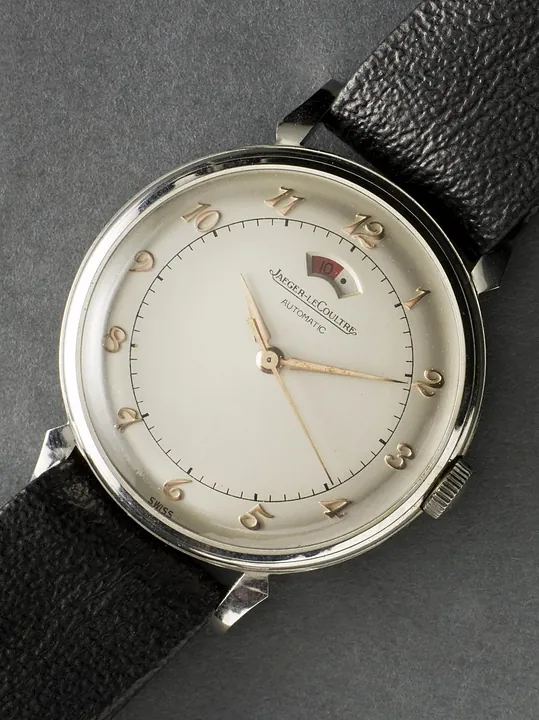
Automatic Wrist-watch, Jaeger-LeCoultre, Geneva, Switzerland, with reserve power indicator complete in steel case, 1953. Back numbered 564556.
Science Museum Group, London
Wristwatches · 1953
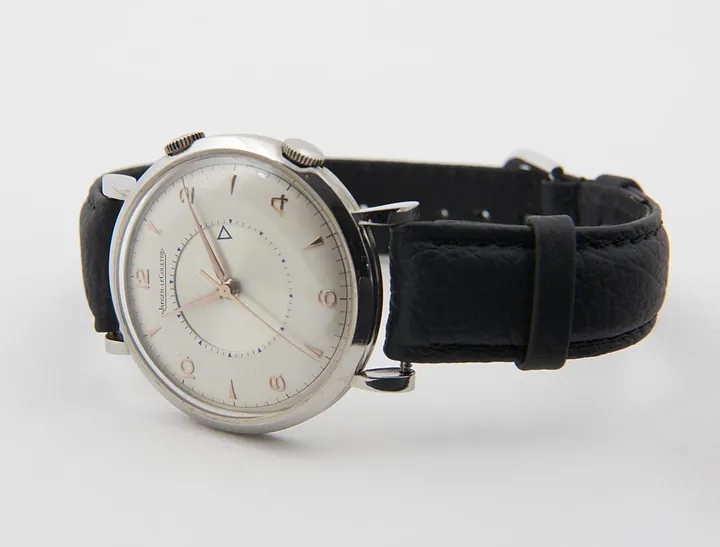
Wrist-watch, 'Memovox' alarm, Jaeger-LeCoultre, Geneva, Switzerland, complete in steel case, 1953.
Science Museum Group, London

Wristwatches · 1945
Wristwatch by Eterna, 1945
Museum Rotterdam

Wristwatches · c. 1945
Breitling Premier, ref. 790, c. 1945
Antiquorum auction archive, Geneva

Wristwatches · c. 1945
Universal Genève Uni-Compax, ref. 22492, c. 1945
Antiquorum auction archive, Geneva

Wristwatches · c. 1950s
Baume & Mercier wristwatch, c. 1950s
Antiquorum auction archive, Geneva