
Wristwatches · Wristwatch
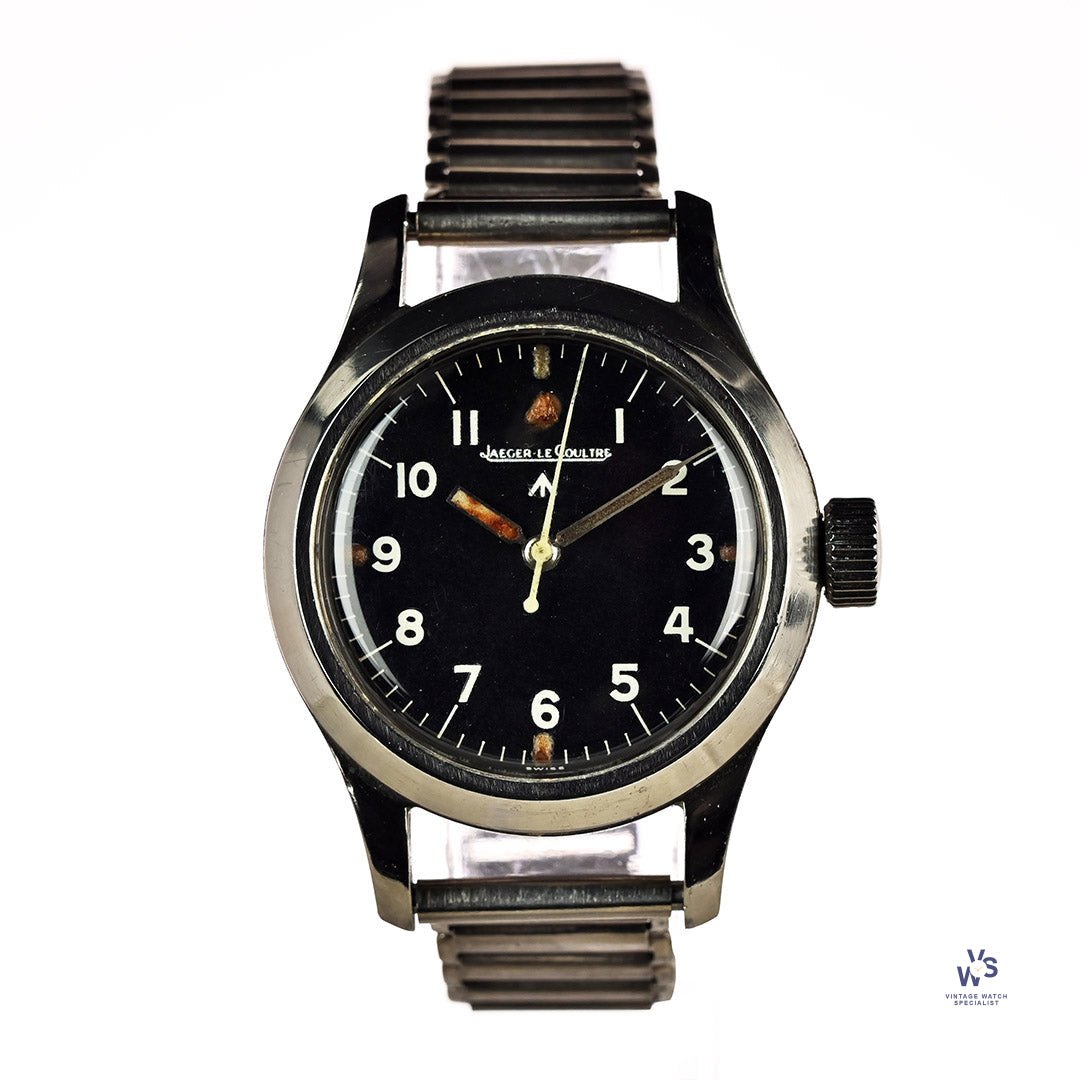
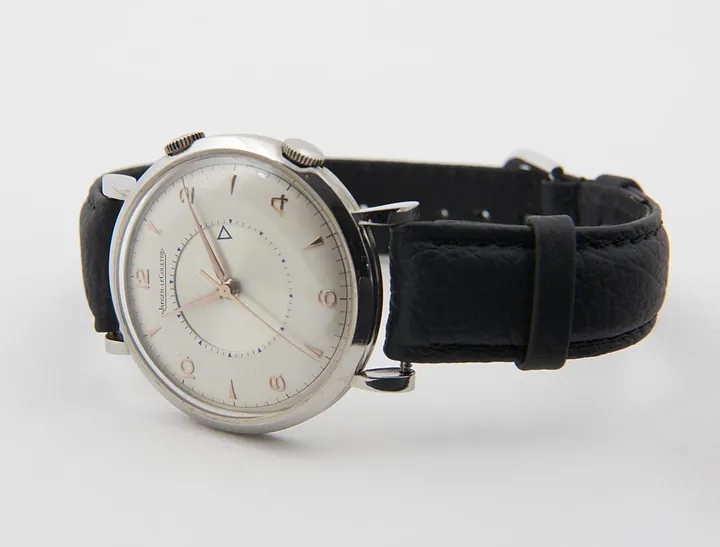
Jaeger LeCoultre, Mark 11 (XI), 6B-346, Military RAF Issued Watch, circa 1948
- Maker / attribution
- Jaeger-LeCoultre (maker)
- Date
- c. 1948
- Historical period
- Modern Mechanical Horology (1945 – 1969)
- Country of origin
- Switzerland
- Object type
- Wristwatch
- Stock no.
- vws3006
- Credit line
- Dealer listing, Vintage Watch Specialist (vws3006)
- Catalogue title (original)
- Jaeger LeCoultre - Mark 11 (XI) - 6B-346 - Military RAF Issued Watch - c.1948 (English)
View the source record (dealer listing) ↗ (opens another website in a new tab)Suggest a correction
Record summary
Catalogued by Vintage Watch Specialist (dealer), United Kingdom (stock number vws3006), this is a wristwatch by Jaeger-LeCoultre, made in Switzerland, dated c. 1948. The Atlas places it in the Modern Mechanical Horology period (1945 – 1969) of its Wristwatches collection. The record is illustrated with 6 photographs.
Assembled from the source record's structured fields. Dates and attributions are given as the source states them; where a field is missing the Atlas leaves it blank rather than estimating.
Catalogue description
Dealer description — Vintage Watch Specialist
A Superb Manually Wound Jaeger LeCoultre Mark XI RAF Watch in Fantastic Original Condition with Original Military Engravings, c.1948 An accurate and revolutionary tool watch for the British Royal Air Force; not just for the UK but for many of the Commonwealth countries around the world. The Mark XI's can claim to be the first wristwatch in the world designed from scratch to be anti-magnetic. Both JLC and IWC feature a very thick iron dial, which is cup-shaped and so covers the side of the movement; the movement "iron cover" is similarly shaped and rises to meet the dial sides. This means that the movement is completely encased in a non-magnetic "Faraday Cage", thereby providing a high degree of anti-magnetic shielding. These particular watches were not produced in large numbers, and many were decommissioned from military service later in their lives, a few like ours, live on - thankfully! What's on Offer We are very pleased to offer a fantastic opportunity to own this rare Jaeger LeCoultre Mark 11 RAF watch in superb condition. It is very timely that we have managed to acquire it as we have recently sold one of these pieces and they are becoming more and more sought-after. The watch has been very well preserved given its age of 80 years plus. The dial has all of the hallmarks one would expect to see including the bold white Arabic numerals and military pheon (the arrow on the dial which denotes the watch as property of the MoD). This watch was originally manufactured with either cathedral hands or the boxed stick/syringe hands you see on this example - both are completely original. The hour plots at 12, 3, 6 and 9 still boast their original lume and there is also the same in the hands. The dial is encapsulated underneath shatterproof Plexiglas and encased in stainless steel. The case and lugs are in exemplary condition and to the caseback you will note original military engravings. We had the watch serviced very recently, by our revered military watchmaker, so it is in excellent shape! A fantastic watch with much historical relevance. We do not expect this one to be around for long.
Historical context
Modern Mechanical Horology (1945 – 1969)
Tool watches for divers, pilots and astronauts; electric watches anticipate the electronic age.
The classic era of the mechanical wristwatch: dive watches, chronographs for motor racing and space flight, GMT watches for jet travel, slim dress watches, automatic calendars, and the rise of Japanese manufacturers alongside Swiss, American, German and Soviet industries.
Read the period in the timelineMore wristwatches from this periodEarlier: Golden Age of Mechanical Watchmaking
Atlas type guide
Military, pilot and travel watches
The wristwatch owes much of its adoption by men to warfare and aviation. Wristlets — small pocket watches soldered with lugs and worn on a strap — were used in colonial campaigns and became standard equipment in the First World War, with protective grilles over the crystal ('shrapnel guards'). Louis Cartier's Santos (1904), designed for the aviator Alberto Santos-Dumont, is often cited as an early purpose-made pilot's watch.
In the Second World War governments specified watches in detail: the German B-Uhr observation watches, the American A-11, and the British 'W.W.W.' (the 'Dirty Dozen' set of 1945). After the war, jet travel brought GMT and world-time watches, which show two or more time zones at once — Louis Cottier's world-time mechanism and the Rolex GMT-Master (1955) are examples.
What to look for
- Military markings on the case back: broad arrow, issue numbers, 'W.W.W.', 'A.T.P.'
- High-legibility black dials with luminous Arabic numerals; oversized crowns for gloved hands.
- 24-hour hands and rotating 24-hour bezels or city rings on GMT/world-time watches.
- Wire lugs on early wristlets converted from pocket watches.
Dating clues
- Wire-lug wristlets: c. 1900–1925.
- Military specifications of the Second World War: 1939–1945.
- GMT and world-time wristwatches: mainly after 1950.
General guidance written by the Atlas editors about this kind of object. It is not a statement about this particular piece; for that, rely on the source record above and on physical examination.
Related records
Clocks · 1937–1938
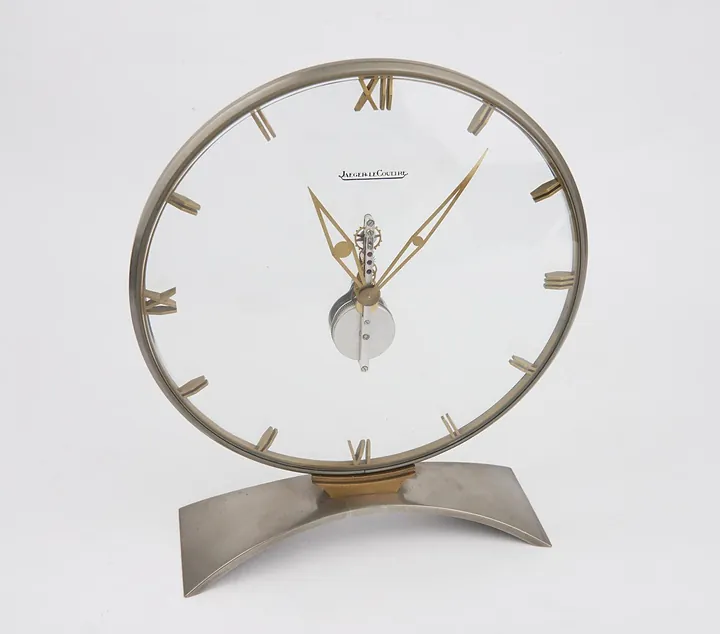
Skeleton clock by Jaeger-LeCoultre, Switzerland, 1937–1938
Science Museum Group, London
Movements & Components · 1953
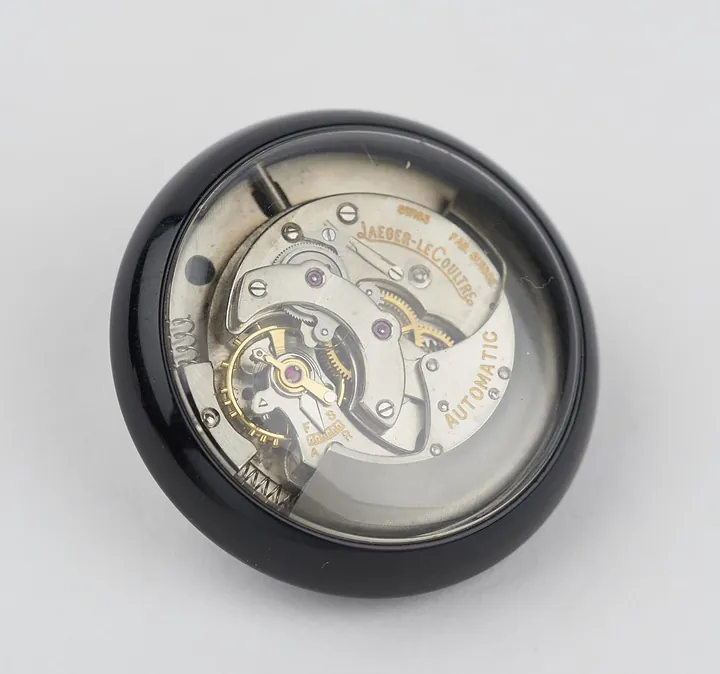
Automatic watch movement, Jaeger-LeCoultre, 1953, Geneva, Switzerland, showing self-winding mechanism
Science Museum Group, London
Wristwatches · 1953
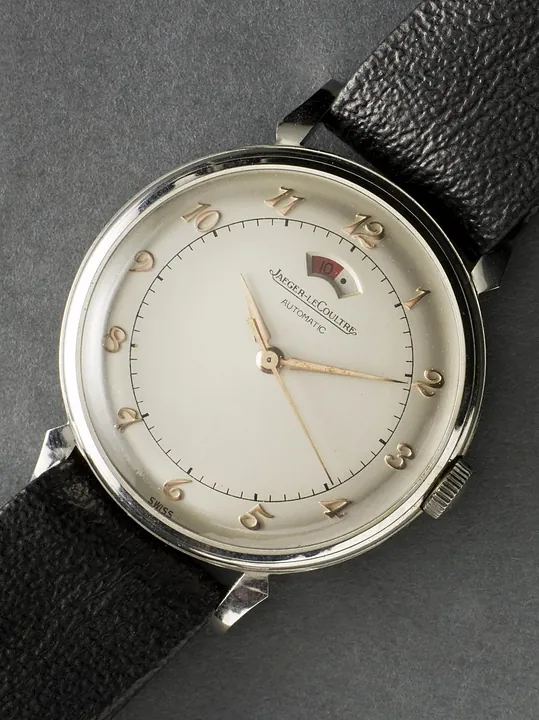
Automatic Wrist-watch, Jaeger-LeCoultre, Geneva, Switzerland, with reserve power indicator complete in steel case, 1953. Back numbered 564556.
Science Museum Group, London
Wristwatches · 1953
Wrist-watch, 'Memovox' alarm, Jaeger-LeCoultre, Geneva, Switzerland, complete in steel case, 1953.
Science Museum Group, London

Wristwatches · 1945
Wristwatch by Eterna, 1945
Museum Rotterdam

Wristwatches · c. 1945
Breitling Premier, ref. 790, c. 1945
Antiquorum auction archive, Geneva

Wristwatches · c. 1945
Universal Genève Uni-Compax, ref. 22492, c. 1945
Antiquorum auction archive, Geneva

Wristwatches · c. 1950s
Baume & Mercier wristwatch, c. 1950s
Antiquorum auction archive, Geneva