
Wristwatches · Wristwatch
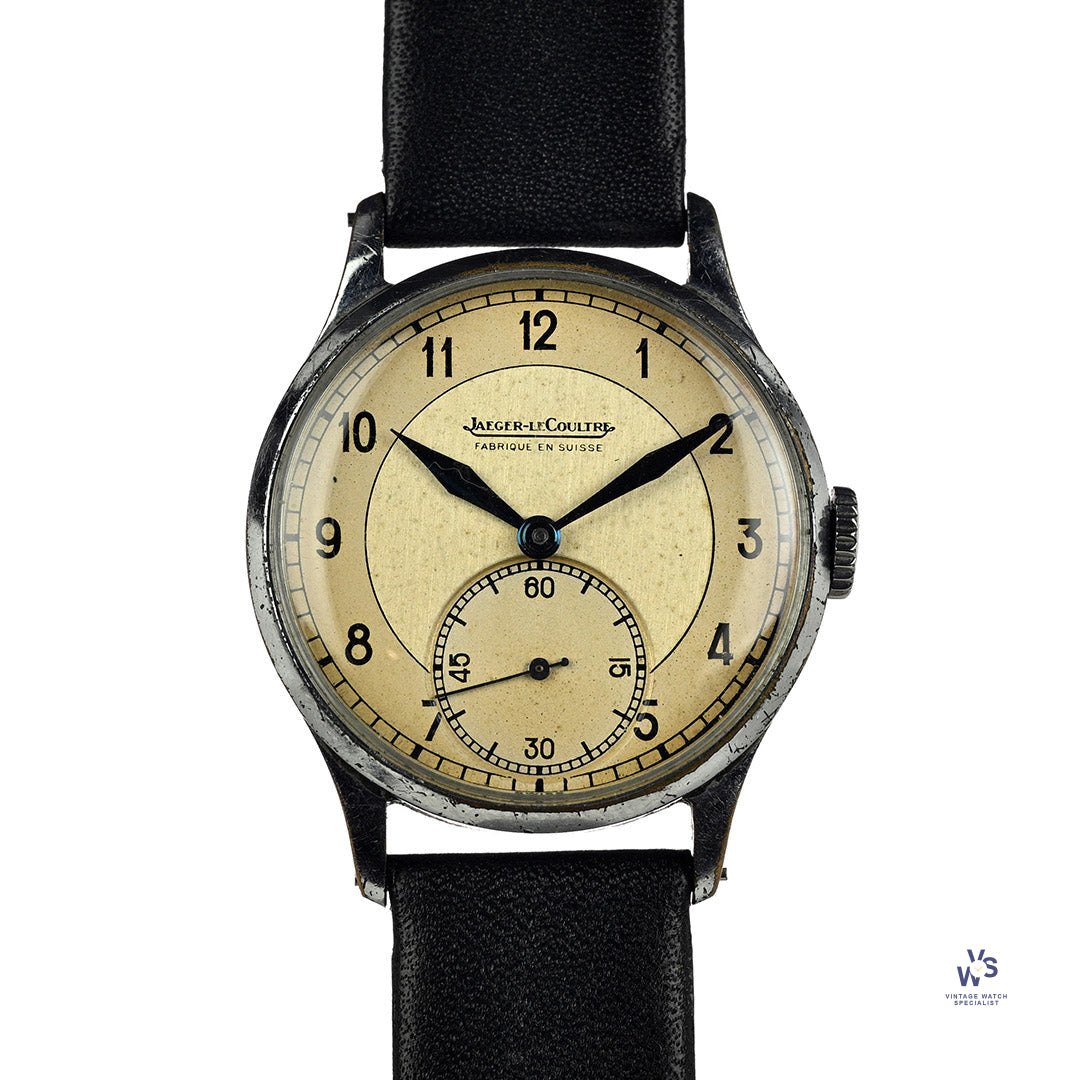
Jaeger LeCoultre, Chrome Plated Field Style Watch, circa 1940s
- Maker / attribution
- Jaeger-LeCoultre (maker)
- Date
- c. 1940s
- Historical period
- Golden Age of Mechanical Watchmaking (1900 – 1945)
- Country of origin
- Switzerland
- Object type
- Wristwatch
- Dimensions
- Case 30 mm
- Stock no.
- vws3590cs
- Credit line
- Dealer listing, Vintage Watch Specialist (vws3590cs)
- Catalogue title (original)
- Jaeger LeCoultre - Chrome Plated Field Style Watch - c.1940s (English)
View the source record (dealer listing) ↗ (opens another website in a new tab)Suggest a correction
Record summary
Catalogued by Vintage Watch Specialist (dealer), United Kingdom (stock number vws3590cs), this is a wristwatch by Jaeger-LeCoultre, made in Switzerland, dated c. 1940s. The Atlas places it in the Golden Age of Mechanical Watchmaking period (1900 – 1945) of its Wristwatches collection. Recorded dimensions: Case 30 mm. The record is illustrated with 6 photographs.
Assembled from the source record's structured fields. Dates and attributions are given as the source states them; where a field is missing the Atlas leaves it blank rather than estimating.
Catalogue description
Dealer description — Vintage Watch Specialist
A Beautiful Jaeger Le Coultre Field Watch with a Wonderful Sector Dial Including an Oversized Sub-Seconds Dial and Blued Steel Lozenge Hands, c.1940s Jaeger-LeCoultre, a prestigious Swiss watchmaker, was founded in 1833 by Antoine LeCoultre in Le Sentier, Switzerland. Known for its exquisite craftsmanship and innovative designs, the brand has significantly contributed to horological advancements. In 1844, LeCoultre developed the Millionometer, the first instrument capable of measuring microns, revolutionizing precision in watchmaking. In 1903, Edmond Jaeger, a French watchmaker, partnered with LeCoultre’s grandson, Jacques-David LeCoultre, to produce ultra-thin movements exclusively for Jaeger’s designs, forming the iconic Jaeger-LeCoultre brand in 1937. The company gained fame in 1931 with the introduction of the Reverso, a reversible watch designed for polo players that combined elegance and practicality. Throughout its history, Jaeger-LeCoultre has created over 1,000 calibres, including the legendary Atmos clock and the Master Control series. What's on Offer We are delighted to offer this wonderful 1940s 'field watch' for sale in such fantastic vintage condition. The dial has aged to a beautiful ecru colour and taken on some attractive patina whilst the sector design offers a unique look. The sub-second dial is oversized and is almost touching the central pinion - a nice point of difference. The watch features Arabic numerals and stylish blued steel lozenge hands. The dial is completed by a JLC signature at 12 o' clock. The plated case also looks well with some minor deterioration to the inner edges. The watch is fairly slight in proportion at just over 30mm wide, however, this is reflective of the period in which it was produced. A fine looking watch, never the less, with definite nods to military design, it is running well and keeping good time, it wears beautifully on the wrist and will no doubt offer many years of time-keeping. The case back is marked B398440.
Historical context
Golden Age of Mechanical Watchmaking (1900 – 1945)
The wristwatch displaces the pocket watch; waterproof cases, self-winding and grand complications.
The wristwatch overtook the pocket watch. Military use in the First World War, aviation, water-resistant cases (1926), automatic winding (1923–31), rectangular Art Deco designs and early chronographs and calendars defined the period.
Read the period in the timelineMore wristwatches from this periodEarlier: Industrial Revolution
Atlas type guide
Wristwatches
Bracelet watches were worn by women from the early nineteenth century — Breguet made one for Caroline Murat, Queen of Naples, in 1810–12 — but the wristwatch only became a man's instrument with military use and aviation in the early twentieth century. Between the World Wars it overtook the pocket watch; the 1920s and 1930s brought rectangular Art Deco cases, water-resistant cases and the first automatic winding systems.
After 1945 the wristwatch became a carrier of identity — dress watches, sports and dive watches, chronographs, calendars — produced by Swiss, American, Japanese, German, Soviet and Chinese industries. The quartz revolution after 1969 and the mechanical renaissance since the 1990s, including the rise of independent watchmakers, complete the story.
What to look for
- The reference number (between the lugs or inside the case back) and serial number, the starting point for dating.
- The calibre: its maker and number are often stamped under the dial or on the bridge.
- Originality of dial, hands and crown — refinished ('redial') dials are common.
- Case material marks: 18K/750, 14K/585, stainless steel, gold-filled, plated.
Dating clues
- Wire-lug cases: before c. 1925.
- Water-resistant screw-down cases: from 1926.
- Quartz movements: from 1969; sapphire crystals widespread after c. 1980.
General guidance written by the Atlas editors about this kind of object. It is not a statement about this particular piece; for that, rely on the source record above and on physical examination.
Related records
Clocks · 1937–1938
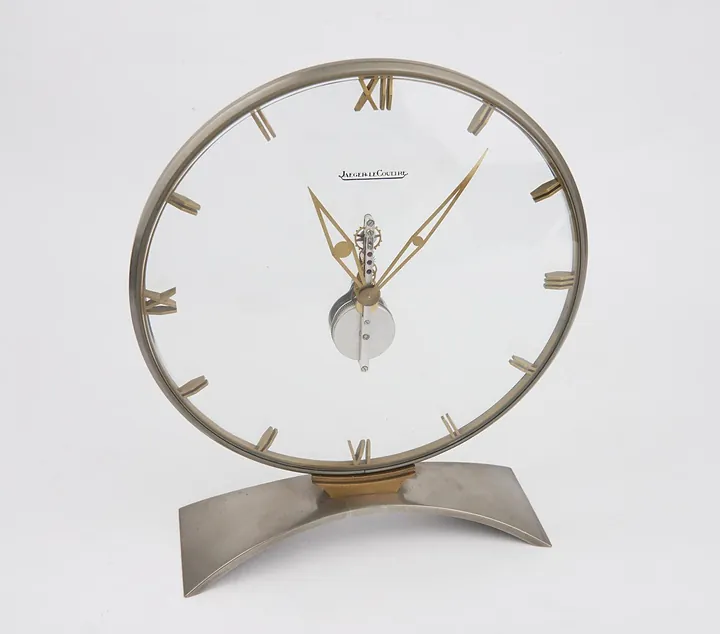
Skeleton clock by Jaeger-LeCoultre, Switzerland, 1937–1938
Science Museum Group, London
Movements & Components · 1953
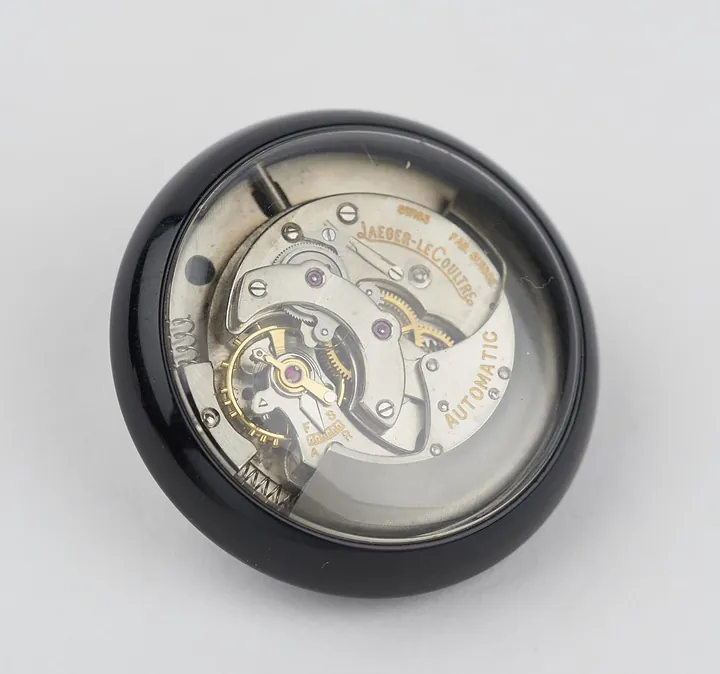
Automatic watch movement, Jaeger-LeCoultre, 1953, Geneva, Switzerland, showing self-winding mechanism
Science Museum Group, London
Wristwatches · 1953
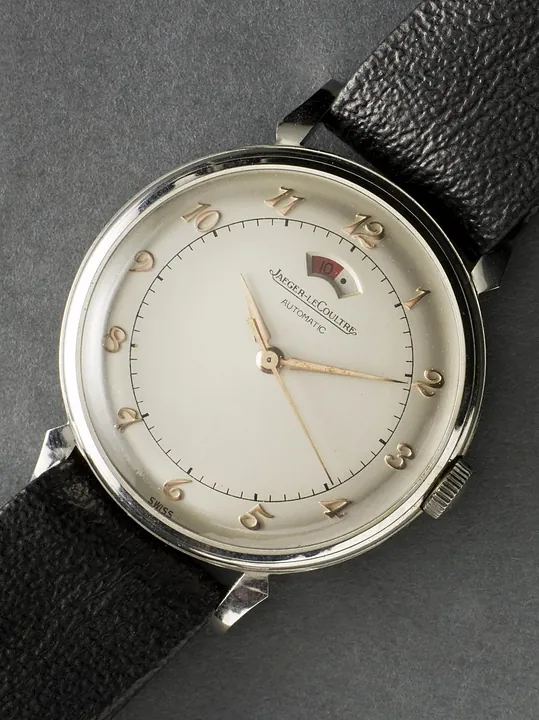
Automatic Wrist-watch, Jaeger-LeCoultre, Geneva, Switzerland, with reserve power indicator complete in steel case, 1953. Back numbered 564556.
Science Museum Group, London
Wristwatches · 1953
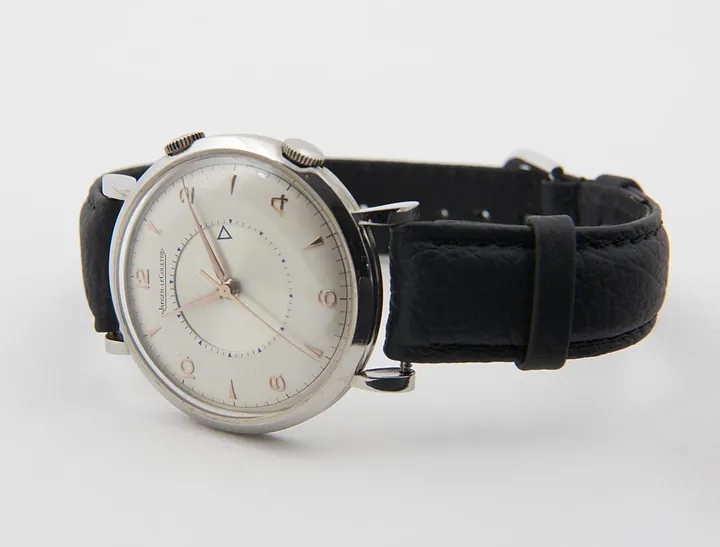
Wrist-watch, 'Memovox' alarm, Jaeger-LeCoultre, Geneva, Switzerland, complete in steel case, 1953.
Science Museum Group, London

Wristwatches · 1931
Rolex 'Oyster Perpetual' rotor self-winding wrist-watch, lever escapement, in steel case with glass in back, Montres Rolex SA, Geneva, Switzerland, 1931
Science Museum Group, London

Wristwatches · 1900–1999
Wristwatch by Certina, Switzerland, 1900–1999
Nordic Museum Foundation

Wristwatches · 1900–1999
Wristwatch by Omega, Västerås, 1900–1999
Nordic Museum Foundation

Wristwatches · 1900–1999
Wristwatch by Universal, Switzerland, 1900–1999
Nordic Museum Foundation