
Wristwatches · Wristwatch
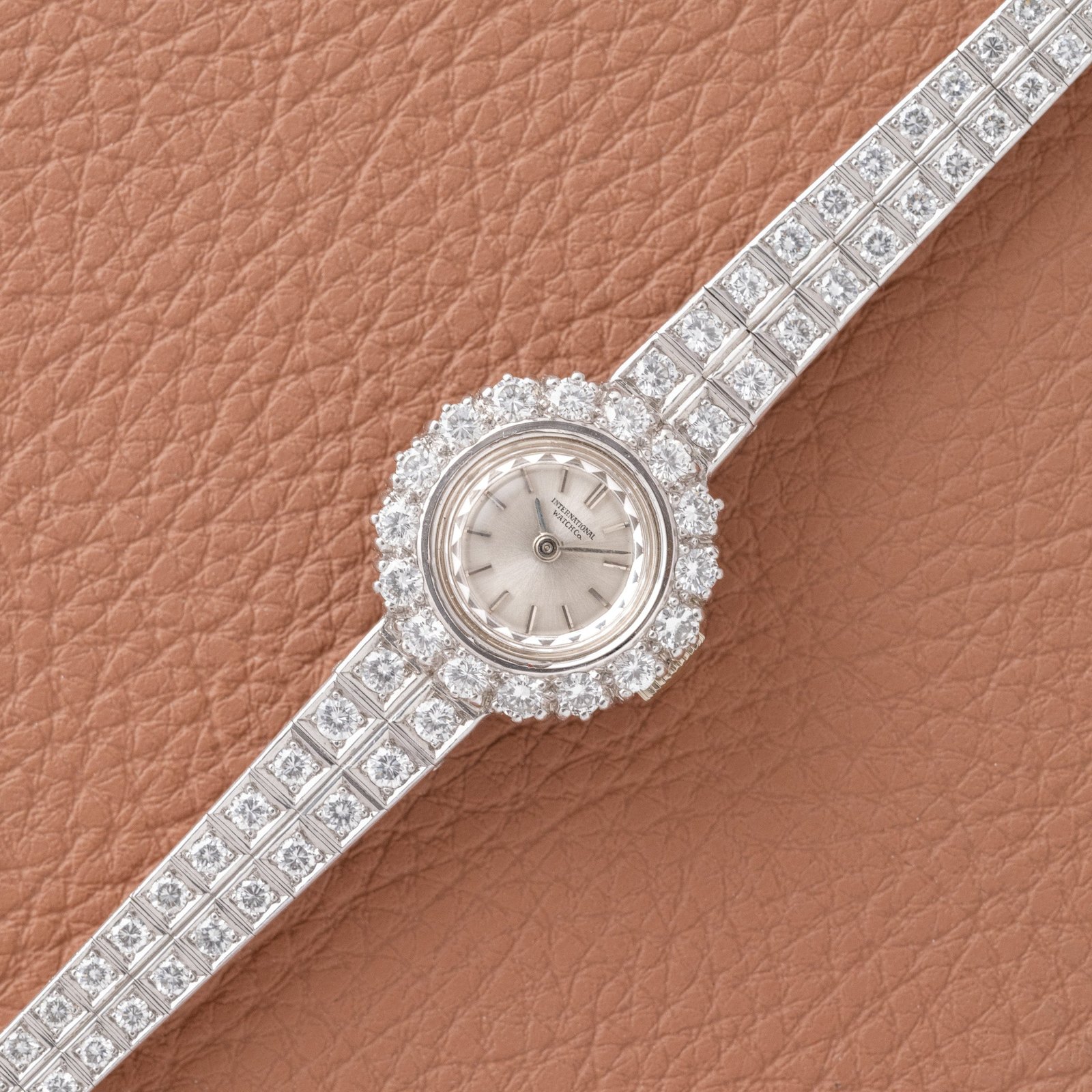
IWC White Gold Diamond Cocktail Watch, 1950s
- Maker / attribution
- IWC (maker)
- Date
- 1950s
- Historical period
- Modern Mechanical Horology (1945 – 1969)
- Country of origin
- Switzerland
- Object type
- Wristwatch
- Materials / technique
- white gold
- Dimensions
- Case 18 mm
- Stock no.
- Product 8403159187639
- Credit line
- Dealer listing, Huntington Company (product 8403159187639)
- Catalogue title (original)
- 1950s IWC White Gold Diamond Cocktail Watch - Rare (English)
View the source record (dealer listing) ↗ (opens another website in a new tab)Suggest a correction
Record summary
Catalogued by Huntington Company (dealer) (stock number Product 8403159187639), this is a wristwatch by IWC, made in Switzerland, dated 1950s. The Atlas places it in the Modern Mechanical Horology period (1945 – 1969) of its Wristwatches collection. Materials and techniques recorded by the source: white gold. Recorded dimensions: Case 18 mm. The record is illustrated with 6 photographs.
Assembled from the source record's structured fields. Dates and attributions are given as the source states them; where a field is missing the Atlas leaves it blank rather than estimating.
Catalogue description
Dealer description — Huntington Company
History & Significance During the mid-20th century, International Watch Company produced a small number of fine jewelry watches that sat outside their better-known pilot and tool watch catalog. These cocktail watches were made in precious metals and often paired with elaborate gem-set bracelets, intended for formal evening wear rather than everyday use. Production numbers were low, and many were custom-ordered through jewelers, which makes surviving examples highly individual. This piece is crafted in white gold and features an integrated bracelet fully set with diamonds, including a halo surrounding the dial. The dial itself is restrained and understated, allowing the case and bracelet to carry the visual weight. Unlike many diamond watches of the era that feel decorative first and horological second, this retains the proportions and balance of a proper watch, scaled down intentionally rather than compromised. The result is a piece that reflects both IWC’s technical discipline and the mid-century appetite for refined luxury. Writer’s Thoughts This is one of those watches that stops you once you really look at it. The diamond work is extensive but surprisingly tasteful, and the small silver dial keeps everything grounded. It feels like a true period piece that hasn’t been altered or over-polished, which is rare with watches like this. I love how it balances restraint and excess at the same time. It’s unmistakably special, but still feels honest and original. Our Promise Every watch is thoroughly vetted, carefully described with complete transparency, and guaranteed authentic. This watch is offered in honest condition. Specifications Brand: International Watch Company Model: Cocktail Watch Year: 1950s Case Material: White gold case with diamond-set bezel integrated into the case design Case Size: 18 mm Dial: Silver dial with applied hour markers Crystal: Acrylic Movement: Manual wind IWC movement Strap/Bracelet: Integrated white gold bracelet fully set with diamonds Buckle/Clasp: Integrated concealed clasp Contents: Watch only Condition Case: White gold case and diamond-set bezel are exceptionally well preserved with crisp edges and minimal wear consistent with careful use. Crystal: The unique art deco crystal is in mint condition. Dial: In mint condition, with clean printing and no discoloration or damage. Hands: The original hands are well-preserved and match the dial beautifully. Strap/Bracelet: Integrated diamond bracelet is in excellent condition with tight links and strong presence. Buckle/Clasp: Original clasp functions properly and shows light wear consistent with age.
Historical context
Modern Mechanical Horology (1945 – 1969)
Tool watches for divers, pilots and astronauts; electric watches anticipate the electronic age.
The classic era of the mechanical wristwatch: dive watches, chronographs for motor racing and space flight, GMT watches for jet travel, slim dress watches, automatic calendars, and the rise of Japanese manufacturers alongside Swiss, American, German and Soviet industries.
Read the period in the timelineMore wristwatches from this periodEarlier: Golden Age of Mechanical Watchmaking
Atlas type guide
Wristwatches
Bracelet watches were worn by women from the early nineteenth century — Breguet made one for Caroline Murat, Queen of Naples, in 1810–12 — but the wristwatch only became a man's instrument with military use and aviation in the early twentieth century. Between the World Wars it overtook the pocket watch; the 1920s and 1930s brought rectangular Art Deco cases, water-resistant cases and the first automatic winding systems.
After 1945 the wristwatch became a carrier of identity — dress watches, sports and dive watches, chronographs, calendars — produced by Swiss, American, Japanese, German, Soviet and Chinese industries. The quartz revolution after 1969 and the mechanical renaissance since the 1990s, including the rise of independent watchmakers, complete the story.
What to look for
- The reference number (between the lugs or inside the case back) and serial number, the starting point for dating.
- The calibre: its maker and number are often stamped under the dial or on the bridge.
- Originality of dial, hands and crown — refinished ('redial') dials are common.
- Case material marks: 18K/750, 14K/585, stainless steel, gold-filled, plated.
Dating clues
- Wire-lug cases: before c. 1925.
- Water-resistant screw-down cases: from 1926.
- Quartz movements: from 1969; sapphire crystals widespread after c. 1980.
General guidance written by the Atlas editors about this kind of object. It is not a statement about this particular piece; for that, rely on the source record above and on physical examination.
Related records
Pocket Watches · c. 1950
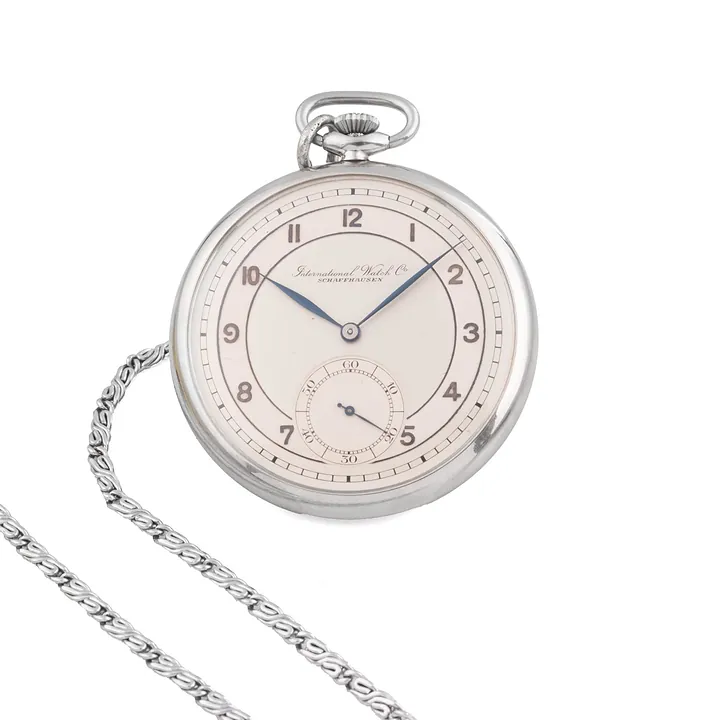
IWC Pocket Watch, c. 1950
Antiquorum auction archive, Geneva
Pocket Watches · c. 1980
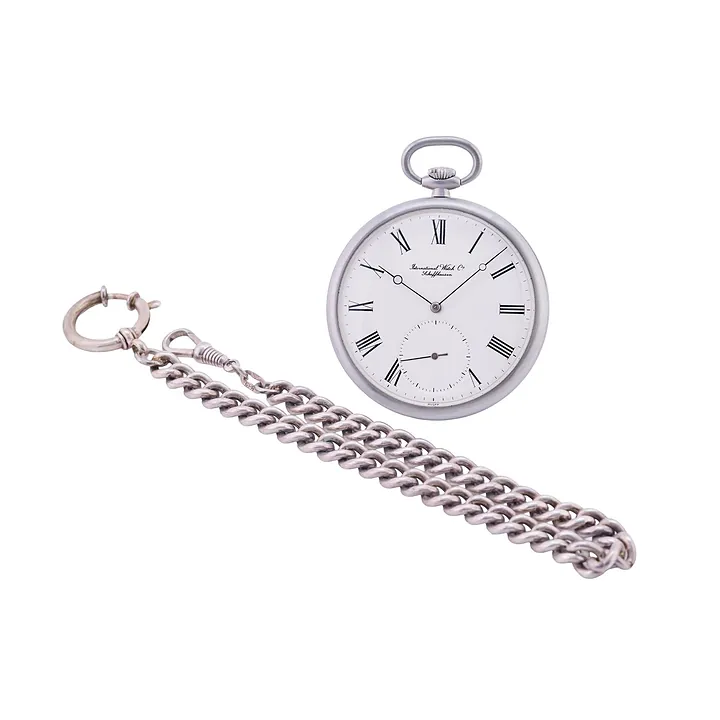
IWC pocket watch, ref. 5301, c. 1980
Antiquorum auction archive, Geneva
Wristwatches · originally sold in April 2016 (per the lot record)
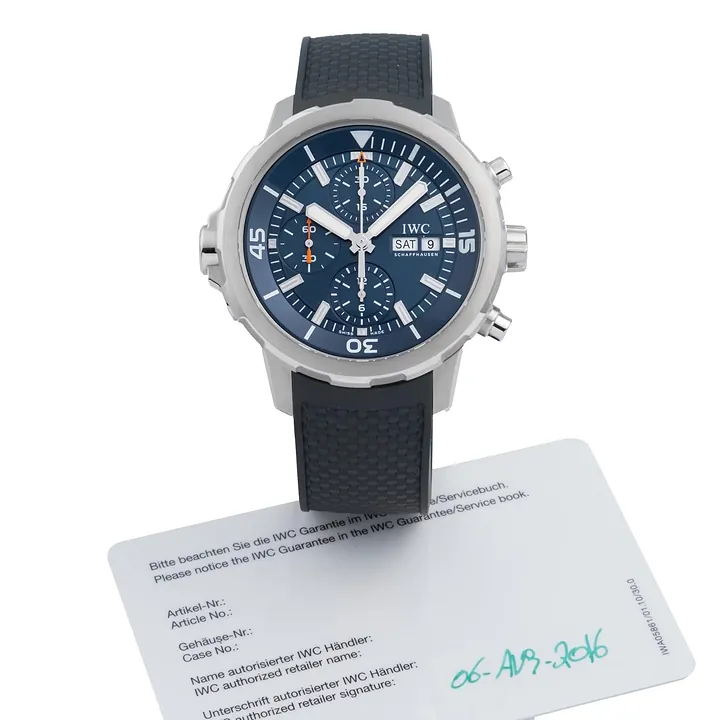
IWC Aquatimer Chronograph Cousteau, ref. IW3768, originally sold in April 2016
Antiquorum auction archive, Geneva
Wristwatches · c. 2010s
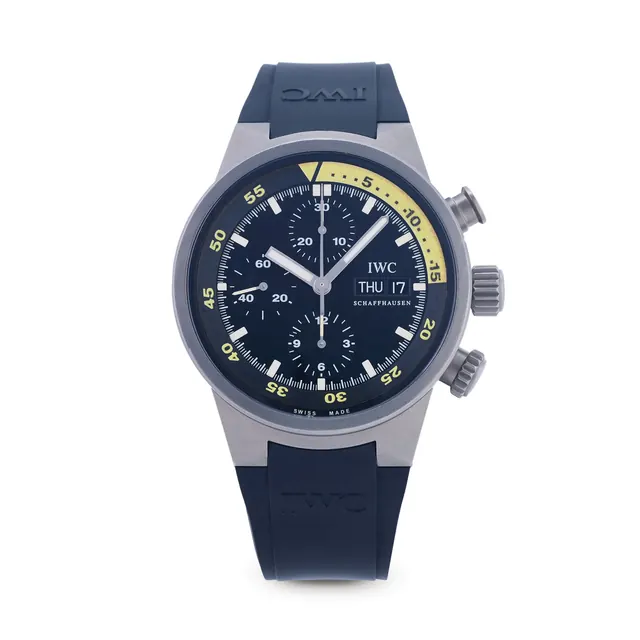
IWC wristwatch, ref. IW371918, Aquatimer, circa 2010s
Antiquorum auction archive, Geneva

Wristwatches · 1945
Wristwatch by Eterna, 1945
Museum Rotterdam

Wristwatches · c. 1945
Breitling Premier, ref. 790, c. 1945
Antiquorum auction archive, Geneva

Wristwatches · c. 1945
Universal Genève Uni-Compax, ref. 22492, c. 1945
Antiquorum auction archive, Geneva

Wristwatches · c. 1950s
Baume & Mercier wristwatch, c. 1950s
Antiquorum auction archive, Geneva