
Wristwatches · Wristwatch
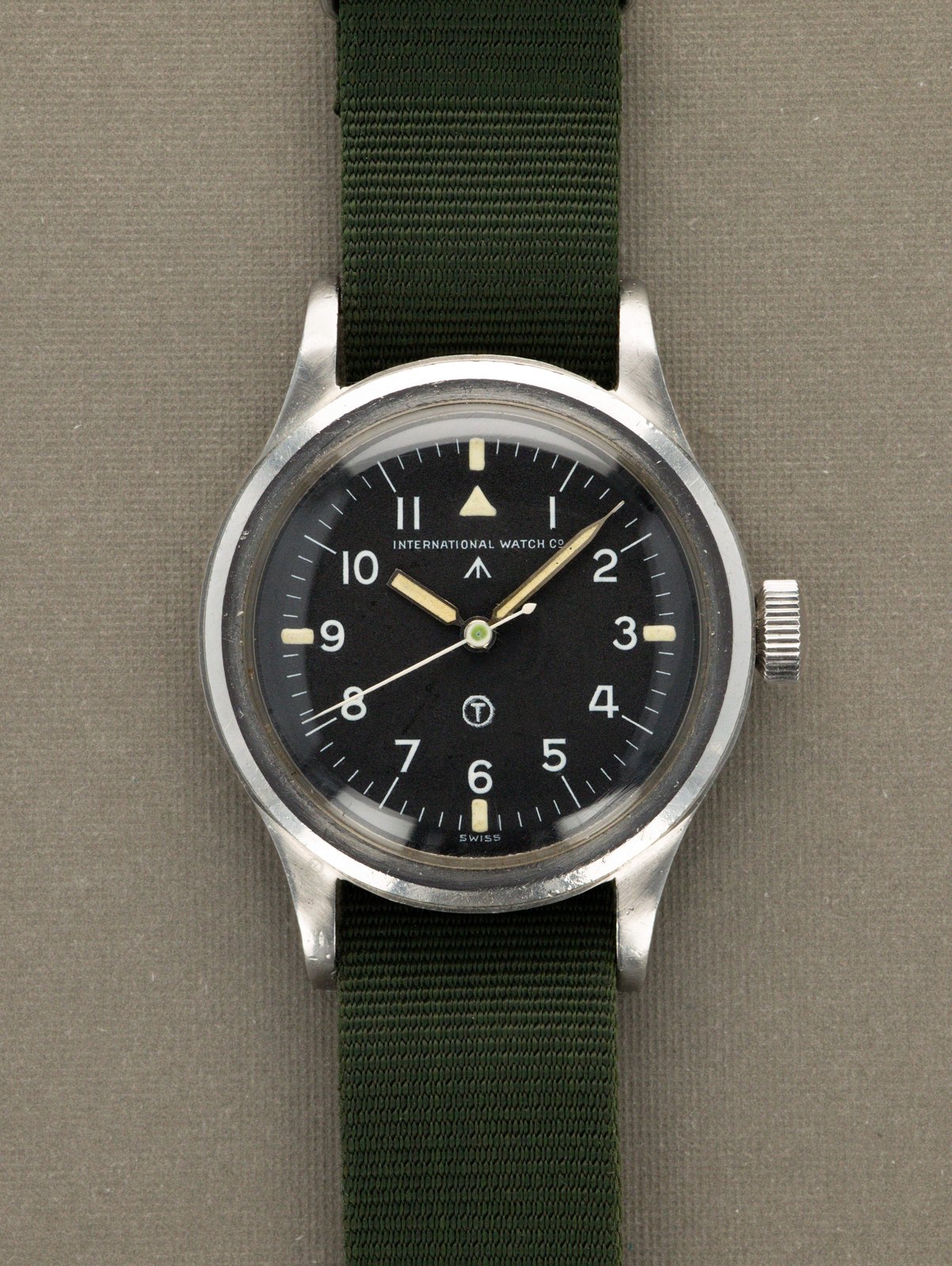
IWC Mark XI 6B/346 'WWW', Matte Black 'Circle T' Dial with Documentation
- Maker / attribution
- IWC (maker)
- Date
- c. 1951
- Historical period
- Modern Mechanical Horology (1945 – 1969)
- Country of origin
- Switzerland
- Object type
- Wristwatch
- Stock no.
- OC3242
- Credit line
- Dealer listing, Oliver & Clarke (OC3242)
- Catalogue title (original)
- IWC Mark XI 6B/346 'WWW' - Matte Black 'Circle T' Dial W/ Documentation (English)
View the source record (dealer listing) ↗ (opens another website in a new tab)Suggest a correction
Record summary
Catalogued by Oliver & Clarke (dealer), United Kingdom (stock number OC3242), this is a wristwatch by IWC, made in Switzerland, dated c. 1951. The Atlas places it in the Modern Mechanical Horology period (1945 – 1969) of its Wristwatches collection. The record is illustrated with 6 photographs.
Assembled from the source record's structured fields. Dates and attributions are given as the source states them; where a field is missing the Atlas leaves it blank rather than estimating.
Catalogue description
Dealer description — Oliver & Clarke
The International Watch Company. Founded in 1868 in Switzerland by an American, IWC Schaffhausen enjoys a rich history in watchmaking, spanning complicated pocket watches, to pioneering wrist watches made of out experimental materials. Be there no doubt, the most popular and well-known family of watches from the brand is its 'Pilot' line, which began in the first half of the twentieth century and now offers a simply massive variety of models with different materials, sizes, movements, etc. You name it, they have it. The Mark XI was a watch born out of necessity and uncompromising standards. Following the issuance of the famed 'Dirty Dozen' watches during the Second World War, the British Ministry of Defence determined that its pilots required something even more accurate, durable, and resistant to the unique demands of aviation. In 1947, the Ministry introduced the 6B/346 navigation watch specification, setting a new benchmark for military wristwatches. Only two manufacturers were entrusted with the contract: IWC and Jaeger-LeCoultre. After 1953, JLC ended production, leaving IWC as the sole supplier, equipping Royal Air Force pilots with the Mark XI until its retirement from service in 1981. IWC built their Mark XI around their now legendary Calibre 89 — widely regarded as one of the finest manually wound movements ever produced. To meet the Ministry's stringent anti-magnetic requirements, the movement was housed within a soft iron inner case, while each watch endured an exhaustive 44-day testing period before entering service. The earliest examples were fitted with radium dials, though nearly all were updated during routine military servicing as specifications evolved. As a result, most surviving examples feature the matte black 'Circle-T' Tritium dials that have become synonymous with British military watches, making the Mark XI not only one of the most capable military timepieces ever issued, but also one of the most enduring icons of military watchmaking. Additionally, the cases utilize 'fixed' bar lugs and were designed to be worn on a NATO strap. The example that we have here dates to circa 1951 and is offered in fantastic overall condition. The case has seemingly been spared of any polishing and presents very nicely with normal signs of wear from use given the life it has endured. The correct crown and inner dust cover also emain in fantastic condition, with screw-down caseback also r, with all the appropriate engravings clear and present. Inside, the dial is well-preserved, with clear white text, a stamped 'Circle-T' and patinated luminous plots at the 3, 6, 9, & 12 o'clock positions with a matching patinated handset. Additionally, this piece is accompanied by a letter of provenance from the original owner, service papers, and an extract from IWC themselves. To many collectors of vintage, regardless of whether the focus is of military watches or not, this piece has everything going for it. Military issued, properly vintage, strong condition, and its from one of the great brands. This is a real piece of history — a phrase often repeated in the world of watches, though rarely as deservedly as in this case.
Historical context
Modern Mechanical Horology (1945 – 1969)
Tool watches for divers, pilots and astronauts; electric watches anticipate the electronic age.
The classic era of the mechanical wristwatch: dive watches, chronographs for motor racing and space flight, GMT watches for jet travel, slim dress watches, automatic calendars, and the rise of Japanese manufacturers alongside Swiss, American, German and Soviet industries.
Read the period in the timelineMore wristwatches from this periodEarlier: Golden Age of Mechanical Watchmaking
Atlas type guide
Wristwatches
Bracelet watches were worn by women from the early nineteenth century — Breguet made one for Caroline Murat, Queen of Naples, in 1810–12 — but the wristwatch only became a man's instrument with military use and aviation in the early twentieth century. Between the World Wars it overtook the pocket watch; the 1920s and 1930s brought rectangular Art Deco cases, water-resistant cases and the first automatic winding systems.
After 1945 the wristwatch became a carrier of identity — dress watches, sports and dive watches, chronographs, calendars — produced by Swiss, American, Japanese, German, Soviet and Chinese industries. The quartz revolution after 1969 and the mechanical renaissance since the 1990s, including the rise of independent watchmakers, complete the story.
What to look for
- The reference number (between the lugs or inside the case back) and serial number, the starting point for dating.
- The calibre: its maker and number are often stamped under the dial or on the bridge.
- Originality of dial, hands and crown — refinished ('redial') dials are common.
- Case material marks: 18K/750, 14K/585, stainless steel, gold-filled, plated.
Dating clues
- Wire-lug cases: before c. 1925.
- Water-resistant screw-down cases: from 1926.
- Quartz movements: from 1969; sapphire crystals widespread after c. 1980.
General guidance written by the Atlas editors about this kind of object. It is not a statement about this particular piece; for that, rely on the source record above and on physical examination.
Related records
Pocket Watches · c. 1950
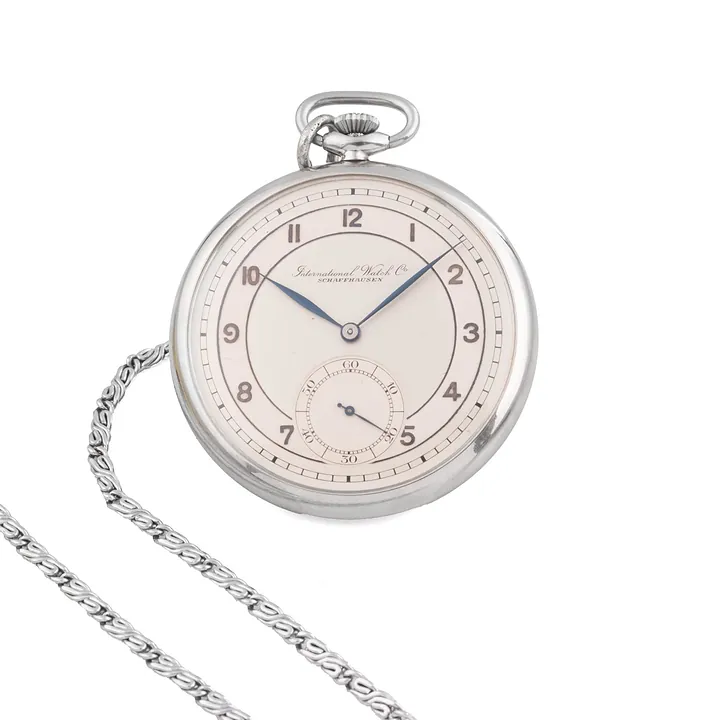
IWC Pocket Watch, c. 1950
Antiquorum auction archive, Geneva
Pocket Watches · c. 1980
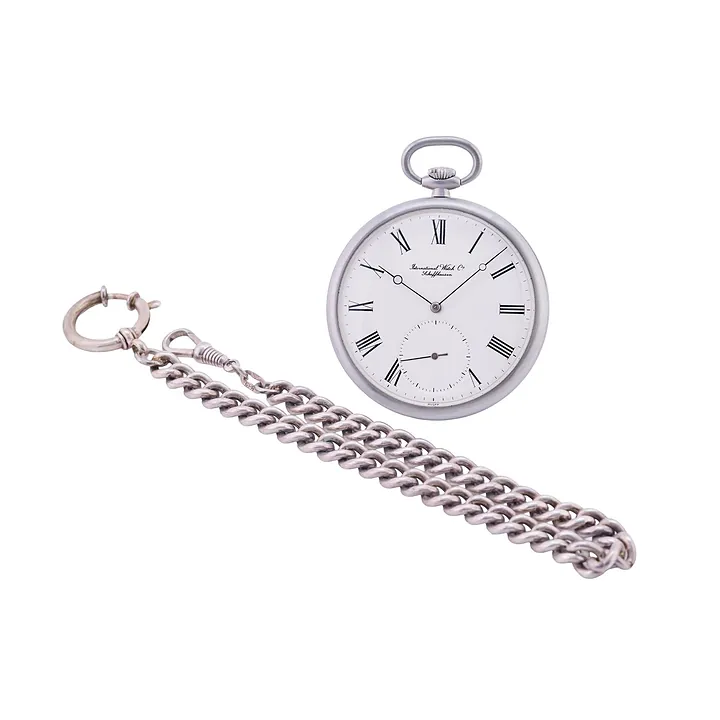
IWC pocket watch, ref. 5301, c. 1980
Antiquorum auction archive, Geneva
Wristwatches · originally sold in April 2016 (per the lot record)
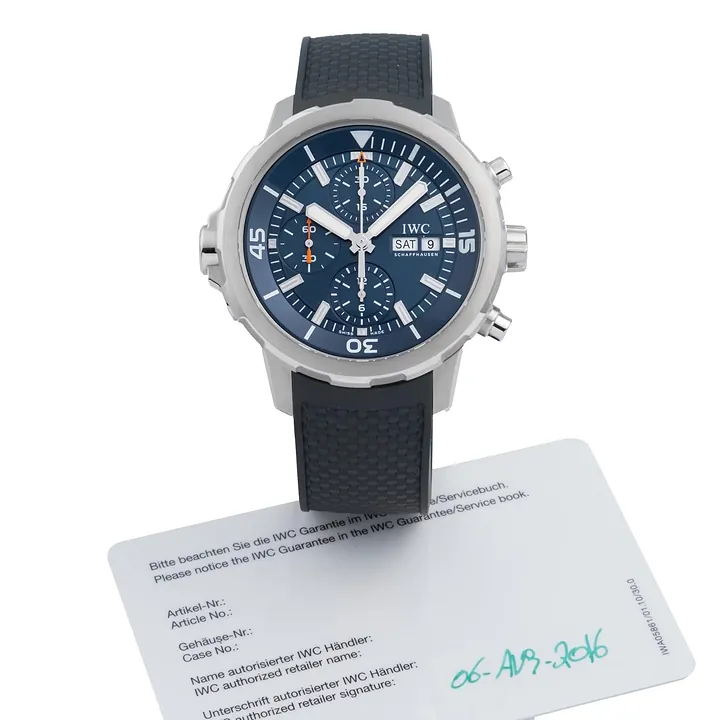
IWC Aquatimer Chronograph Cousteau, ref. IW3768, originally sold in April 2016
Antiquorum auction archive, Geneva
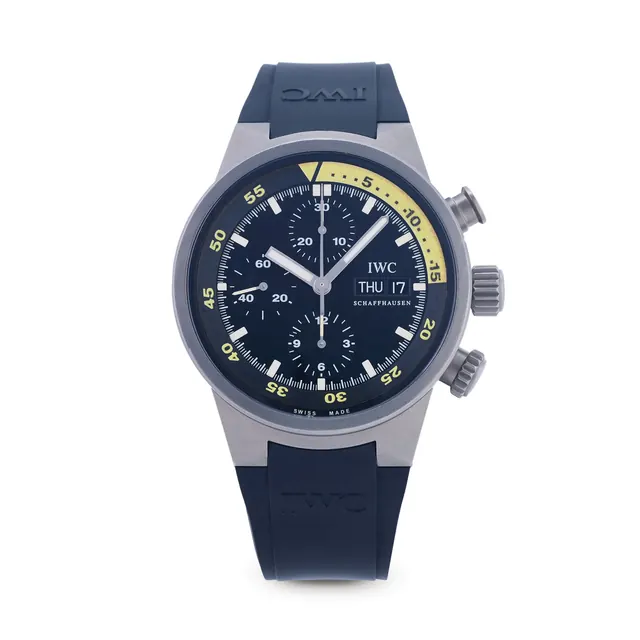
Wristwatches · c. 2010s
IWC wristwatch, ref. IW371918, Aquatimer, circa 2010s
Antiquorum auction archive, Geneva

Wristwatches · 1945
Wristwatch by Eterna, 1945
Museum Rotterdam

Wristwatches · c. 1945
Breitling Premier, ref. 790, c. 1945
Antiquorum auction archive, Geneva

Wristwatches · c. 1945
Universal Genève Uni-Compax, ref. 22492, c. 1945
Antiquorum auction archive, Geneva

Wristwatches · c. 1950s
Baume & Mercier wristwatch, c. 1950s
Antiquorum auction archive, Geneva