
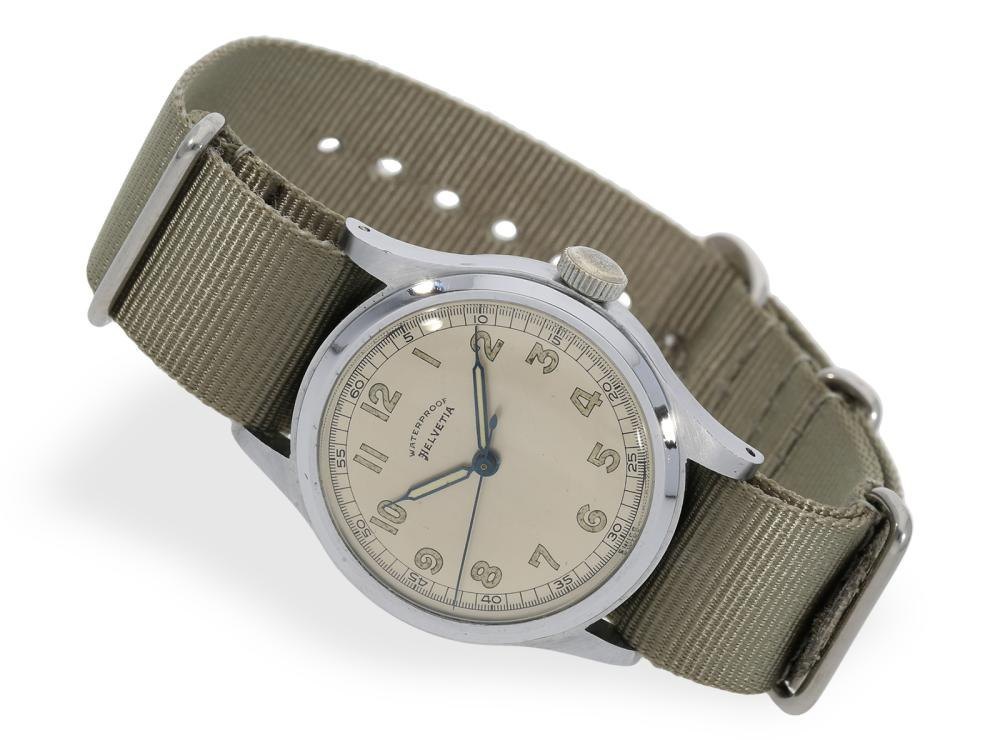
Wristwatches · Military wristwatch
Helvetia Military Wristwatch, Calibre 820B
- Maker / attribution
- Helvetia (source attribution)
- Date
- around 1940
- Historical period
- Golden Age of Mechanical Watchmaking (1900 – 1945)
- Country of origin
- Switzerland
- Object type
- Military wristwatch
- Auction house
- Cortrie Spezial Auktionen
- Lot
- 4065
- Credit line
- Cortrie Spezial Auktionen
- Catalogue title (original)
- Sold at Auction: Wristwatch: Military watch from around 1940, Second World War, Helvetia with center seconds (English)
View the source record (auction lot) ↗ (opens another website in a new tab)Suggest a correction
Record summary
Catalogued by Cortrie Spezial Auktionen (lot 4065), this is a military wristwatch attributed to Helvetia, made in Switzerland, dated around 1940. The Atlas places it in the Golden Age of Mechanical Watchmaking period (1900 – 1945) of its Wristwatches collection. The record is illustrated with 1 photograph.
Assembled from the source record's structured fields. Dates and attributions are given as the source states them; where a field is missing the Atlas leaves it blank rather than estimating.
Catalogue description
Original object description
Dated by the auction house to circa 1940 during the Second World War and attributed to Helvetia, this military wrist timepiece features a steel case with an approximate diameter of 34 mm. Its silvered dial is detailed with luminescent Arabic numeral hours, blued skeletonized hands, a central sweep seconds hand, and a railroad-pattern minute track displaying five-minute Arabic increments. Dial text reads 'WATERPROOF HELVETIA' beneath the 12 o'clock marker and 'SWISS MADE' across the bottom near the 6 o'clock position. Accompanied by an olive-drab woven fabric military strap fitted with steel retaining rings, the watch is noted as running and in very good overall condition. Although the cataloguer states that the threaded case back bears the marking 'No. 3190' along with U.S. Army military inscriptions, these designations are unpictured and thus visually unconfirmed; similarly, the center-seconds Helvetia calibre 820B movement lacks recorded specifics regarding its jewel count, caliber engravings, shock absorption, or surface finishing.
Inscriptions & marks
3190
Historical context
Golden Age of Mechanical Watchmaking (1900 – 1945)
The wristwatch displaces the pocket watch; waterproof cases, self-winding and grand complications.
The wristwatch overtook the pocket watch. Military use in the First World War, aviation, water-resistant cases (1926), automatic winding (1923–31), rectangular Art Deco designs and early chronographs and calendars defined the period.
Read the period in the timelineMore wristwatches from this periodEarlier: Industrial Revolution
Atlas type guide
Military, pilot and travel watches
The wristwatch owes much of its adoption by men to warfare and aviation. Wristlets — small pocket watches soldered with lugs and worn on a strap — were used in colonial campaigns and became standard equipment in the First World War, with protective grilles over the crystal ('shrapnel guards'). Louis Cartier's Santos (1904), designed for the aviator Alberto Santos-Dumont, is often cited as an early purpose-made pilot's watch.
In the Second World War governments specified watches in detail: the German B-Uhr observation watches, the American A-11, and the British 'W.W.W.' (the 'Dirty Dozen' set of 1945). After the war, jet travel brought GMT and world-time watches, which show two or more time zones at once — Louis Cottier's world-time mechanism and the Rolex GMT-Master (1955) are examples.
What to look for
- Military markings on the case back: broad arrow, issue numbers, 'W.W.W.', 'A.T.P.'
- High-legibility black dials with luminous Arabic numerals; oversized crowns for gloved hands.
- 24-hour hands and rotating 24-hour bezels or city rings on GMT/world-time watches.
- Wire lugs on early wristlets converted from pocket watches.
Dating clues
- Wire-lug wristlets: c. 1900–1925.
- Military specifications of the Second World War: 1939–1945.
- GMT and world-time wristwatches: mainly after 1950.
General guidance written by the Atlas editors about this kind of object. It is not a statement about this particular piece; for that, rely on the source record above and on physical examination.
Related records
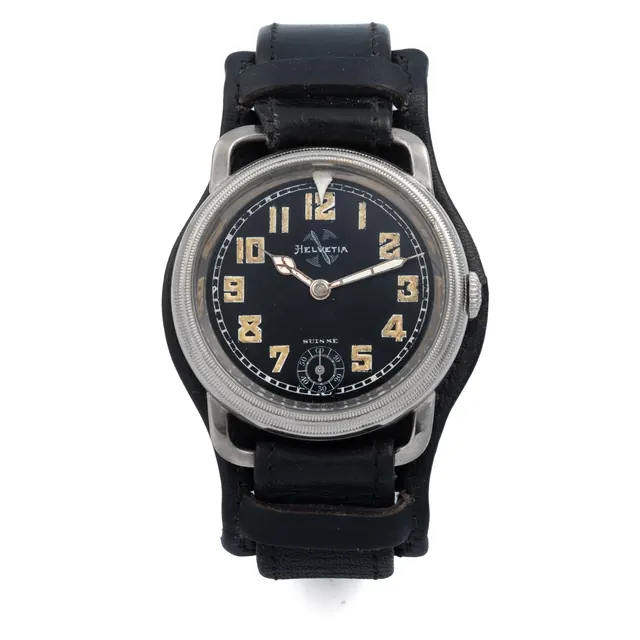
Wristwatches · c. 1935
Helvetia wristwatch, ref. 7011, Aviateur Chrome, circa 1935
Antiquorum auction archive, Geneva
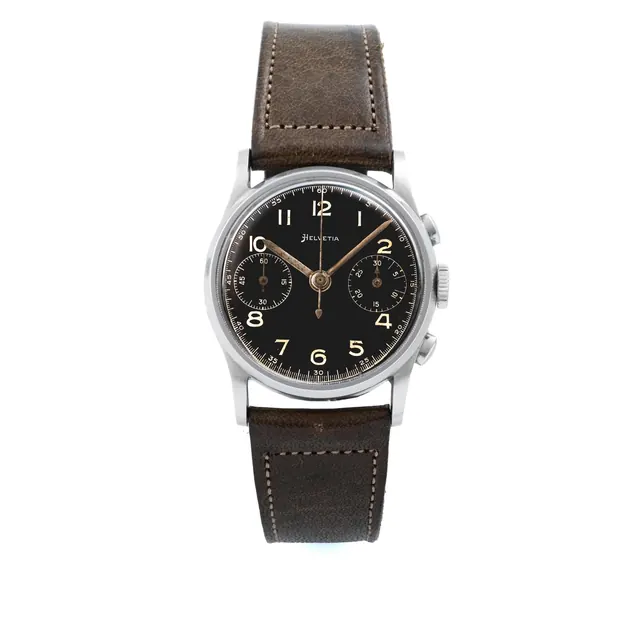
Wristwatches · c. 1940s
Helvetia wristwatch, circa 1940's
Antiquorum auction archive, Geneva
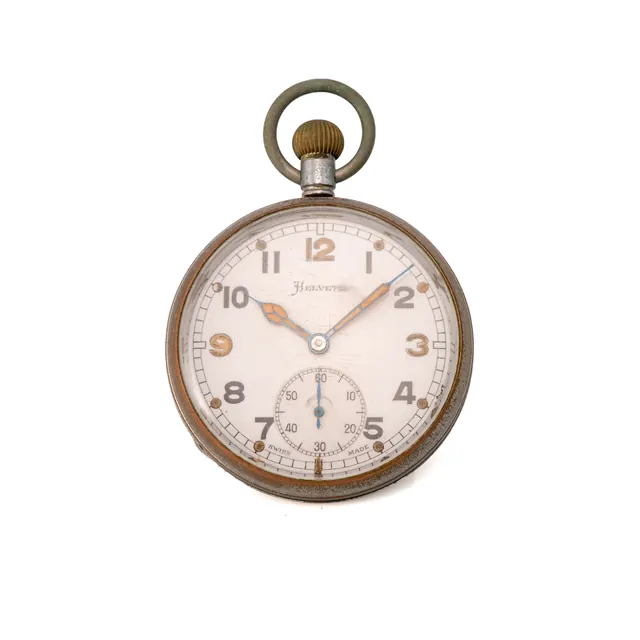
Pocket Watches · c. 1950
Helvetia pocket watch, 6010 Pocket Watch, circa 1950
Antiquorum auction archive, Geneva
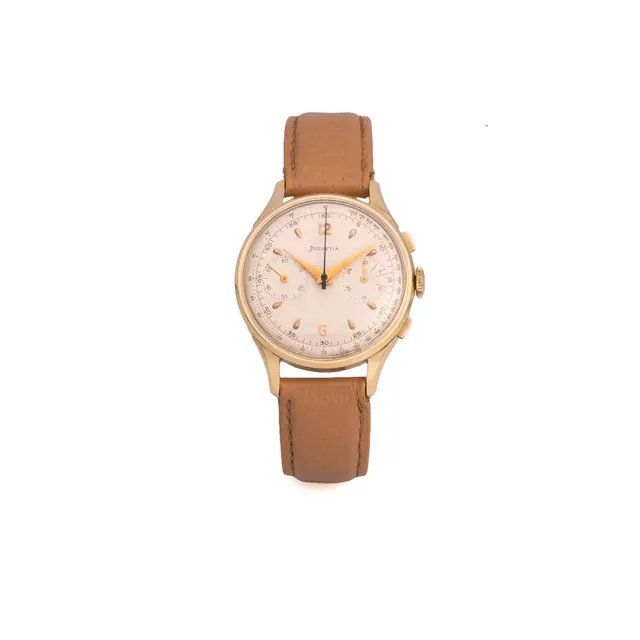
Wristwatches · c. 1940-1950
Helvetia wristwatch, Minute Counter, circa 1940-1950
Antiquorum auction archive, Geneva

Wristwatches · 1931
Rolex 'Oyster Perpetual' rotor self-winding wrist-watch, lever escapement, in steel case with glass in back, Montres Rolex SA, Geneva, Switzerland, 1931
Science Museum Group, London

Wristwatches · 1900–1999
Wristwatch by Certina, Switzerland, 1900–1999
Nordic Museum Foundation
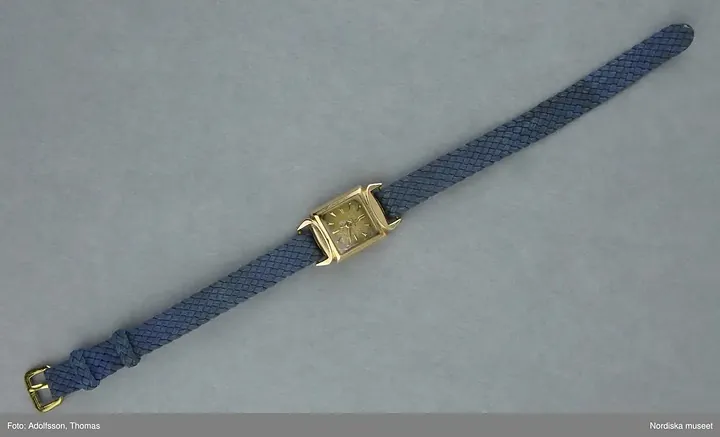
Wristwatches · 1900–1999
Wristwatch by Omega, Västerås, 1900–1999
Nordic Museum Foundation
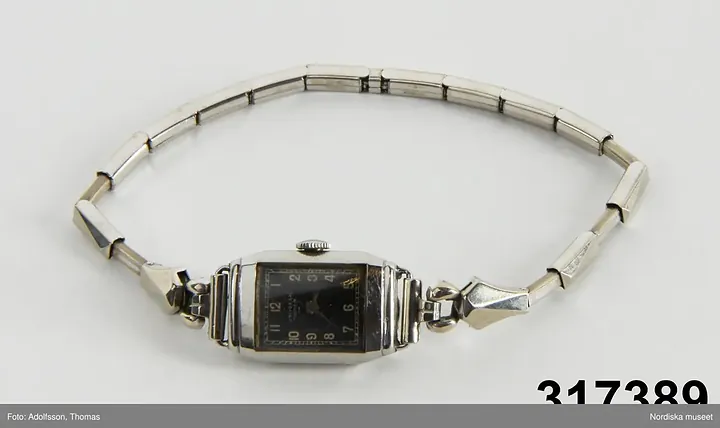
Wristwatches · 1900–1999
Wristwatch by Universal, Switzerland, 1900–1999
Nordic Museum Foundation