
Wristwatches · Wristwatch
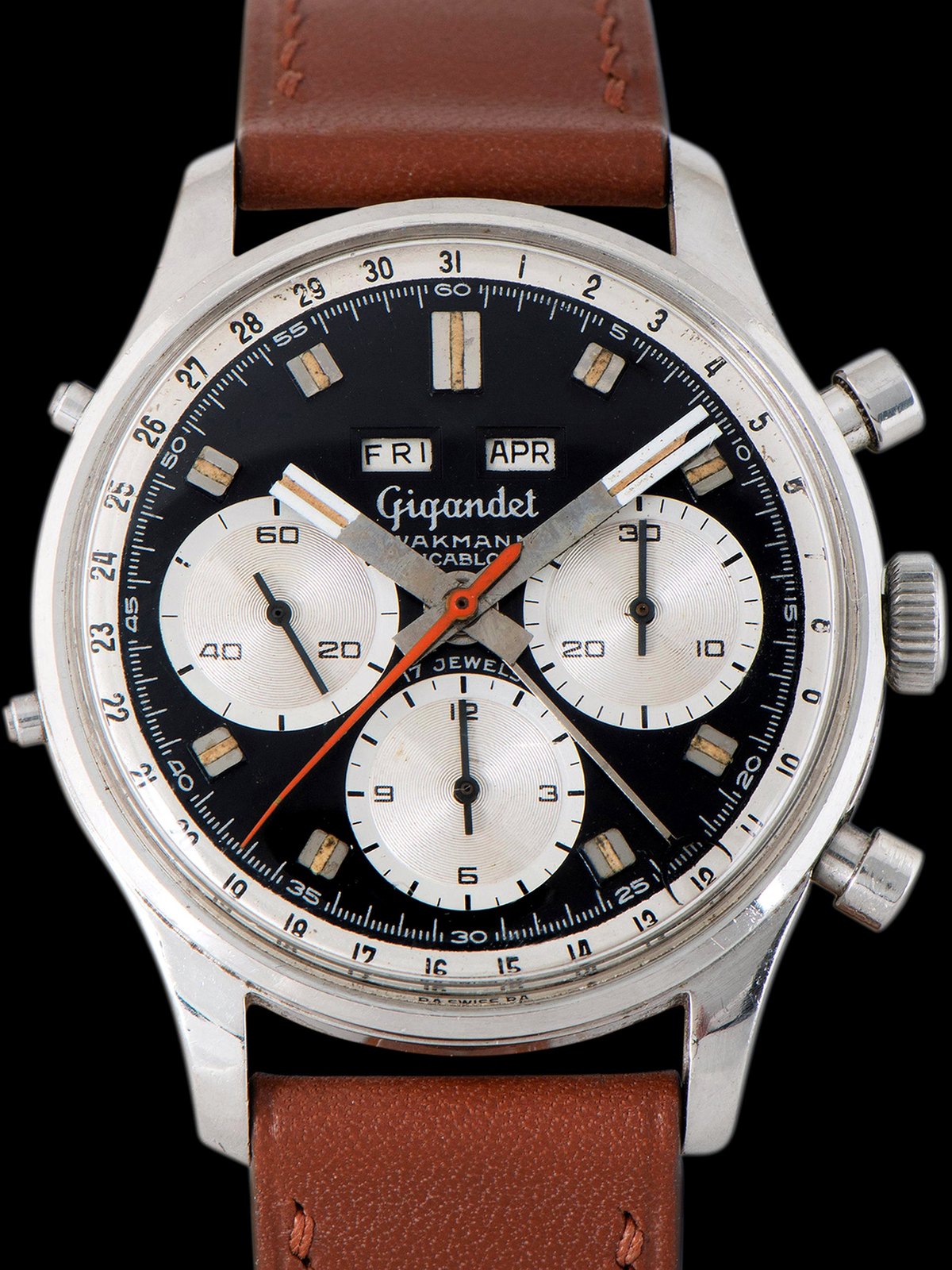
Gigandet Wakmann Triple Calendar Chronograph (Ref. 1309), 1960s
- Maker / attribution
- Wakmann (maker)
- Date
- 1960s
- Historical period
- Modern Mechanical Horology (1945 – 1969)
- Country of origin
- Unrecorded in source
- Object type
- Wristwatch
- Dimensions
- Case 37 mm
- Stock no.
- GDWKMTCDC
- Credit line
- Dealer listing, Craft & Tailored (GDWKMTCDC)
- Catalogue title (original)
- 1960s Gigandet Wakmann Triple Calendar Chronograph (Ref. 1309) (English)
View the source record (dealer listing) ↗ (opens another website in a new tab)Suggest a correction
Record summary
Catalogued by Craft & Tailored (dealer), Los Angeles (stock number GDWKMTCDC), this is a wristwatch by Wakmann, dated 1960s. The Atlas places it in the Modern Mechanical Horology period (1945 – 1969) of its Wristwatches collection. Recorded dimensions: Case 37 mm. The record is illustrated with 6 photographs.
Assembled from the source record's structured fields. Dates and attributions are given as the source states them; where a field is missing the Atlas leaves it blank rather than estimating.
Catalogue description
Dealer description — Craft & Tailored
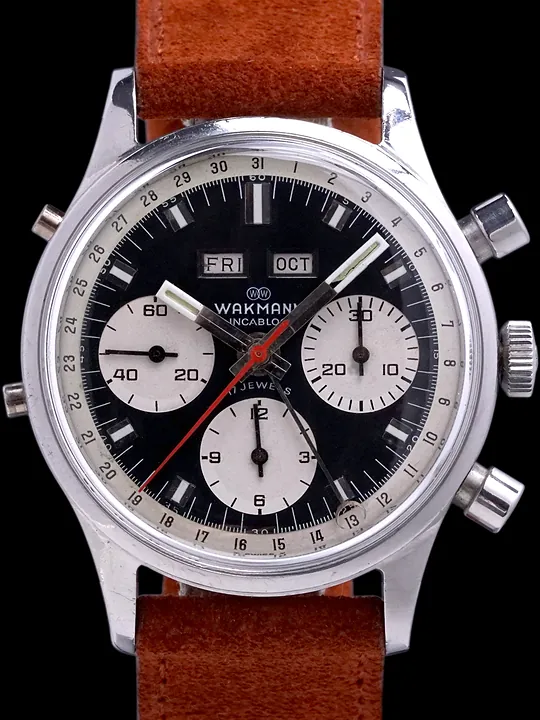
Charles Gigandet SA—better known simply as Gigandet—was founded in 1959 in Tramelan, Switzerland, and quickly became known for producing high-quality movements and components for esteemed brands such as Breitling and Wakmann. Their work behind the scenes helped shape some of the most compelling tool watches of the mid-20th century. This 1960s Gigandet Wakmann Triple Calendar Chronograph (Ref. 1309) is a perfect example of that legacy. A technical yet beautifully balanced piece, it features a suite of complications arranged in a dial layout that prioritizes both clarity and charm. The reverse-panda color palette underscores the watch’s sporty sophistication, offering excellent contrast and legibility while giving the design real wrist presence. Housed in a well-proportioned 37mm case, the watch wears comfortably and feels entirely at home among contemporary sizing preferences—while still retaining all the character of a true vintage chronograph. Powering the watch is the Valjoux cal. 730, a derivative of the legendary Valjoux 72, celebrated for its robustness, reliability, and smooth chronograph action. A compelling blend of technical prowess, refined aesthetics, and historical context, this Wakmann Triple Calendar Chronograph stands as a striking example of mid-century Swiss design at its best. SPECS Stock # WGDKMTCDC Brand Gigandet / Wakmann Style Triple Calendar Chronograph Model 1309 Serial N/A Size Men's Material Stainless Steel Dial Matte Black "Reverse Panda" Millimeters 37 Strap 2pc Handmade Leather Strap CASE & BRACELET The excellent case shows honest signs of use while retaining thick and symmetrical lugs, with factory finishing intact. The case retains its original pump pushers, and the crown appears to be an early replacement. The case back retains all of the original factory markings in crisp and fully present condition. The watch comes supplied on a 2pc handmade leather strap. DIAL & HANDS The original matte black "reverse panda" dial is simply wonderful, showing nominal aging, mostly in the white outer date track, but it remains in excellent condition overall. The silver sub-dials display minimal aging, which is common. The tritium in the hour markers has achieved a lovely creamy patina and shows no degradation when inspected under UV light. The original tritium hands match the dial perfectly. Under UV light inspection, the minute hand exhibits some minor lume loss, while the hour hand remains fully intact. ACCESSORIES None. The watch is running, but the previous service history is unknown. A movement service can be purchased upon request.
Historical context
Modern Mechanical Horology (1945 – 1969)
Tool watches for divers, pilots and astronauts; electric watches anticipate the electronic age.
The classic era of the mechanical wristwatch: dive watches, chronographs for motor racing and space flight, GMT watches for jet travel, slim dress watches, automatic calendars, and the rise of Japanese manufacturers alongside Swiss, American, German and Soviet industries.
Read the period in the timelineMore wristwatches from this periodEarlier: Golden Age of Mechanical Watchmaking
Atlas type guide
Chronographs and split-seconds watches
A chronograph is a watch with an additional seconds hand that can be started, stopped and returned to zero independently of the timekeeping. Louis Moinet built an early example in 1816 and Nicolas Rieussec a recording 'chronographe' in 1821; Adolphe Nicole's heart-shaped reset cam (patented 1862) made the modern return-to-zero possible. Split-seconds (rattrapante) chronographs add a second hand that can be stopped for intermediate times; flyback chronographs restart instantly.
Chronographs were essential tools for doctors (pulsometer scales), artillery (telemeter), engineers and sport. In wristwatches, Valjoux, Venus, Lemania and later the automatic chronographs of 1969 (Zenith El Primero, the Chronomatic Calibre 11 group and Seiko 6139) are milestones.
What to look for
- Push-pieces on the case band or a single button in the crown (monopusher).
- Subsidiary registers for minutes and hours; tachymeter, telemeter or pulsometer scales.
- Column wheel versus cam control visible in the movement.
- Calibre markings of specialist makers (Valjoux, Lemania, Venus, Landeron).
Dating clues
- Pocket chronographs with heart cam reset: after 1862.
- Wrist chronographs: from c. 1910; two-button designs from the 1930s.
- Automatic chronographs: from 1969.
General guidance written by the Atlas editors about this kind of object. It is not a statement about this particular piece; for that, rely on the source record above and on physical examination.
Read next:Flyback chronographChronograph
Related records
Wristwatches · c. 1950
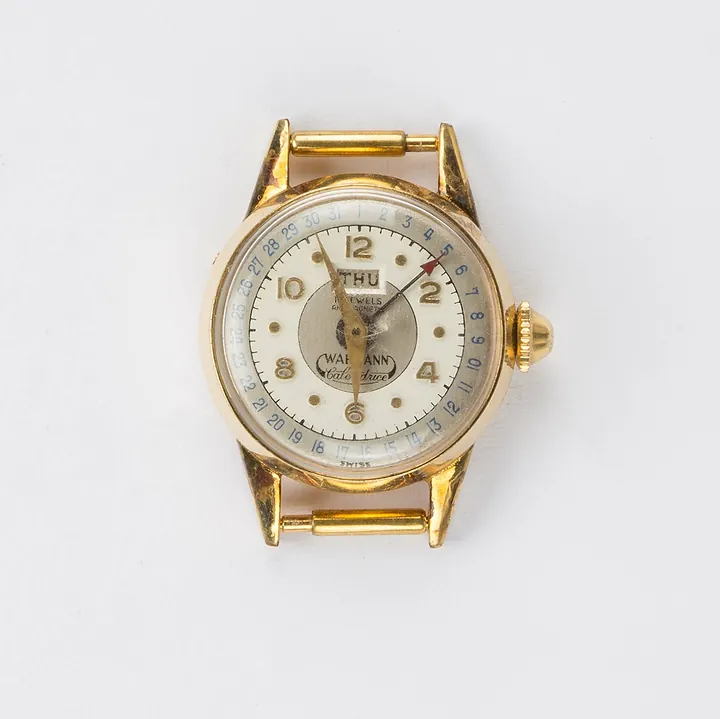
Wristwatch by Wakmann, Switzerland, c. 1950
German Clock Museum
Wristwatches · 1970s
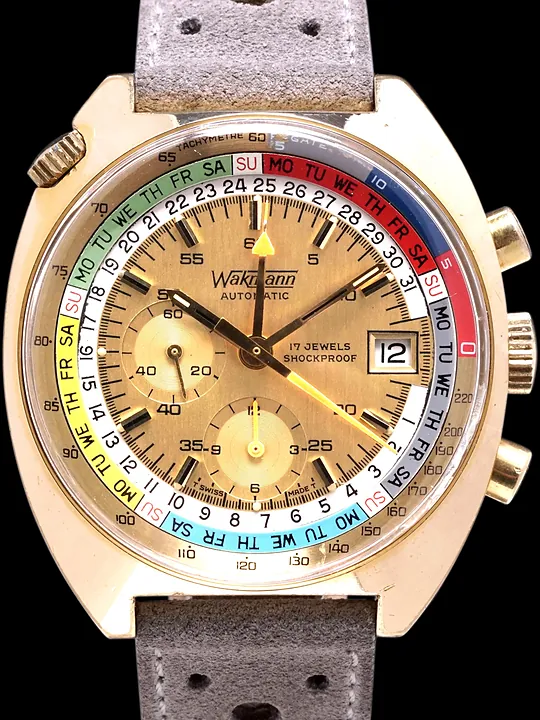
Wakmann Regatta Chronograph (Ref. 9804), 1970s
Craft & Tailored (dealer), Los Angeles
Wristwatches · 1970s
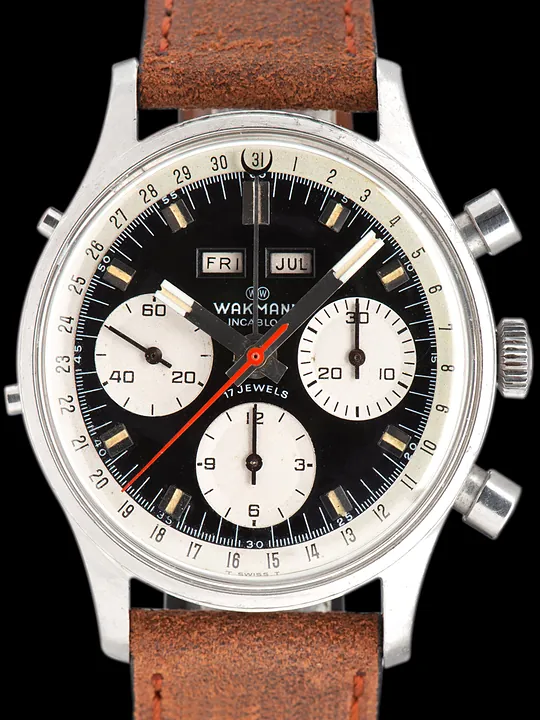
Wakmann Triple Calendar Chronograph "Jumbo", 1970s
Craft & Tailored (dealer), Los Angeles
Wristwatches · 1970s
Wakmann Triple Calendar Chronograph (Ref. 750.1309), 1970s
Craft & Tailored (dealer), Los Angeles

Wristwatches · 1945
Wristwatch by Eterna, 1945
Museum Rotterdam

Wristwatches · c. 1945
Breitling Premier, ref. 790, c. 1945
Antiquorum auction archive, Geneva

Wristwatches · c. 1945
Universal Genève Uni-Compax, ref. 22492, c. 1945
Antiquorum auction archive, Geneva
Wristwatches · c. 1950s
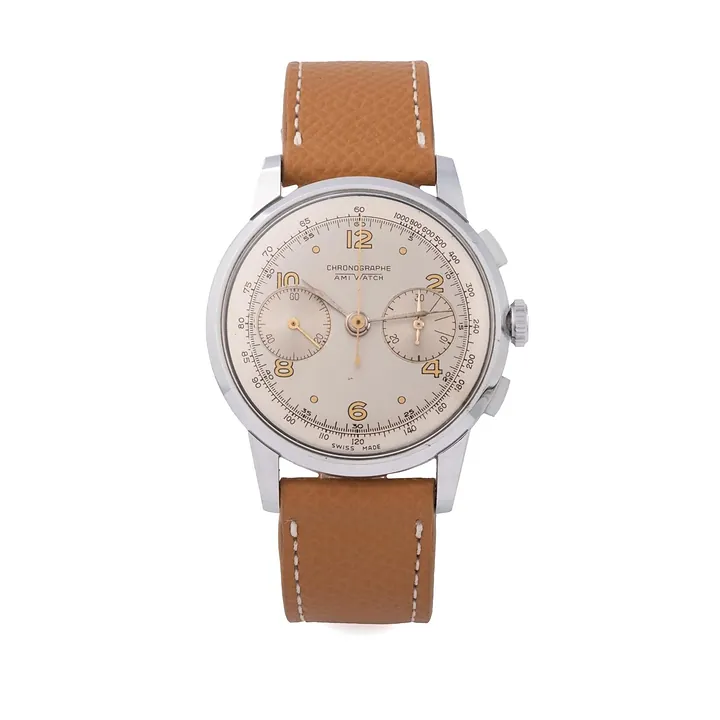
Ami Watch Chronographe, c. 1950s
Antiquorum auction archive, Geneva