
Wristwatches · Wristwatch
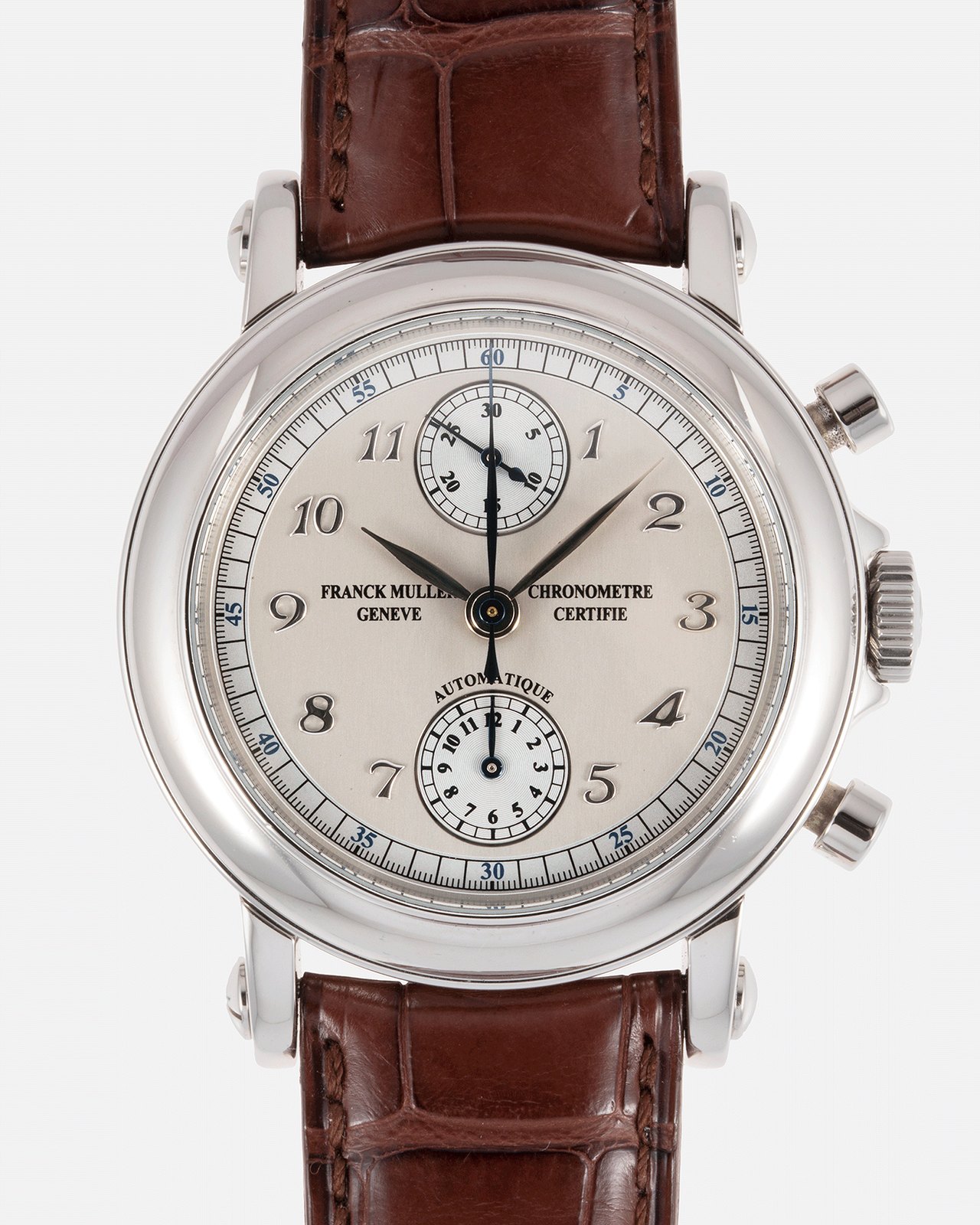
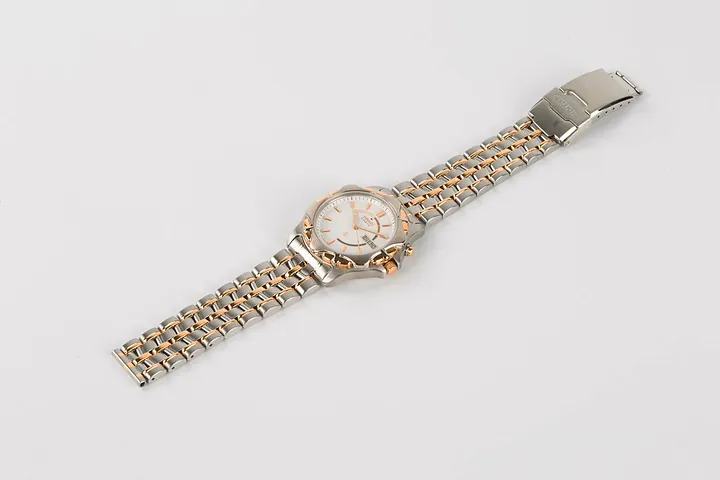
Franck Muller Chronograph 7000CC Japan Limited Edition, 2000s
- Maker / attribution
- Franck Muller (maker)
- Date
- 2000s
- Historical period
- Mechanical Renaissance (1990 – 2010)
- Country of origin
- Japan
- Object type
- Wristwatch
- Dimensions
- Case 39 mm
- Stock no.
- Product 6645629943895
- Credit line
- Dealer listing, S.Song Watches (product 6645629943895)
- Catalogue title (original)
- Franck Muller Chronograph 7000CC Japan Limited Edition (English)
View the source record (dealer listing) ↗ (opens another website in a new tab)Suggest a correction
Record summary
Catalogued by S.Song Watches (dealer), Seattle (stock number Product 6645629943895), this is a wristwatch by Franck Muller, made in Japan, dated 2000s. The Atlas places it in the Mechanical Renaissance period (1990 – 2010) of its Wristwatches collection. Recorded dimensions: Case 39 mm. The record is illustrated with 6 photographs.
Assembled from the source record's structured fields. Dates and attributions are given as the source states them; where a field is missing the Atlas leaves it blank rather than estimating.
Catalogue description
Dealer description — S.Song Watches
Founded in 1992 by Franck Muller and Vartan Sirmakes and known as the "Master of Complications," Franck Muller has grown to become synonymous with complex microengineering, whacky original designs, and stunning craftsmanship. By blending horological know-how with their passionate desire to create truly revolutionary timepieces, Franck Muller lays claim to an impressive list of innovations, a unique design language, and a flavor for the unknown. Beloved by collectors for their part in revitalizing the watchmaking industry in the 1990s, Franck Muller has proven to be an influential watchmaker who quickly developed a fanbase attracted to his distinct aesthetic. While Franck Muller's aesthetic quickly became dominated by tonneau-shaped cases and colorful dials, their early watches were more traditional round timepieces that featured somewhat conservative design motifs, much like this Franck Muller Chronograph Japan Edition ref. 7000CC, which draws inspiration from those earlier years of the brand. Released in the early 2000s, this particular timepiece is a limited edition variant of Franck Muller's Chronograph collection, with just 20 pieces produced that were only available in Japan. Featuring the Chronograph collection's around 39mm stainless steel case with its straight lugs complete with screw-in bars and a thick domed bezel surrounding its dial, this limited edition timepiece flies under the radar as a stylish piece on the wrist without the need to draw attention to itself like some of Franck Muller's modern designs. Powered by the cal. FM 7000 movement, this timepiece is a dual sub-dialed chronograph, unlike the normal production references from the Chronograph collection as they were three sub-dialed chronographs. Serving as the window to its unique movement, the Japan Edition ref. 7000CC features a stunning silver dial complete with applied 18ct white gold Breguet numerals and twin chronograph registers aligned vertically on the dial harboring a concentric guilloche finish within. With two lines of text on either side of the dial balancing its subdials, this timepiece's design is unapologetically symmetrical, monochromatic through the use of silver, white gold, and stainless steel, and utterly beautiful.
Historical context
Mechanical Renaissance (1990 – 2010)
Mechanical watches return as cultural objects; independent watchmaking flourishes.
Mechanical watches returned as cultural and luxury objects. Complications, tourbillons and new materials proliferated; independent watchmakers such as George Daniels, F.P. Journe and Philippe Dufour revived artisanal watchmaking; collecting vintage watches became a major field.
Read the period in the timelineMore wristwatches from this periodEarlier: Quartz Revolution
Atlas type guide
Chronographs and split-seconds watches
A chronograph is a watch with an additional seconds hand that can be started, stopped and returned to zero independently of the timekeeping. Louis Moinet built an early example in 1816 and Nicolas Rieussec a recording 'chronographe' in 1821; Adolphe Nicole's heart-shaped reset cam (patented 1862) made the modern return-to-zero possible. Split-seconds (rattrapante) chronographs add a second hand that can be stopped for intermediate times; flyback chronographs restart instantly.
Chronographs were essential tools for doctors (pulsometer scales), artillery (telemeter), engineers and sport. In wristwatches, Valjoux, Venus, Lemania and later the automatic chronographs of 1969 (Zenith El Primero, the Chronomatic Calibre 11 group and Seiko 6139) are milestones.
What to look for
- Push-pieces on the case band or a single button in the crown (monopusher).
- Subsidiary registers for minutes and hours; tachymeter, telemeter or pulsometer scales.
- Column wheel versus cam control visible in the movement.
- Calibre markings of specialist makers (Valjoux, Lemania, Venus, Landeron).
Dating clues
- Pocket chronographs with heart cam reset: after 1862.
- Wrist chronographs: from c. 1910; two-button designs from the 1930s.
- Automatic chronographs: from 1969.
General guidance written by the Atlas editors about this kind of object. It is not a statement about this particular piece; for that, rely on the source record above and on physical examination.
Read next:Flyback chronographChronograph
Related records
Wristwatches · c. 1996-99
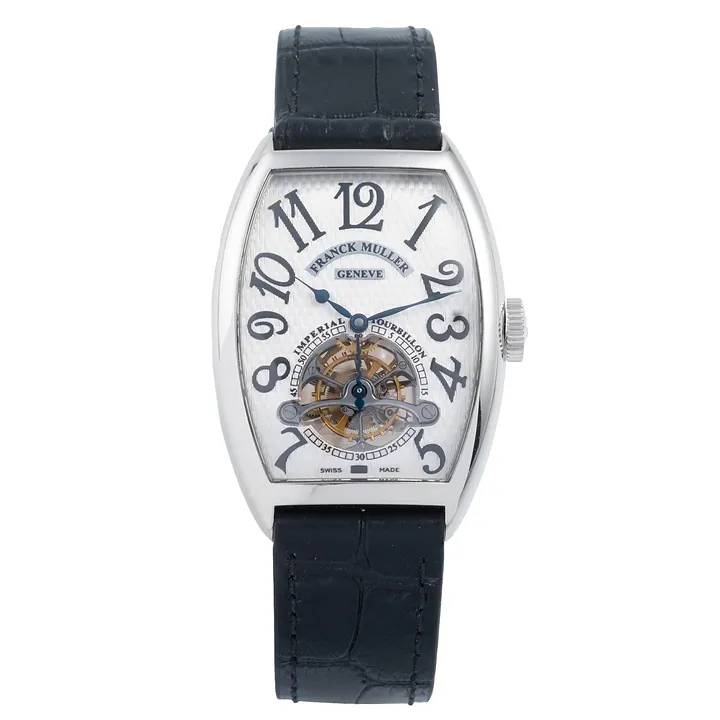
Franck Muller Imperial Tourbillon, ref. 5850T, c. 1996-99
Antiquorum auction archive, Geneva
Wristwatches · c. 2005
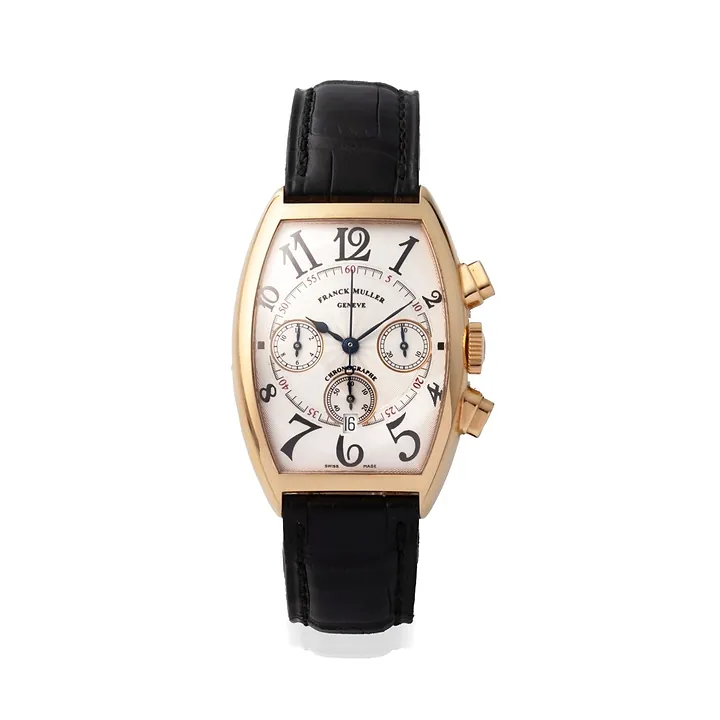
Franck Muller Casablanca Chronograph, ref. 5850 CC AT, c. 2005
Antiquorum auction archive, Geneva
Wristwatches · c. 2010-2020
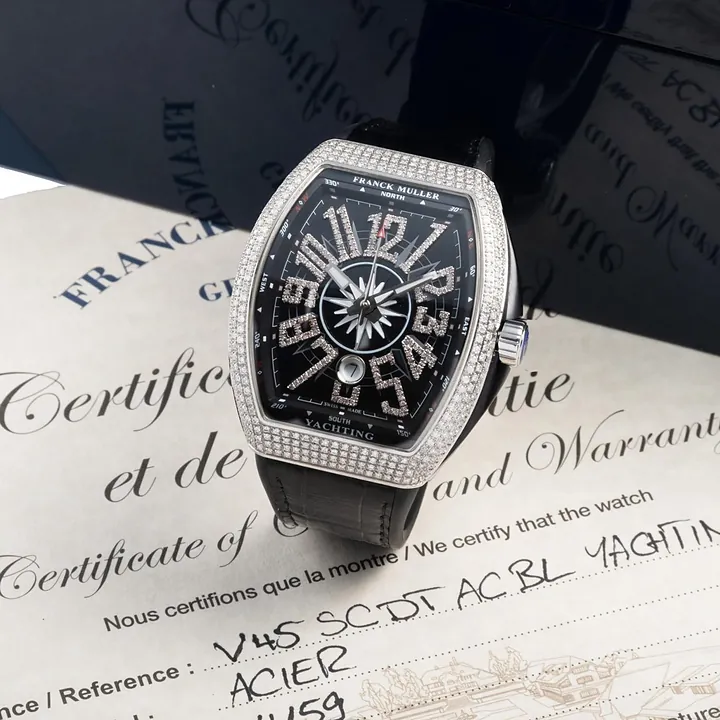
Franck Muller Vanguard Yachting, ref. V45SCDT, c. 2010-2020
Antiquorum auction archive, Geneva
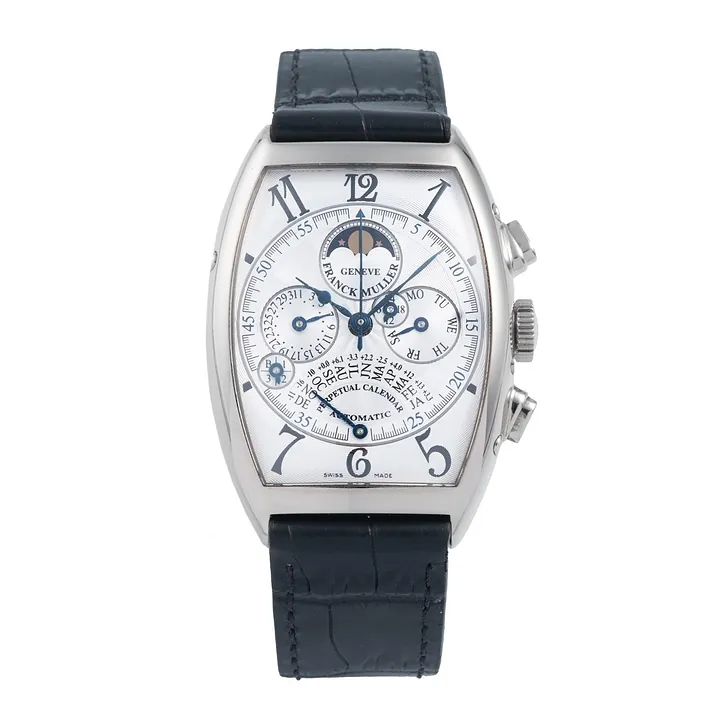
Wristwatches · Sold in August 2016
Franck Muller wristwatch, ref. 6850 QPE, Sold in August 2016
Antiquorum auction archive, Geneva
Wristwatches · 1990–1996
Wristwatch by Ricoh Elemex Corporation, Japan, 1990–1996
Science Museum Group, London
Wristwatches · 1990
Wristwatch, Japan, 1990
Blekinge Museum
Wristwatches · 1995
Wristwatch, Japan, 1995 (no. 57932)
German Clock Museum
Wristwatches · 1995
Wristwatch, Japan, 1995 (no. 57933)
German Clock Museum