
Wristwatches · Wristwatch
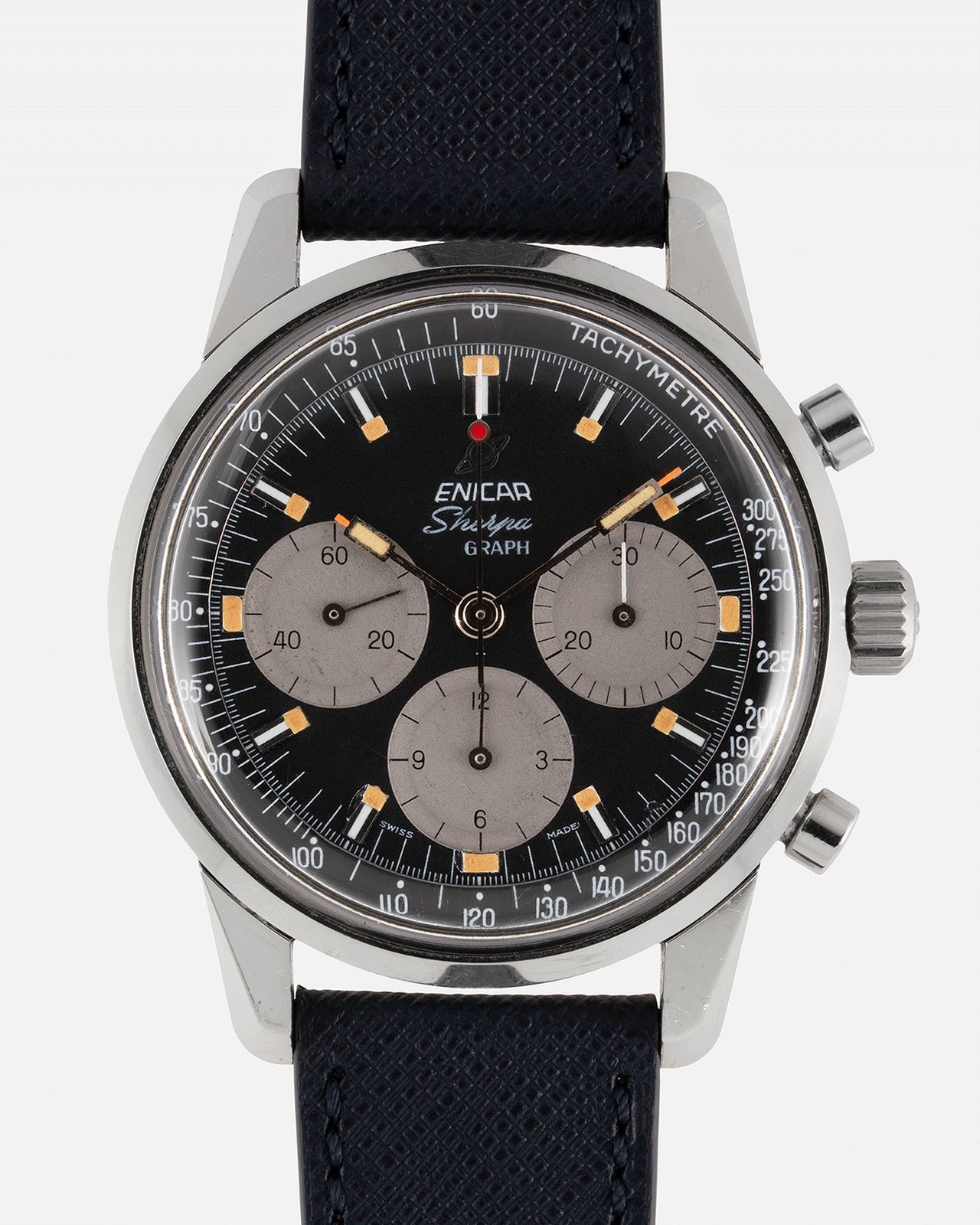
Enicar Sherpa Graph Mk III, 1960s
- Maker / attribution
- Enicar (maker)
- Date
- 1960s
- Historical period
- Modern Mechanical Horology (1945 – 1969)
- Country of origin
- Switzerland
- Object type
- Wristwatch
- Dimensions
- Case 40 mm
- Stock no.
- Product 6580569374807
- Credit line
- Dealer listing, S.Song Watches (product 6580569374807)
- Catalogue title (original)
- Enicar Sherpa Graph Mk III (English)
View the source record (dealer listing) ↗ (opens another website in a new tab)Suggest a correction
Record summary
Catalogued by S.Song Watches (dealer), Seattle (stock number Product 6580569374807), this is a wristwatch by Enicar, made in Switzerland, dated 1960s. The Atlas places it in the Modern Mechanical Horology period (1945 – 1969) of its Wristwatches collection. Recorded dimensions: Case 40 mm. The record is illustrated with 6 photographs.
Assembled from the source record's structured fields. Dates and attributions are given as the source states them; where a field is missing the Atlas leaves it blank rather than estimating.
Catalogue description
Dealer description — S.Song Watches
Launched in 1913 by the Racine family, Enicar ('Racine' backwards) rose to fame thanks to slick marketing campaigns built upon the successes of explorers, mountaineers, and other adventurers who wore their robust timepieces on their escapades. On the back of one particularly prominent iconic event whereby a team of Swiss mountaineers summited Lhoste and Mount Everest in 1966, Enicar released the Sherpa collection of watches that would quickly represent the apex of Enicar's offerings. Debuting in 1960, the Sherpa Graph collection was a motorsports-inspired chronograph collection built around the iconic Valjoux cal. 72 column-wheel operated movement, which rose to popularity thanks to an endorsement from legendary British racing car driver and world champion Stirling Moss. Powered by the same movement as the Rolex Daytona, the Heuer Carrera, and the Breitling Navitimer, the Sherpa Graph married engineering prowess with Enicar's rich heritage and an automotive-inspired design that enabled it to become a success despite its uncharacteristically large (for the time) 40mm stainless steel case. In keeping with its robust case design, the Sherpa Graph features a set of thick lugs that, in turn, feature thick bevelling that was unusual given the prevalence of classical mid-century styling within the industry. Moreover, with such a robust supercompressor case, the Sherpa Graph was water-resistant to an impressive 160 feet or 50 meters, an awe-inspiring feat for a chronograph at the time. Released circa 1963, the Mark III Sherpa Graph that I have introduced a slew of updates to the Graph's design that are primarily focused around its hands and dial. To begin with, its handset is totally unlike that of its predecessor, the Mark II. With a paddle-style hour and minute hand with tritium lume and an orange tip that set them apart from the Mark II's hands. In addition to this, the Mark III swaps the Mark II's red chronograph seconds hand for an unpainted silver lollipop hand with a red spot below the tip. Found in superb condition, my example here also features a beautiful black dial complete with wonderfully aged grainy textured grey subdials, which provide a beautiful two-tone aesthetic to this iconic timepiece. With white inscriptions along the tachymeter scale and aged lume plots punctuating the hour markers, the Mark III dial features a myriad of colors that enhance its aesthetic much in the same way that its rich history enhances its standing amongst seasoned chronograph collectors.
Historical context
Modern Mechanical Horology (1945 – 1969)
Tool watches for divers, pilots and astronauts; electric watches anticipate the electronic age.
The classic era of the mechanical wristwatch: dive watches, chronographs for motor racing and space flight, GMT watches for jet travel, slim dress watches, automatic calendars, and the rise of Japanese manufacturers alongside Swiss, American, German and Soviet industries.
Read the period in the timelineMore wristwatches from this periodEarlier: Golden Age of Mechanical Watchmaking
Atlas type guide
Wristwatches
Bracelet watches were worn by women from the early nineteenth century — Breguet made one for Caroline Murat, Queen of Naples, in 1810–12 — but the wristwatch only became a man's instrument with military use and aviation in the early twentieth century. Between the World Wars it overtook the pocket watch; the 1920s and 1930s brought rectangular Art Deco cases, water-resistant cases and the first automatic winding systems.
After 1945 the wristwatch became a carrier of identity — dress watches, sports and dive watches, chronographs, calendars — produced by Swiss, American, Japanese, German, Soviet and Chinese industries. The quartz revolution after 1969 and the mechanical renaissance since the 1990s, including the rise of independent watchmakers, complete the story.
What to look for
- The reference number (between the lugs or inside the case back) and serial number, the starting point for dating.
- The calibre: its maker and number are often stamped under the dial or on the bridge.
- Originality of dial, hands and crown — refinished ('redial') dials are common.
- Case material marks: 18K/750, 14K/585, stainless steel, gold-filled, plated.
Dating clues
- Wire-lug cases: before c. 1925.
- Water-resistant screw-down cases: from 1926.
- Quartz movements: from 1969; sapphire crystals widespread after c. 1980.
General guidance written by the Atlas editors about this kind of object. It is not a statement about this particular piece; for that, rely on the source record above and on physical examination.
Related records
Wristwatches · 2000
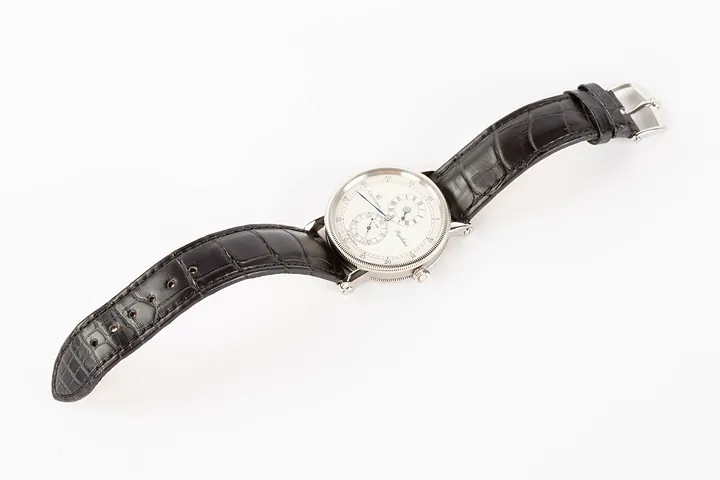
Wristwatch by Enicar, Switzerland, 2000
German Clock Museum
Wristwatches · c. 1960s
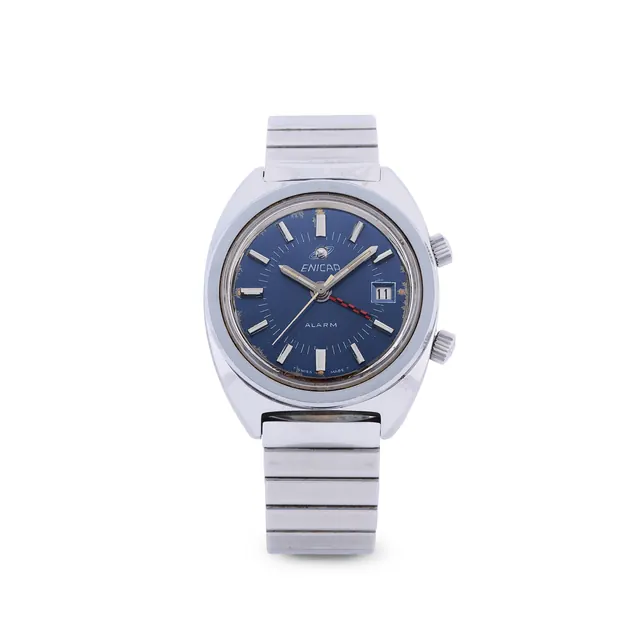
Enicar wristwatch, ref. 477-01-02, circa 1960s
Antiquorum auction archive, Geneva
Wristwatches · c. 1970s
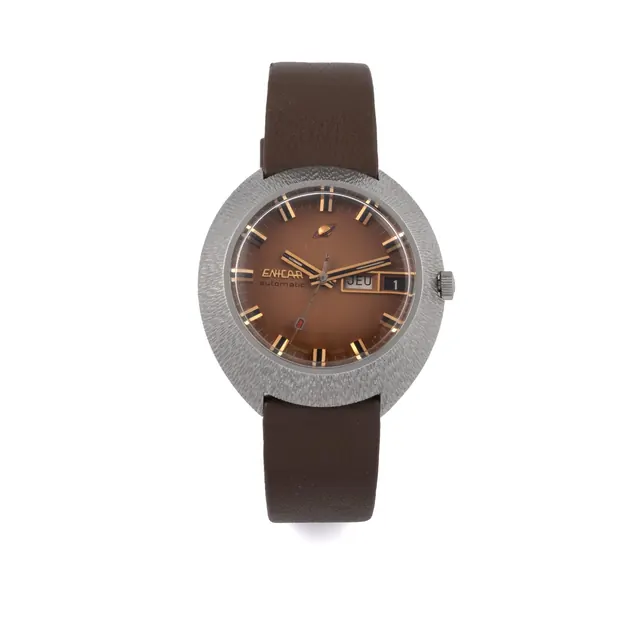
Enicar wristwatch, ref. 144-62-02, Sherpa Star Brown Dial, circa 1970's
Antiquorum auction archive, Geneva
Wristwatches · c. 1970s
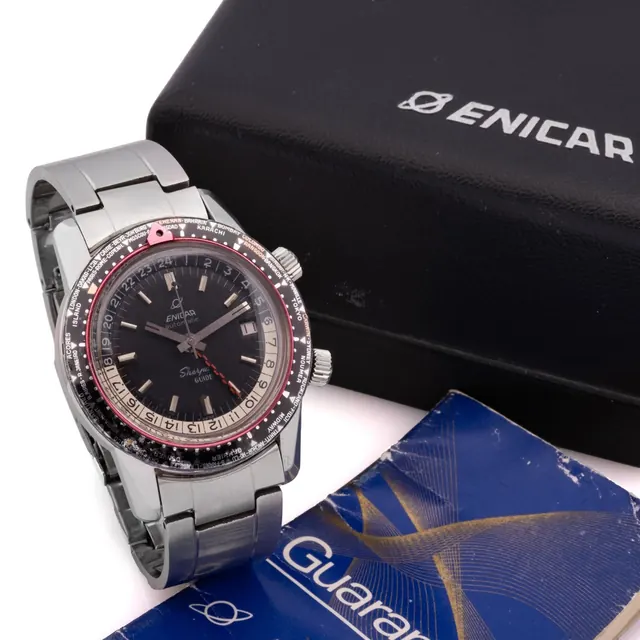
Enicar wristwatch, ref. 148-35-01, Sherpa Guide Box and Blank Warranty Booklet, circa 1970's
Antiquorum auction archive, Geneva

Wristwatches · 1945
Wristwatch by Eterna, 1945
Museum Rotterdam

Wristwatches · c. 1945
Breitling Premier, ref. 790, c. 1945
Antiquorum auction archive, Geneva

Wristwatches · c. 1945
Universal Genève Uni-Compax, ref. 22492, c. 1945
Antiquorum auction archive, Geneva

Wristwatches · c. 1950s
Baume & Mercier wristwatch, c. 1950s
Antiquorum auction archive, Geneva