
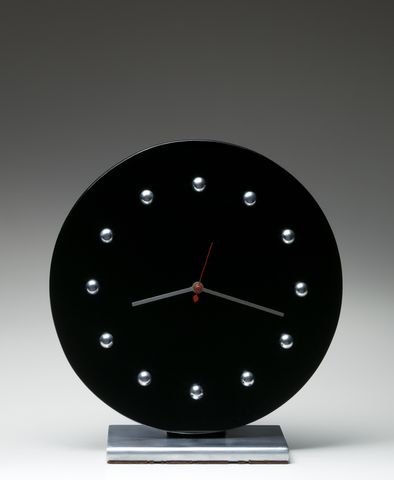
Clocks · Electric clock, model no. 4083 a
Electric Clock, Model No. 4083 A by Gilbert Rohde
- Maker / attribution
- Gilbert Rohde (designer); Herman Miller Clock Company (manufacturer); Pittsburgh Plate Glass Company (manufacturer)
- Date
- 1933
- Historical period
- Golden Age of Mechanical Watchmaking (1900 – 1945)
- Country of origin
- United States
- Place
- Zeeland
- Object type
- Electric clock, model no. 4083 a
- Materials / technique
- carrara glass with chromium-plated and painted metal
- Dimensions
- 10 5/8 × 9 3/4 × 3 1/2 in. (27 × 24.8 × 8.9 cm)
- Holding institution
- Yale University Art Gallery, New Haven
- Accession / object no.
- 2011.223.2
- Credit line
- John C. Waddell Collection, Gift of John C. Waddell, B.A. 1959
- Catalogue title (original)
- Electric Clock, Model No. 4083 A (English)
View the source record ↗ (opens another website in a new tab)Suggest a correction
Record summary
Held and catalogued by Yale University Art Gallery, New Haven (object number 2011.223.2), this is an electric clock, model no. 4083 a by Gilbert Rohde, made in Zeeland, United States, dated 1933. The Atlas places it in the Golden Age of Mechanical Watchmaking period (1900 – 1945) of its Clocks collection. Materials and techniques recorded by the source: carrara glass with chromium-plated and painted metal. Recorded dimensions: 10 5/8 × 9 3/4 × 3 1/2 in. (27 × 24.8 × 8.9 cm). The record is illustrated with 1 photograph.
Assembled from the source record's structured fields. Dates and attributions are given as the source states them; where a field is missing the Atlas leaves it blank rather than estimating.
Catalogue description
Catalogue description — Yale University Art Gallery
Gilbert Rohde designed this “clock that personifies simplicity” in 1933 as part of a group manufactured by the Herman Miller Clock Company. The clock was first displayed in the Design for Living House at the 1933 Chicago World’s Fair, where it was placed atop a cabinet in the living room. The following year, Philip Johnson included it in Machine Art, an exhibition at the Museum of Modern Art in New York. Machine Art displayed some four hundred objects divided into six sections, ranging from industrial units to house furnishings. Although museums had long displayed decorative arts, this exhibition was one of the first in America to treat industrial objects with the same level of veneration. Springs, propeller blades, and ball bearings held equal weight as silverware and furniture in conveying the machine as the supreme inspiration for American design in the twentieth century. Rohde’s clock embodied a number of the tenets that defined the exhibition. It had a machinelike “practical application of geometry” in its use of circles and rectangles. “Motion is an essential function of many machines,” Alfred H. Barr, Jr., wrote in the catalogue’s foreword, “and sometimes increases their aesthetic interest.” This holds true for Rohde’s design as the constant rotation of the rectangular hands enlivens the circular composition. Barr specifically referenced this clock in his discussion of art and the designer, noting that “the rôle [sic] of the artist in machine art is to choose. . . . He does not embellish or elaborate, but refines, simplifies and perfects.”
Published references — Yale University Art Gallery
John Stuart Gordon, "Time in a Bottle," Antiques 185, no. 5 (September/October 2018), 95, ill. · Phyllis Ross, Gilbert Rhode: Modern Design for Modern Living (New Haven, Conn.: Yale University Press, 2009), 91, 124, fig. 55 · John Stuart Gordon et al., A Modern World: American Design from the Yale University Art Gallery, 1920–1950 (New Haven, Conn.: Yale University Art Gallery, 2011), 624, no. 178 · "Acquisitions," Yale University Art Gallery Bulletin: Online Supplement (accessed December 21, 2012), 22 · John Stuart Gordon, American Glass: The Collections at Yale (New Haven, Conn.: Yale University Art Gallery, 2018), 232–33, no. 120
Provenance
Purchased by John C. Waddell, New York, 2001
Historical context
Golden Age of Mechanical Watchmaking (1900 – 1945)
The wristwatch displaces the pocket watch; waterproof cases, self-winding and grand complications.
Between 1900 and 1945 clocks were electrified: master-clock systems ran factories and offices, synchronous mains clocks entered homes, and the Shortt free-pendulum clock set new standards of accuracy before the first quartz clocks (1927). Art Deco design reshaped mantel and table clocks.
Read the period in the timelineMore clocks from this periodEarlier: Industrial Revolution
Atlas type guide
Electric and synchronous clocks
Alexander Bain patented the electric clock in 1841, and through the later nineteenth century electricity was used both to drive pendulums and to distribute time. Master clocks sent impulses every half-minute or minute to subsidiary ('slave') dials across factories, schools, railway stations and post offices; Matthäus Hipp's toggle (1842) kept pendulums swinging with minimal interference. William Hamilton Shortt's free-pendulum clock (1921), with a slave pendulum doing the mechanical work, became the most accurate mechanical clock ever made in series.
In the 1920s and 1930s synchronous motor clocks, which count the alternating-current cycles of the mains supply (50 or 60 Hz), arrived in homes; Telechron in the United States and Smiths 'Sectric' and Ferranti in Britain made them in great numbers. Battery clocks such as the Bulle, Eureka and ATO used electromagnetic impulsing of balances or pendulums.
What to look for
- Electromagnets, contacts and coils in place of springs or weights.
- Cables, terminal blocks and labels for voltage or frequency.
- Master/subsidiary systems: a subsidiary dial has a stepping mechanism and no escapement.
- Brand names such as Synchronome, Gent, Magneta, Telechron, Smiths, Ferranti.
Dating clues
- Bain and Hipp clocks: from the 1840s.
- Synchronome master clocks: from 1895.
- Synchronous mains clocks: from the late 1920s (UK grid frequency standardised in the 1930s).
General guidance written by the Atlas editors about this kind of object. It is not a statement about this particular piece; for that, rely on the source record above and on physical examination.
Related records
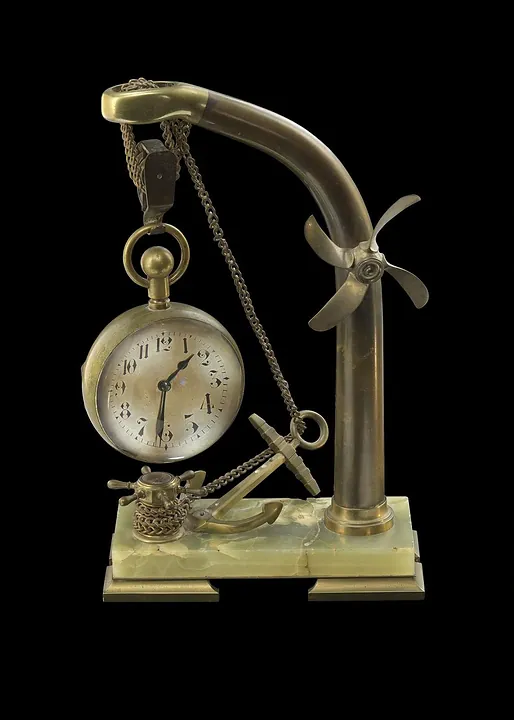
Clocks · 1905–1919
Mantel clock given by President Theodore Roosevelt to William L. Houston, United States, 1905–1919
National Museum of African American History and Culture, Smithsonian Institution, Washington DC
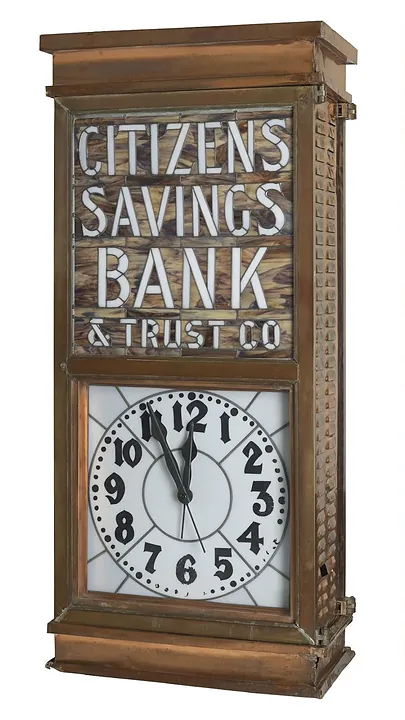
Clocks · 1920–2013
Bank clock and sign of the Citizens Savings Bank & Trust Co., Nashville, 1920–2013
National Museum of African American History and Culture, Smithsonian Institution, Washington DC
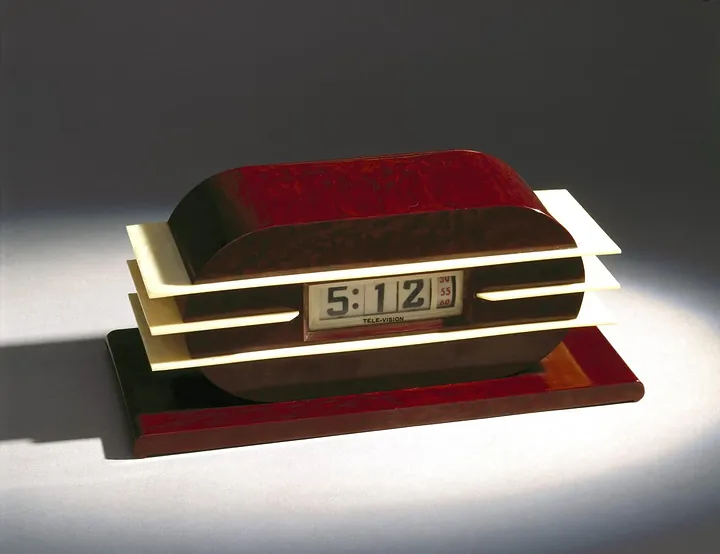
Clocks · 1925–1940
Brown phenolic electric digital clock with `TELE-VISION' on the face. Made by Penwood Numechron Co., U.S.A., c. 1930. Art Deco design.
Science Museum Group, London
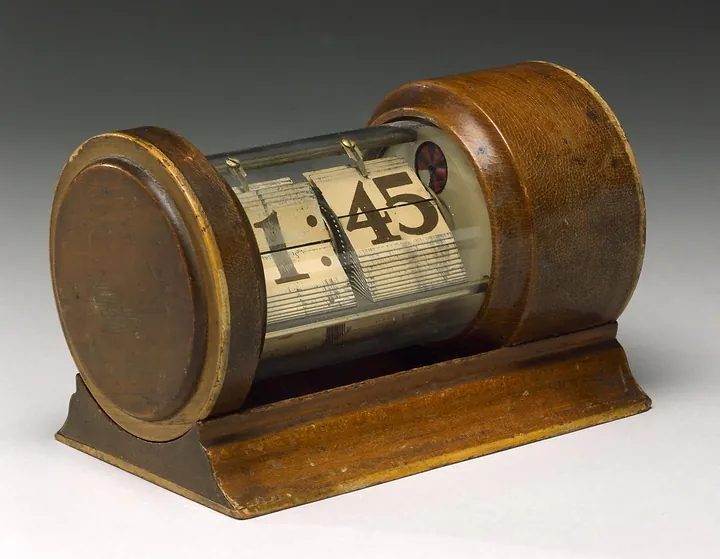
Clocks · 1934
Synchronous mains electric clock of the self-starting type, with digital display. Made by The Westinghouse Electric Supply Co. USA. Early c.1934's
Science Museum Group, London
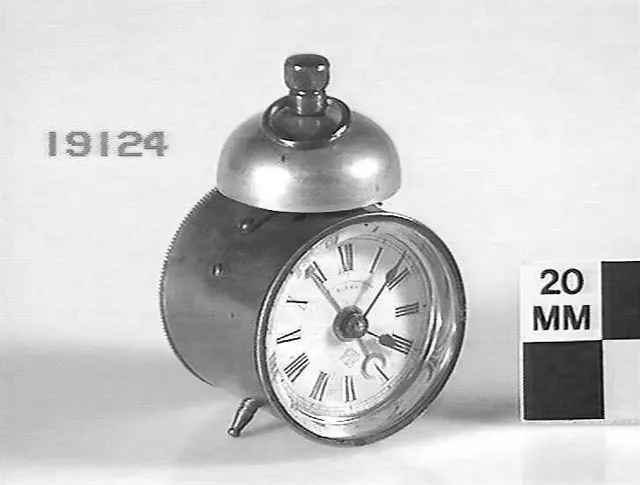
Clocks · c. 1900
Alarm Clock - Ansonia Clock Co, 'Bee', USA, c. 1900
Museums Victoria, Melbourne
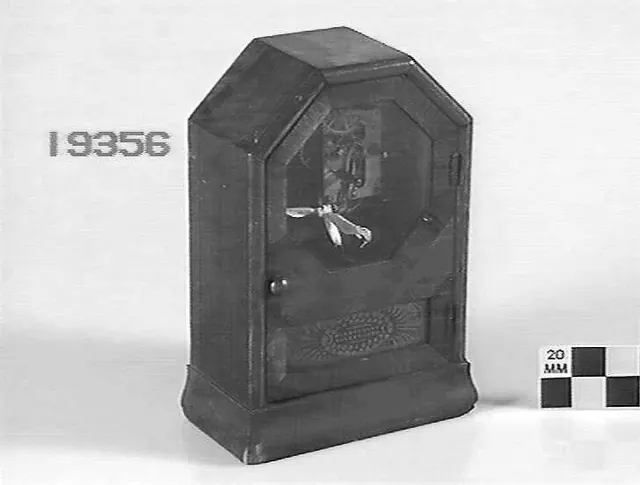
Clocks · c. 1900
Alarm Clock - Seth Thomas Clock Co, USA, c. 1900
Museums Victoria, Melbourne
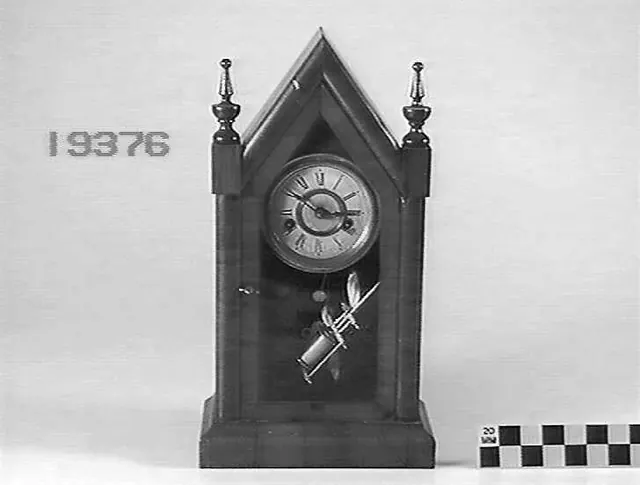
Clocks · c. 1900
Mantel Clock - Ansonia Clock Co, New York, c. 1900
Museums Victoria, Melbourne
Clocks · c. 1944
Alarm Clock - 'War Alarm', USA, c. 1944
Museums Victoria, Melbourne