
Wristwatches · Wristwatch
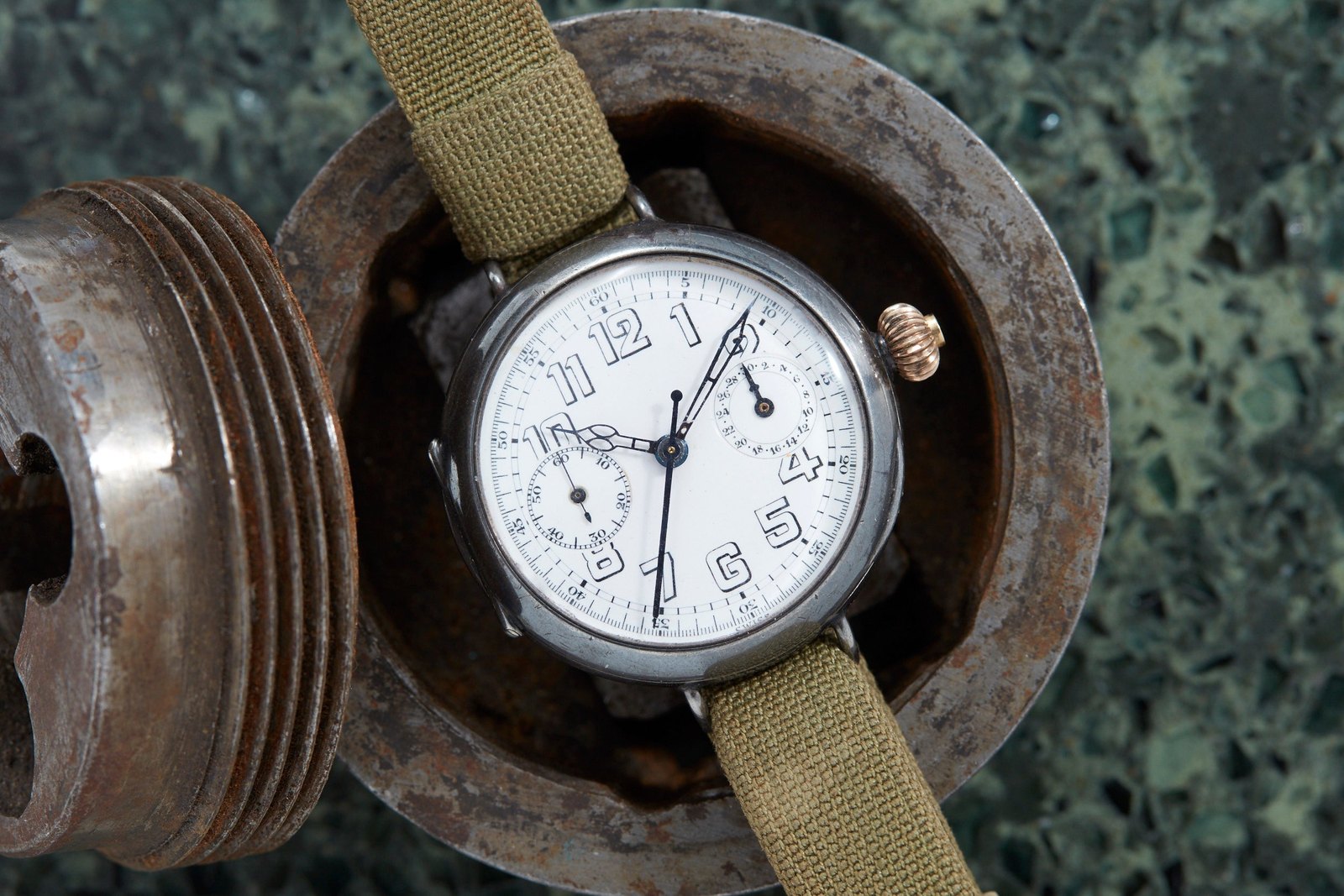
Electa Monopusher Chronograph, 1918
- Maker / attribution
- Electa (maker)
- Date
- 1918
- Historical period
- Golden Age of Mechanical Watchmaking (1900 – 1945)
- Country of origin
- Unrecorded in source
- Object type
- Wristwatch
- Stock no.
- Product 388400414750
- Credit line
- Dealer listing, Analog/Shift (product 388400414750)
- Catalogue title (original)
- Electa Monopusher Chronograph (English)
View the source record (dealer listing) ↗ (opens another website in a new tab)Suggest a correction
Record summary
Catalogued by Analog/Shift (dealer), New York (stock number Product 388400414750), this is a wristwatch by Electa, dated 1918. The Atlas places it in the Golden Age of Mechanical Watchmaking period (1900 – 1945) of its Wristwatches collection. The record is illustrated with 6 photographs.
Assembled from the source record's structured fields. Dates and attributions are given as the source states them; where a field is missing the Atlas leaves it blank rather than estimating.
Catalogue description
Dealer description — Analog/Shift
Names can sometimes be misleading. While the name “Electa” might not conjure up any associations, its parent company, Gallet, sure does. Delving a little deeper yields a rich history full of watches like this one, which was worn during the “war to end all wars”—World War I. Gallet is an old name in watchmaking, with roots leading back to the 1400s, when Humbertus Gallet made clocks in Geneva. In the 19th century, his descendant, Julien, established Gallet & Cie in La Chaux-de-Fonds. For the next century, Gallet made a variety of watches under many different brand names. In these early years, the company’s high-grade watches—including complicated watches like chronographs—were made under the brand name Electa. The trademark was registered to Gallet in 1907. Movements and even fully-finished watches were made out of the Electa factory in Geneva, under the leadership of Léon Gallet. With the advent of World War I, Electa found itself faced with growing demand for wristwatches as the armed forces of Europe prepared for war. Officers were issued pocket watches at first, but in the cramped, dusty confines of trenches, pocket watches proved too inconvenient for practical use. Many officers bought their own wristwatches, or received them as gifts from friends and family. By 1916, so many officers had opted to wear a wristwatch that it was listed in a 1916 book, Knowledge of War: Every Officer’s Handbook for the Front , as the most important item in an officer’s kit. Before long, brands like Omega, Rolex, and Electa were making wristwatches for the men on the front; due to their use in trench warfare, they became known as “trench watches.” An ad from this period, dating from 1918, shows a cavalry officer looking down at his Electa watch. Though it’s hard to make out exactly what type of trench watch he’s wearing, perhaps it looked something like this monopusher chronograph. Gallet made its first wrist chronograph in 1914. These early chronographs were powered by 12 or 13 ligne Valjoux movements modified and signed by Electa, and featured a 30-minute counter at 3 o’clock. This gave rise to the model name MultiChron 30, which would become Gallet’s signature chronograph line. The movements were fitted in sterling silver cases, many with hinged backs like this watch has. As with many watches of the period, the dial is enamel, a resilient material that holds its crispness throughout the years (and is also very difficult to refinish). Many of these MultiChron 30s were issued to pilots in the Royal Air Force, but also saw use throughout the armies of the United Kingdom and the United States. With 1914 marking the centennial of this great and terrible conflict, watches dating from that era are antiques. Therefore, they are valuable not only from a horological, but also a historical, standpoint. But more than that, they are living, wearable artifacts that link us in the present to the brave men who wore them.
Historical context
Golden Age of Mechanical Watchmaking (1900 – 1945)
The wristwatch displaces the pocket watch; waterproof cases, self-winding and grand complications.
The wristwatch overtook the pocket watch. Military use in the First World War, aviation, water-resistant cases (1926), automatic winding (1923–31), rectangular Art Deco designs and early chronographs and calendars defined the period.
Read the period in the timelineMore wristwatches from this periodEarlier: Industrial Revolution
Atlas type guide
Chronographs and split-seconds watches
A chronograph is a watch with an additional seconds hand that can be started, stopped and returned to zero independently of the timekeeping. Louis Moinet built an early example in 1816 and Nicolas Rieussec a recording 'chronographe' in 1821; Adolphe Nicole's heart-shaped reset cam (patented 1862) made the modern return-to-zero possible. Split-seconds (rattrapante) chronographs add a second hand that can be stopped for intermediate times; flyback chronographs restart instantly.
Chronographs were essential tools for doctors (pulsometer scales), artillery (telemeter), engineers and sport. In wristwatches, Valjoux, Venus, Lemania and later the automatic chronographs of 1969 (Zenith El Primero, the Chronomatic Calibre 11 group and Seiko 6139) are milestones.
What to look for
- Push-pieces on the case band or a single button in the crown (monopusher).
- Subsidiary registers for minutes and hours; tachymeter, telemeter or pulsometer scales.
- Column wheel versus cam control visible in the movement.
- Calibre markings of specialist makers (Valjoux, Lemania, Venus, Landeron).
Dating clues
- Pocket chronographs with heart cam reset: after 1862.
- Wrist chronographs: from c. 1910; two-button designs from the 1930s.
- Automatic chronographs: from 1969.
General guidance written by the Atlas editors about this kind of object. It is not a statement about this particular piece; for that, rely on the source record above and on physical examination.
Read next:Flyback chronographChronograph
Related records
Wristwatches · 1900–1999
Wristwatch by Mercury, 1900–1999
Modemuseum Hasselt
Wristwatches · 1900–1999
Wristwatch by Nutrix, 1900–1999
Modemuseum Hasselt
Wristwatches · 1920
Wristwatch, 1920
Modemuseum Hasselt

Wristwatches · 1931
Rolex 'Oyster Perpetual' rotor self-winding wrist-watch, lever escapement, in steel case with glass in back, Montres Rolex SA, Geneva, Switzerland, 1931
Science Museum Group, London
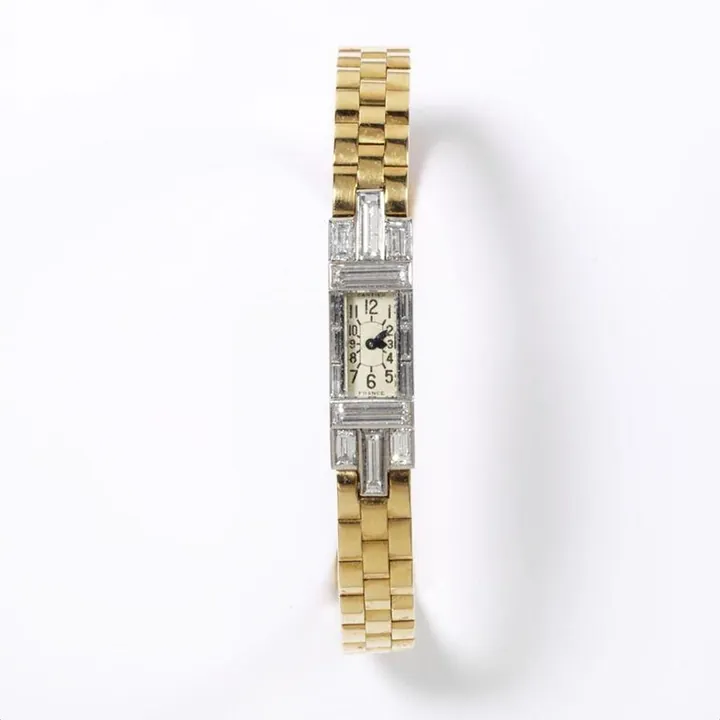
Wristwatches · c. 1936
Watch with diamond-set platinum case and gold link bracelet, Cartier, Paris, c. 1936.
Victoria and Albert Museum, London
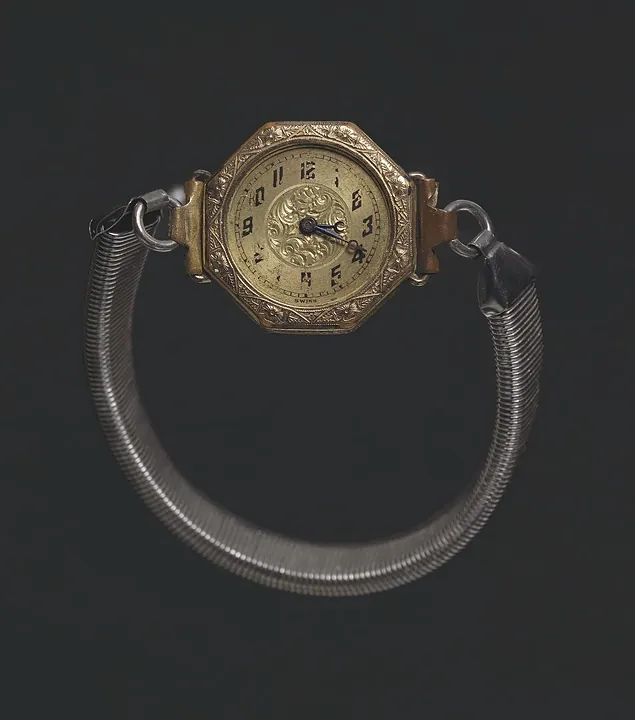
Wristwatches · early to mid 20th century
Woman's wristwatch worn by Harriette Vyda Simms Moore, early to mid 20th century
National Museum of African American History and Culture, Smithsonian Institution, Washington DC

Wristwatches · 1900–1999
Wristwatch by Certina, Switzerland, 1900–1999
Nordic Museum Foundation
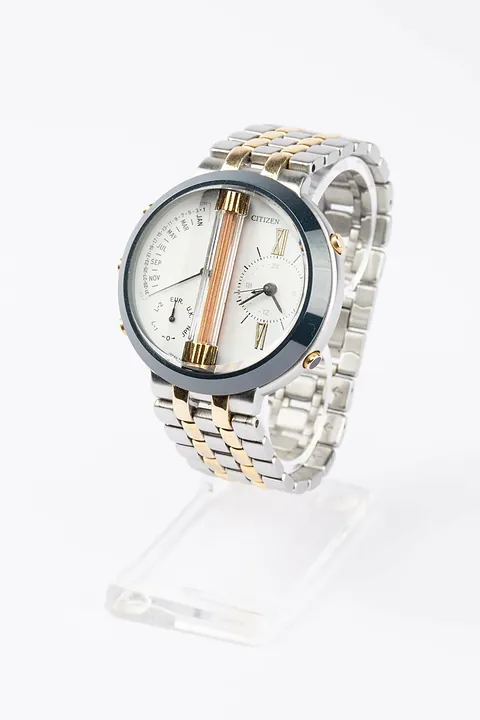
Wristwatches · 1900–1999
Wristwatch by Citizen, Japan, 1900–1999
German Clock Museum