Clocks · Clock
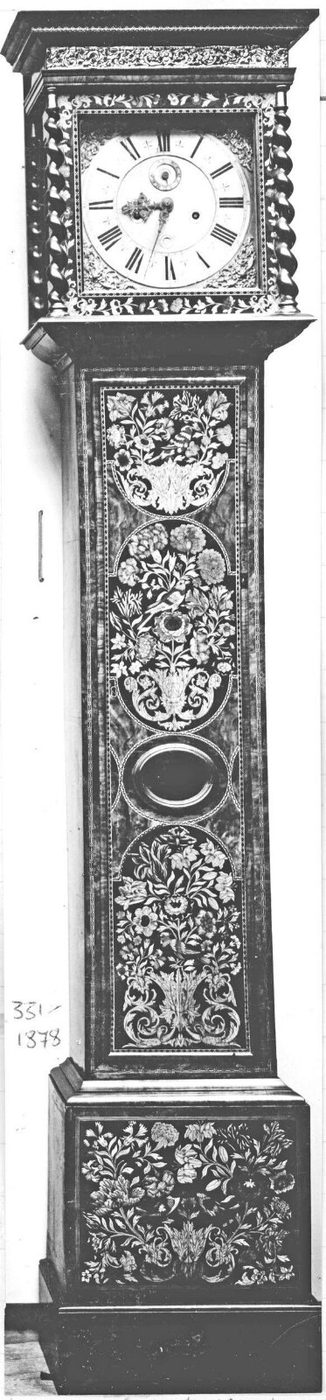
EIGHT-DAY LONG CASE CLOCK Walnut case inlaid with various woods Inscribed 'Mansell Bennett at Charing Cross', made in about 1700
- Maker / attribution
- Mansell Bennett (made)
- Date
- c. 1700
- Historical period
- Early Modern Horology (1600 – 1750)
- Country of origin
- England
- Place
- London
- Object type
- Clock
- Materials / technique
- Wood clock-case with panels of marquetry, the dia brass, engraved and part-silvered, pierced steel hands, brass and steel movement
- Dimensions
- Height: 211.5 cm; Width: 47 cm; Depth: 26.5 cm; Weight: 6.3 kg (331:2 weight 10/10/2025 NH)
- Holding institution
- Victoria and Albert Museum, London
- Accession / object no.
- 331:1-1878
Record summary
Held and catalogued by Victoria and Albert Museum, London (object number 331:1-1878), this is a clock by Mansell Bennett, made in London, England, dated c. 1700. The Atlas places it in the Early Modern Horology period (1600 – 1750) of its Clocks collection. Materials and techniques recorded by the source: Wood clock-case with panels of marquetry, the dia brass, engraved and part-silvered, pierced steel hands, brass and steel movement. Recorded dimensions: Height: 211.5 cm; Width: 47 cm; Depth: 26.5 cm; Weight: 6.3 kg (331:2 weight 10/10/2025 NH). The record is illustrated with 4 photographs.
Assembled from the source record's structured fields. Dates and attributions are given as the source states them; where a field is missing the Atlas leaves it blank rather than estimating.
Catalogue description
V&A — Summary
Mansell Bennett was based at Charing Cross in London and was a member of the Clockmakers Company from 1688 to 1711. The case is inlaid with panels of flowers and birds and acanthus scrollwork, probably inspired by Dutch marquetry but of a higher quality. The decoration on the cornice is applied in pressed brass.
V&A — Physical description
Case: Marquetry, inlaid with panels of flowers, birds and acanthus scrollwork on front surfaces only, including hood and part of cornice, the sides veneered and with rectangular inlays. Rectangular trunk door with convex moulding to edge and pendulum lenticle. Trunk top with convex moulding below hood. Hood with barley twist columns applied to front, quarter columns at rear. Front part only of frieze with an applied decorative metal panel. Hood sides with rectangular glazed panels. Rectangular plinth. Backboard with hole in upper proper left. Sliding hood with hinged glazed door at front; no mask between hood and dial. Dial: Brass, 11 inches square. Dial plate bordered with plain, single engraved line; centre matted. Ringed decoration around both winding holes, seconds hand aperture and circular calendar aperture. Cherub head spandrels each located by a single screw; lower proper left spandrel with detailed differences in design, smaller, of inferior finish to the others and located with a different style of screw. Pinned to the dial plate is the silvered brass chapter ring with engraved minute and quarter hour bands, Roman hour numerals at intervals of five, Arabic minute numerals. Engraved half-hour markers connected to quarter-hour band by single line take the form of opposed arrowheads with semicircles. At lower part of chapter ring between numerals IIII to VIII is engraved: Mansell Bennett at Charing Cross. Pinned to the dial plate below "XII", is the subsidiary seconds ring of silvered brass with engraved seconds band and at intervals of five, Arabic seconds numerals; it occupies less than the available space between the dial centre and inner edge of the chapter ring. A silvered brass ring with engraved Arabic numerals for the date (1-31) runs behind dial on brass pulleys. Four dial feet are pinned to the movement front plate. Hands: Steel. Pierced and chiselled, the minute hand with a straight portion. Movement: Brass and steel, weight driven, hour striking of 8-day duration with recoil anchor escapement, pendulum regulated. Five, finned pillars each with turned lines on both the central knop and semicircular ends. Pillars riveted to back plate, pinned to front plate. Hour striking on bell by internal countwheel controlled by externally mounted detent operating through aperture in backplate. Brass train wheels with four semicircular crossings. Where visible, scribed lines on wheel faces: one at teeth roots, one above base of wheel band. Similar lines also visible on barrel flanges, countwheel, hour wheel and 24-hour wheel. Three-spoked crossings on cannon pinion and minute wheel. Plain, domed wheel collets. Forward mounted centre wheel. Steel arbors barrel-shaped with relatively short pinion heads. Steel pallets, spanning 7½ teeth of escape wheel, mounted directly onto pallet arbor; crutch is squared onto end of this arbor. Detailing is present on some steelwork: shaped tails to barrel clicks, bevelling to foot of front-mounted bell standard and hammer spring foot. Hour wheel bridge tapers to a point at both ends. Description and notes by Francis Brodie, c. 2008
V&A — Object history
Thomas Whitehead, 8 Dukes Street, St James', long case clock Notes from R.P. 4062 Purchased from Mr Whitehead 30 May 1878 General Stores Division "Agenda on Objects" records receipt of "1 upright marqueterie clock, with 2 keys - - on approval - - Price £35" Three staff members recommend the purchase. One notes "we have nothing like it in the Museum and considering its excellent condition I think the piece (valuable?)" Maker's details: CC1688-1711; 1685-1711. Dial and Three Crowns, Charing Cross; CC1685-99; CC brother 1686-1711 (Baillie, G.H., Watchmakers and Clockmakers of the World, Volume 1, London, 1982). Remarks: The design of the hood (now slightly altered), combined with the barley twist hood columns and the convex moulding at the top of the trunk indicate a date pre-1700. The style and distribution of the marquetry, the bold designs laid in panels rather than all over, are further indicators of late seventeenth century horological practice. The presence of a lenticle in the trunk door is more usually associated with the square dial period, the square dial tending to give way to the break-arch dial during the early eighteenth century. By 1700, longcase dials were enlarged to twelve inches square and much before 1690, dials were less than eleven inches. It is because of the size of the dial and the arrangement of the wheelwork, that the seconds ring does not fully fill the space between the inside of the chapter ring and the dial centre at this date. Ringed decoration around the winding, and other holes, became common from 1690 in longcase clocks. The cherub head spandrel type introduced from c. 1675 was rare until c.1685. The type of half-hour markers on the chapter ring was introduced by Tompion in 1680. Although the Arabic minutes lie outside the band, they are still relatively small in comparison with those found on later twelve inch dials. The detailed hour hand of the loop form, symmetrical about its centre line, with its sculpted surfaces is usual for a clock of this date. Movement components are hard to date precisely because of their persistence but finned pillars and domed collets were in use during the seventeenth century being largely abandoned by the mid-eighteenth. The internal countwheel striking controlled by a detent operating through an aperture in the backplate was introduced by Tompion around 1675-8 and generally adopted from 1690. Other earlier movement features include: the mounting of the pallets directly onto the arbor; the relatively short pinion heads; the detailing of the steel work. In conclusion, the features discussed above would indicate a date around the 1690s. The metal frieze is uncharacteristic; wooden frets would have been more likely, perhaps being replaced a result of damage or woodworm. It is possible that the present frieze is a nineteenth century replacement, emulating gilded frets to be found on the finest quality seventeenth century longcases. It was extremely rare to find marquetry applied to any other face of a clock case than the front; the reason for this is not apparent (Robey, J.A., The Longcase Clock Reference Book, Ashbourne, 2001). The hood marquetry is partially concealed by the front columns. In view of the decorative nature of the columns it was a much simpler operation to apply the marquetry to the front of the hood in total, attach the columns by cutting a segment out of their backs. The alternative of cutting the marquetry to suit the profile of the columns would have been laborious. When first made, the case was fitted with a rising hood. To access the winding holes or set the hands, the hood would have been slid up vertically and rested on a sprung catch near the top of its travel, an arrangement both awkward to carry out with a clock of this height, and liable to impose stresses on the case components. At the end of the seventeenth century, as clocks became larger, the rising hood was superseded by the sliding hood, with a hinged, glazed door fitted as standard; as part of this design, a mask, or wooden frame was usually fitted behind the hood door to form a neat border to the dial. That W.19-1946 was converted at some later date from rising to sliding hood is indicated by the present hinged door and the absence of the mask. The spare hole in the backboard probably marks where the catch for the rising hood was once located. The detailed difference between one spandrel and the rest indicates it is probably a replacement and is secured with a modern screw. Various scribed markings on the train wheels are indicative of earlier, hand methods of wheel cutting. It is likely that at the period when this clock was manufactured, the wheel teeth would not have been cut with fully profiled addenda; also, the crossings would have required finishing. The scribed lines would have been used as a guide to completing these operations by hand. Description and notes by Francis Brodie, c. 2008
V&A gallery label
LONG-CASE CLOCK ENGLISH; about 1700 The case in walnut inlaid with various woods. Signed 'Mansell Bennett, at Charing Cross.' Mansell Bennett was a member of the Clockmakers Company from 1688 to 1711.
Inscriptions & marks
Mansell Bennett at Charing Cross
Historical context
Early Modern Horology (1600 – 1750)
Huygens' pendulum and balance spring transform accuracy; English makers develop the anchor and deadbeat escapements.
Huygens's pendulum (1656–57) improved clock accuracy from about a quarter of an hour to under a minute a day. The anchor escapement (c. 1670) and the long seconds pendulum created the longcase clock; London makers such as Fromanteel, Knibb, Tompion and Quare led European clockmaking, and French makers created the Boulle pendule.
Read the period in the timelineMore clocks from this periodEarlier: Renaissance Horology
Atlas type guide
Longcase (tall-case or grandfather) clocks
The longcase clock was born from two seventeenth-century innovations: Christiaan Huygens's pendulum (1656–57) and the anchor escapement (c. 1670). A long seconds pendulum, nearly a metre long, swings with a small arc, and enclosing it together with the driving weights in a tall wooden case protected the mechanism and created a new piece of furniture. London makers such as Ahasuerus Fromanteel, Thomas Tompion and Joseph Knibb set the pattern.
By the eighteenth century longcase clocks were made throughout Britain, the Netherlands, Scandinavia (the Swedish Mora clock), France (the Comtoise from the Franche-Comté), Germany and colonial America. Eight-day movements with two weights became standard in better clocks; thirty-hour clocks with one weight and a rope or chain were cheaper alternatives.
What to look for
- Winding holes in the dial: two (eight-day, going and striking) or none (thirty-hour, pulled up by a chain).
- Brass dials with applied chapter rings (earlier) versus painted iron 'white' dials (after c. 1770 in Britain).
- Moon-phase arches, date apertures, seconds dials and maker's name on the dial.
- Case woods and style: ebonised, walnut marquetry, lacquer, oak or mahogany; regional styles from London, Lancashire, Scotland or America.
- Whether the movement and dial match the case — 'marriages' are common.
Dating clues
- Square brass dials suggest c. 1670–1720; arched brass dials c. 1715–1790.
- Painted (white) dials were made by Birmingham dial-makers from about 1772.
- Comtoise clocks with repoussé pendulums are mostly nineteenth century.
General guidance written by the Atlas editors about this kind of object. It is not a statement about this particular piece; for that, rely on the source record above and on physical examination.
Read next:Anchor escapement
Related records
Clocks · 1598-1603
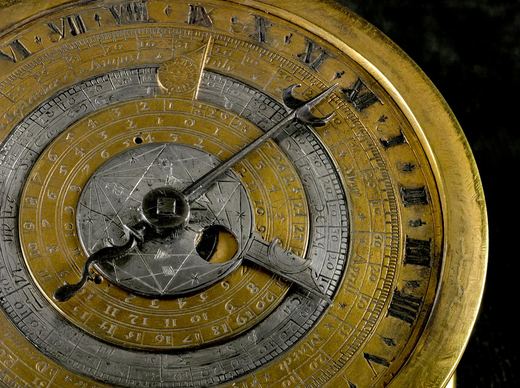
Circular table-clock with calendrical and lunar indications made by Nicholas Vallin in London between 1598 and 1603.
Science Museum Group, London
Clocks · 1611
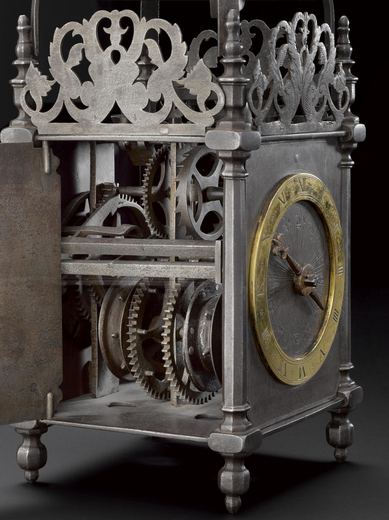
English iron lantern clock, with wheel balance, by John Holloway, Market Lavington, Wiltshire, England, 1611.
Science Museum Group, London
Clocks · 1630
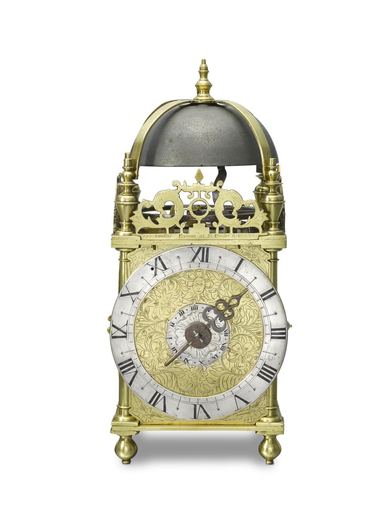
Lantern clock by Forman, Francis, England, 1630
Science Museum Group, London
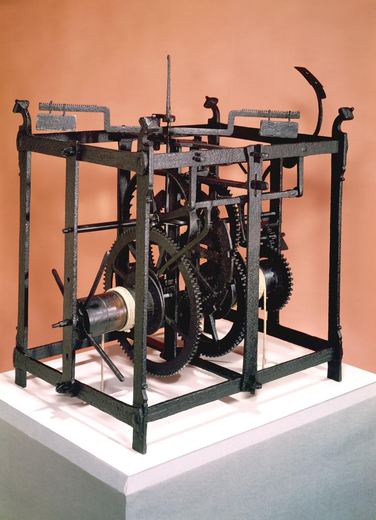
Clocks · 1632-1640
Turret clock, England, 1632-1640
Science Museum Group, London
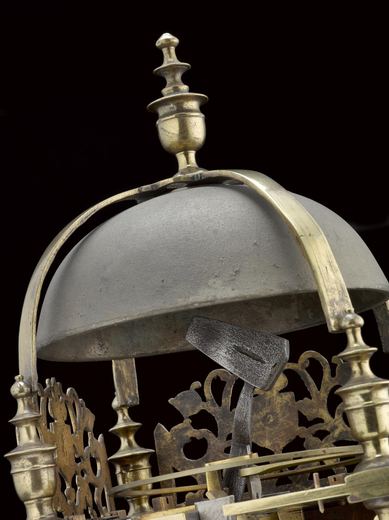
Clocks · 1645-1655
Balance-wheel brass lantern clock, with two driving weights and one counterweight, by Thomas Knifton, Cross Keys, Lothbury, London, England, 1645-1655.
Science Museum Group, London
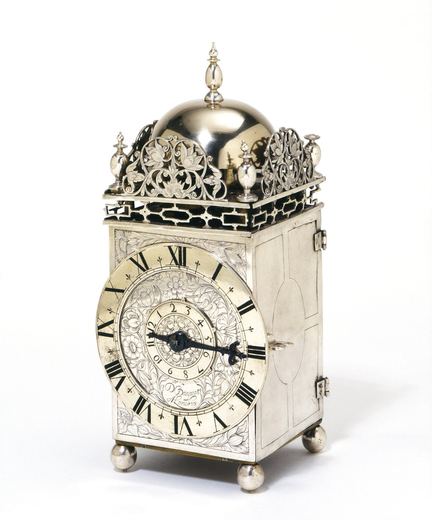
Clocks · ca. 1650
Lantern alarm clock, silver, by David Bouquet, circa 1650
Victoria and Albert Museum, London
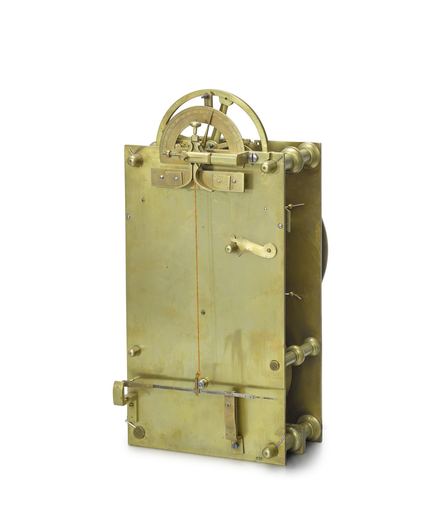
Clocks · 1650-1660
Lantern clock by Closon, Peter, England, 1650-1660
Science Museum Group, London
Clocks · ca. 1660
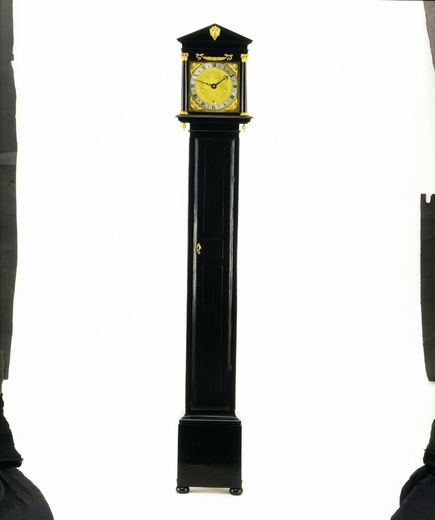
Longcase clock, ca. 1660, English, made by Ahasuerus Fromanteel
Victoria and Albert Museum, London