
Wristwatches · Wristwatch
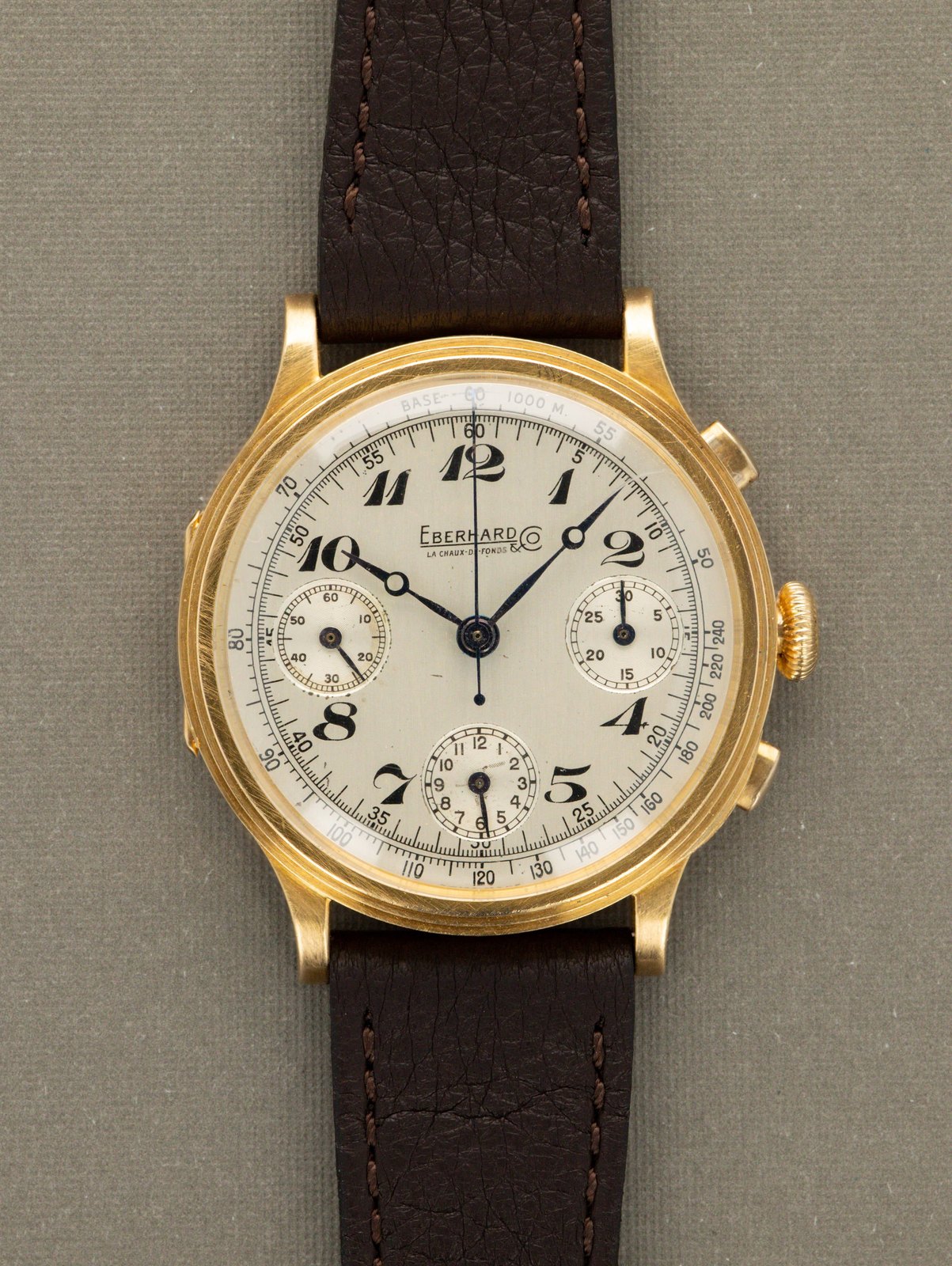
Eberhard and Co. Pre Extra-Fort, Brushed Silver 'Breguet' Dial
- Maker / attribution
- Eberhard (maker)
- Date
- c. late 1930s
- Historical period
- Golden Age of Mechanical Watchmaking (1900 – 1945)
- Country of origin
- Switzerland
- Object type
- Wristwatch
- Materials / technique
- silver
- Dimensions
- Case 40 mm
- Stock no.
- OC3389
- Credit line
- Dealer listing, Oliver & Clarke (OC3389)
- Catalogue title (original)
- Eberhard and Co. Pre Extra-Fort - Brushed Silver 'Breguet' Dial (English)
View the source record (dealer listing) ↗ (opens another website in a new tab)Suggest a correction
Record summary
Catalogued by Oliver & Clarke (dealer), United Kingdom (stock number OC3389), this is a wristwatch by Eberhard, made in Switzerland, dated c. late 1930s. The Atlas places it in the Golden Age of Mechanical Watchmaking period (1900 – 1945) of its Wristwatches collection. Materials and techniques recorded by the source: silver. Recorded dimensions: Case 40 mm. The record is illustrated with 6 photographs.
Assembled from the source record's structured fields. Dates and attributions are given as the source states them; where a field is missing the Atlas leaves it blank rather than estimating.
Catalogue description
Dealer description — Oliver & Clarke
We've handled, collected, sold, and personally owned a number of Eberhards over the years, and it has become clear that each brings a distinctly different character to wrist. There's a consistent sense of individuality across the brands offerings and no two models feel quite the same. From the highly sought-after Scafograf, to the earlier and more obscure 'snail dial' chronographs, Eberhard's designs remain consistently engaging, each with a personality that sets it apart from the their contemporaries. This is not a manufacturer defined by restraint or uniformity, but rather by a willingness to experiment and specialize. The piece that we have here is a very special chronograph dating to circa the late 1930s. Along with a handful of other chronographs that pre-date the Extra-Fort model that debuted in 1942, this is colloquially known as a 'Pre Extra-Fort.' It features a massive for the era, 40mm case crafted out of solid yellow gold with a 'hinged' caseback affixed to the left profile, fixed 'wire' lugs, a crown at 3 o'clock, and what appears to be a pair of 'oval' pushers in the usual configuration. The top pusher functions as a monopusher for the chronograph while the lower pushers is a locking/stop mechanism in disguise. Even today, this very unique function is thanks to one of the highest-grade chronograph movements of the era: Eberhard's Cal. 16000. Based on the Valjoux Cal. 65, this massive 36mm movement was and is about as Eberhard as Eberhard gets, truly embodying the ethos of the brand. The condition of this piece is fantastic — wonderfully-preserved throughout for a watch of this age, let alone a precious metal chronograph. The case remains strong with correct finishing and shows normal wear, with no apparent damage or major wear. It must be said, however, that the highlight of this piece is the stunning and unusual dial inside. Silver in color, it features a vertically 'brushed' surface with black enamel 'Breguet' indices and a blued-steel 'Breguet' handset. It shows very light wear on the surface from age and is otherwise fantastic. Best of all, it is an Eberhard. A brand unknown to many, but with models such as the Scientigraf, Scafograf, and Contograf, tug hard at the hearts of so many collectors of vintage. And like many Eberhards, these were produced in small numbers and are seldom-seen on the open market. This sold gold example, quite simply, is something we have never seen and very well may never seen again.
Historical context
Golden Age of Mechanical Watchmaking (1900 – 1945)
The wristwatch displaces the pocket watch; waterproof cases, self-winding and grand complications.
The wristwatch overtook the pocket watch. Military use in the First World War, aviation, water-resistant cases (1926), automatic winding (1923–31), rectangular Art Deco designs and early chronographs and calendars defined the period.
Read the period in the timelineMore wristwatches from this periodEarlier: Industrial Revolution
Atlas type guide
Wristwatches
Bracelet watches were worn by women from the early nineteenth century — Breguet made one for Caroline Murat, Queen of Naples, in 1810–12 — but the wristwatch only became a man's instrument with military use and aviation in the early twentieth century. Between the World Wars it overtook the pocket watch; the 1920s and 1930s brought rectangular Art Deco cases, water-resistant cases and the first automatic winding systems.
After 1945 the wristwatch became a carrier of identity — dress watches, sports and dive watches, chronographs, calendars — produced by Swiss, American, Japanese, German, Soviet and Chinese industries. The quartz revolution after 1969 and the mechanical renaissance since the 1990s, including the rise of independent watchmakers, complete the story.
What to look for
- The reference number (between the lugs or inside the case back) and serial number, the starting point for dating.
- The calibre: its maker and number are often stamped under the dial or on the bridge.
- Originality of dial, hands and crown — refinished ('redial') dials are common.
- Case material marks: 18K/750, 14K/585, stainless steel, gold-filled, plated.
Dating clues
- Wire-lug cases: before c. 1925.
- Water-resistant screw-down cases: from 1926.
- Quartz movements: from 1969; sapphire crystals widespread after c. 1980.
General guidance written by the Atlas editors about this kind of object. It is not a statement about this particular piece; for that, rely on the source record above and on physical examination.
Related records
Wristwatches · originally sold in 2013 (per the lot record)
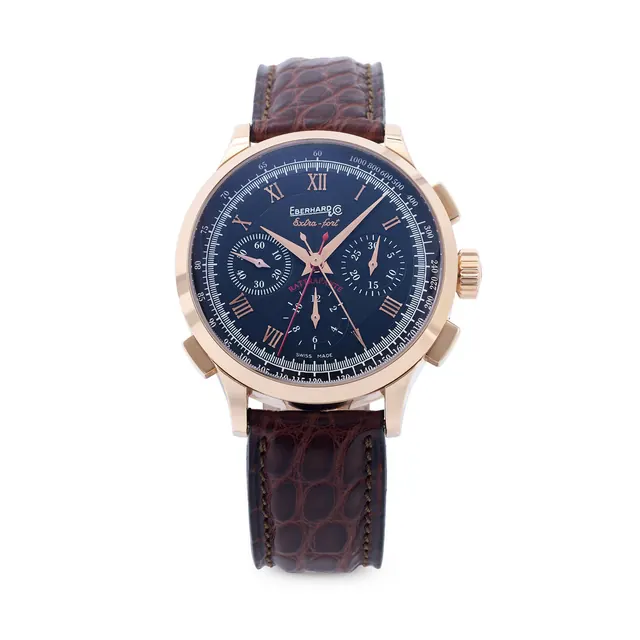
Eberhard wristwatch, ref. 30063, Extra-Fort Chrono Rattrapante Limited 011/121, originally sold in 2013
Antiquorum auction archive, Geneva
Wristwatches · c. 1950s
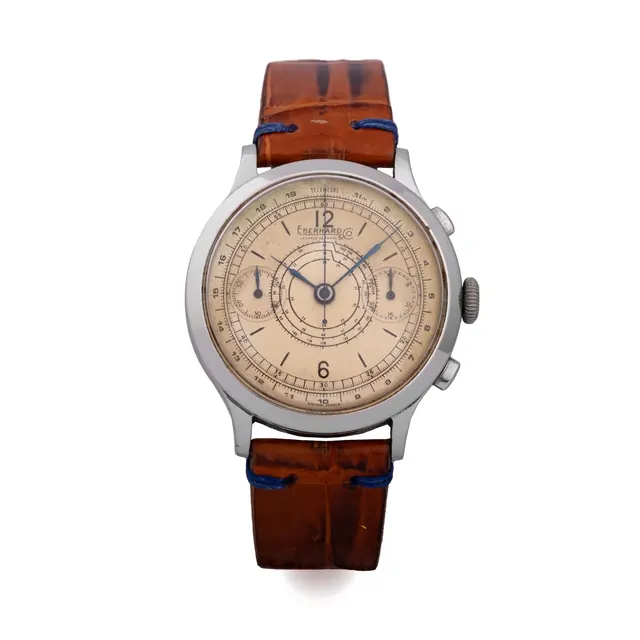
Eberhard wristwatch, Single Button Chronograph, circa 1950's
Antiquorum auction archive, Geneva
Wristwatches · 1960s
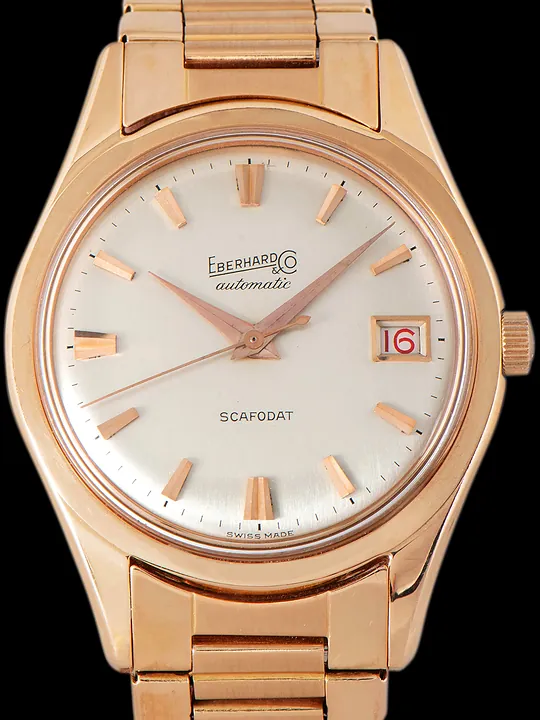
Eberhard Scafodat 18K RG (Ref. 11532-1) "Roulette Date Wheel", 1960s
Craft & Tailored (dealer), Los Angeles
Wristwatches · 1950s
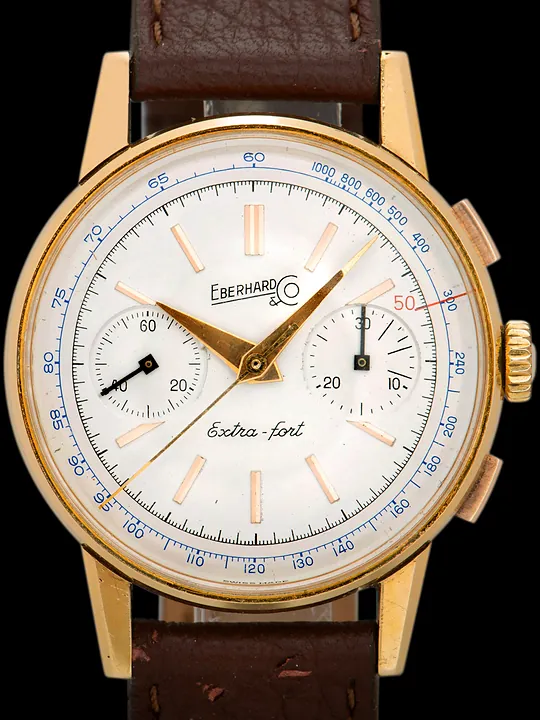
Eberhard Extra-Fort Chronograph (Ref. 14801) 18K YG, 1950s
Craft & Tailored (dealer), Los Angeles

Wristwatches · 1931
Rolex 'Oyster Perpetual' rotor self-winding wrist-watch, lever escapement, in steel case with glass in back, Montres Rolex SA, Geneva, Switzerland, 1931
Science Museum Group, London

Wristwatches · 1900–1999
Wristwatch by Certina, Switzerland, 1900–1999
Nordic Museum Foundation
Wristwatches · 1900–1999
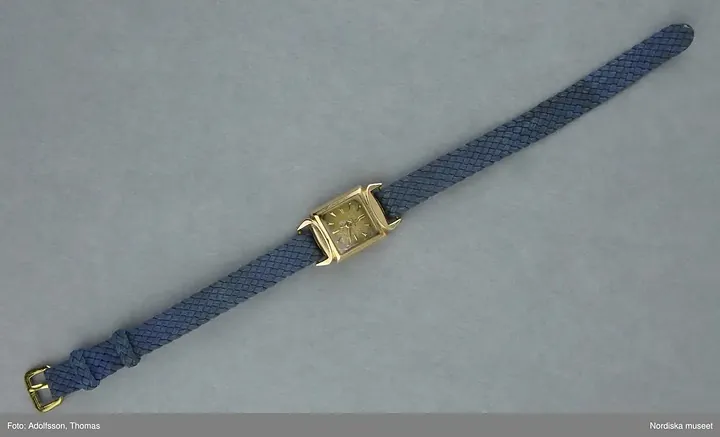
Wristwatch by Omega, Västerås, 1900–1999
Nordic Museum Foundation
Wristwatches · 1900–1999
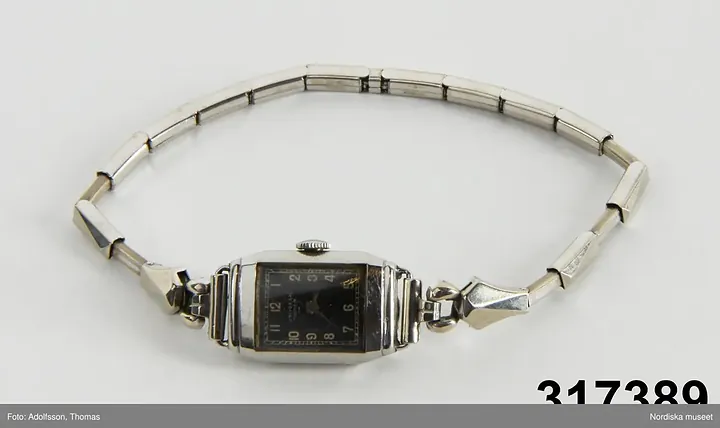
Wristwatch by Universal, Switzerland, 1900–1999
Nordic Museum Foundation