
Wristwatches · Wristwatch
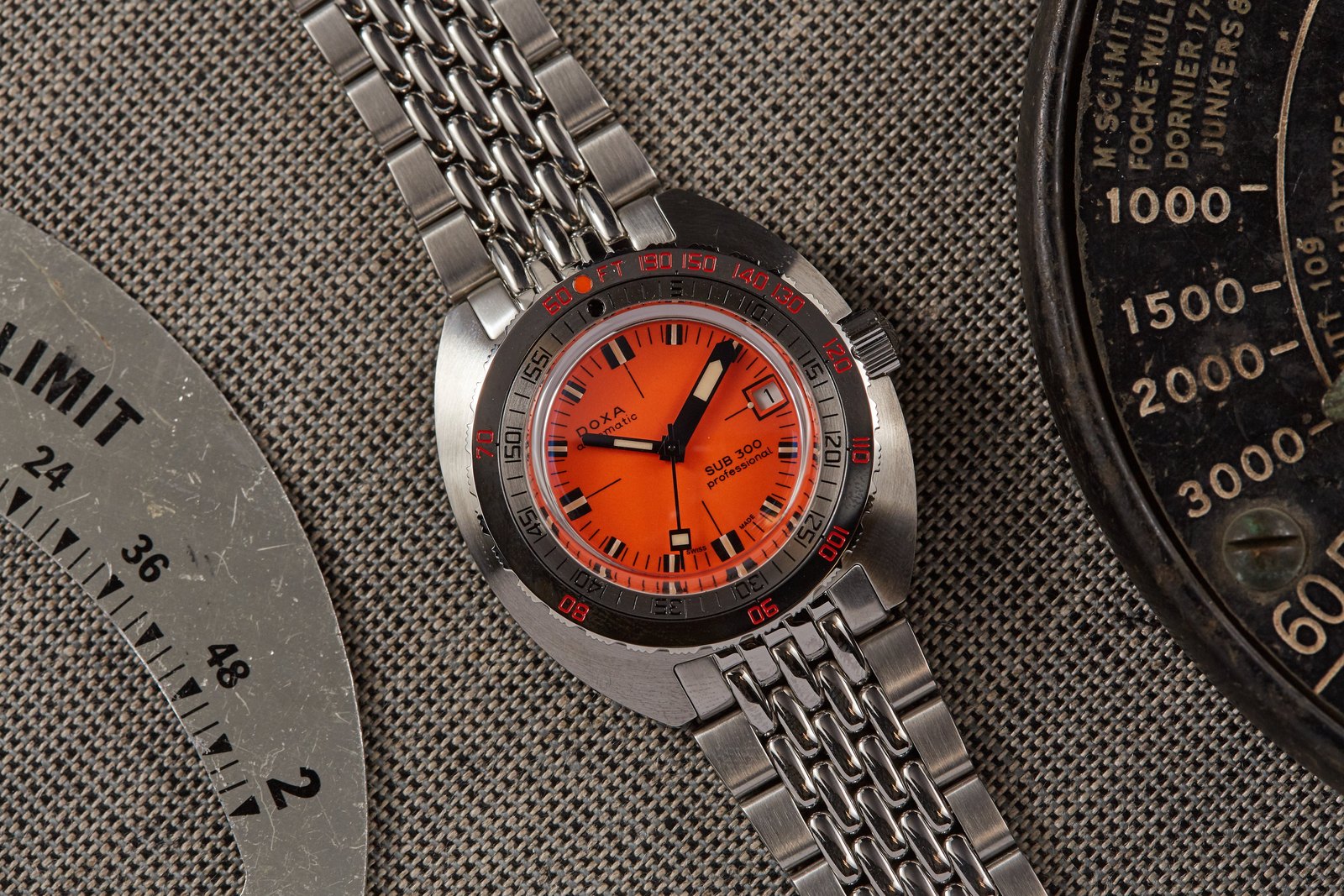
Doxa Sub 300 Professional 50th Anniversary Edition, 2017
- Maker / attribution
- Doxa (maker)
- Date
- 2017
- Historical period
- Contemporary Horology (2010 – Present)
- Country of origin
- Switzerland
- Object type
- Wristwatch
- Stock no.
- Product 1994777493591
- Credit line
- Dealer listing, Analog/Shift (product 1994777493591)
- Catalogue title (original)
- DOXA Sub 300 Professional 50th Anniversary Edition (English)
View the source record (dealer listing) ↗ (opens another website in a new tab)Suggest a correction
Record summary
Catalogued by Analog/Shift (dealer), New York (stock number Product 1994777493591), this is a wristwatch by Doxa, made in Switzerland, dated 2017. The Atlas places it in the Contemporary Horology period (2010 – Present) of its Wristwatches collection. The record is illustrated with 6 photographs.
Assembled from the source record's structured fields. Dates and attributions are given as the source states them; where a field is missing the Atlas leaves it blank rather than estimating.
Catalogue description
Dealer description — Analog/Shift
Why We Love It Here at Analog/Shift, we can't hide our love of DOXA. While not nearly as well-known as the Blancpain Fifty-Fathoms or the Rolex Submariner, the DOXA Sub series played an integral role in the development of the modern diver's watch. The first generation of the model, introduced in 1967, brought innovations we now take for granted; the uni-direcitonal bezel with the US Navy's no-decompression dive timing marks engraved, the expanding bracelet, and oversized luminous minute hands to name a few. After its introduction, DOXAxa rapidly became a household name for professional and amateur divers in the late 1960s and 1970s, and the Sub 300 evolved into an even more capable and reliable instrument. The limited edition example we have today dates from 2017, the 50th Anniversary of the original 300 Professional, and is in superb 'like-new' condition with virtually no signs of wear. An absolutely brilliant homage to the most important diver's watch you've never heard of. The Story DOXA began Research and Development for the Sub 300 in 1964, under a team helmed by Urs Eschle, the brand's head of operations, who consulted professional divers including none other than the father of SCUBA himself, Jacques-Yves Cousteau. Since wearability was crucial, Eschle designed a large case with wide rounded lugs. For the dial, the team tested many colors (orange, yellow, turquoise, and red) in the waters of Neuchatel Lake. An unprecedented amount of tritium was also used on the hands and hour indices. The team implemented a unidirectional bezel with an innovative insert: the U.S. Navy No Decompression chart, with the outer depth scale in orange and the minute scale in black, to allow divers to gauge how much air was in left in their tanks. Rounding out the Sub 300's innovative design was a beads-of-rice bracelet that was the first to implement an ratcheting expandable clasp capable of fitting over a diver's wetsuit without having to remove links.
Historical context
Contemporary Horology (2010 – Present)
Silicon components, connected watches, optical-lattice research clocks and a thriving independent scene.
Smartwatches became the world's best-selling watches, while mechanical watchmaking focuses on craft, innovation (silicon components, new escapements) and independent makers.
Read the period in the timelineMore wristwatches from this periodEarlier: Mechanical Renaissance
Atlas type guide
Wristwatches
Bracelet watches were worn by women from the early nineteenth century — Breguet made one for Caroline Murat, Queen of Naples, in 1810–12 — but the wristwatch only became a man's instrument with military use and aviation in the early twentieth century. Between the World Wars it overtook the pocket watch; the 1920s and 1930s brought rectangular Art Deco cases, water-resistant cases and the first automatic winding systems.
After 1945 the wristwatch became a carrier of identity — dress watches, sports and dive watches, chronographs, calendars — produced by Swiss, American, Japanese, German, Soviet and Chinese industries. The quartz revolution after 1969 and the mechanical renaissance since the 1990s, including the rise of independent watchmakers, complete the story.
What to look for
- The reference number (between the lugs or inside the case back) and serial number, the starting point for dating.
- The calibre: its maker and number are often stamped under the dial or on the bridge.
- Originality of dial, hands and crown — refinished ('redial') dials are common.
- Case material marks: 18K/750, 14K/585, stainless steel, gold-filled, plated.
Dating clues
- Wire-lug cases: before c. 1925.
- Water-resistant screw-down cases: from 1926.
- Quartz movements: from 1969; sapphire crystals widespread after c. 1980.
General guidance written by the Atlas editors about this kind of object. It is not a statement about this particular piece; for that, rely on the source record above and on physical examination.
Related records
Wristwatches · c. 1930s
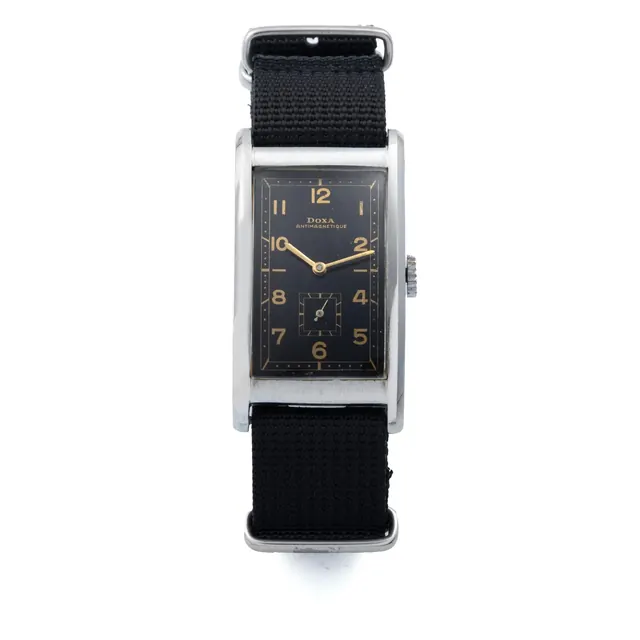
Doxa wristwatch, Antimagnetique, circa 1930's
Antiquorum auction archive, Geneva
Wristwatches · c. 1940
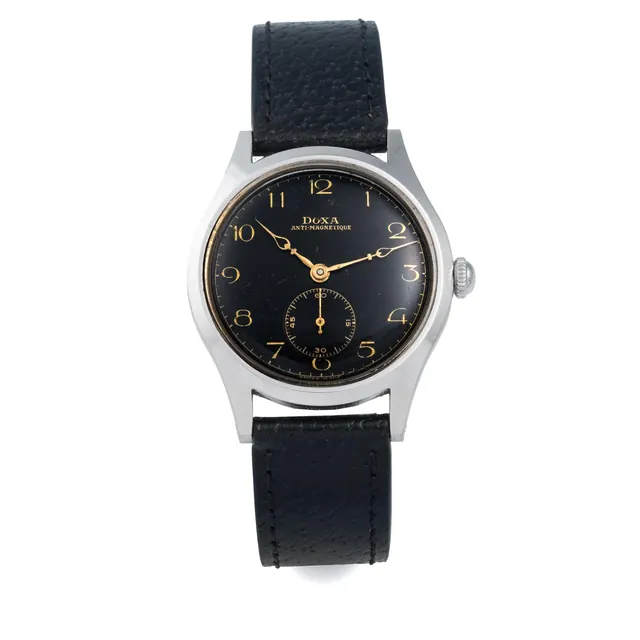
Doxa wristwatch, circa 1940
Antiquorum auction archive, Geneva
Wristwatches · c. 1970s
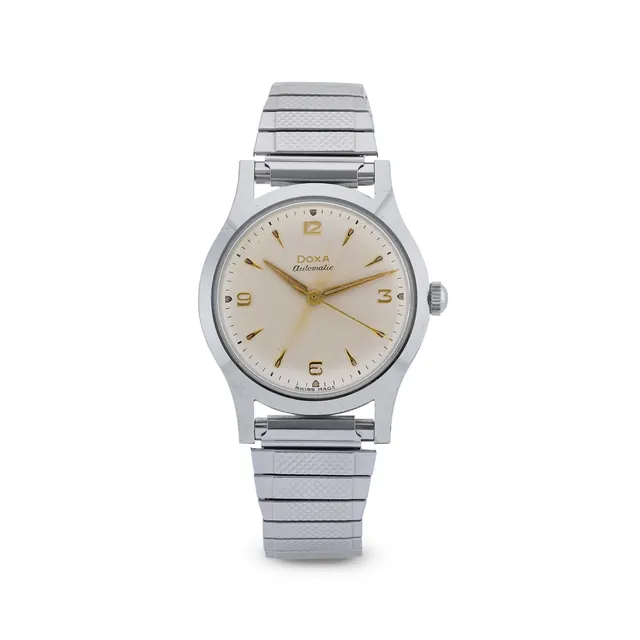
Doxa wristwatch, ref. 13921, circa 1970s
Antiquorum auction archive, Geneva
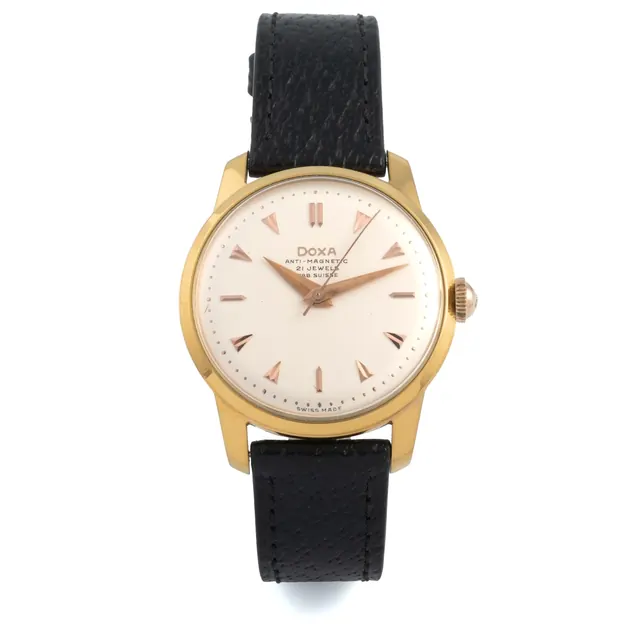
Wristwatches · c. 1960s
Doxa wristwatch, ref. 15001, circa 1960's
Antiquorum auction archive, Geneva

Wristwatches · c. 2010s
Breguet Type XXI, ref. 3810, c. 2010s (Antiquorum Lot 381-24)
Antiquorum auction archive, Geneva

Wristwatches · c. 2010s
Breguet Type XXI, ref. 3810, c. 2010s (Antiquorum Lot 386-229)
Antiquorum auction archive, Geneva

Wristwatches · Sold in September 2010
Breitling Cosmonaute, ref. A 22322, Sold in September 2010
Antiquorum auction archive, Geneva

Wristwatches · c. 2010
Corum Bubble Chrono, ref. 396.150.20, c. 2010
Antiquorum auction archive, Geneva