
Wristwatches · Wristwatch
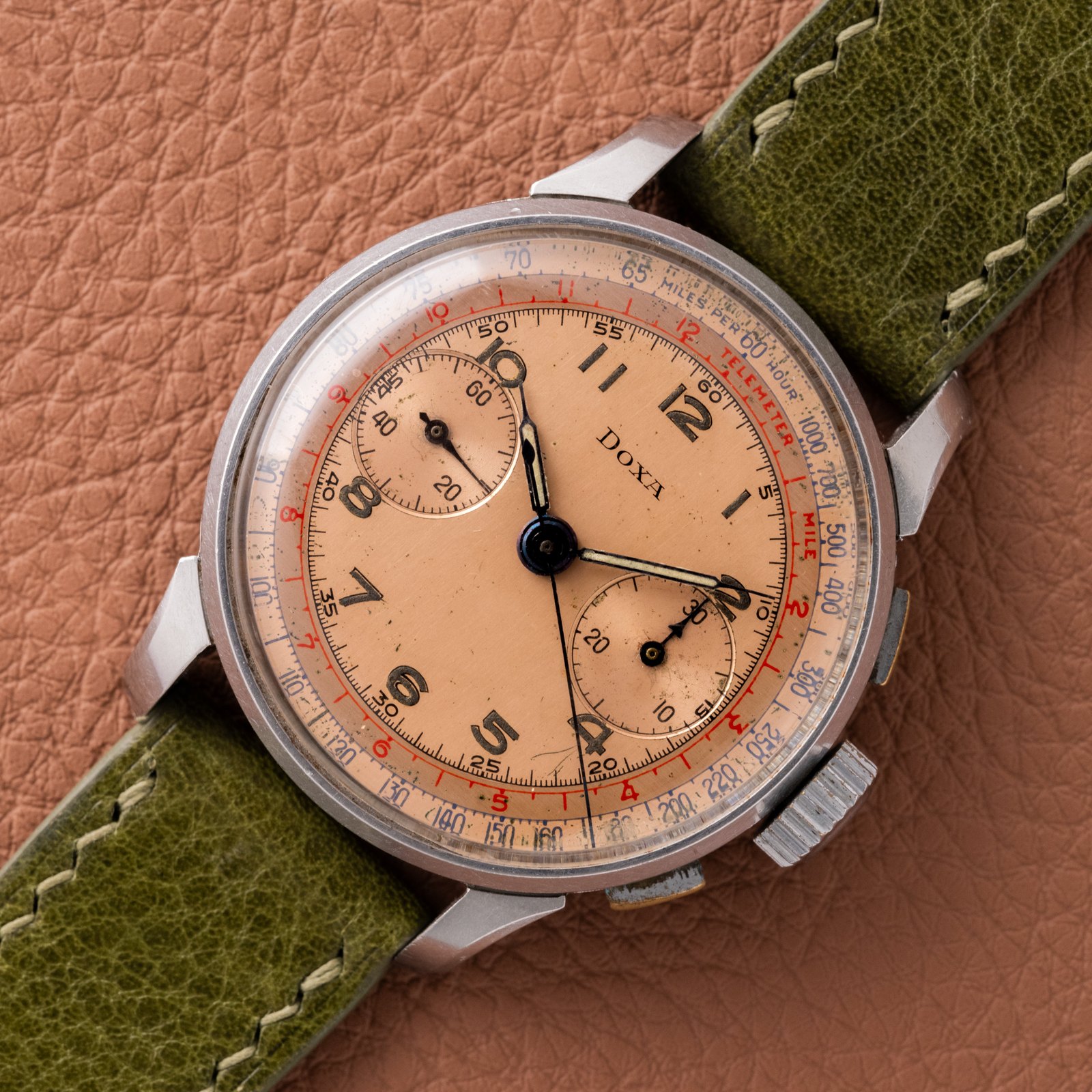
Doxa Chronograph Salmon Sector Dial, 1940s
- Maker / attribution
- Doxa (maker)
- Date
- 1940s
- Historical period
- Golden Age of Mechanical Watchmaking (1900 – 1945)
- Country of origin
- Switzerland
- Object type
- Wristwatch
- Dimensions
- Case 34 mm
- Stock no.
- Product 8744009859255
- Credit line
- Dealer listing, Huntington Company (product 8744009859255)
- Catalogue title (original)
- 1940s Doxa Chronograph Salmon Sector Dial (English)
View the source record (dealer listing) ↗ (opens another website in a new tab)Suggest a correction
Record summary
Catalogued by Huntington Company (dealer) (stock number Product 8744009859255), this is a wristwatch by Doxa, made in Switzerland, dated 1940s. The Atlas places it in the Golden Age of Mechanical Watchmaking period (1900 – 1945) of its Wristwatches collection. Recorded dimensions: Case 34 mm. The record is illustrated with 6 photographs.
Assembled from the source record's structured fields. Dates and attributions are given as the source states them; where a field is missing the Atlas leaves it blank rather than estimating.
Catalogue description
Dealer description — Huntington Company
History and Significance intage chronographs from the 1940s have a character that is difficult to reproduce because so much of their appeal comes from the relationship between the dial and case proportions. This Doxa is a particularly attractive example, pairing a 34mm stainless steel case with a salmon sector dial and blued hands. The diameter is substantial for the period, giving the watch enough presence to remain comfortable by modern standards without losing its unmistakably vintage proportions. The two-register chronograph layout keeps the design balanced even with the amount of information presented across the dial. The salmon sector dial is what immediately separates this example from a more conventional mid-century chronograph. Multiple concentric tracks divide the dial into clearly defined areas, giving the watch the technical appearance associated with early timing instruments while maintaining a surprising amount of elegance. Blued hands introduce a sharp contrast against the warm salmon surface and change dramatically depending on the light. The combination of color, typography, and scale creates a dial that rewards close inspection without becoming visually overwhelming. Condition of the case is equally important. The stainless steel case appears unpolished and retains unusually thick lugs with strong chamfers still clearly visible along their edges. Those details provide valuable evidence of preservation because the original geometry of vintage chronograph cases can disappear quickly after repeated refinishing. At 34mm, the substantial lugs also give the watch considerably more presence than the case diameter alone would suggest. A new H.C. leather strap has been fitted and paired with a steel buckle, keeping the presentation simple and allowing the dial and case to remain the focus. The strap also emphasizes the warmer tones of the salmon dial without attempting to make the watch feel overly formal. With its unpolished case, preserved chamfers, sector layout, and blued hands, this Doxa brings together many of the details that make 1940s chronographs particularly appealing. It is an uncommon configuration whose character comes as much from its preservation as from the design itself. Writer's Thoughts The dial could easily be enough to make this Doxa interesting, but the case is what elevates the entire watch. Salmon sector dials already have enormous visual character, and the blued hands create exactly the contrast needed to make all of the scales and typography come alive. Finding that dial inside an apparently unpolished 34mm case with thick lugs and clearly preserved chamfers makes the package considerably more compelling. The proportions also work exceptionally well, giving the watch genuine wrist presence while retaining the compact feeling expected from a 1940s chronograph. Our Promise Every watch is thoroughly vetted, carefully described with complete transparency, and guaranteed authentic. Each piece is offered in honest condition, ensuring collectors receive a timepiece that reflects both originality and integrity. Specifications Brand: Doxa Model: Chronograph Year: Circa 1940s Case Material: Stainless steel Case Size: 34mm Dial: Salmon sector dial with chronograph registers Movement: Manual-wind chronograph Strap/Bracelet: New H.C. leather strap Buckle/Clasp: Steel buckle Contents: Watch only Condition Case: The stainless steel case appears unpolished and retains excellent original proportions. The lugs remain particularly thick, with attractive chamfers still clearly defined along their edges and age-related surface wear present throughout. Dial: The salmon sector dial presents beautifully with an attractive, even appearance. The multiple scales, printing, and chronograph registers remain well defined and give the dial excellent visual depth. Hands: The blued hands present attractively and provide strong contrast against the salmon dial, with age-related characteristics consistent with the watch. Crystal: The crystal presents well overall with signs of wear consistent with age and use. Strap/Bracelet: Fitted to a new H.C. leather strap in excellent condition. Buckle/Clasp: The steel buckle presents in excellent overall condition.
Historical context
Golden Age of Mechanical Watchmaking (1900 – 1945)
The wristwatch displaces the pocket watch; waterproof cases, self-winding and grand complications.
The wristwatch overtook the pocket watch. Military use in the First World War, aviation, water-resistant cases (1926), automatic winding (1923–31), rectangular Art Deco designs and early chronographs and calendars defined the period.
Read the period in the timelineMore wristwatches from this periodEarlier: Industrial Revolution
Atlas type guide
Chronographs and split-seconds watches
A chronograph is a watch with an additional seconds hand that can be started, stopped and returned to zero independently of the timekeeping. Louis Moinet built an early example in 1816 and Nicolas Rieussec a recording 'chronographe' in 1821; Adolphe Nicole's heart-shaped reset cam (patented 1862) made the modern return-to-zero possible. Split-seconds (rattrapante) chronographs add a second hand that can be stopped for intermediate times; flyback chronographs restart instantly.
Chronographs were essential tools for doctors (pulsometer scales), artillery (telemeter), engineers and sport. In wristwatches, Valjoux, Venus, Lemania and later the automatic chronographs of 1969 (Zenith El Primero, the Chronomatic Calibre 11 group and Seiko 6139) are milestones.
What to look for
- Push-pieces on the case band or a single button in the crown (monopusher).
- Subsidiary registers for minutes and hours; tachymeter, telemeter or pulsometer scales.
- Column wheel versus cam control visible in the movement.
- Calibre markings of specialist makers (Valjoux, Lemania, Venus, Landeron).
Dating clues
- Pocket chronographs with heart cam reset: after 1862.
- Wrist chronographs: from c. 1910; two-button designs from the 1930s.
- Automatic chronographs: from 1969.
General guidance written by the Atlas editors about this kind of object. It is not a statement about this particular piece; for that, rely on the source record above and on physical examination.
Read next:Flyback chronographChronograph
Related records
Wristwatches · c. 1930s
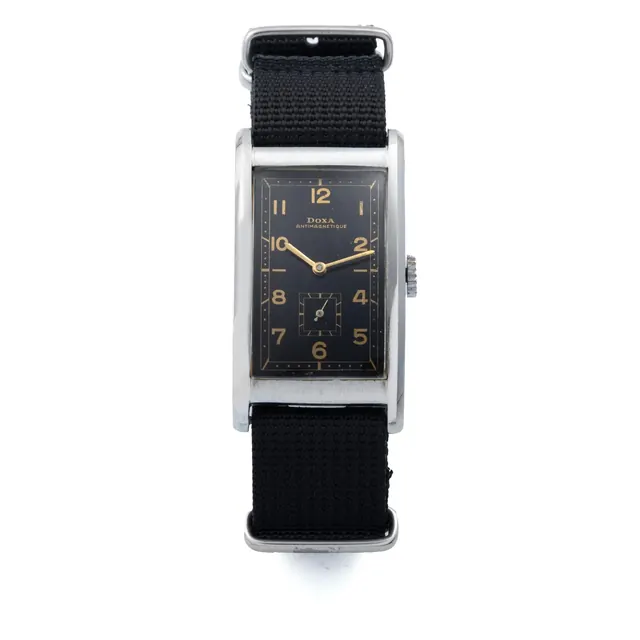
Doxa wristwatch, Antimagnetique, circa 1930's
Antiquorum auction archive, Geneva
Wristwatches · c. 1940
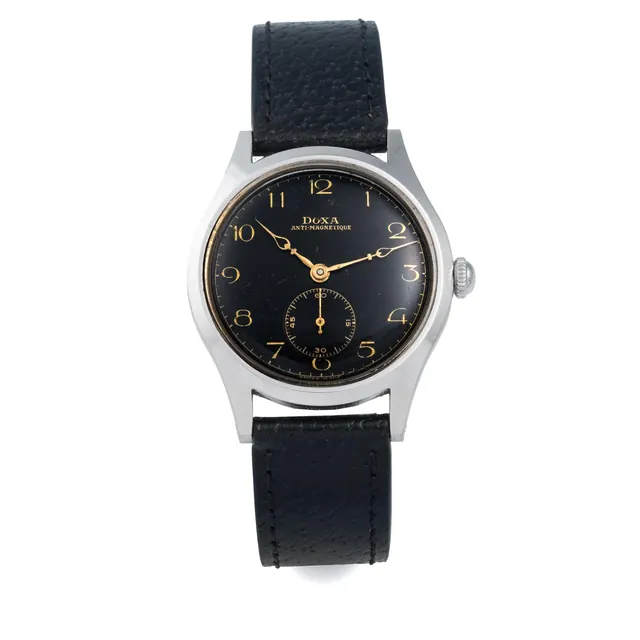
Doxa wristwatch, circa 1940
Antiquorum auction archive, Geneva
Wristwatches · c. 1970s
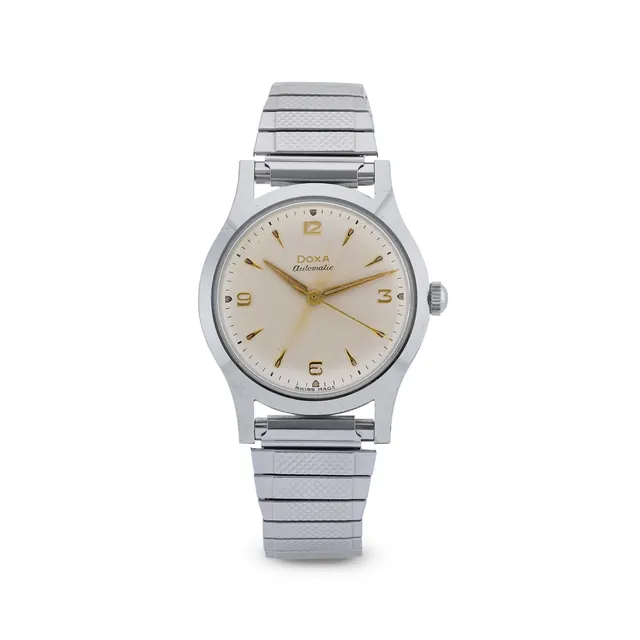
Doxa wristwatch, ref. 13921, circa 1970s
Antiquorum auction archive, Geneva
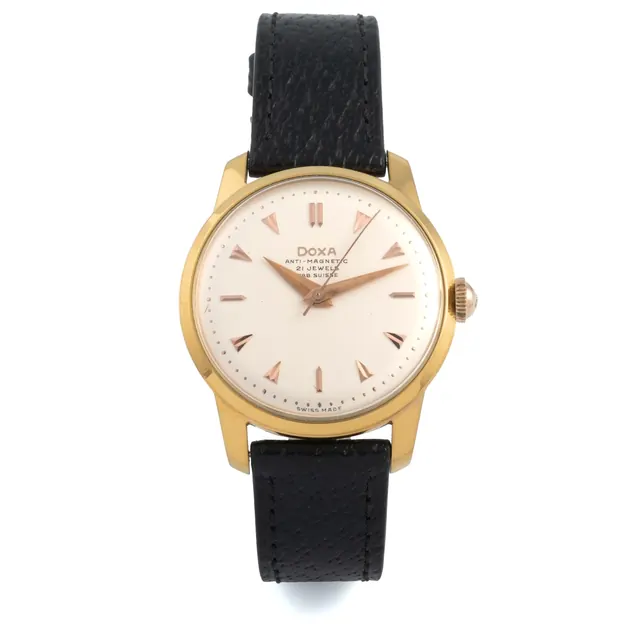
Wristwatches · c. 1960s
Doxa wristwatch, ref. 15001, circa 1960's
Antiquorum auction archive, Geneva

Wristwatches · 1931
Rolex 'Oyster Perpetual' rotor self-winding wrist-watch, lever escapement, in steel case with glass in back, Montres Rolex SA, Geneva, Switzerland, 1931
Science Museum Group, London

Wristwatches · 1900–1999
Wristwatch by Certina, Switzerland, 1900–1999
Nordic Museum Foundation
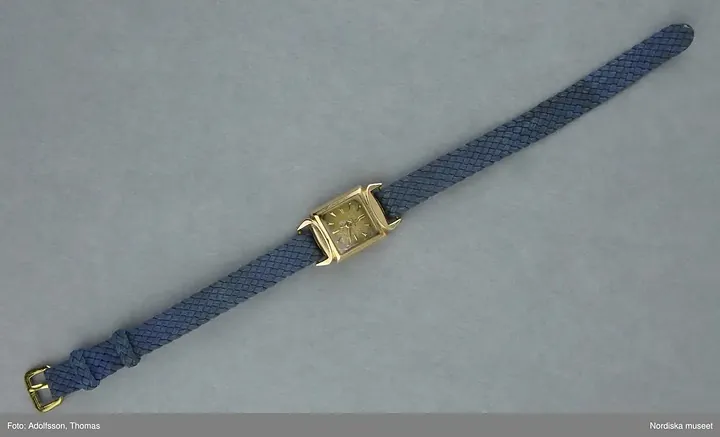
Wristwatches · 1900–1999
Wristwatch by Omega, Västerås, 1900–1999
Nordic Museum Foundation
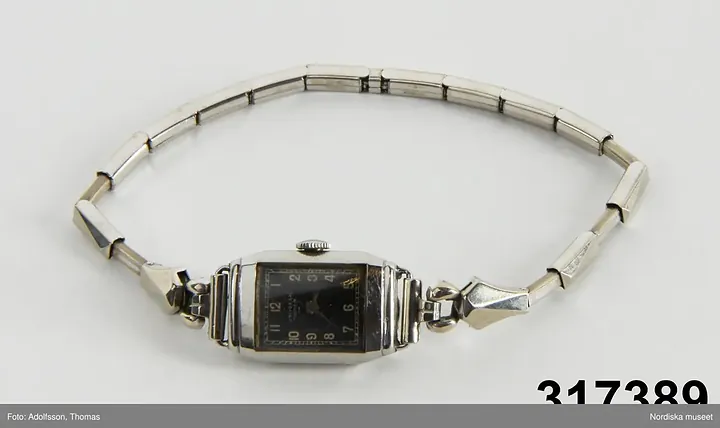
Wristwatches · 1900–1999
Wristwatch by Universal, Switzerland, 1900–1999
Nordic Museum Foundation