
Wristwatches · Wristwatch
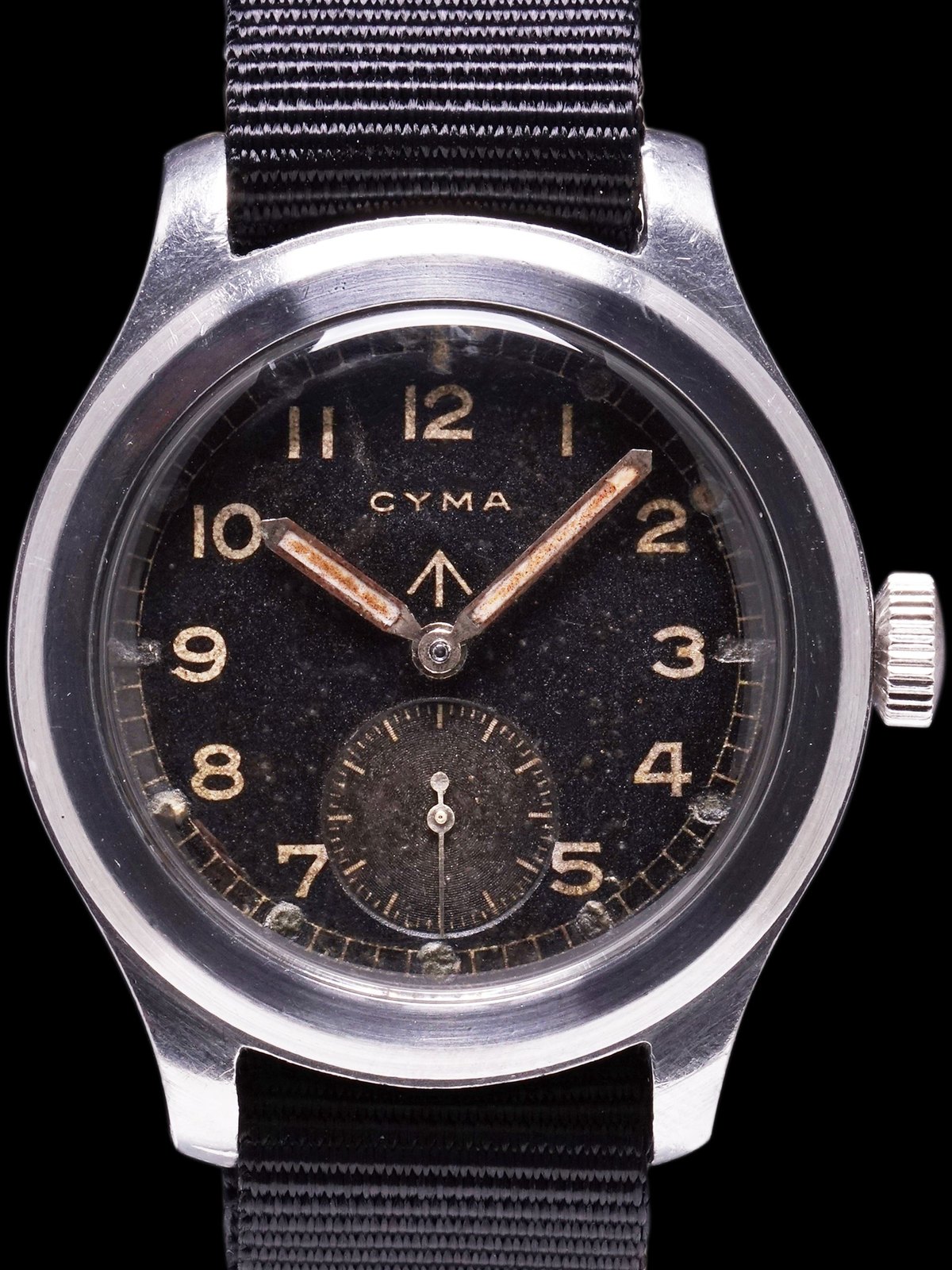
Cyma Military Watch, 1940s
- Maker / attribution
- Cyma (maker)
- Date
- 1940s
- Historical period
- Golden Age of Mechanical Watchmaking (1900 – 1945)
- Country of origin
- Unrecorded in source
- Object type
- Wristwatch
- Dimensions
- Case 38 mm
- Stock no.
- CYM
- Credit line
- Dealer listing, Craft & Tailored (CYM)
- Catalogue title (original)
- 1940s Cyma Military Watch (English)
View the source record (dealer listing) ↗ (opens another website in a new tab)Suggest a correction
Record summary
Catalogued by Craft & Tailored (dealer), Los Angeles (stock number CYM), this is a wristwatch by Cyma, dated 1940s. The Atlas places it in the Golden Age of Mechanical Watchmaking period (1900 – 1945) of its Wristwatches collection. Recorded dimensions: Case 38 mm. The record is illustrated with 6 photographs.
Assembled from the source record's structured fields. Dates and attributions are given as the source states them; where a field is missing the Atlas leaves it blank rather than estimating.
Catalogue description
Dealer description — Craft & Tailored
In the 1940s CYMA was one of the ‘Dirty Dozen’, which was a selection of 12 watch brands worn by WWII British soldiers. The 'Dirty Dozen' brands were commissioned by the British Ministry of Defense, which needed as many watches as possible produced for the British soldiers. Manufacturing capacity at the time allowed for roughly 145,000 watches to be produced. The arrow seen on the dial, which is regularly seen on military watches, marks the watch as "crown property"; the British monarch's sovereign public estate, which was considered neither government property nor part of the monarch's private estate. Although manufactured by a dozen companies (known as the "Dirty Dozen" by military watch collectors), CYMA's models are especially sought-after, as CYMA utilized high-quality steel for their version of the MOD spec watch, despite the steel shortage caused by the war efforts of the time. The other brands had to make their watch cases from much more inferior metals, meaning many of the watches offered by the other brands of the "dirty dozen" haven't held up in the following decades. Stock # CYM Brand Cyma Style Military Model Dirty Dozen Serial 10837 Size Men's Material SS Dial Matte Black Millimeters 38mm Bracelet NATO Strap CASE & BRACELET The case of this CYMA appears to remain unpolished, showing thick lugs and an even patina through the watch. The crown is also original to the watch. The military engravings on the backside and inside teh case remain deep and clear, which is another indicator that the watch has never been polished. The fixed spring bars remain intact, and the watch will come supplied on a NATOP strap. DIAL & HANDS The dial shows a patina throughout and has a deep chocolate like coloration. The radium lume plots on the outer track of the dial shows some degradation but are still present under U.V. inspection. The original hands were restored at some point to match the color of the lume plots on the dial. The watch still shows positive and high Geiger readings. ACCESSORIES None.
Historical context
Golden Age of Mechanical Watchmaking (1900 – 1945)
The wristwatch displaces the pocket watch; waterproof cases, self-winding and grand complications.
The wristwatch overtook the pocket watch. Military use in the First World War, aviation, water-resistant cases (1926), automatic winding (1923–31), rectangular Art Deco designs and early chronographs and calendars defined the period.
Read the period in the timelineMore wristwatches from this periodEarlier: Industrial Revolution
Atlas type guide
Military, pilot and travel watches
The wristwatch owes much of its adoption by men to warfare and aviation. Wristlets — small pocket watches soldered with lugs and worn on a strap — were used in colonial campaigns and became standard equipment in the First World War, with protective grilles over the crystal ('shrapnel guards'). Louis Cartier's Santos (1904), designed for the aviator Alberto Santos-Dumont, is often cited as an early purpose-made pilot's watch.
In the Second World War governments specified watches in detail: the German B-Uhr observation watches, the American A-11, and the British 'W.W.W.' (the 'Dirty Dozen' set of 1945). After the war, jet travel brought GMT and world-time watches, which show two or more time zones at once — Louis Cottier's world-time mechanism and the Rolex GMT-Master (1955) are examples.
What to look for
- Military markings on the case back: broad arrow, issue numbers, 'W.W.W.', 'A.T.P.'
- High-legibility black dials with luminous Arabic numerals; oversized crowns for gloved hands.
- 24-hour hands and rotating 24-hour bezels or city rings on GMT/world-time watches.
- Wire lugs on early wristlets converted from pocket watches.
Dating clues
- Wire-lug wristlets: c. 1900–1925.
- Military specifications of the Second World War: 1939–1945.
- GMT and world-time wristwatches: mainly after 1950.
General guidance written by the Atlas editors about this kind of object. It is not a statement about this particular piece; for that, rely on the source record above and on physical examination.
Related records
Pocket Watches · c. 1940
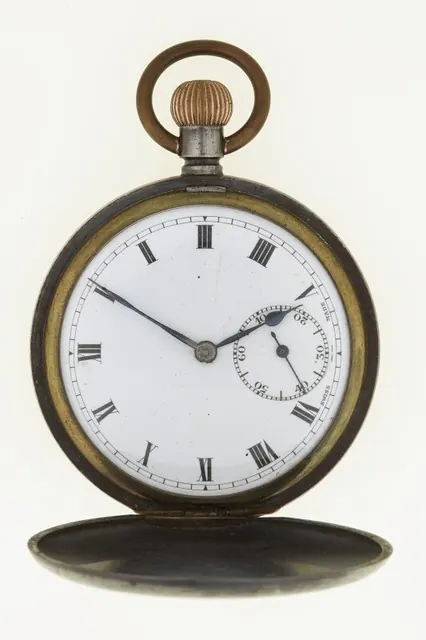
Pocket Watch - Cyma, Switzerland, c. 1940
Museums Victoria, Melbourne
Wristwatches · c. 1960s
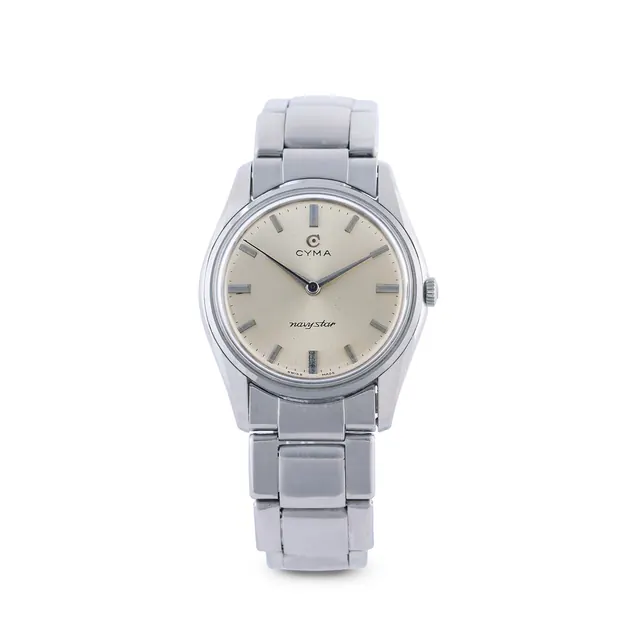
Cyma wristwatch, Navy Star, circa 1960s
Antiquorum auction archive, Geneva
Wristwatches · c. 1950
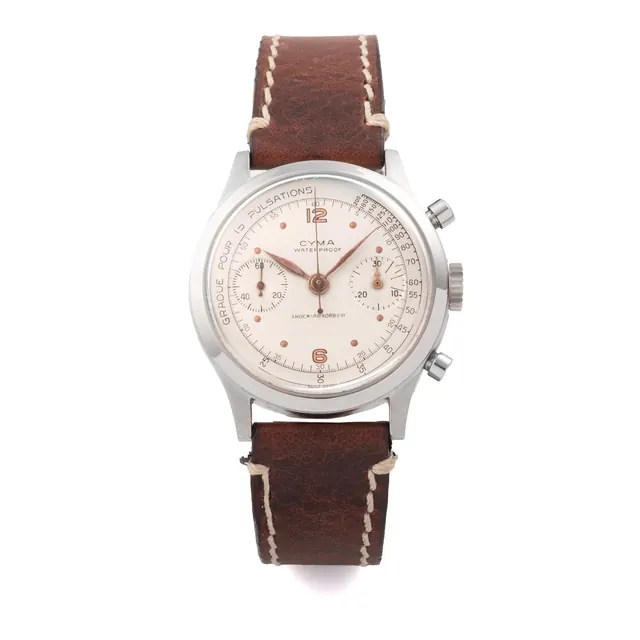
Cyma wristwatch, ref. 9803-178, Oversize Pulsation Scale, circa 1950
Antiquorum auction archive, Geneva
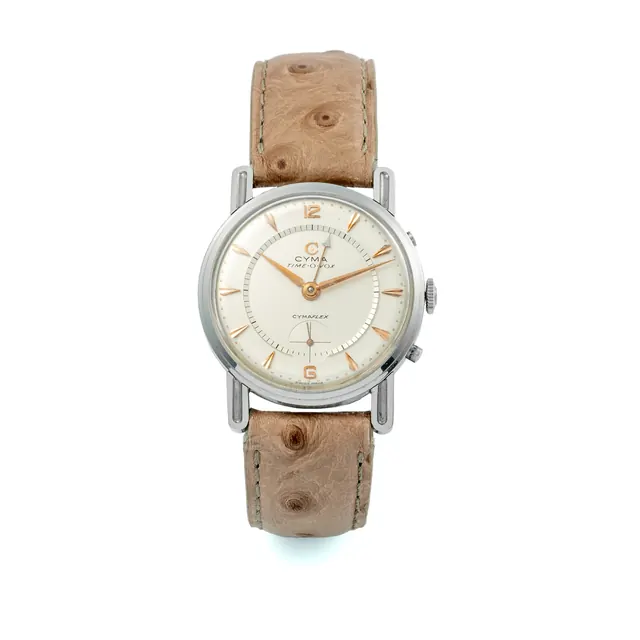
Wristwatches · c. 1950-1955
Cyma wristwatch, ref. 1261, Alarm;, circa 1950-1955
Antiquorum auction archive, Geneva
Wristwatches · 1900–1999
Wristwatch by Mercury, 1900–1999
Modemuseum Hasselt
Wristwatches · 1900–1999
Wristwatch by Nutrix, 1900–1999
Modemuseum Hasselt

Wristwatches · 1920
Wristwatch, 1920
Modemuseum Hasselt

Wristwatches · 1931
Rolex 'Oyster Perpetual' rotor self-winding wrist-watch, lever escapement, in steel case with glass in back, Montres Rolex SA, Geneva, Switzerland, 1931
Science Museum Group, London