
Wristwatches · Wristwatch
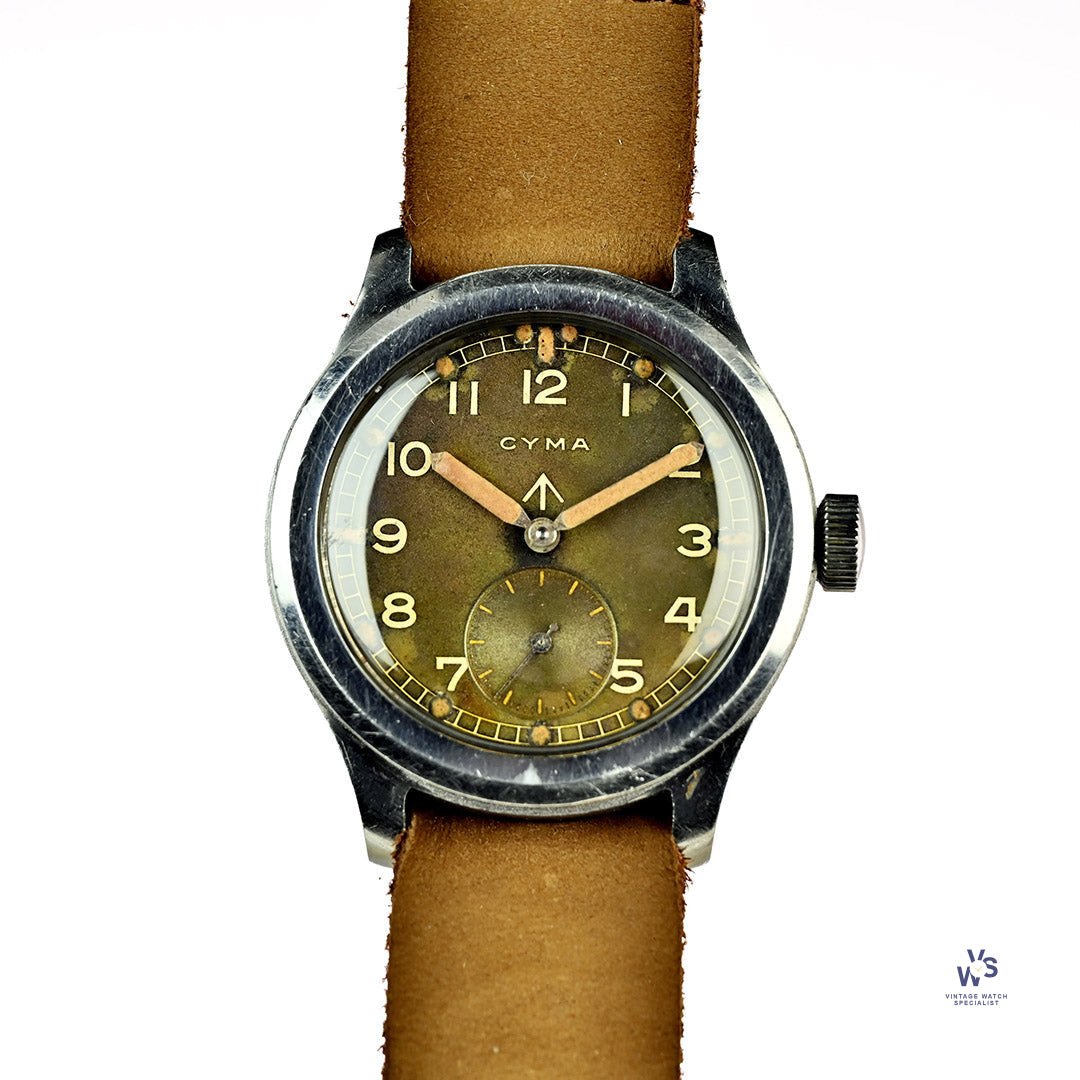
Cyma Dirty Dozen, A British Military Issued W.W.W. from WWII, Bronze Tropical Dial, circa 1944
- Maker / attribution
- Cyma (maker)
- Date
- c. 1944
- Historical period
- Golden Age of Mechanical Watchmaking (1900 – 1945)
- Country of origin
- Unrecorded in source
- Object type
- Wristwatch
- Materials / technique
- bronze
- Stock no.
- vws3191
- Credit line
- Dealer listing, Vintage Watch Specialist (vws3191)
- Catalogue title (original)
- Cyma Dirty Dozen - A British Military Issued W.W.W. from WWII - c.1944 - Rare Bronze Tropical Dial (English)
View the source record (dealer listing) ↗ (opens another website in a new tab)Suggest a correction
Record summary
Catalogued by Vintage Watch Specialist (dealer), United Kingdom (stock number vws3191), this is a wristwatch by Cyma, dated c. 1944. The Atlas places it in the Golden Age of Mechanical Watchmaking period (1900 – 1945) of its Wristwatches collection. Materials and techniques recorded by the source: bronze. The record is illustrated with 6 photographs.
Assembled from the source record's structured fields. Dates and attributions are given as the source states them; where a field is missing the Atlas leaves it blank rather than estimating.
Catalogue description
Dealer description — Vintage Watch Specialist
A Very Unique and Stunning Example of a Cyma 'Dirty Dozen' WWII Military Watch With Gorgeous Bronze Dial In the closing years of World War II, a basic but carefully specified model wristwatch was commissioned to members of the British armed forces by the Ministry of Defence - manufactured by one of twelve watchmakers who delivered 20,000 of these Cymas to the MoD in 1944 and 1945. Nobody knows how many survived and are still available to the collectors market and we find it more and more difficult to find GOOD honest examples like the ones we have for sale currently! A lot of these watches were destroyed in the 1970s by the MOD due to the presence of radioactive Radium-226 when kept in large quantities, in the luminescent material, hence the number of surviving watches dwindled. This teamed with the obvious historical significance of the watches, has made them increasingly more collectable. What's on Offer The Cyma, the largest of the Dirty Dozen watches, offers a commanding presence on the wrist. This particular piece stands out due to its unique dial ageing: the lume colour on the hour markers and hands has turned a lovely pumpkin, while the black dial has gone a beautiful tone of bronzed chocolate, this is something we have not seen before, although we have owned and seen several more standard "chocolate" coloured dials in our years of collecting and selling. This contrast creates a striking aesthetic, adding distinctive character. Pairing this watch with a boldly coloured strap could make the dial stand out even more. You need to see this watch to truly appreciate the beauty of the dial, hands and lume! The Arabic numerals are well-preserved, and the MoD Broad Arrow is intact, maintaining its historical significance. The countersunk subdial at 6 o'clock is also in excellent condition. The case itself is in great shape and retains its original military engravings on the back, marked with: W.W.W. P18047 23047. The watch is fresh back from our military watchmaker, John Senior who most military collectors will either know or have read about. This Cyma has undergone a complete strip-down and service by John to add to its already great pedigree. Overall, this is a fine and authentic example that would make an excellent addition to any collection, especially for military watch enthusiasts. It’s not just a timepiece but a piece of history that would be a pleasure to wear.
Historical context
Golden Age of Mechanical Watchmaking (1900 – 1945)
The wristwatch displaces the pocket watch; waterproof cases, self-winding and grand complications.
The wristwatch overtook the pocket watch. Military use in the First World War, aviation, water-resistant cases (1926), automatic winding (1923–31), rectangular Art Deco designs and early chronographs and calendars defined the period.
Read the period in the timelineMore wristwatches from this periodEarlier: Industrial Revolution
Atlas type guide
Military, pilot and travel watches
The wristwatch owes much of its adoption by men to warfare and aviation. Wristlets — small pocket watches soldered with lugs and worn on a strap — were used in colonial campaigns and became standard equipment in the First World War, with protective grilles over the crystal ('shrapnel guards'). Louis Cartier's Santos (1904), designed for the aviator Alberto Santos-Dumont, is often cited as an early purpose-made pilot's watch.
In the Second World War governments specified watches in detail: the German B-Uhr observation watches, the American A-11, and the British 'W.W.W.' (the 'Dirty Dozen' set of 1945). After the war, jet travel brought GMT and world-time watches, which show two or more time zones at once — Louis Cottier's world-time mechanism and the Rolex GMT-Master (1955) are examples.
What to look for
- Military markings on the case back: broad arrow, issue numbers, 'W.W.W.', 'A.T.P.'
- High-legibility black dials with luminous Arabic numerals; oversized crowns for gloved hands.
- 24-hour hands and rotating 24-hour bezels or city rings on GMT/world-time watches.
- Wire lugs on early wristlets converted from pocket watches.
Dating clues
- Wire-lug wristlets: c. 1900–1925.
- Military specifications of the Second World War: 1939–1945.
- GMT and world-time wristwatches: mainly after 1950.
General guidance written by the Atlas editors about this kind of object. It is not a statement about this particular piece; for that, rely on the source record above and on physical examination.
Related records
Pocket Watches · c. 1940
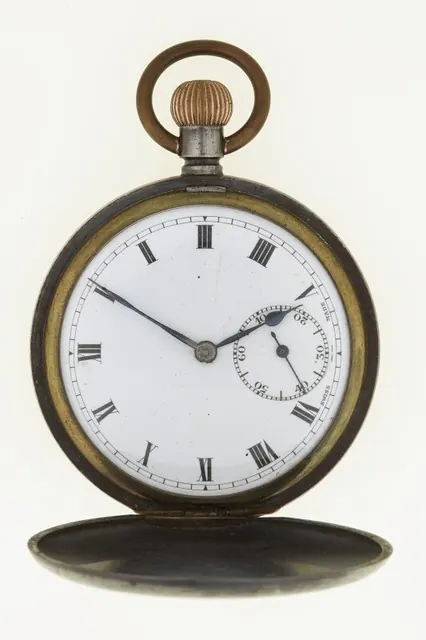
Pocket Watch - Cyma, Switzerland, c. 1940
Museums Victoria, Melbourne
Wristwatches · c. 1960s
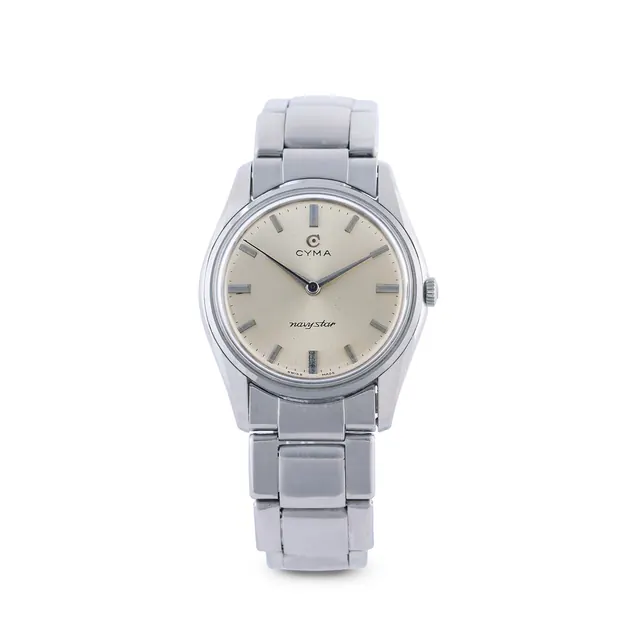
Cyma wristwatch, Navy Star, circa 1960s
Antiquorum auction archive, Geneva
Wristwatches · c. 1950
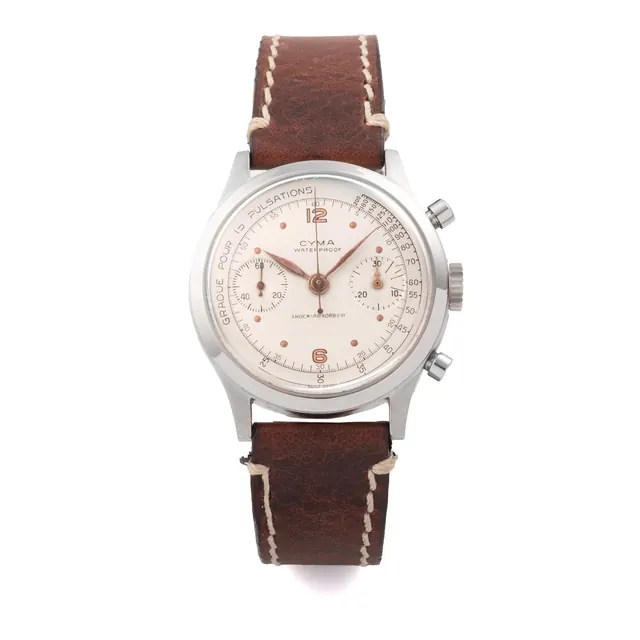
Cyma wristwatch, ref. 9803-178, Oversize Pulsation Scale, circa 1950
Antiquorum auction archive, Geneva
Wristwatches · c. 1950-1955
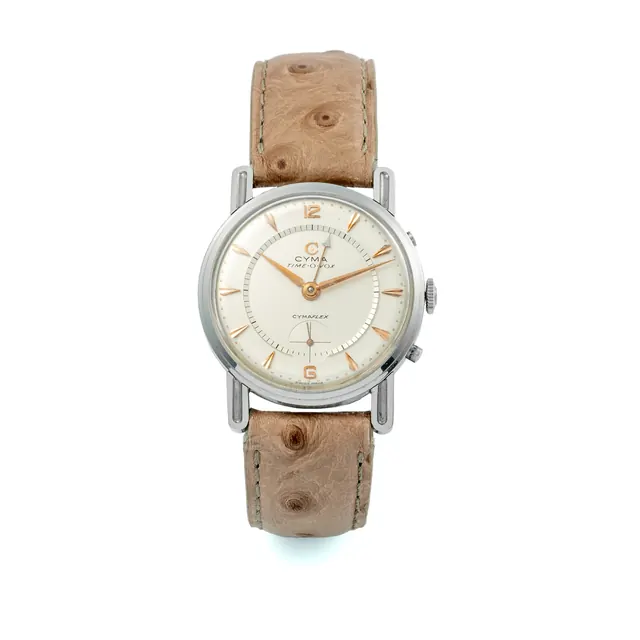
Cyma wristwatch, ref. 1261, Alarm;, circa 1950-1955
Antiquorum auction archive, Geneva
Wristwatches · 1900–1999
Wristwatch by Mercury, 1900–1999
Modemuseum Hasselt
Wristwatches · 1900–1999
Wristwatch by Nutrix, 1900–1999
Modemuseum Hasselt
Wristwatches · 1920
Wristwatch, 1920
Modemuseum Hasselt

Wristwatches · 1931
Rolex 'Oyster Perpetual' rotor self-winding wrist-watch, lever escapement, in steel case with glass in back, Montres Rolex SA, Geneva, Switzerland, 1931
Science Museum Group, London