
Wristwatches · Wristwatch
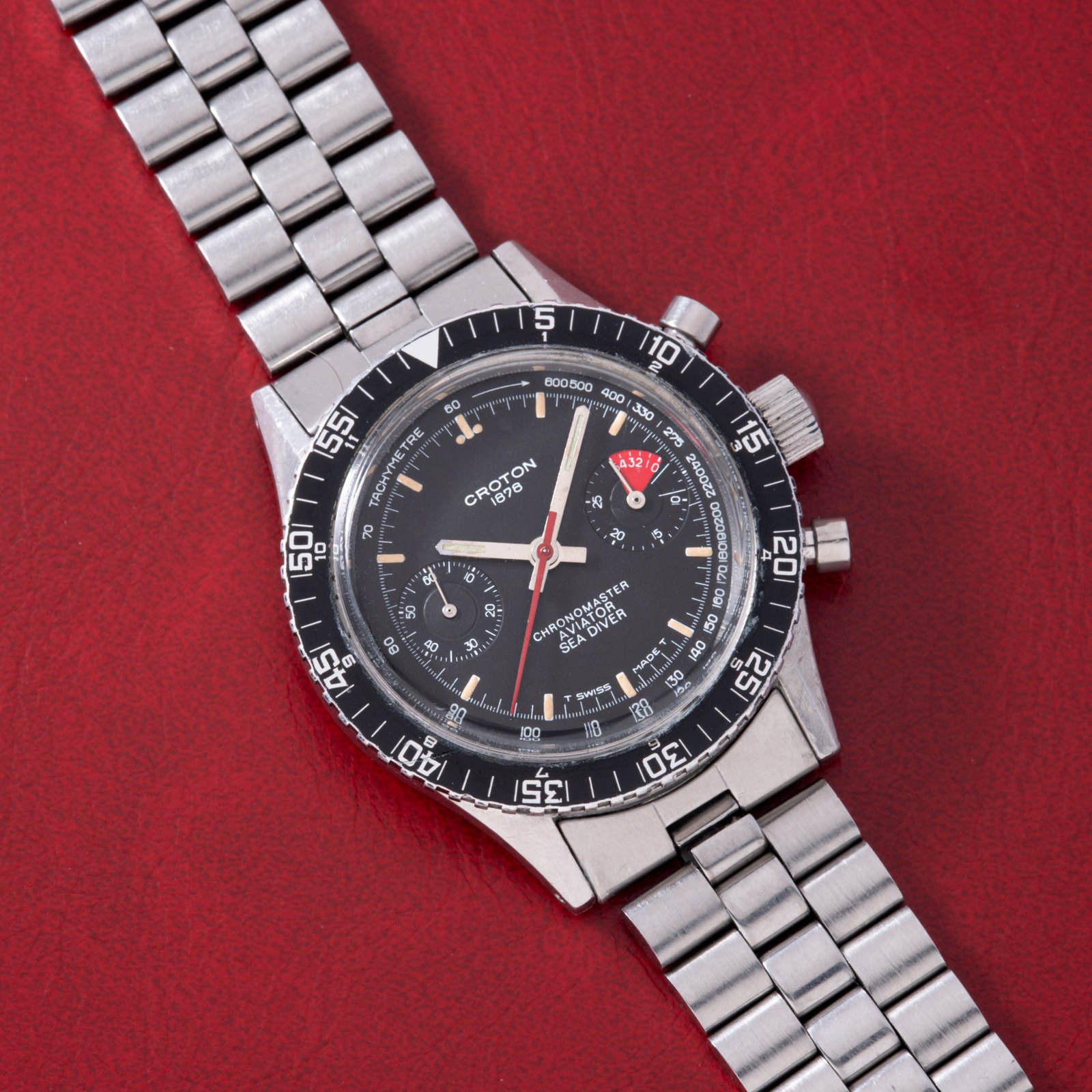
Croton Chronomaster Aviator Sea Diver, 1970s
- Maker / attribution
- Nivada (maker)
- Date
- 1970s
- Historical period
- Quartz Revolution (1969 – 1990)
- Country of origin
- Unrecorded in source
- Object type
- Wristwatch
- Dimensions
- Case 38 mm
- Stock no.
- 40992999
- Credit line
- Dealer listing, Analog/Shift (40992999)
- Catalogue title (original)
- Croton Chronomaster Aviator Sea Diver (English)
View the source record (dealer listing) ↗ (opens another website in a new tab)Suggest a correction
Record summary
Catalogued by Analog/Shift (dealer), New York (stock number 40992999), this is a wristwatch by Nivada, dated 1970s. The Atlas places it in the Quartz Revolution period (1969 – 1990) of its Wristwatches collection. Recorded dimensions: Case 38 mm. The record is illustrated with 6 photographs.
Assembled from the source record's structured fields. Dates and attributions are given as the source states them; where a field is missing the Atlas leaves it blank rather than estimating.
Catalogue description
Dealer description — Analog/Shift
In an era defined by exploration — of oceans, skies, and the most remote corners of the globe — watchmakers were tasked with building instruments that could keep up. Few brands embodied that spirit quite like Nivada Grenchen . By the time Admiral Richard E. Byrd returned from Operation Deep Freeze with glowing praise for the brand’s durability, its reputation had already been forged in some of the harshest conditions on Earth. What followed was a run of purpose-built tool watches that remain compelling to this day. Chief among them is the Chronomaster Aviator Sea Diver — a watch that, as its name suggests, was designed to do just about everything. Introduced in the early 1960s, it combined the functionality of a chronograph with the added utility of a rotating dive bezel, answering the growing demand for multi-purpose sports watches at a time when specialization was still taking shape. It’s a format that feels familiar now, but at the time, it was quietly forward-thinking. This particular example, dating to the 1970s and dialed 'Croton' for the U.S. market, showcases the model in one of its more refined later executions. Gone are the earlier 'broad arrow' hands, replaced here by slimmer stick hands that lend the dial a more restrained, legible quality. The overall aesthetic remains unmistakably vintage: a densely informative dial balanced by crisp sub-registers, paired with a bidirectional timing/12-hour bezel that adds both visual contrast and real utility. Sharp, faceted lugs anchor the case, giving it a presence on the wrist that belies its modest proportions. What sets this example apart, however, is its bracelet. Fitted with a matching steel multi-link bracelet featuring a signed fold-over clasp, it offers a level of completeness — and wearability — that’s increasingly difficult to find. Period-correct bracelets for these models are rare, and they transform the watch into something that feels fully realized rather than merely preserved. Powering the watch is a manually wound, Swiss-made chronograph movement — robust, proven, and entirely in keeping with the Chronomaster’s tool-watch ethos. It’s a movement built not for show, but for reliability, echoing the very qualities that made these watches indispensable to explorers decades ago. At approximately 38mm in stainless steel, the case strikes a sweet spot: large enough to feel contemporary, yet compact enough to retain its vintage charm. On the wrist, it wears with an easy versatility that mirrors its original intent — a watch equally at home in the air, at sea, or simply navigating the rhythms of everyday life. In all, the Chronomaster Aviator Sea Diver stands as a reminder of a time when watches were built to go anywhere — and expected to make it back. This example, complete with its correct bracelet, captures that spirit in full.
Historical context
Quartz Revolution (1969 – 1990)
Seiko's Astron begins mass quartz timekeeping; traditional industries contract sharply.
Quartz and digital watches transformed the market after 1969. Swiss employment collapsed, Japanese and Hong Kong production soared, and the Swatch (1983) helped the Swiss industry recover; mechanical watches survived as luxury goods.
Read the period in the timelineMore wristwatches from this periodEarlier: Modern Mechanical Horology
Atlas type guide
Dive and water-resistant watches
Keeping water and dust out of a wristwatch was a long-standing challenge. Rolex's screw-down Oyster case (1926) and Omega's Marine (1932) were landmarks; in the early 1950s Blancpain's Fifty Fathoms and Rolex's Submariner defined the professional dive watch with rotating bezels for timing dives, luminous dials and high water resistance. The ISO 6425 standard (1982) later codified what a 'diver's watch' must do.
Dive watches became icons of post-war design and exploration, and their evolution — helium escape valves, ceramic bezels, saturation-diving depth ratings — records the history of underwater work.
What to look for
- Unidirectional or bidirectional rotating bezel with minute markings.
- Screw-down crown and case back; depth rating printed on the dial.
- Luminous hands and markers (radium before c. 1960, tritium c. 1960–1998, then Super-LumiNova).
- Reference numbers on the case between the lugs or inside the back.
Dating clues
- Screw-down Oyster cases: from 1926.
- Professional dive watches: from 1953.
- Tritium 'T' marks on dials: c. 1960–1998.
General guidance written by the Atlas editors about this kind of object. It is not a statement about this particular piece; for that, rely on the source record above and on physical examination.
Related records
Wristwatches · 1900–1999
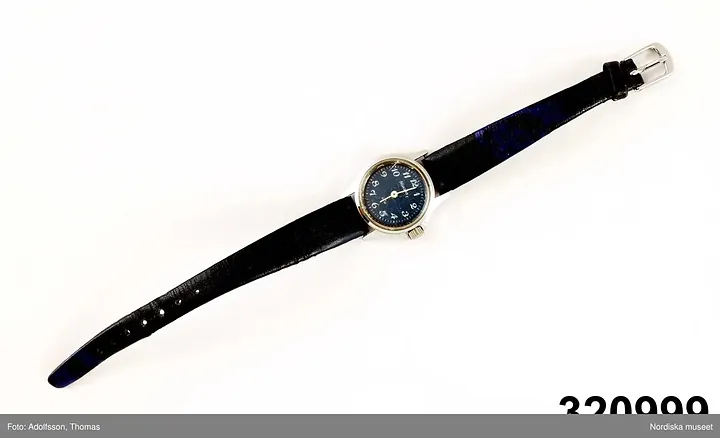
Wristwatch by Nivada, Sweden, 1900–1999
Nordic Museum Foundation

Wristwatches · 1970
Wristwatch by Heno, Switzerland, 1970
Museum Rotterdam
Wristwatches · 1970s
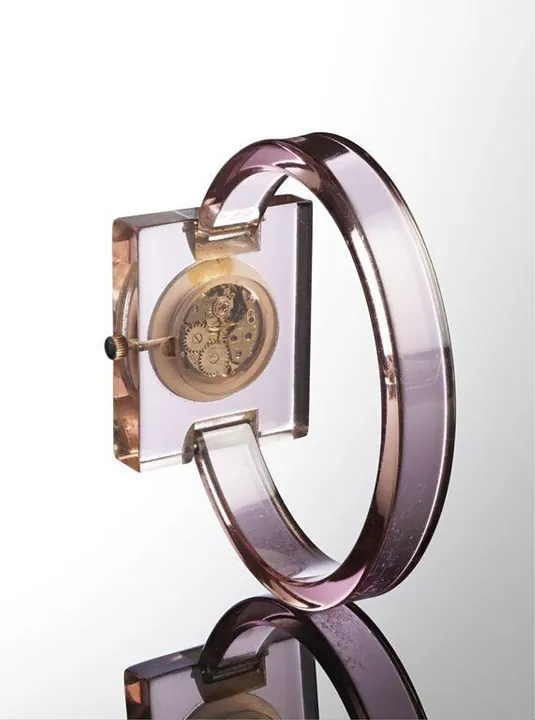
Wristwatch, plastic, by Gucci; Italy, 1970s.
Victoria and Albert Museum, London
Wristwatches · 1978
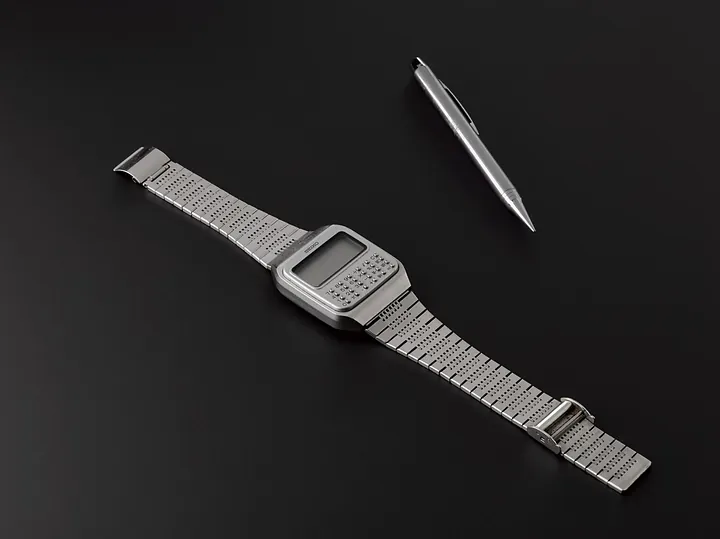
Calculator wristwatch by Suwa Seikosha Co. Limited, Japan, 1978
Science Museum Group, London
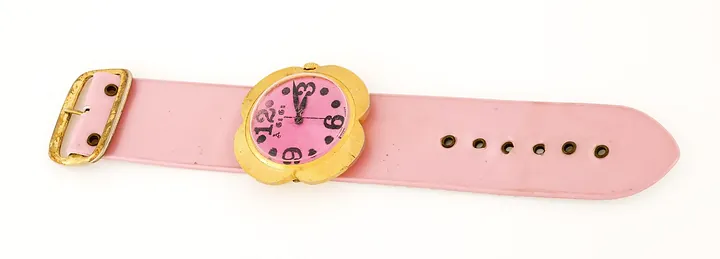
Wristwatches · 1980
Wristwatch, 1980 (no. 71413)
Museum Rotterdam
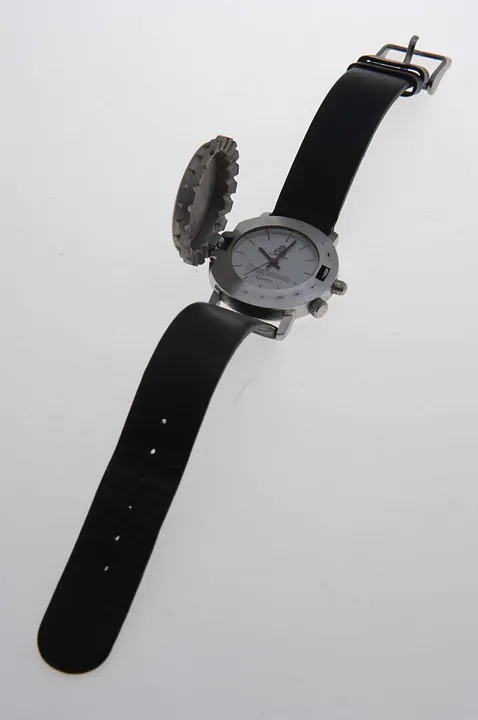
Wristwatches · 1980
Wristwatch, 1980 (no. 91477)
Museum Rotterdam
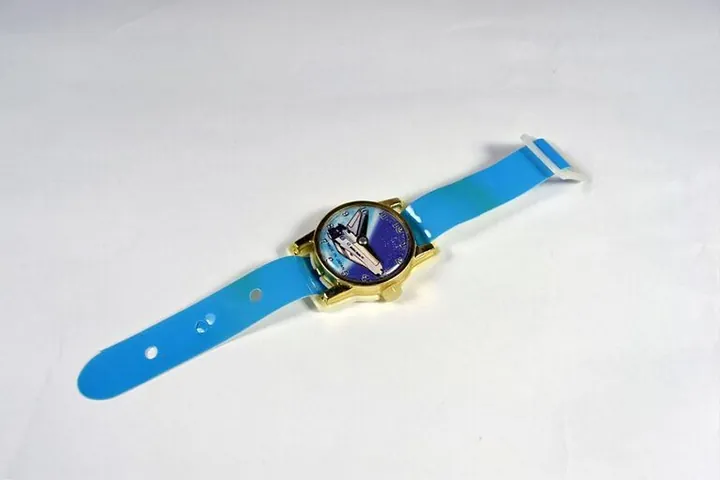
Wristwatches · 1980–1982
Wristwatch, Space Shuttle; plastic, Japan, 1970-1979?
Victoria and Albert Museum, London
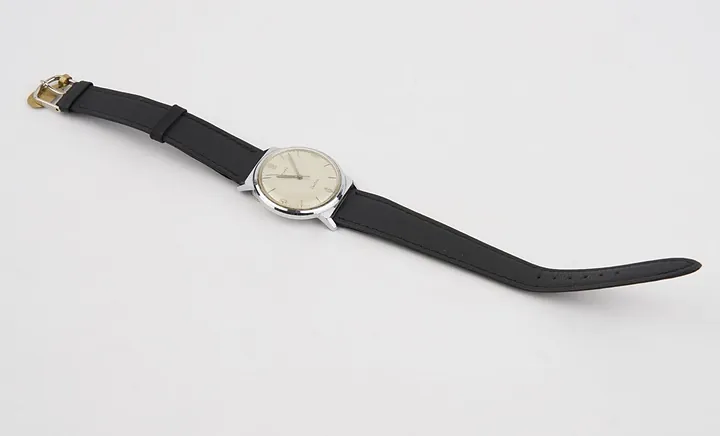
Wristwatches · 1949–1992
Timex `Electric' wristwatch, with electrically operated balance wheel mechanism, United States, 1949–1992
Science Museum Group, London