Clocks · Clock
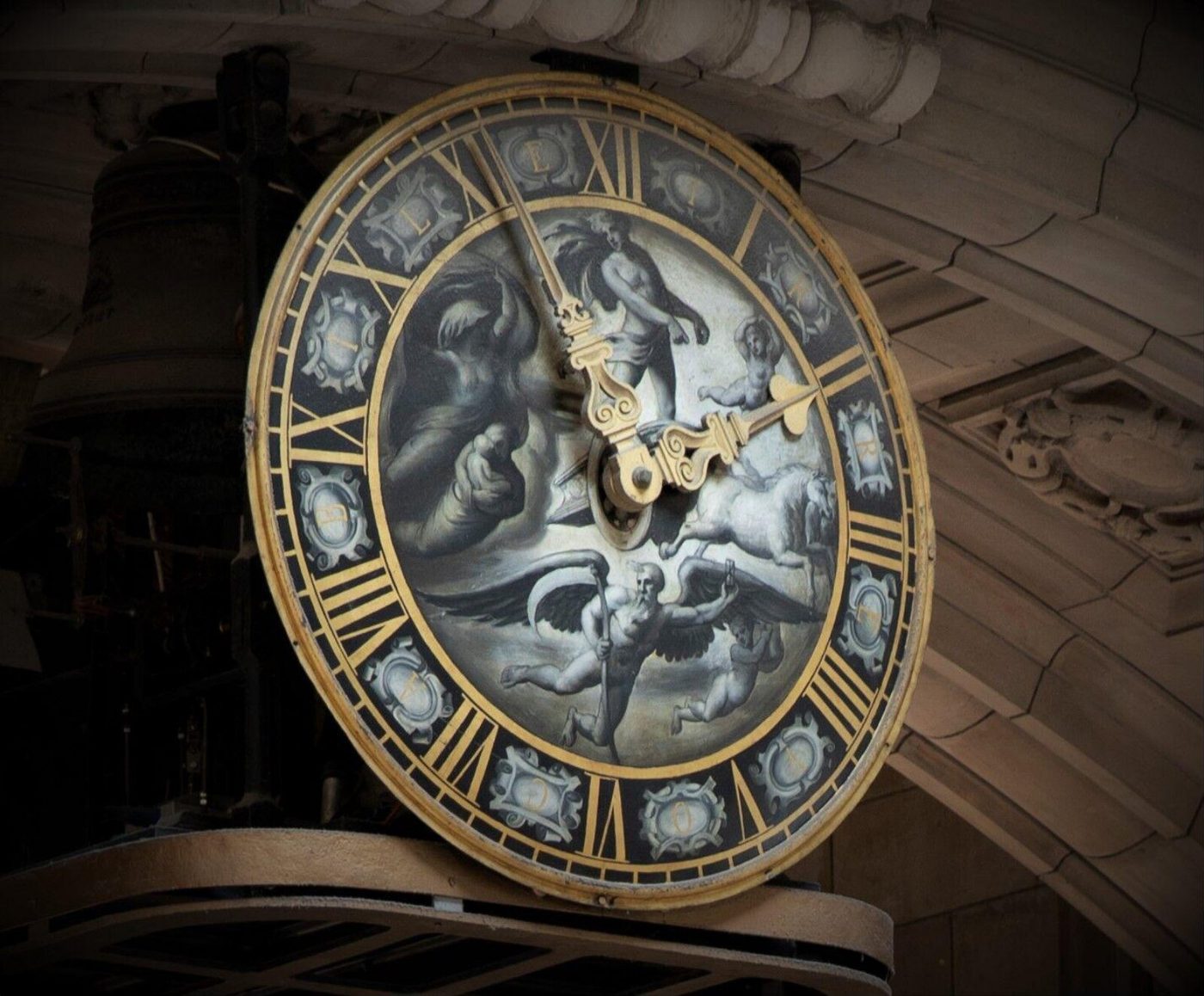
Clock with highly decorated round face and pendulum; J. Smith & Sons, Clerkenwell, ca. 1857-62.
- Maker / attribution
- Francis Wollaston Moody (painters (artists)); J. Smith & Sons (maker); J. Warner (Crescent Foundry) (founder)
- Date
- 1857-62
- Historical period
- Industrial Revolution (1850 – 1900)
- Country of origin
- England
- Place
- Clerkenwell
- Object type
- Clock
- Materials / technique
- gun-metal, steel, iron, pine
- Dimensions
- Weight: 1305 kg
- Holding institution
- Victoria and Albert Museum, London
- Accession / object no.
- M.159-1984
- Credit line
- Gift of the Department of Education and Science
Record summary
Held and catalogued by Victoria and Albert Museum, London (object number M.159-1984), this is a clock by Francis Wollaston Moody, made in Clerkenwell, England, dated 1857-62. The Atlas places it in the Industrial Revolution period (1850 – 1900) of its Clocks collection. Materials and techniques recorded by the source: gun-metal, steel, iron, pine. Recorded dimensions: Weight: 1305 kg. The record is illustrated with 4 photographs.
Assembled from the source record's structured fields. Dates and attributions are given as the source states them; where a field is missing the Atlas leaves it blank rather than estimating.
Catalogue description
V&A — Summary
J. Smith & Sons (the company that became Smiths Metal Centres) was established in 1780 at a site in Clerkenwell, London. The original business was clock making and J. Smith & Sons became a very well known name as a supplier of all kinds of clocks from large turret clocks for buildings such as chucrhes to small decorative clocks for mantlepieces. Over time the business developed various new skills and techniques and their clocks were recognised for their excellence at numerous trade exhibitions and export fairs. As a consequence the business grew quickly to become one of the major clock makers in the country but when war broke out at the beginning of the 20th century the demand for clocks, especially the large clocks Smiths specialised in declined dramatically. Over time, the clock making side of the business declined and the last clock was made in 1938. Smiths was still a large successful business but instead of clock making it now focussed all its efforts on material stock holding and distribution. Today, Smiths is one of the UK's largest suppliers of engineering raw materials.
V&A — Physical description
Pendulum clock with two weights. Highly decorated faces depicting bearing the same design, executed by F.W. Moody, showing allegorical figures of Day in a chariot followed by a cloaked woman representing Night, with - below, the figure of Time, with his hour glass and scythe. The irrevocability of Time is represented by the letters of the Latin word IRREVOCABLE spaced out between the Roman numerals around the faces. The hands, a later addition, of wood are scrolled and gold in colour. Extract from the Illustrated Catalogue of the London International Exhibition 1862, Volume II. Eight-day turret or church clock, of the same construction and material as that supplied by the exhibitors to the order of the Government Department of Science and Art, and which may be seen in the Museum, South Kensington. The wheels and bosses for the pivots to act in are of gun metal, the mixture being the same as that used for the manufacture of ordnance bearings, the pinions of wrought steel, cut and finished in an engine as well as the wheels; thus securing the greatest possible accuracy. the frames are of iron, and so constructed that any part can be removed for cleaning without disturbing the remaining parts. The escapement is on the principle of Graham's deadbeat, and the steel pads are made to slide in turned grooves, so as to set the pitch with the greatest exactness; they may be removed as they are secured by screws. The striking apparatus is on the repeating principle, which prevents the possibility of striking wrong hours - a fault so common to many clocks with locking plates. The maintaining power to keep the clock going during winding is by lever and bolt; there is a small inside dial to set the hands by. The pendulum has a heavy spherical ball, and the rod, which is of prepared pine, coated with varnish and afterwards French polished, is thus secured against the action of air or damp; the pendulum is set in beat by means of a traversing screw, and the crutch has also two large screws to regulate and reduce its friction.
V&A — Historical context
Transcript of a letter from John Physick, Keeper of Museum Services, Victoria and Albert Museum to Eric Parsons, Supplies Division, Property Services Agency, Southbridge House, Southwick Bridge Road, London SE1. 26/07/1978 Dear Eric, In 1857, the Department of Science and Art ordered an 8-day turret clock for the Museum, which, since it has never been registered as a museum object, was obviously bought with money allowed for `Works' as part of the original furnishings. It cost £150; that is, £110 for the clock and £40 for the bell and fittings. It strikes the hours, is pendulum operated, and was made by J.Smith and Sons of Clerkenwell, with two large painted faces, designed by F.W. Moody (who decorated much of the Museum). A duplicate of the clock was later made by the same firm and exhibited in the International Exhibition of 1862, where it gained a prize medal. From 1862 until 1909 the clock hung, as a museum timepiece, in the North Court, but it was then repositioned in the main entrance of the new Aston Webb building, in the arch which is now the entrance to the shop. There was an attempt to remove the clock in 1948, but the Director, Sir Leigh Ashton, refused to give his permission. After that time, when concerts were held in the Raphael Cartoon Court, the booming bell proved a nuisance, and it was silenced. In 1951, the clock was at last stopped, mainly due to winding difficulties, and partially dismantled. Thus it remained until 1958. Sir Trenchard Cox, then the Director, stated, "I am reluctant to agree with the scrapping of this clock which is connected with the period of office of my great predecessor, Cole...[it] is a familiar landmark in the V&A", and suggested that the clock be got going again but without the strike. However owing to its inaccessibility, there was a problem. Mr. Abbott, of Supplies, wrote on 12/12/1958, that the clock required winding twice a week: "This will necessitate a ladder being provided between the hours of 9 am and 12 noon, and twice a year on a Sunday for Summertime alteration, to give the clock-winder access to the bridge. It is apparently impossible to arrange with any certainty the exact time the winder can call." The provision of this twice-weekly ladder has already caused problems for many years for on occasions it often remained in the Main Entrance waiting for the next visitation of the winder. Sir Trenchard decided not to proceed, but to leave the clock unwound. The Ministry of Works's clock expert, a Mr May, was reported as having "little regard for the design" and having the opinion that there was nothing extraordinary about the mechanism. In 1970, the clock was taken down by Supplies and put into store by the Museum - the two faces being cared for by the Department of Furniture and Woodwork, and the mechanism by the Department of metalwork. The pendulum of interest has now swung back towards the clock. and you will see from our 1978/79 estimates that we would like the clock brought into working order, and reinstalled in its position at the Main Entrance. To overcome the problem of the twice weekly winding and the almost permanent installation of ladders, perhaps an electric winding system can be incorporated (without any alteration to the clock's mechanism), as is being done with so many church clocks nowadays where there is also a problem with winders. The faces need to be spot lit, as part of the newly-designed Main Entrance hall scheme, and the bell perhaps muffled to reduce its effect on nervous visitors at mid-day! Yours sincerely, John Physick Keeper of the Department of Museum Services.
V&A — Object history
This turret clock which has been re-erected in its former position in the main entrance was originally bought by the Science and Art Department (later the Department of Education and Science) for the South Kensington Museum, (later the Victoria and Albert Museum). It is an eight day striking clock, originally operated by a pendulum and was made by J. Smith and Sons of Clerkenwell. A duplicate was made by the same firm for the London International Exhibition of 1862 - held on the site of the present day Natural History Museum - where it gained a prize award. The two dials were designed by F.W. Moody who designed much of the decoration throughout the Museum and incorporates allegorical representations of Day and Night. It was originally hung in the North Court, being moved to the main Entrance when the Aston Webb extension was completed in 1909. The clock was stopped in 1951 because of the difficulties of winding it by hand and the noise of the chimes was thought to be disturbing for visitors. It languished unused for a number of years until it was finally dismantled and removed in 1969. More recently it has been reconsidered as an interesting object in its own right and worthy of renovation because of its association with the early history of this Museum. An automatic electric winding mechanism has been installed to overcome the earlier difficulties of winding it by hand but nonetheless most of the original mechanism has been salvaged and restored in order to duplicate, as far as possible, its original appearance. This clock was restored to working order and installed in the Museum, 1983-84.
V&A — Production note
The clock faces were designed by F.W. Moody and painted in his studio.
Inscriptions & marks
J. Warner, Crescent Foundry, Cripplegate, 1862
Historical context
Industrial Revolution (1850 – 1900)
American interchangeable-parts manufacture; railroad time standards; Swiss and German factory systems.
Factory production transformed the clock into an everyday object. American makers (Seth Thomas, Ansonia, Waterbury) and German factories (Junghans, Gustav Becker, Lenzkirch) sold millions of shelf, wall and alarm clocks worldwide; France produced standardised Paris movements and carriage clocks; electric time distribution began.
Read the period in the timelineMore clocks from this periodEarlier: Precision & Scientific Horology
Atlas type guide
Domestic clocks
A clock combines four systems: a source of power (falling weight, coiled spring, or later electricity), a gear train that divides time, an escapement and oscillator that regulate it (foliot, pendulum or balance), and an indicating system of dial and hands or a bell. Its history runs from the large iron weight-driven clocks of the late thirteenth century to Renaissance spring-driven table clocks, the pendulum revolution of 1656, the factory clocks of the nineteenth century and electric and quartz clocks of the twentieth.
Domestic clocks also reflect regional furniture and decorative traditions — English longcase and bracket clocks, French pendules, Viennese regulators, Black Forest and American shelf clocks — and therefore record changing tastes as much as technical progress.
What to look for
- How the clock is powered: weights, spring barrel, fusee, electric coil.
- The oscillator: foliot, short pendulum, long seconds pendulum or balance.
- Whether it strikes: hour only (count wheel) or hours and quarters (rack striking).
- The maker or retailer's name on dial and movement, and any factory trademarks.
- Signs of alteration — replaced dials, converted escapements, 'married' cases.
Dating clues
- Before 1656 clocks used foliots or balances; after, most domestic clocks have pendulums.
- Anchor escapements spread after c. 1670; minute hands became common at the same time.
- Factory production in America and Germany transformed prices after c. 1840.
General guidance written by the Atlas editors about this kind of object. It is not a statement about this particular piece; for that, rely on the source record above and on physical examination.
Related records
Clocks · 1830-1870
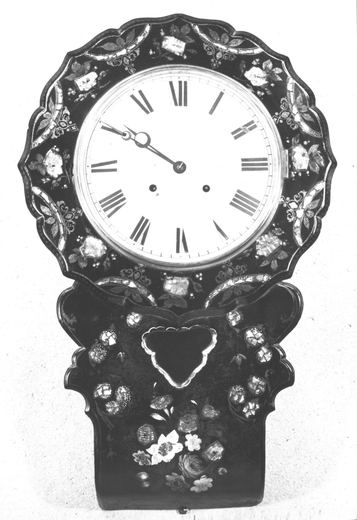
Wall clock in a papier mâché case with painted decoration. English, mid 19th century.
Victoria and Albert Museum, London
Clocks · 1840-1900
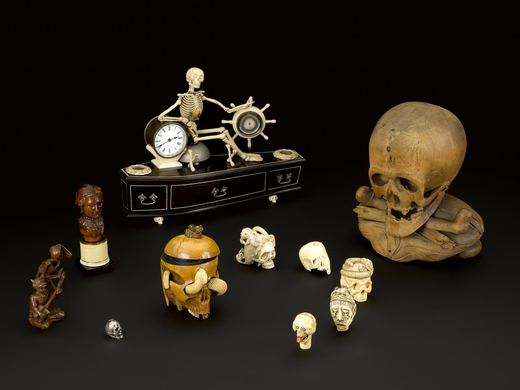
Alarm clock, mounted on model of coffin with skeleton, probably English, 1840-1900
Science Museum Group, London
Clocks · 1840-1880
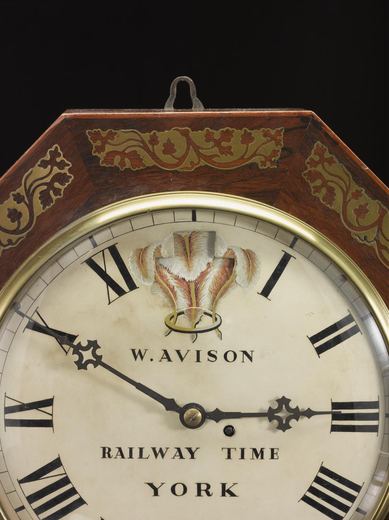
Wall Clock in octagonal case with Prince of Wales Feathers above makers name "W. Avison, Railway Time, York", made by William Avison, England, 1840-1880.
Science Museum Group, London
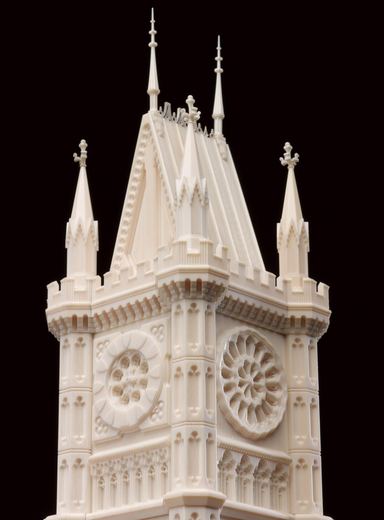
Clocks · 1843-1884
One ivory gothic clock tower & travelling case, by Holtzapffel and Company, London, England, 1843-1884
Science Museum Group, London
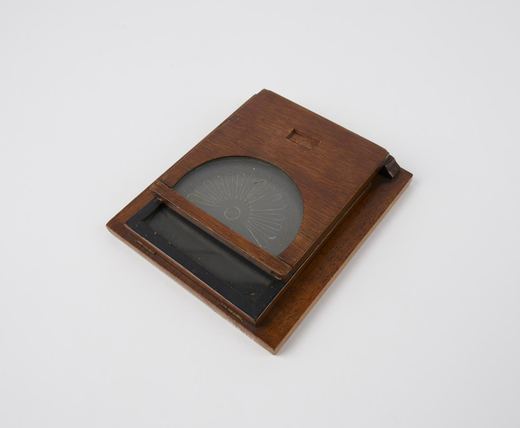
Clocks · 1845-1855
Clock by Darker, W. H., England, 1845-1855
Science Museum Group, London
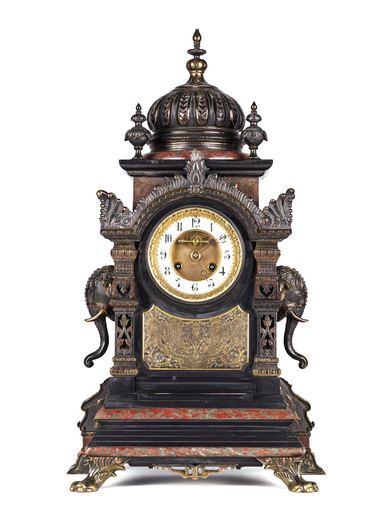
Clocks · 1845-1855
Clock, England, 1845-1855
Science Museum Group, London
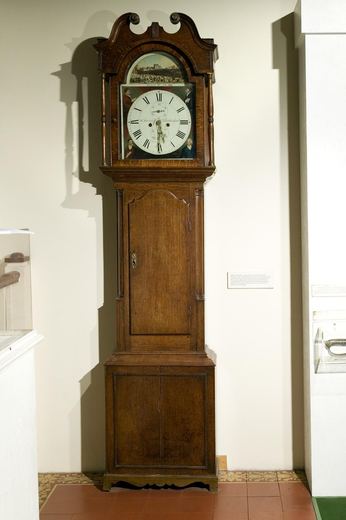
Clocks · 1845-1855
Longcase clock commemorating the Peterloo Massacre of 1819, made by W. Stancliffe, Barkisland.
Science Museum Group, London
Clocks · 1850-1900
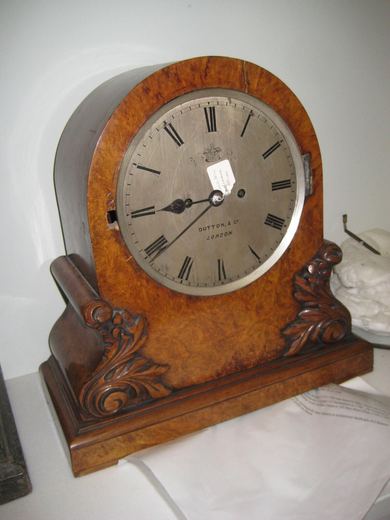
Case veneered in burr walnut, with arched top; from the early furnishings of the V&A
Victoria and Albert Museum, London