Clocks · Clock
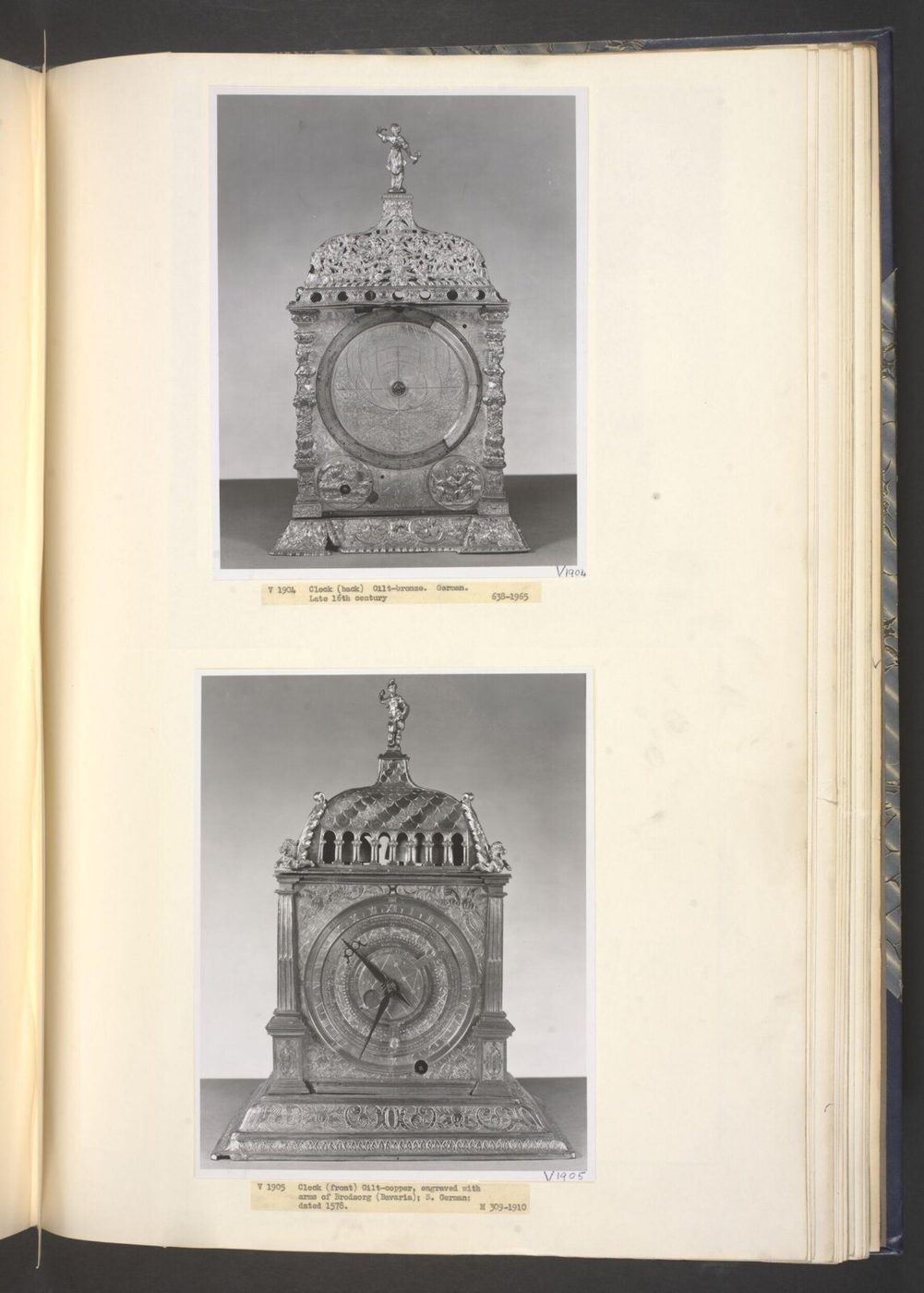
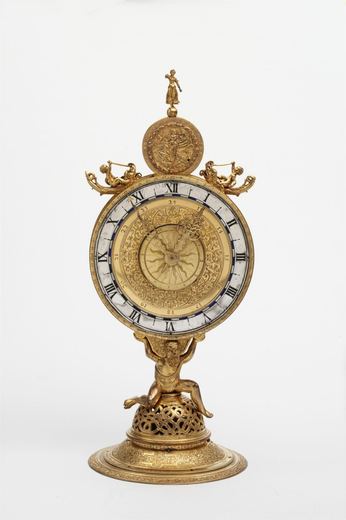
Clock with gilt brass case made by Stephen Brenner, South German, 1578.
- Maker / attribution
- Stephen Brenner (maker)
- Date
- 1578
- Historical period
- Renaissance Horology (1400 – 1600)
- Country of origin
- Germany
- Place
- Germany
- Object type
- Clock
- Materials / technique
- Gilt brass, cast, chased and engraved
- Dimensions
- Height: 12 1/2 in; Length: 7 1/4 in; Width: 4 3/4 in
- Holding institution
- Victoria and Albert Museum, London
- Accession / object no.
- M.309-1910
- Credit line
- Purchased from the Rev. Sir Hubert Medlycott 1910
Record summary
Held and catalogued by Victoria and Albert Museum, London (object number M.309-1910), this is a clock by Stephen Brenner, made in Germany, dated 1578. The Atlas places it in the Renaissance Horology period (1400 – 1600) of its Clocks collection. Materials and techniques recorded by the source: Gilt brass, cast, chased and engraved. Recorded dimensions: Height: 12 1/2 in; Length: 7 1/4 in; Width: 4 3/4 in. The record is illustrated with 2 photographs.
Assembled from the source record's structured fields. Dates and attributions are given as the source states them; where a field is missing the Atlas leaves it blank rather than estimating.
Catalogue description
V&A — Summary
A gilt-brass astronomical table clock, signed by Steffen Brenner, 1578. Brenner, who was probably born and trained in Germany, became clockmaker to the Danish Court in 1563 and worked in Copenhagen until 1602. Brenner worked with Johan Sibe, clockmaker and mathematician to Christian III on an astronomical tower clock dated 1556 (destroyed).
V&A — Physical description
Clock in case of copper gilt, chased and engraved, surmounted by a domed top of brass cast in openwork and gilt. Signed S.B. with a coat of arms and a date. There are two principle dials, one divided into two half-circles of twelve hours each, the other an astronomical dial; below the former are two smaller dials, one a calendar-dial with the signs of the zodiac, the other a twelve hour dial with raised points for feeling the time at night. The four corners of the case are fashioned as angle-pilasters with female terminal figures; the ends each have a medallion enclosing a figure of Faith, surrounded by cartouche-work. The cover is formed of strapwork, demi-figures and grotesque ornament; a dolphin ornament remains at one corner. The splayed base is decorated with cupids and bunches of fruit. The space around the dials on back and front is occupied by figures of astrologers and emblematic figures, finely engraved, and by two medallions with figures of St. Luke and St. John in relief. The works are of steel. Many parts are wanting including all the hands, parts of the dials, three dolphins from the cover and a figure from the top.
V&A — Object history
The clock has the coat of arms of Brodsorg (Windsheim, Bavaria) Parti:au premier d'azur à la demi-fl-de-lis d'argent, mouvant du parti; au deuxieme d'argent plein (see Reistap. Armorial Général) Said to have descended in the Medlycott family; the clock was purchased from The Rev. Sir Hubert Medlycott (1841-1920) in 1910
V&A — Production note
Figure on top was added in 1920
V&A gallery label
CLOCK Gilt brass Signed: SB With a coat-of-arms South German; dated 1578 The figure on the top added
Inscriptions & marks
SB
Historical context
Renaissance Horology (1400 – 1600)
Spring power makes clocks portable; Nuremberg and Augsburg produce the first watches; the Prague Orloj is built.
Spring power made the domestic clock portable. Augsburg and Nuremberg produced gilt-brass table clocks, often with astronomical dials and alarms; weight-driven Gothic wall clocks and English lantern clocks served households. Clocks of this period have foliot or balance-wheel control and usually only an hour hand.
Read the period in the timelineMore clocks from this periodEarlier: Medieval Period
Atlas type guide
Domestic clocks
A clock combines four systems: a source of power (falling weight, coiled spring, or later electricity), a gear train that divides time, an escapement and oscillator that regulate it (foliot, pendulum or balance), and an indicating system of dial and hands or a bell. Its history runs from the large iron weight-driven clocks of the late thirteenth century to Renaissance spring-driven table clocks, the pendulum revolution of 1656, the factory clocks of the nineteenth century and electric and quartz clocks of the twentieth.
Domestic clocks also reflect regional furniture and decorative traditions — English longcase and bracket clocks, French pendules, Viennese regulators, Black Forest and American shelf clocks — and therefore record changing tastes as much as technical progress.
What to look for
- How the clock is powered: weights, spring barrel, fusee, electric coil.
- The oscillator: foliot, short pendulum, long seconds pendulum or balance.
- Whether it strikes: hour only (count wheel) or hours and quarters (rack striking).
- The maker or retailer's name on dial and movement, and any factory trademarks.
- Signs of alteration — replaced dials, converted escapements, 'married' cases.
Dating clues
- Before 1656 clocks used foliots or balances; after, most domestic clocks have pendulums.
- Anchor escapements spread after c. 1670; minute hands became common at the same time.
- Factory production in America and Germany transformed prices after c. 1840.
General guidance written by the Atlas editors about this kind of object. It is not a statement about this particular piece; for that, rely on the source record above and on physical examination.
Related records
Clocks · 1400–1499
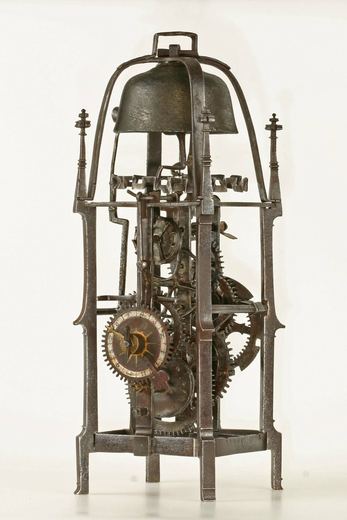
Alarm clock, Germany, 1400–1499
German Clock Museum
Clocks · 1400-1499
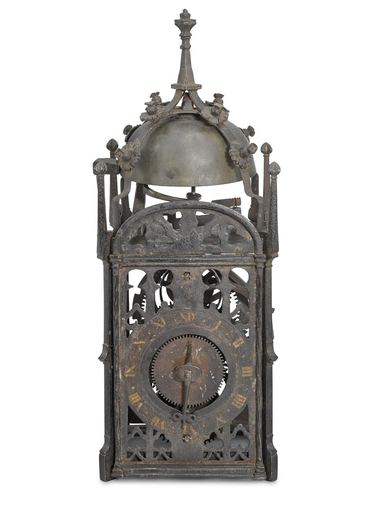
Lantern clock, Germany, 1400-1499
Science Museum Group, London
Clocks · 1500–1599
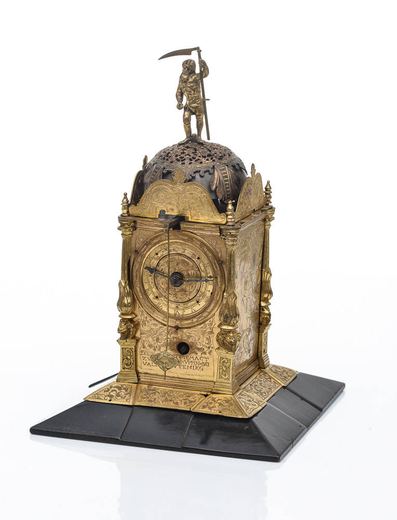
Table clock by Rutenieg, Valentin (um 1550) (Uhrmacher), Germany, 1500–1599
City Museum Berlin
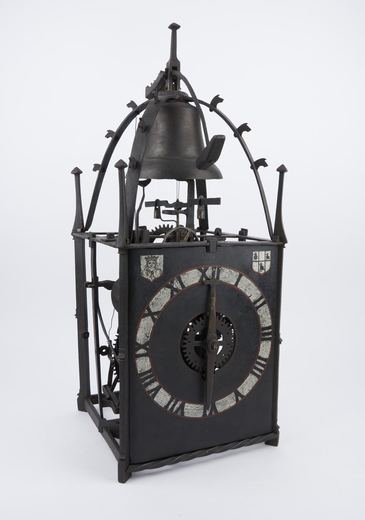
Clocks · 1501-1600
German 16th century iron chamber clock
Science Museum Group, London
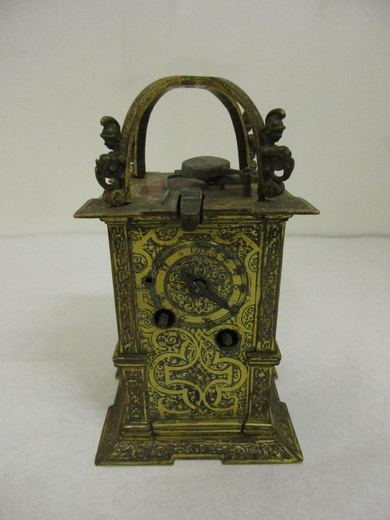
Clocks · ca.1550
Clock, a striking alarm clock in a gilt brass case, Germany, ca.1550.
Victoria and Albert Museum, London
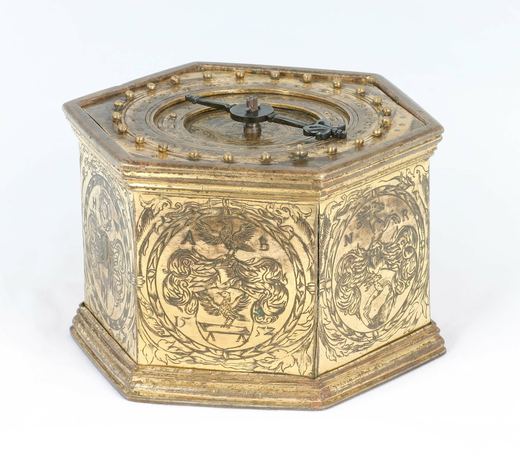
Clocks · 1552
Carriage / travel clock, Germany, 1552
German Clock Museum
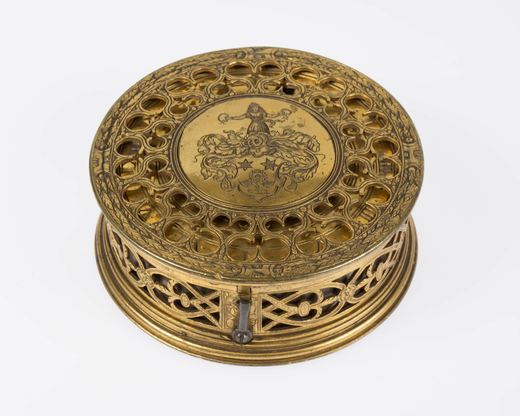
Clocks · 1560
Carriage / travel clock by HG, Germany, 1560
German Clock Museum
Clocks · 1564
Clock, gilt brass with enamelled silver dial ring, signed by Jeremias Metzger, Augsburg, southern Germany, dated 1564
Victoria and Albert Museum, London