Clocks · Clock
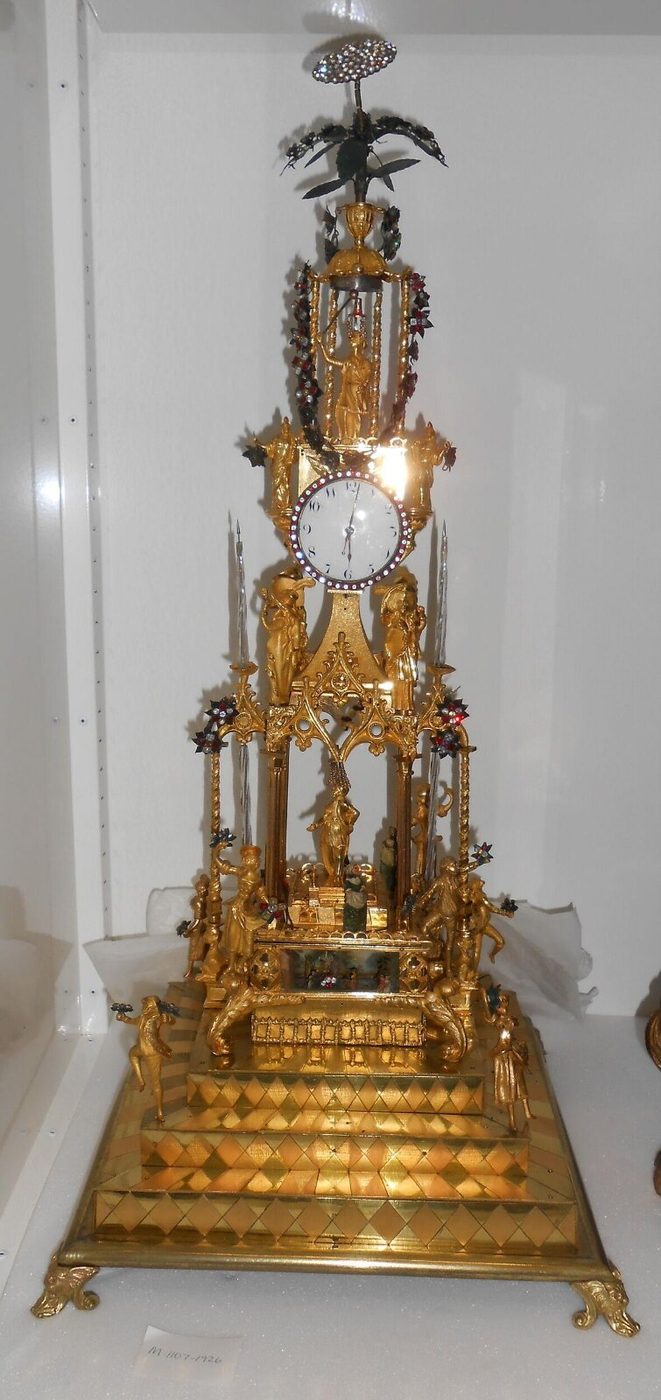
Clock. Gilt bronze, set with coloured pastes; with mechanical figures and musical-box Signed: MORRIS, TOBIAS, LONDON
- Maker / attribution
- Tobias MORRIS
- Date
- 1794-1812
- Historical period
- Precision & Scientific Horology (1750 – 1850)
- Country of origin
- England
- Place
- London
- Object type
- Clock
- Materials / technique
- Gilt bronze set with coloured pastes
- Dimensions
- Height: 28 1/2 in; Width: 14 in
- Holding institution
- Victoria and Albert Museum, London
- Accession / object no.
- M.1107-1926
- Credit line
- Lt. Col. G. B. Croft-Lyons Bequest
Record summary
Held and catalogued by Victoria and Albert Museum, London (object number M.1107-1926), this is a clock by Tobias MORRIS, made in London, England, dated 1794-1812. The Atlas places it in the Precision & Scientific Horology period (1750 – 1850) of its Clocks collection. Materials and techniques recorded by the source: Gilt bronze set with coloured pastes. Recorded dimensions: Height: 28 1/2 in; Width: 14 in. The record is illustrated with 1 photograph.
Assembled from the source record's structured fields. Dates and attributions are given as the source states them; where a field is missing the Atlas leaves it blank rather than estimating.
Catalogue description
V&A — Physical description
Stepped square base from which rises a double canopied structure, containing the clock, and surmounted by a vase of flowers. Around are figures of dancing men and women holding bouquets, and smaller painted figures revolving in front of a central figure in oriental costume. Case: The clock movement is contained within a drum 7.2 cm diameter; 4.5 cm deep, which rests on an elaborate structure consisting at its lowest stage of a square brass plinth stepped in 3 stages and resting on a square base supported on four cast feet each including a grotesque animal mask; the plinth supports a baldacchino in Decorated Gothic style, with two lower stages with applied Decorated ornament, from which rise four fluted columns supporting a canopy with a draped female figurine above each column; two further columns rise from sphinxes on plinths on the main plinth at either side of the baldacchino, and from these rise two further twisted columns which support the outer ends of two ogee arches the inner ends of which link the canopy. Twisted glass rods extend up the centres of these two side arches. There are dancing figures (one missing) at each corner of the middle step of the plinth. The clock case is flanked by two statuettes each carrying a rosette in one hand, and above the clock case rises a further flat oval canopy supported by four twisted columns and surmounted by an elaborate finial system in the form of a basket of flowers with petals of red and white brilliants. This canopy protects a draped female figure carrying in her right hand a bell-hammer striking a bell above her head, immediately below the canopy. The movement of the arm was presumably activated by striking the train of the original clock movement. Dial: The dial is of white enamel 6.5 cm diameter with a bezel now unglazed with a ring of red and white brilliants. The dial has an outer ring of minute dots and inner set of erect arabic numerals, brass hours and minute hands the latter with a tail. Movement: The present movement is essentially that of a large watch, with plates 5.3 cm diameter, the backplate is signed 'No.144 MORRIS TOBIAS LONDON'; this movement is probably a replacement. The pierced bridge balance-cock is marked 'PATENT' and the regulator index moves over a wide arc graduated from 'SLOW' to 'FAST'. The main canopy protects a central turbaned figure mounted on a square, rotatable platform with a low railing and two entry posts each surmounted by an urn. Projecting up through a circular groove surrounding this platform are eight painted silhouette figures in late 18th century dress; these can all revolve together around the centre of the platform. Through an opening in one side of the upper base of the baldacchino two sets of figures are mounted on an invisible travelling belt loop; they, too, can move to the left at the front and to the right at the rear, in front of a painted landscape. The motions are all powered by a musical box movement contained with the plinth, which is driven through by a fusee and chain and sounds on 7 bells.
V&A — Object history
Bequeathed by Lt.Col.G.B. Croft Lyons FSA
V&A gallery label
AUTOMATON CLOCK English; late 18th century Gilt brass The clock movement signed: Morris, Tobias London
Inscriptions & marks
No.144 MORRIS TOBIAS LONDON
Historical context
Precision & Scientific Horology (1750 – 1850)
Harrison solves longitude; Mudge invents the lever; Breguet's Paris workshop defines the modern watch.
The age of the deadbeat escapement, compensated pendulums and observatory regulators. Domestic clocks spread through the middle classes: English longcase and bracket clocks, French gilt-bronze mantel clocks, Viennese Biedermeier wall clocks, Black Forest painted-shield clocks, and the first American shelf clocks.
Read the period in the timelineMore clocks from this periodEarlier: Early Modern Horology
Atlas type guide
Astronomical, musical and automaton clocks
Astronomical clocks display more than the hour: the positions of the sun and moon in the zodiac, the phase of the moon, the calendar, sometimes the planets and eclipses. From Richard of Wallingford's and Giovanni de' Dondi's fourteenth-century clocks to the Prague Orloj and the Strasbourg cathedral clocks, they demonstrated the order of the cosmos. Renaissance makers in Augsburg and Nuremberg built celestial globe clocks and monstrance clocks as princely treasures.
Automaton and musical clocks entertained as well as informed: figures move, birds sing, organs and carillons play tunes from pinned cylinders. The eighteenth-century trade with China ('sing-songs') and Ottoman Turkey created a market for elaborate English, Swiss and French automata.
What to look for
- Subsidiary dials for moon phase, calendar, zodiac and planetary positions.
- Celestial globes or armillary spheres turned by the movement.
- Pinned cylinders, bellows and pipes or bells for music.
- Figures on cams and levers; separate trains for automaton work.
Dating clues
- Renaissance astronomical table and globe clocks: c. 1550–1650.
- English and Swiss automaton clocks for the Chinese market: c. 1760–1820.
- Picture clocks (clockwork pictures) are mostly nineteenth century.
General guidance written by the Atlas editors about this kind of object. It is not a statement about this particular piece; for that, rely on the source record above and on physical examination.
Read next:Verge escapement
Related records
Clocks · 1711–1827
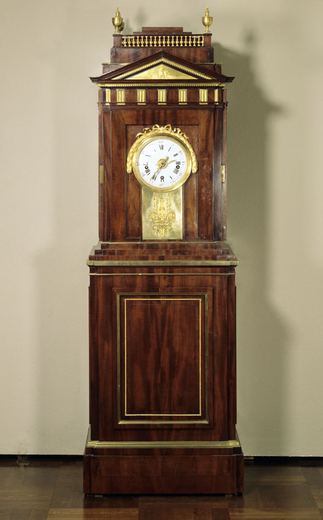
Longcase clock by David Roentgen ( - ), England, 1711–1827
Badisches Landesmuseum Karlsruhe
Clocks · 1740-1760
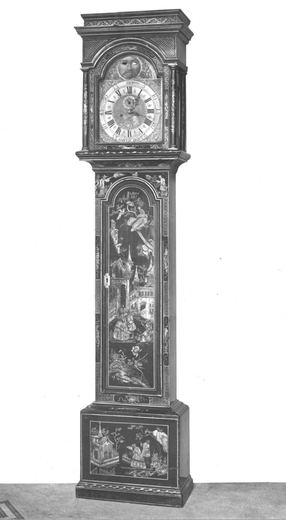
Longcase clock, English, 1740-1760, japanned wood, John Ellicott
Victoria and Albert Museum, London
Clocks · 1751
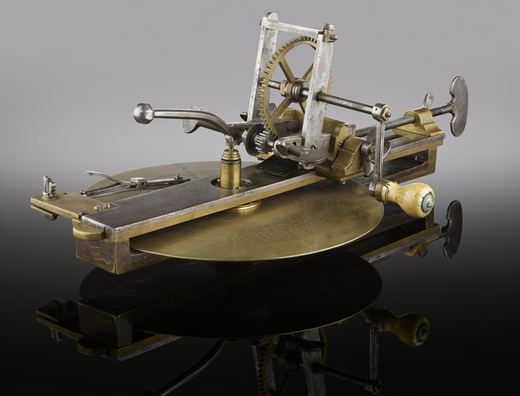
Large wheel engine, signed and dated "John Tipping, Whildon Green, 1751".
Science Museum Group, London
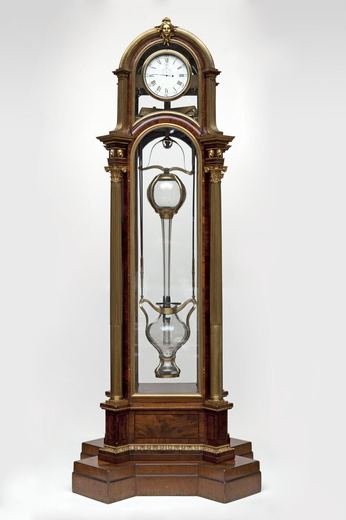
Clocks · ca. 1760
Longcase clock by James Cox, England, ca. 1760
Victoria and Albert Museum, London
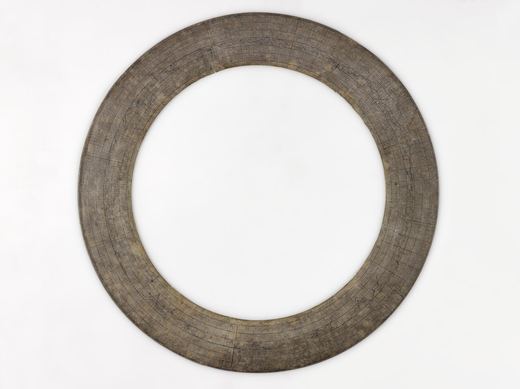
Clocks · 1766
Clock by Cumming, Alexander, England, 1766
Science Museum Group, London
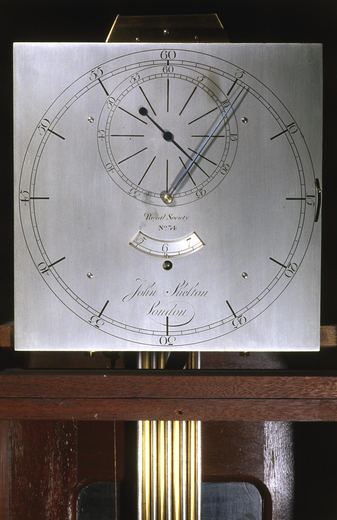
Clocks · 1768-1769
Regulator clock by Shelton, John, England, 1768-1769
Science Museum Group, London
Clocks · ca. 1775
Longcase clock, England, ca. 1775
Victoria and Albert Museum, London
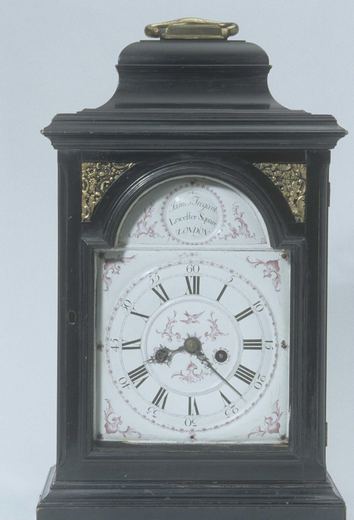
Clocks · ca. 1780
Bracket clock of ebony, with face of West Midlands enamel painted in black and crimson, made by James Tregent, London, England, about 1780
Victoria and Albert Museum, London