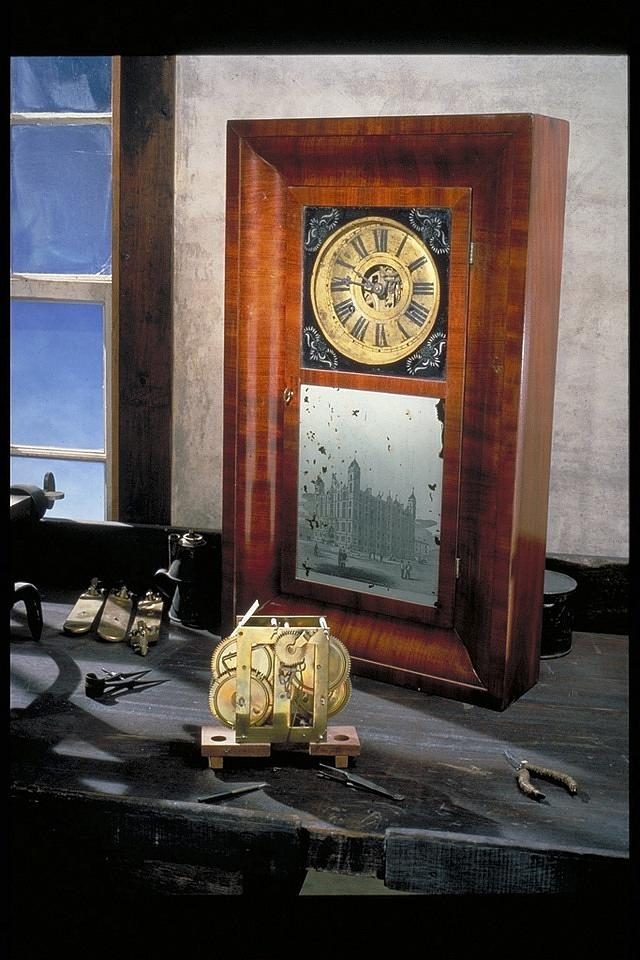
Clocks · Clock
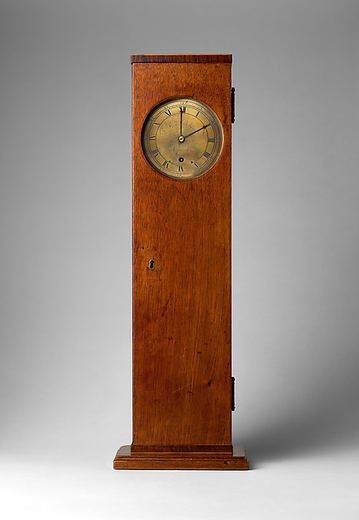
Clock by Jerome, Chauncey, United States, ca 1840
- Maker / attribution
- Jerome, Chauncey (maker)
- Date
- ca 1840
- Historical period
- Precision & Scientific Horology (1750 – 1850)
- Country of origin
- United States
- Place
- United States: Connecticut, Bristol
- Object type
- Clock
- Dimensions
- "brass" (movement material); wood (case material); overall: 26 in x 15 1/2 in x 4 1/2 in; 66.04 cm x 39.37 cm x 11.43 cm
- Holding institution
- National Museum of American History, Smithsonian Institution, Washington DC
- Accession / object no.
- ME.318998
- Catalogue title (original)
- Jerome Brothers Ogee Clock
Record summary
Held and catalogued by National Museum of American History, Smithsonian Institution, Washington DC (object number ME.318998), this is a clock by Jerome, Chauncey, made in United States: Connecticut, Bristol, dated ca 1840. The Atlas places it in the Precision & Scientific Horology period (1750 – 1850) of its Clocks collection. Recorded dimensions: "brass" (movement material); wood (case material); overall: 26 in x 15 1/2 in x 4 1/2 in; 66.04 cm x 39.37 cm x 11.43 cm. The record is illustrated with 1 photograph.
Assembled from the source record's structured fields. Dates and attributions are given as the source states them; where a field is missing the Atlas leaves it blank rather than estimating.
Catalogue description
Description
The depression of 1837 hit Connecticut wooden clock manufacturers so hard that they feared the entire industry might collapse. On a trip to Virginia to collect old bills, Chauncey Jerome—a successful clock producer from Bristol, Connecticut—had a new idea. A simple one-day clock made of brass, he thought, could be produced far more cheaply and in much greater quantities than the standard wooden clock. When he returned home, he described the idea to his brother Noble, a talented clockmaker who quickly made a prototype and received a U.S. patent on it in 1839.
Description
A typical factory might produce several thousand wooden clocks per year, but the Jeromes—and their principal imitators and rivals—were soon mass-producing brass clocks in the hundreds of thousands. For these brass clocks, Chauncey Jerome adopted a simple case introduced by several other New England clockmakers. The case became famous as the "Ogee," named for its characteristic S-shaped moldings.
Description
Unlike wooden clocks, brass movements were unaffected by humidity and could be transported by ship. The entire world, clockmakers quickly recognized, was a potential market. The reception Chauncey Jerome's clocks received in England, home of some of the world's finest clockmakers, illustrates the impact of his innovation. When the first clocks arrived in 1842, valued at an improbable $1.50 each, English customs inspectors assumed that Jerome had set the figure far below cost to avoid paying the proper duties. To teach Jerome a lesson, the inspectors bought the whole shipment at the declared price. When a similar cargo at the same valuation arrived a few days later, they did the same. Only with the third shipment did they recognize that they were unwittingly becoming distributors for Yankee clock manufacturers. Jerome was content with the prices British customs agents had been paying him and would have happily supplied them indefinitely. From then on Jerome's clocks entered the English market unimpeded.
Historical context
Precision & Scientific Horology (1750 – 1850)
Harrison solves longitude; Mudge invents the lever; Breguet's Paris workshop defines the modern watch.
The age of the deadbeat escapement, compensated pendulums and observatory regulators. Domestic clocks spread through the middle classes: English longcase and bracket clocks, French gilt-bronze mantel clocks, Viennese Biedermeier wall clocks, Black Forest painted-shield clocks, and the first American shelf clocks.
Read the period in the timelineMore clocks from this periodEarlier: Early Modern Horology
Atlas type guide
Domestic clocks
A clock combines four systems: a source of power (falling weight, coiled spring, or later electricity), a gear train that divides time, an escapement and oscillator that regulate it (foliot, pendulum or balance), and an indicating system of dial and hands or a bell. Its history runs from the large iron weight-driven clocks of the late thirteenth century to Renaissance spring-driven table clocks, the pendulum revolution of 1656, the factory clocks of the nineteenth century and electric and quartz clocks of the twentieth.
Domestic clocks also reflect regional furniture and decorative traditions — English longcase and bracket clocks, French pendules, Viennese regulators, Black Forest and American shelf clocks — and therefore record changing tastes as much as technical progress.
What to look for
- How the clock is powered: weights, spring barrel, fusee, electric coil.
- The oscillator: foliot, short pendulum, long seconds pendulum or balance.
- Whether it strikes: hour only (count wheel) or hours and quarters (rack striking).
- The maker or retailer's name on dial and movement, and any factory trademarks.
- Signs of alteration — replaced dials, converted escapements, 'married' cases.
Dating clues
- Before 1656 clocks used foliots or balances; after, most domestic clocks have pendulums.
- Anchor escapements spread after c. 1670; minute hands became common at the same time.
- Factory production in America and Germany transformed prices after c. 1840.
General guidance written by the Atlas editors about this kind of object. It is not a statement about this particular piece; for that, rely on the source record above and on physical examination.
Related records
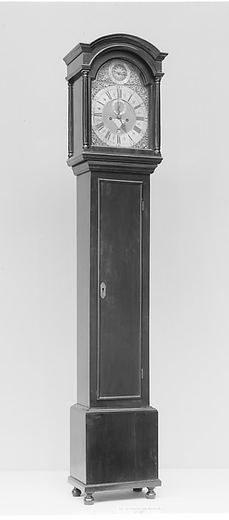
Clocks · 1740–60
Tall clock by Samuel Bagnall, United States, 1740–60
The Metropolitan Museum of Art, New York
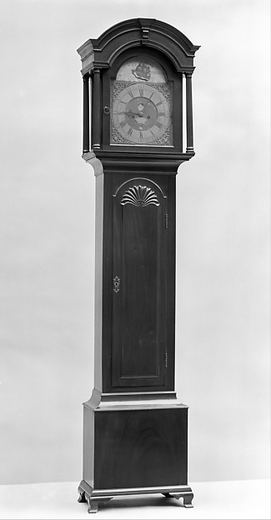
Clocks · 1750–60
Tall clock by Gawen Brown, United States, 1750–60
The Metropolitan Museum of Art, New York
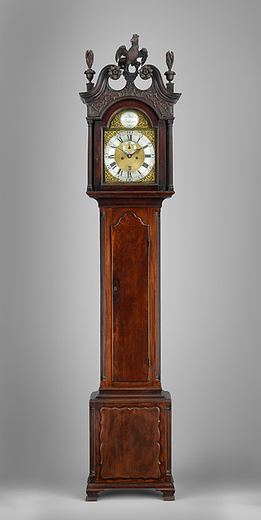
Clocks · 1765–75
Clock by Edward Duffield, United States, 1765–75
The Metropolitan Museum of Art, New York
Clocks · 1767–71
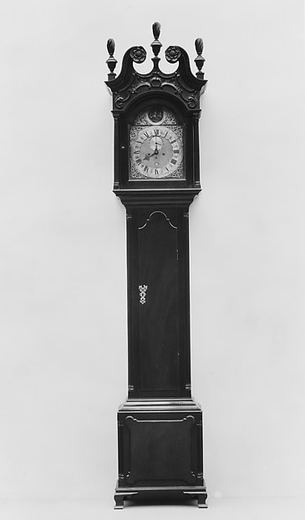
Tall clock by William Huston, United States, 1767–71
The Metropolitan Museum of Art, New York
Clocks · 1769
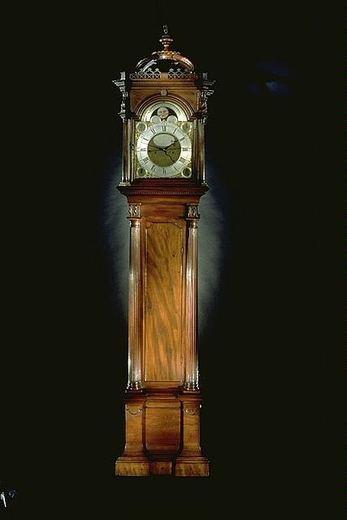
Clock by Ellicott, Joseph, United States, 1769
National Museum of American History, Smithsonian Institution, Washington DC
Clocks · 1772
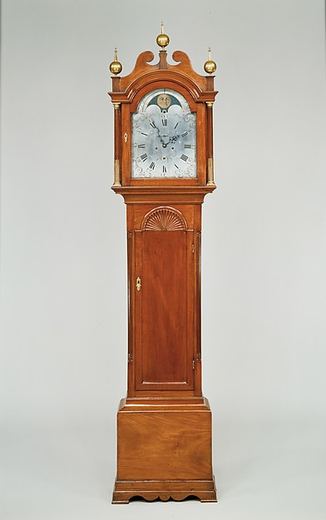
Tall clock by Benjamin Willard, United States, 1772
The Metropolitan Museum of Art, New York
Clocks · 1780–90
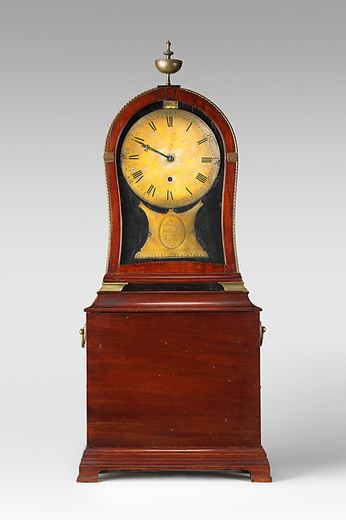
"balloon" shelf clock by Simon Willard, United States, 1780–90
The Metropolitan Museum of Art, New York
Clocks · ca. 1786
Shelf clock by Levi Hutchins, United States, ca. 1786
The Metropolitan Museum of Art, New York